- The paper presents a human-centric framework that captures and tracks weak signals using a continuous risk field for early organizational risk management.
- It employs a bi-axial numeric rating system and temporal trajectory analytics to distinguish between stable and escalating risk factors.
- The model integrates manual processes with AI-compatible metrics to sustain organizational memory and facilitate proactive risk interventions.
The Weak Signal Cultivation Model: A Human-Centric Framework for Frontline Risk Detection and Organizational Resilience
Model Motivation and Conceptual Architecture
The Weak Signal Cultivation Model (WSCM) is explicitly designed to address persistent failures in organizational risk management: specifically, the inability of formal systems to capture, structure, and act on ambiguous, low-level precursors often observed by frontline workers but never elevated to actionable visibility. Drawing insights from Safety-II, participatory design, and behavioral nudging literature, the WSCM proposes a structured, low-technology framework, enabling operational teams to continuously monitor, discuss, and track the evolution of weak signals within their working environment.
The foundation of WSCM is a continuous [0,10]×[0,10] coordinate field—the Weak Signal Cultivation Field—where each candidate weak signal is represented as a node described by two uncoupled axes: current Risk Intensity (x) and Risk Growth Potential (y). The independence of these axes is a central design choice, motivated by the need to model both severity and escalation trajectory separately and to allow the detection of risks that are either intense but stable or weak but rapidly deteriorating.
As new observations are elicited over time, each signal traces a temporal trajectory—the risk locus—across this field, supporting a robust organizational memory and enabling practitioners to interpret not only a signal’s static risk status but also its temporal dynamics, such as persistent escalation, response effectiveness, and chronicity.
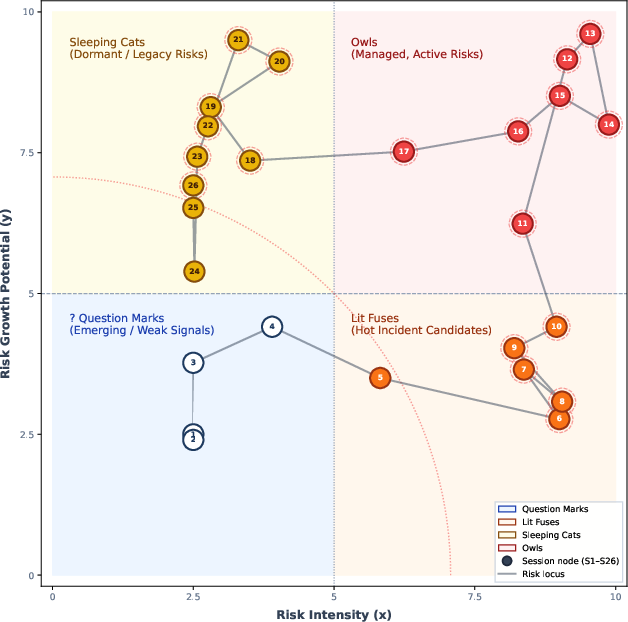
Figure 2: Representative trajectory of the "gas fumes" signal, illustrating a typical path across the WSCM quadrants over 26 cultivation sessions.
Quadrant Taxonomy and Signal Semantics
The field is divided into four pedagogically named quadrants by a 5×5 boundary: Question Marks (x<5, y<5), Lit Fuses (x≥5, y<5), Owls (x≥5, y≥5), and Sleeping Cats (x0, x1). Each region encodes distinct organizational semantics:
- Question Marks: Early-stage, low-intensity, and low-growth signals—requiring active, open-ended attention and deliberative observation, but not yet justifying resource mobilization.
- Lit Fuses: Signals that have surpassed the intensity threshold, marking localized and actionable risk, but with constrained growth. These require immediate focus due to their potential to deteriorate.
- Owls: Both high-intensity and high-growth, representing fully escalated risks that must command sustained, organization-wide intervention and ongoing management.
- Sleeping Cats: Dormant risks—current intensity is low, but growth potential is elevated, demanding vigilance due to their latent potential to re-emerge under changing circumstances.
Transitions across these quadrants are continuous and interpretable in terms of both region and motion direction; organizational attention is directed not solely by quadrant but by movement trends within the risk locus.
Signal Positioning and Computational Methodology
The WSCM operationalizes signal assessment through a bi-axial Numeric Rating Scale (NRS) elicitation protocol, whereby teams independently score intensity and growth (x2—no concern to x3—maximum concern). Model coordinates are anchored with a minimum entry constraint: only signals with NRS x4 on both axes can be registered, ensuring the system focuses strictly on genuinely ambiguous, pre-mature signals.
Subsequent session updates employ recency-weighted convex blending of prior and new assessments, dynamically adjusting influence according to session cadence and the magnitude, persistence, and volume of directional consensus across team members. A passive decay mechanism is applied solely to the growth (x5) axis, representing natural attenuation of escalation urgency absent new evidence; intensity (x6) is retained until direct evidence indicates reduction.
Key parameters, such as recency weight ceilings, momentum amplifiers, session frequency references, and decay rates, are mathematically justified via simulation on worked examples (“Gas Fumes” and “Complacency”) and thoroughly documented for reproducibility and future tuning.
Risk Trajectory Analytics and Action Thresholds
Central to WSCM is the analytic concept of the risk locus—a time series of x7 points encoding not just episodic risk but temporal patterns that reveal escalation velocities, intervention inflection points, and the distinction between managed chronic risk and emerging threats. This locus model provides a data structure immediately amenable to downstream machine learning analytics for automated pattern recognition and comparative risk research.
Escalation is governed primarily by the Euclidean distance from the origin (x8). When x9 (derived from the field midpoint), signals are flagged for formal Safety Management System (SMS) escalation, regardless of their regional status or recent motion, ensuring that significant nonlinearity in escalation patterns is captured and acted upon.
Additionally, the Session Severity Index (SSI), a normalized metric blending distance and cumulative signal frequency, supports cognitive offloading for dashboard-based prioritization and retrospective auditing.
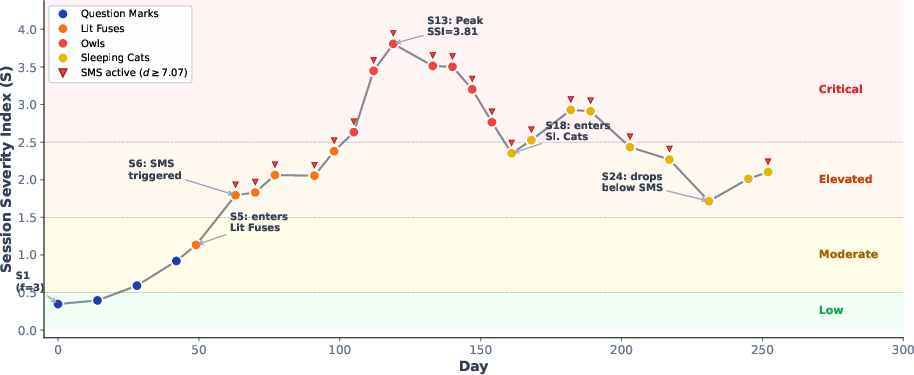
Figure 1: Session Severity Index (y0) dynamics across the "gas fumes" signal lifecycle, contextualizing momentary risk against cumulative occurrence frequency.
Session Workflow and Organizational Implementation
The cultivation session is structured around regular (biweekly, by default) team deliberations, involving signal review, position update, new-signal intake, and explicit action planning for signals trending toward or persisting within the Lit Fuses or Owls regions. All coordinate assignments are collective: registered disagreements are used as signals for clarification or for splitting ambiguous signals, not as a rationale for suppressing minority views.
The model is explicitly designed to function without digital support at small scales (single-team, whiteboard implementation), while ensuring all outputs are rigorously formatted for seamless integration with AI-supported analytical tools as organizational digital maturity scales.
Practical guidance is provided for facilitation, anticipated bias and failure modes (e.g., anomaly inflation, convergence bias, drift toward incident analysis), and the minimum viable organizational implementation for early adoption.
Numerical Results and Illustrative Trajectory
The core computational design is substantiated with a detailed synthetic use case: the gas fumes signal tracked across 26 biweekly sessions. The example demonstrates robust locus dynamics:
- Initial stagnation within Question Marks.
- Escalation with sustained evidence to Lit Fuses and Owls, crossing both regional and global alert thresholds.
- Detected de-escalation following targeted intervention, transitioning the locus into Sleeping Cats—characterizing a well-managed risk, but with persistent potential for relapse.
This illustration substantiates the model’s sensitivity to both magnitude and trajectory of risk, the utility of SSI as a practical prioritization tool, and the maintenance of organizational memory via locus history even after de-escalation.
Theoretical and Practical Implications
The WSCM advances the field by formalizing a human-centric, coordinate-based framework for risk tracking that abrogates the inherent limitations of categorical, event-driven taxonomies. The ability to record and reason about weak signals while integrating natural organizational conversational flow and participatory sense-making directly supports the theoretical underpinnings of Safety-II. The built-in mathematical structure enables straightforward scaling to advanced AI-based risk analytics, with immediate utility in both analog (manual) and digital (platform) use cases.
For practice, the model enables:
- Early detection and structured monitoring of emerging threats well before they are measurable by conventional risk systems.
- Persistent, transparent, and reviewable organizational memory, ensuring that dormant risks and organizational learnings are retained across personnel or structural changes.
- Seamless handoff to data-driven, machine-learning based risk analytics and pattern extraction as digital infrastructure matures.
Future Research Directions
Future work is needed to empirically evaluate the reproducibility and predictive utility of WSCM in longitudinal, multi-site organizational deployments and across sectors (e.g., healthcare, cyber, financial, supply chain). Formalization of locus-based statistical anomaly and escalation detectors, compensation for known human biases in NRS elicitation, and integration protocols for human-AI risk monitoring in hybrid organizational settings are identified as near-term priorities. A forthcoming methods paper will address parameter robustness, locus characterization, and reporting culture normalization.
Conclusion
The WSCM offers a mathematically rigorous, operationally pragmatic, and explicitly human-centric framework for the capture, visualization, and progression tracking of weak signals in organizational risk environments. Its core contributions—the cultivation field, risk locus analytics, and parameterized consensus/momentum mechanisms—constitute a methodological bridge from low-technology, participatory signal detection to scalable, AI-integrable organizational resilience solutions. Full utility depends on disciplined, session-based engagement, but no new technology, ensuring low barriers to early adoption and immediate value in both analog and digital domains.