- The paper demonstrates that AI-enabled methods compute higher-order superpotential terms in LG orbifold models, yielding explicit Minkowski vacua.
- It reveals that flux choices in the 1^9 and 2^6 models achieve full moduli stabilization, with higher-order contributions crucial for massless directions.
- The study challenges existing swampland and tadpole conjectures by showing a linear scaling between the stabilized moduli and the flux tadpole bound.
AI-Assisted Analysis of String Vacua in the Interior of Moduli Space
Context and Motivation
The paper "AI usage in string theory, a case study: String Vacua in the Interior of Moduli Space" (2604.01384) scrutinizes the intersection of AI-driven methodologies and technical problems in string phenomenology, focusing on flux stabilization in type IIB compactifications deep inside moduli space. The study exploits exact worldsheet constructions based on Landau–Ginzburg (LG) models, with emphasis on the 19 and 26 models which are mirrors to rigid Calabi–Yau threefolds and thus lack Kähler moduli. The absence of Kähler moduli circumvents the usual need for non-perturbative stabilization mechanisms and makes these models optimal for rigorous testing of moduli stabilization and swampland conjectures.
Theoretical Framework: Moduli Stabilization in LG Models
Moduli stabilization remains an essential challenge for connecting string compactifications to phenomenology. In generic Calabi–Yau compactifications, fluxes stabilize the axio-dilaton and complex-structure moduli, but Kähler moduli require additional ingredients (e.g., instanton corrections). The models analyzed here, with h1,1=0, restrict the field content to complex structure moduli and the axio-dilaton, making stabilization achievable algorithmically. These LG orbifold points facilitate exact worldsheet computations and enable expansion of the superpotential in local coordinates, with explicit calculation of higher-order terms.
The critical object is the flux-induced superpotential:
W=∫G3∧Ω,G3=F3−τH3
The existence and detailed properties of supersymmetric Minkowski vacua are derived from solving W=0 and ∂aW=0 at the Fermat locus, where higher-order terms can contribute to stabilization beyond the quadratic approximation.
Algorithmic Approaches and Numerical Analysis
Analysis proceeds by computing the superpotential expansion coefficients for specific flux configurations, with stabilization understood via the rank of the quadratic term wab(2) and subsequent evaluation of higher-order contributions. The finite tadpole constraints for the 19 (Nflux≤12; 64 moduli) and 26 (260; 91 moduli) models limit the flux lattice and make exhaustive computer-aided searches feasible.
A major insight is the distinction between "massive" directions (with quadratic mass term) and "stabilized" directions (fixed only by higher-order terms). The 261 model demonstrates explicit stabilization of fields massless at quadratic order via cubic and quartic terms in the superpotential [Becker:2024nqu]. The 262 model achieves fully massive vacua already at quadratic order [Becker:2025mhy].
The correlation between moduli stabilization and tadpole budget illustrates strong violation of refined tadpole conjecture bounds: more moduli are stabilized per unit flux than conjectured. Yet, overall scaling remains approximately linear rather than superlinear.
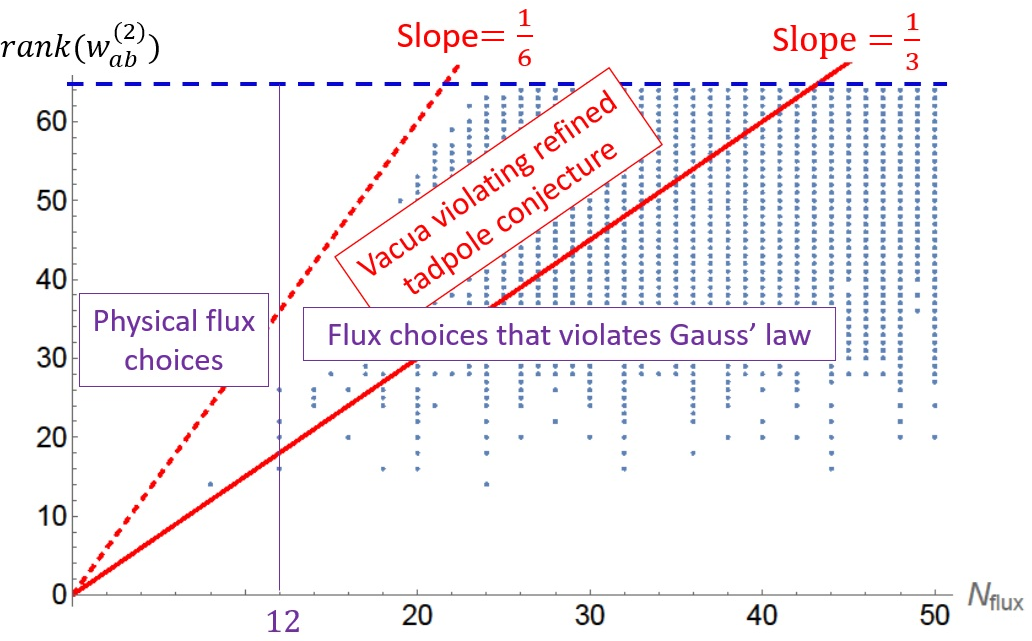
Figure 1: In the 263 model, each blue dot is a different ISD flux choice yielding a Minkowski vacuum; higher-order superpotential terms stabilize massless fields, challenging refined tadpole bounds with 264.
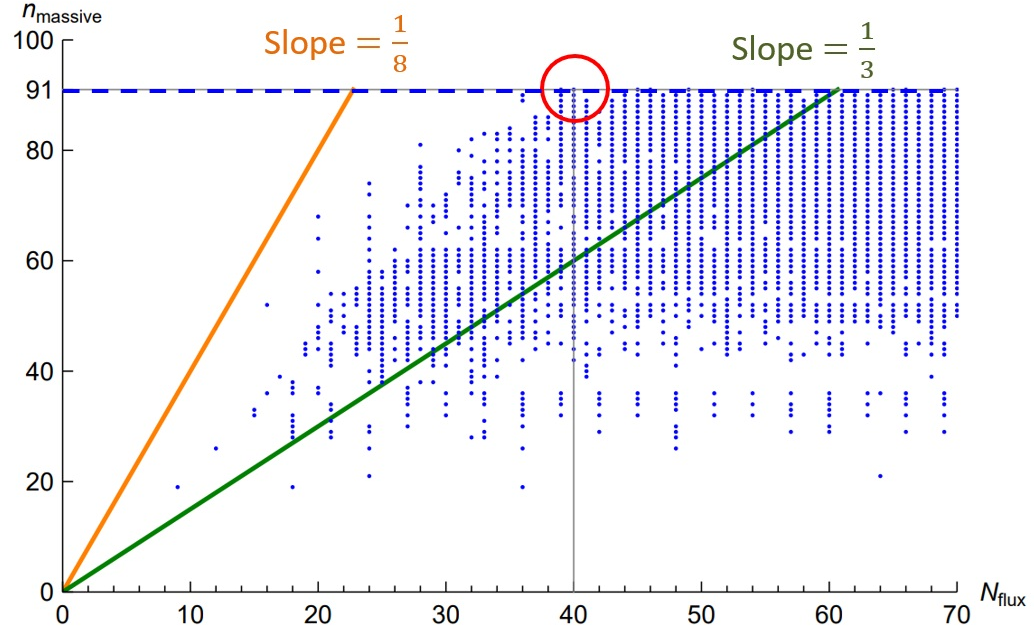
Figure 2: In the 265 model, ISD flux choices produce Minkowski vacua and allow full stabilization of 91 moduli within the 266 tadpole bound—marked by a red circle are the vacua where all fields are massive.
Implications for Swampland Program and Conjectural Constraints
These results provide sharp tests for swampland conjectures. The linear scaling between stabilized moduli and tadpole budget persists, opposing any conjectures that require superlinear scaling for full stabilization. Furthermore, the existence of fully massive Minkowski vacua in string theory (with no residual moduli) directly contradicts strong forms of the massless Minkowski conjecture, which posit that such vacua cannot exist in controlled compactifications.
The symmetry-enhanced loci probed by LG models, treated as microscopes rather than outliers, reinforce the notion that exact worldsheet constructions at interior points yield computable, physically relevant vacua. The methodology demonstrates that higher-order terms can and do play a decisive role in vacuum structure, contrary to approaches where only quadratic mass terms are counted.
AI Accelerates Research Paradigms in String Theory
A substantial component of this paper documents the evolving role of AI in theoretical physics research. The author details progressive adoption of LLMs for generation and validation of research papers, computational checks, and pedagogical functions—where paid versions now reliably solve research-level problems, outperforming traditional workflows in speed and breadth.
AI-assisted exploration is particularly potent in finite, algorithmic settings such as LG flux landscapes, where exhaustive scans and higher-order calculations are tractable only with automated computational support. The potential for AI to classify and map the landscape of vacua, as well as to uncover subtle algebraic relations missed in human analysis, is tangible and immediate.
At the same time, persistent issues surrounding overreliance, plausible hallucinations in AI output, and the separation of true research skills from AI prompting remain unresolved. The paper calls for systematic guidelines and community discussions to balance opportunity and responsibility.
Future Directions
Open questions concern full classification of flux vacua, generalization to models with Kähler moduli, and systematic understanding of when higher-order stabilization mechanisms fail or succeed. The possibility of symmetry-protected existence theorems for Minkowski vacua remains an intriguing avenue, as does the refining of swampland conjectures to distinguish "massive" from "stabilized"—a distinction made concrete by the LG analysis.
The practical trajectory points toward AI-facilitated cataloguing of explicitly computable vacua, algorithmic scans of symmetry-enhanced points, and broader adoption of AI as a research partner in both computation and drafting.
Conclusion
This paper provides a rigorous evaluation of flux stabilization in LG orbifold models of string compactification, leveraging AI-assisted workflows for both physical and computational analysis. The principal outcomes are the explicit construction and classification of Minkowski vacua in the interior of moduli space—vacua inaccessible by traditional geometric limits—with violation of refined tadpole conjecture bounds and realization of completely massive four-dimensional vacua. The study advances both technical insights on moduli stabilization and a reflective analysis on the future integration of AI in theoretical research workflows.