- The paper introduces the innovative concept that cosmological wavefunction coefficients uniquely map to amplitude-like objects using combinatorial generating graphs and blob zeros.
- It details how the shuffle product factorizes these amplitudes by leveraging tube variables and on-shell kinematics, replicating BCFW shift behavior.
- The study validates the method with numerical examples, showing that a minimal set of hidden zeros fully determines the structure of the wavefunction.
Cosmological Wavefunctions, Shuffle Dual Factorization, and Hidden Zero Uniqueness
Introduction
The paper "Cosmological Wavefunctions as Amplitudes: Dual Shuffle Factorization and Uniqueness from New Hidden Zeros" (2604.01133) formulates a comprehensive connection between the combinatorics of late-time cosmological wavefunctions and the analytic, graph-theoretic structure of scattering amplitudes. Leveraging the dual language of tube variables and on-shell kinematics, the authors show that cosmological wavefunction coefficients in scalar ϕn theories map to amplitude-like objects constructed from generating graphs. This enables a transfer of amplitude-theoretic principles—particularly the structure of hidden zeros, shuffle decompositions, and BCFW behavior—to the cosmological setting, and reveals a mechanism for uniquely determining wavefunctions from purely combinatorial and locality properties, without recourse to traditional diagrammatic unitarity.
Cosmological Wavefunctions: Combinatorial Structure
The main object of interest is the late-time vacuum wavefunction coefficient ψG, associated to a graph G (i.e., a Feynman diagram stripped of universal 1-tube and total-energy singularities). The coefficients admit an explicitly combinatorial construction in terms of sums over maximal tubings of G, each defined by a product over tube energy variables Sτ for connected subgraphs τ.

Figure 1: All maximal tubings of a 222-star.
For the archetype 222-star, this construction yields all possible maximal tubings, demonstrating the systematic reduction of diagrammatic complexity to purely combinatorial sums dictated by graph topology.
Kinematic Mapping: Amplitudes from Tube Variables
A central element is the introduction of a map from tube variables SI to flat-space Mandelstam invariants sI=(∑i∈Ipi)2, thus interpreting each stripped wavefunction as an amplitude-like quantity AG. The augmentation of G by an auxiliary vertex implements on-shell conditions, facilitating direct correspondence with the Cayley function—realized as the Parke-Taylor factor for chains and its CHY generalization for arbitrary trees.

Figure 2: The 3-chain ψG0 maps to a color-ordered Tr(ψG1) amplitude ψG2; for the 2222-star, multiple permutations are generated by the mapping.
This structural mapping demonstrates that cosmological wavefunctions are not just analogous but strictly equivalent, at the tree level, to unordered sums over color-ordered amplitudes generated by the underlying graph topology.
Hidden Zeros and Graph-Based Blob Zeros
The authors systematically generalize the concept of "hidden zeros"—kinematic loci where amplitude objects vanish nontrivially—to cosmological wavefunctions, defining blob zeros associated with separations of the underlying graph. For a pair of vertices ψG3 splitting ψG4 into subgraphs ψG5, ψG6, the condition ψG7 yields strong vanishing constraints. The construction encompasses all previously known zero types (parametric, wavefunction, and factorization zeros) and introduces new constraints critical for establishing uniqueness.
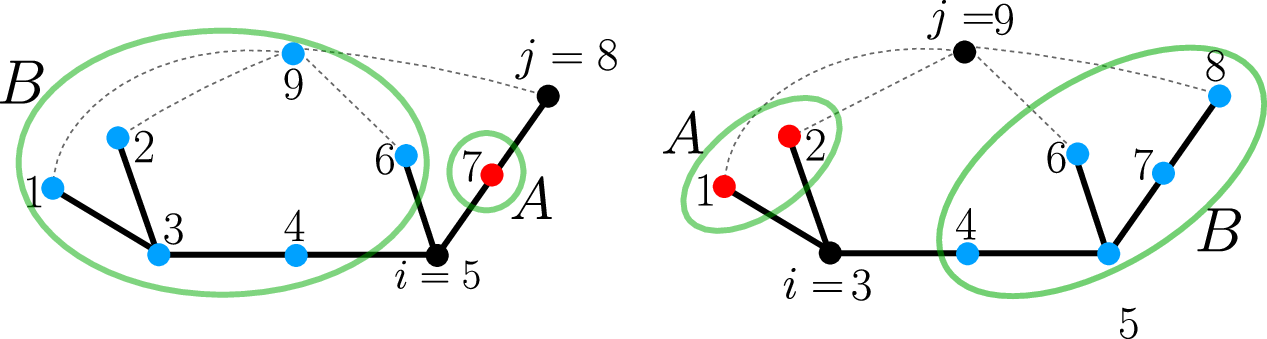
Figure 3: Left: Example of a blob zero uniquely defined by external boundary ψG8; Right: Multi-branching example splitting at vertices ψG9.
Dual Shuffle Factorization: The Principle Beyond Unitarity
Imposing graph-based zeros, the ansatz for G0 is shown to necessarily decompose as a shuffle product of objects associated with the factor graphs induced by the cut. Formally, the presence of a zero for G1 implies G2, where the shuffle product interleaves diagrams while preserving the internal ordering of each factor.
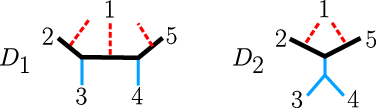
Figure 4: 5-point amplitude G3-subsets for the zero G4: different insertions generate shuffle products.
The duality is made precise: while traditional unitarity factorization occurs at poles, this dual factorization occurs at zeros and governs the diagrammatic generation (rather than only residues) of the full amplitude-like object from its subgraph constituents.
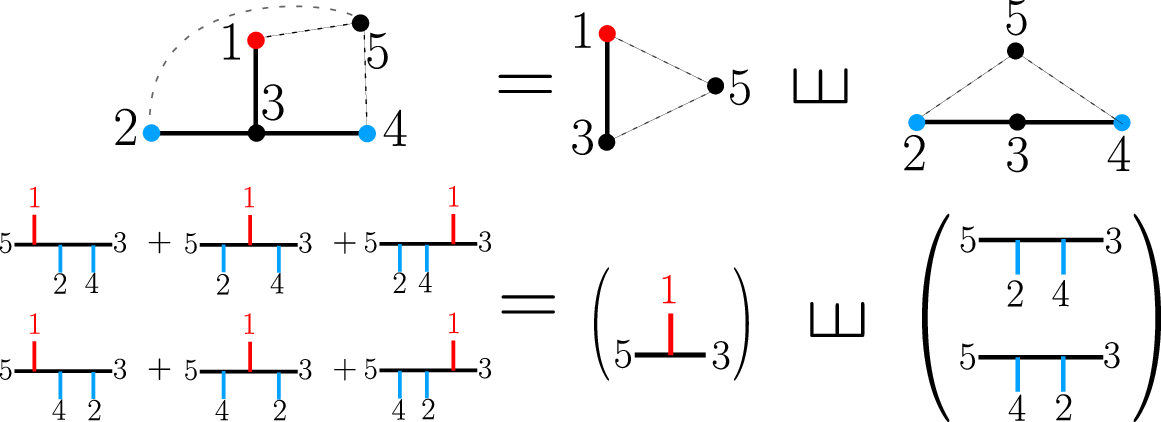
Figure 5: Dual factorization at the graph level: cutting a graph at specified vertices, the amplitude is reconstructed as the shuffle sum of lower-point diagrams.
Uniqueness from Zeros and Graph Reductions
Iteratively imposing all blob zeros for a given graph enforces a recursive decomposition into 2-vertex chain graphs, each of which is fixed up to normalization. The process provably fixes all coefficients of the local ansatz, as the number of independent coefficients reduces multiplicatively at each factorization.
Strong numerical results include the identification that, for an 11-vertex 222-2222-222 triple-star graph with 82,320 initial coefficients, only 8 zero conditions suffice for a complete fix.

Figure 6: Systematic reduction of the 5-chain via imposing blob zeros, demonstrating exact recursive factorization.
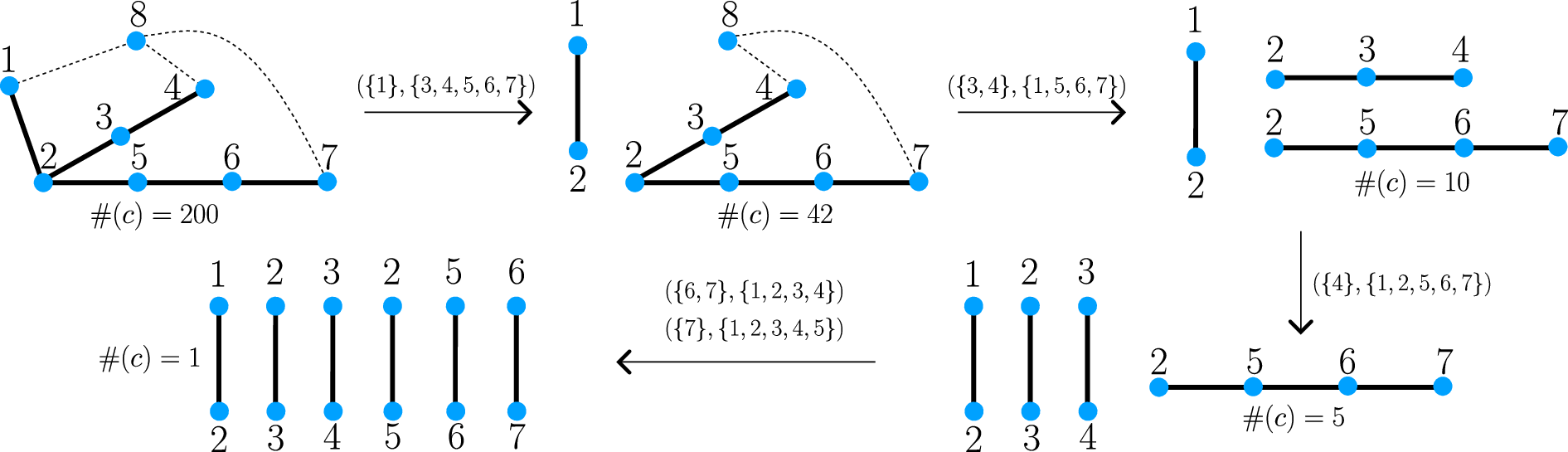
Figure 7: Reduction of the 234-star via sequential blob zeros, culminating in a unique assignment.
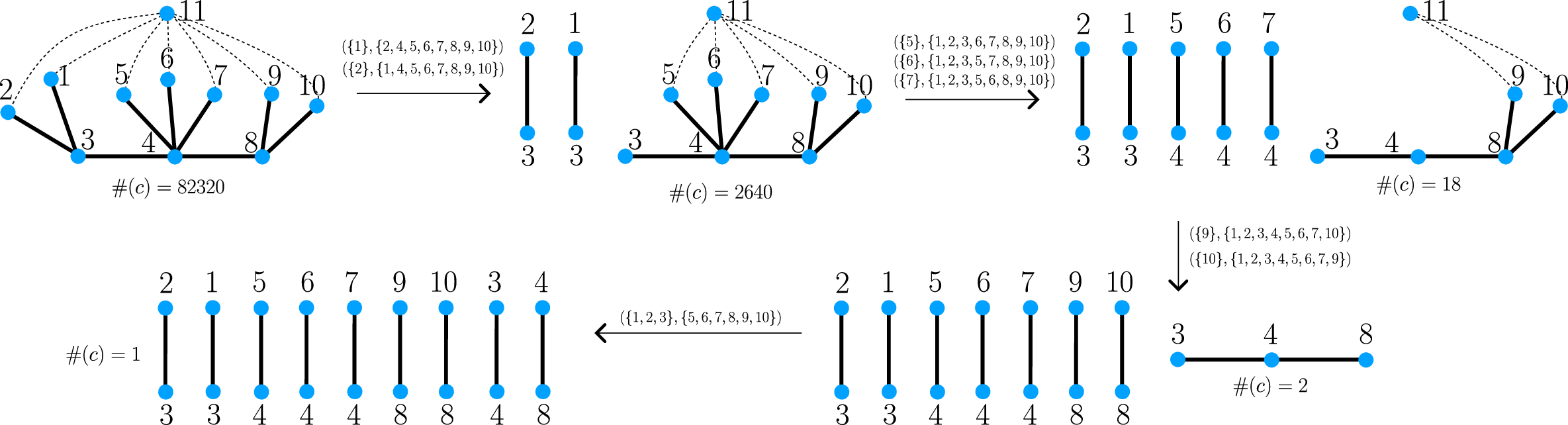
Figure 8: Decomposition of the 222-2222-222 triple-star graph under blob zeros—starting from 82320 coefficients, 8 zeros complete the fix.
Equivalence to BCFW Shift Behavior
Blob zeros exhibit direct correspondence with enhanced scaling under large-Britto-Cachazo-Feng-Witten (BCFW) shifts, extending the scaling-zeroes equivalence from amplitudes to cosmological wavefunctions. In particular, for graphs split into G5 branches at G6, the enhanced scaling is by G7 powers, tightly encoding all blob zero constraints into shift behavior.
Implications and Directions for Future Research
The results position zeros and dual shuffle factorization as organizing, constraining principles coequal in status to locality and unitarity—but acting through a dual channel. The explicit combinatorial-analytic correspondence enables recursive construction of unique cosmological wavefunctions at tree level and suggests a generic framework for higher loops. The relation with the CHY/Cayley formalism hints at extensive interplay between amplitude geometry, cosmological polytopes, and moduli space interpretations. The approach admits generalization to non-scalar theories, with possible implications for spin, color, and gravity. Furthermore, the observed loop-level phenomena warrant systematic exploration of the principle beyond tree order.
Conclusion
The paper demonstrates that the cosmological wavefunction in scalar theories is uniquely determined by locality and a minimal set of graph-based blob zeros, with dual shuffle factorization as the central organizing constraint. The constructive mapping from combinatorics to amplitudes, the unification and extension of hidden zeros, and the equivalence to on-shell BCFW behavior collectively advance the analytic understanding of both cosmological and flat-space observables. The structure discovered here is likely to inform future approaches to S-matrix bootstrap, positive geometry, and the combinatorial foundations of perturbative quantum field theory.