Analytical Probabilistic Power Flow Approximation Using Invertible Neural Networks
Published 1 Apr 2026 in eess.SY | (2604.00673v1)
Abstract: Probabilistic power flow (PPF) is essential for quantifying operational uncertainty in modern distribution systems with high penetration of renewable generation and flexible loads. Conventional PPF methods primarily rely on Monte Carlo (MC) based power flow (PF) simulations or simplified analytical approximations. While MC approaches are computationally intensive and demand substantial data storage, analytical approximations often compromise accuracy. In this paper, we propose a novel analytical PPF framework that eliminates the dependence on MC-based PF simulations and, in principle, enables an approximation of the analytical form of arbitrary voltage distributions. The core idea is to learn an explicit and invertible mapping between stochastic power injections and system voltages using invertible neural networks (INNs). By leveraging the Change of Variable Theorem, the proposed framework facilitates direct approximation of the analytical form of voltage probability distributions without repeated PF computations. Extensive numerical studies demonstrate that the proposed framework achieves state-of-the-art performance both as a high-accuracy PF solver and as an efficient analytical PPF estimator.
The paper introduces an analytical framework using invertible neural networks to directly compute voltage probability distributions without Monte Carlo simulations.
It leverages a bijective mapping combined with graph attention networks and Latin Supercube Sampling for efficient, topology-aware power flow analysis.
Empirical results on both transmission and distribution systems demonstrate reduced error metrics (JSD/TVD) and enhanced fidelity in capturing nonlinear dynamics.
Analytical Density Approximation for Probabilistic Power Flow Using Invertible Neural Networks
Introduction
The paper "Analytical Probabilistic Power Flow Approximation Using Invertible Neural Networks" (2604.00673) addresses a central challenge in modern power systems: efficient, accurate quantification of system state uncertainty due to stochastic renewable generation and flexible loads. The authors introduce an analytical framework leveraging Invertible Neural Networks (INNs), notably the Invertible Mixed Neural Flow (IMNF) model, to enable direct and highly accurate estimation of voltage probability distributions. The approach eliminates reliance on computationally intensive Monte Carlo (MC) simulation-based power flow (PF) methods and does not require restrictive model linearizations or scenario selection heuristics, thereby maintaining high fidelity to nonlinear power system dynamics.
Methodological Framework
The authors formalize the Probabilistic Power Flow (PPF) problem as the task of analytically characterizing the voltage (magnitude and angle) distributions at each system bus, given the distribution of active and reactive power injections. Using the Change of Variable Theorem, a learned invertible bijection between injections and voltages facilitates explicit computation of output densities from the known (typically GMM) input densities. The framework generates marginal or conditional voltage PDFs for arbitrary buses, circumventing the need for repeated PF solutions or scenario-based density estimation.
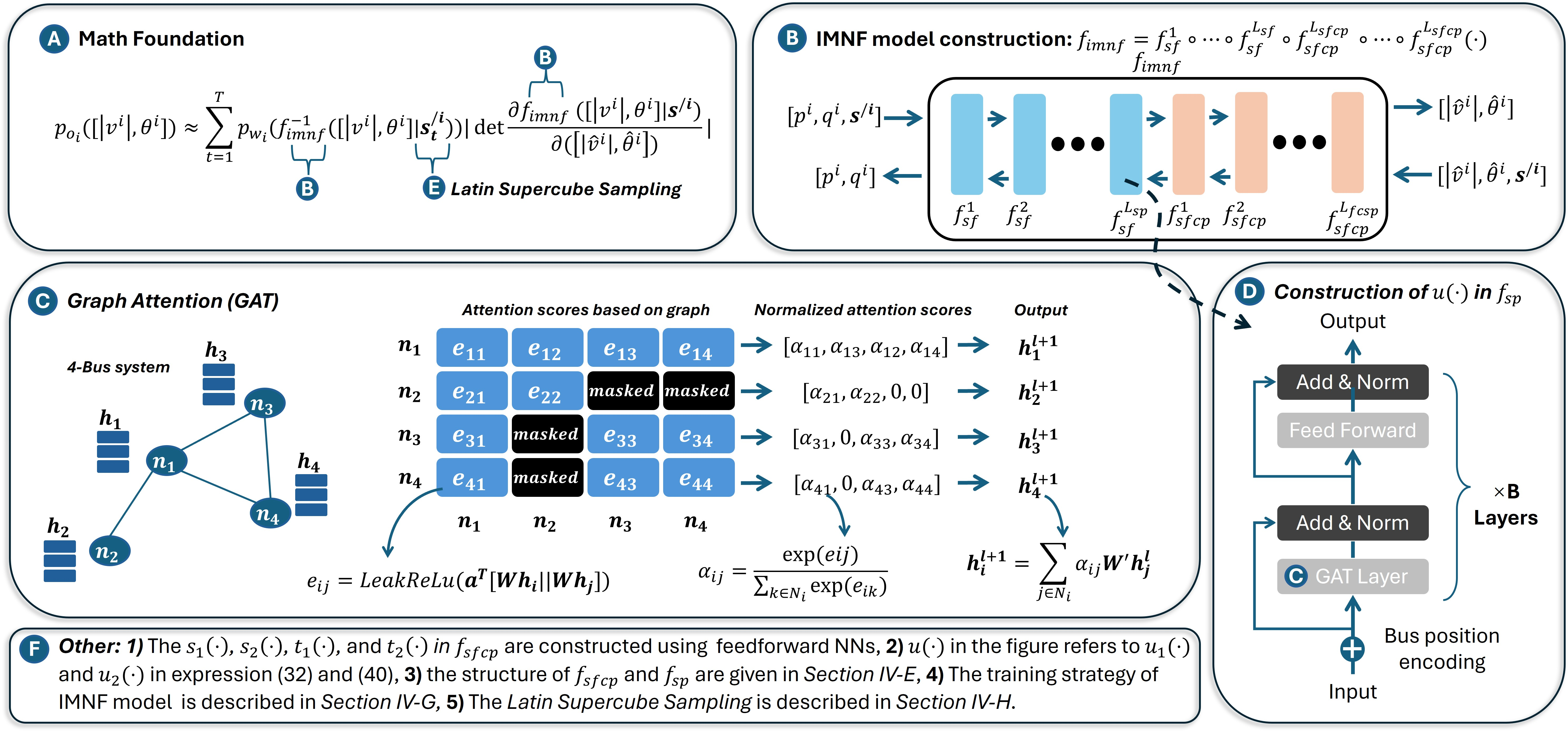
Figure 1: Overview of the probabilistic power flow framework, including density transformation, IMNF architecture, topology-aware aggregation with GAT, and specialized Transformer-style local blocks.
Four architectural and methodological pillars define the framework:
INN-based Bijective Modeling: The IMNF implements a flexible invertible mapping between the power and voltage domains via stacking Simplified FCPFlow (SFCP) and Spline Flow (SF) blocks. The SFCP block delivers robust scale handling, while SF layers inject nonlinear expressiveness via rational–quadratic spline transformations.
Topology-Aware Feature Aggregation: The model incorporates Graph Attention Networks (GAT) for effective inductive bias encoding of the system topology, restricting information propagation according to bus adjacency.
Bidirectional Training: Training loss comprises both forward (power to voltage) and inverse (voltage to power) mean-squared error terms, promoting optimal fidelity in both transformation directions and counteracting asymmetry in mapping difficulty.
Efficient Scenario Integration: Marginalization over unobserved system states during single-bus density estimation is performed efficiently using Latin Supercube Sampling (LSS), which combines quasi–Monte Carlo and Latin Hypercube techniques, greatly accelerating convergence in high dimensions.
Power Flow and Density Estimation via INNs
The PF problem is modeled by the nonlinear steady-state mapping between vector-valued active/reactive injections and bus voltages. Given the analytical or empirically estimated PDF of the injections, the authors show that an invertible neural mapping justifies applying the Change of Variable Theorem to obtain the voltage PDF analytically:
Here, marginalization over unmeasured components is achieved by scenario sampling and explicit evaluation of Jacobians is tractable due to the INN architecture.
Empirical Results
Power Flow Simulation
The IMNF outperforms alternatives including NICE, RealNVP, SplineFlow, and recent GNN or physics-based models (e.g., PowerFlowNet, graph attention-enabled convolutional networks, and physics-guided DNNs) on both power and voltage estimation (MAE):
IMNF-GAT produces MAEs as low as 0.1489 (active power), 0.1619 (reactive power), 0.0151 (angle), and 0.0220 (magnitude), surpassing even physics-guided networks optimized for invertibility.
Analytical PPF and Density Estimation
Accuracy is assessed on both transmission (IEEE-39, CIGRE-HV) and distribution (IEEE-69, CIGRE-LV) systems, using Jensen-Shannon Divergence (JSD) and Total Variation Distance (TVD) to compare against ground-truth MC-derived or linear/PLinear analytical benchmarks.
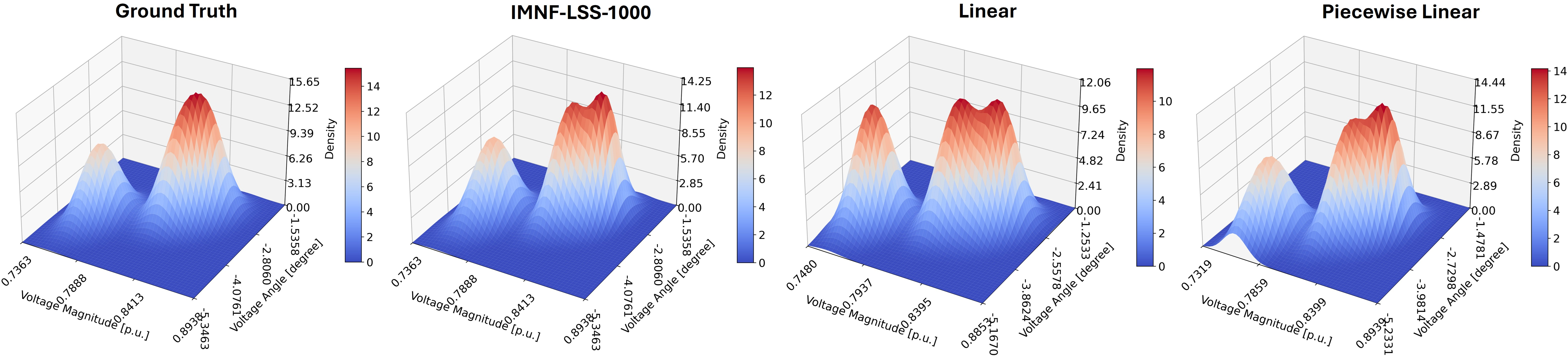
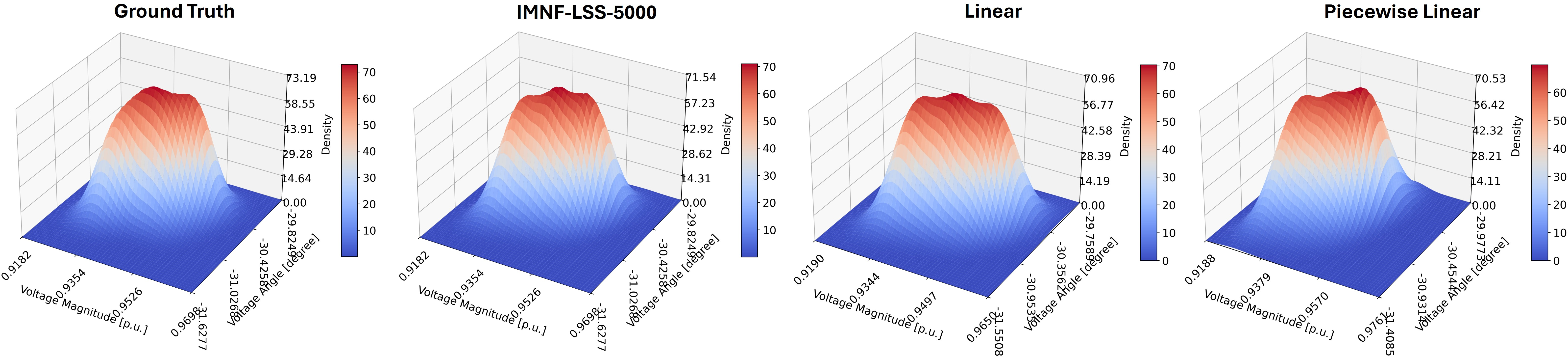
In highly nonlinear systems (e.g., IEEE-39), the proposed method achieves significant improvements (e.g., JSD/TVD reductions of 0.23/0.09 over linear and 0.05/0.01 over PLinear).
In near-linear systems (e.g., CIGRE-HV), the IMNF matches or marginally improves performance over linear methods.
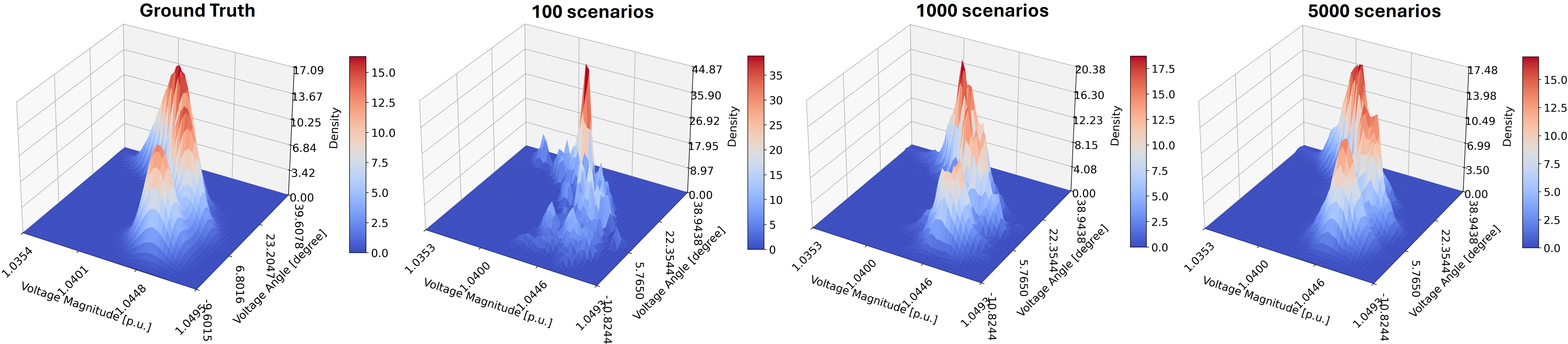
LSS sampling provides rapidly diminishing error with sample count, outperforming MC at equal numerical cost.
Figure 2: Effect of increasing scenario samples on voltage density estimation accuracy for bus 1 in the 39-bus system under LSS, revealing rapid convergence.
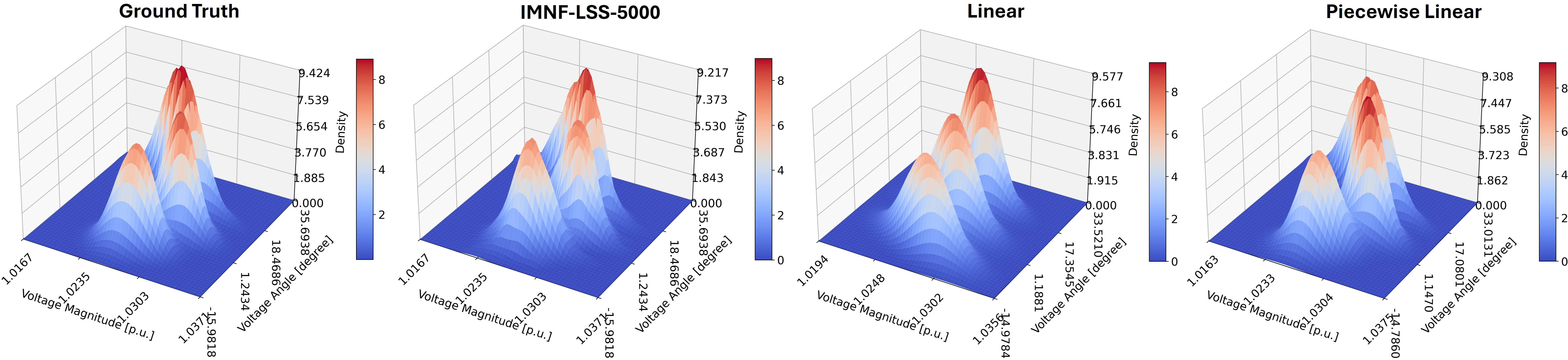
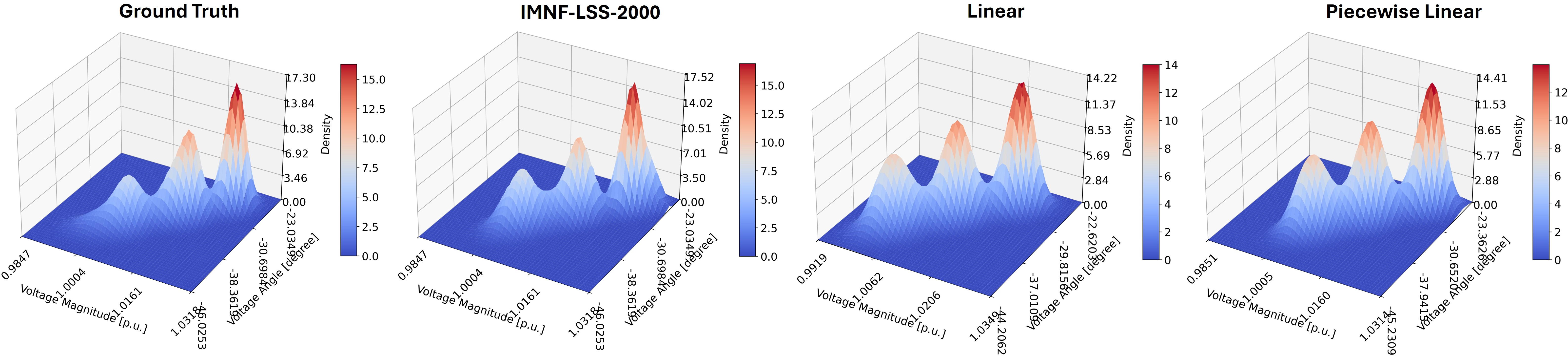
Figure 3: Comparison of voltage density estimates for representative buses across multiple systems (IEEE-39, CIGRE-HV, IEEE-69, CIGRE-LV), demonstrating superior sharpness and fidelity of IMNF-derived densities relative to linear and piecewise linear baselines.
Contrasting Claims and Implications
The paper makes a strong claim: the proposed INN-based analytical PPF framework achieves both the computational efficiency (simulation-free density access) and accuracy (handling arbitrary, non-standard voltage distributions) that are conventionally at odds in prior art.
This claim is supported by:
Extensive coverage of near-linear and highly nonlinear test cases.
Consistently lower JSD and TVD across system types and bus locations.
Demonstrated reduction in required scenario samples for target accuracy thresholds, yielding computational savings.
Practically, these properties have immediate value for real-time probabilistic security analysis, risk-driven control/optimization, and integration into advanced energy management systems (EMS). Theoretically, the work links deep generative modeling paradigms (normally applied to image/text domains) to power system analysis, opening the door to further advances in fully end-to-end uncertainty quantification.
Future Work
The authors note key challenges and future directions:
Current INN architectures are not specifically designed for power systems; architectural and training refinements targeted towards the unique structure of PF problems (notably, asymmetric mapping difficulty and numerical constraints) could yield additional performance gains.
Extension to time-dependent, temporally correlated stochastic injections, broader operational uncertainties, and direct incorporation of control/action variables will further enhance practicality.
Conclusion
This paper rigorously demonstrates that invertible neural network architectures, when thoughtfully engineered (IMNF) and combined with principled scenario sampling (LSS) and topology exploitation (GAT), provide a new state-of-the-art analytical framework for probabilistic power flow approximation. The method is robust to system size and degree of nonlinearity, offering both practical speedup and improved fidelity in quantification of voltage uncertainty. This substantially advances the capacity for uncertainty-aware operation in deeply decarbonized, highly stochastic electrical grids.
“Emergent Mind helps me see which AI papers have caught fire online.”
Philip
Creator, AI Explained on YouTube
Sign up for free to explore the frontiers of research
Discover trending papers, chat with arXiv, and track the latest research shaping the future of science and technology.Discover trending papers, chat with arXiv, and more.