- The paper presents a rotating bumblebee black hole solution where a Lorentz-violation parameter modifies standard Kerr precession signatures.
- It demonstrates that enhanced periastron precession and altered Lense-Thirring and geodetic spin precession provide measurable indicators in strong-field regimes.
- Accretion disk imaging reveals a shrinking inner shadow and modified redshift profiles, highlighting observable astrophysical consequences.
Lorentz Violation Signatures in Precession and Black Hole Imaging for Rotating Bumblebee Spacetimes
Theoretical Framework and Rotating Bumblebee Solution
This paper analyzes strong-field phenomenology in the context of bumblebee gravity, an effective field theory realizing spontaneous Lorentz symmetry breaking via a vector field acquiring a nonzero vacuum expectation value (VEV). The focus is a rotating bumblebee black hole generated by a scalar-gradient bumblebee field, yielding a stationary, axisymmetric solution as a deformation of the standard Kerr metric. Key features include off-diagonal metric components (grθ) obstructing complete separability, and all modifications are governed by a Lorentz-violation parameter l associated with the bumblebee field’s coupling and VEV.
Unlike many prior studies confined to spherically symmetric or static geometries [Casana et al., (1711.02273); Xu et al., (Xu et al., 2022)], this work leverages the exact rotating solution construction of Poulis and Soares (Poulis et al., 2021). The analysis encapsulates both particle and photon geodesics, with emphasis on observables accessible to current and near-future astronomical instrumentation.
Timelike Precession and Geodesic Dynamics
Timelike geodesics in the equatorial plane admit a modified set of conserved quantities, leading to perturbed epicyclic frequencies that encode characteristics of precession. Notably, the presence of l alters the radial potential experienced by massive test particles, directly affecting periastron precession frequency Ωpre while leaving ISCO location invariant. The analysis demonstrates that Ωpre is enhanced as Lorentz violation increases, with the effect most pronounced in the strong-field regime near ISCO, but nullifying at ISCO itself where the radial epicyclic frequency vanishes.
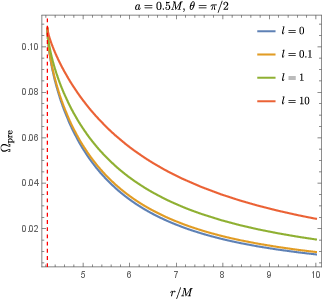
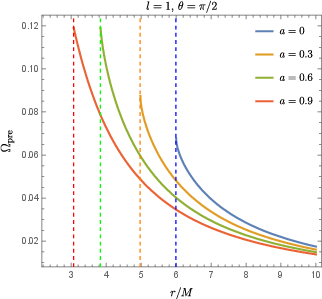
Figure 1: The periastron precession frequency Ωpre as a function of radius, for various values of l and Kerr parameter a, highlighting the monotonic growth of Ωpre with increasing l.
The nodal precession (vertical oscillation) frequency does not depend on l0 for equatorial orbits, aligning with the invariant character of the l1 component at l2. This decoupling of Lorentz-violating signatures in different precession observables provides a discriminant for strong-field tests.
Spin Precession: LT and Geodetic Limits
The spin precession of a test gyroscope, parallel-transported along stationary observer worldlines, reveals complementary traces of Lorentz violation. The Lense–Thirring (LT) precession, evaluated for static observers outside the ergosphere, is suppressed by positive l3, while the geodetic precession in the nonrotating (l4) spherically symmetric limit is enhanced with increasing l5. The analytic expressions show that for ZAMOs, divergences at the horizon are canceled, yielding finite spin precession at the horizon—a nontrivial consequence of frame-dragging in the modified geometry.
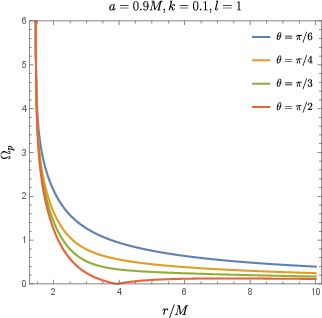
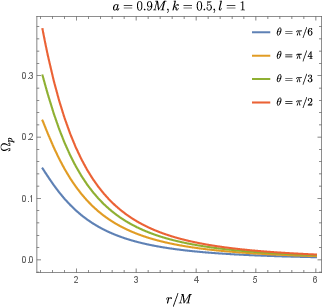
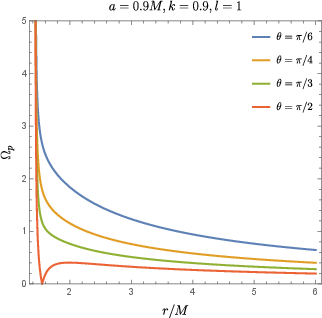
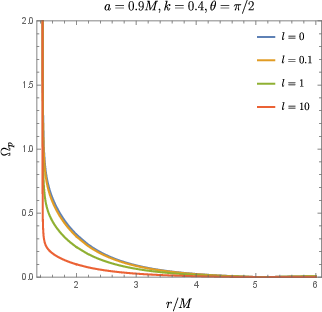
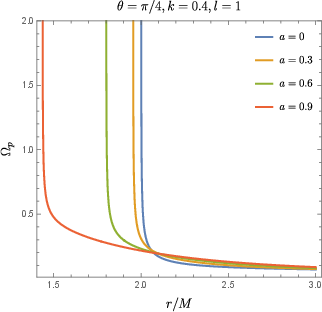
Figure 2: Spin precession frequency versus radius for different l6, l7, l8 (orbit parameter), and latitudinal angles, showing suppression of LT precession at high l9.
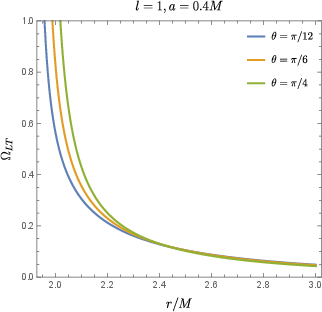
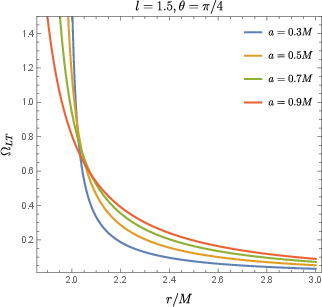
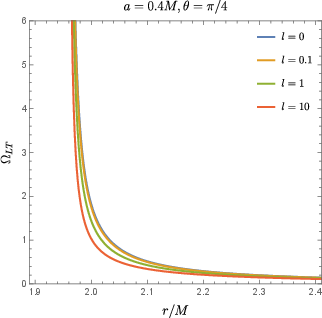
Figure 3: Lense-Thirring precession frequency as a function of radius across l0, l1, and l2, demonstrating monotonic increase toward the horizon and attenuation with larger l3.
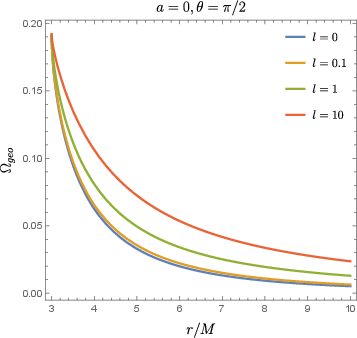
Figure 4: Geodetic precession versus radius in the spherically symmetric case (l4). Magnitude increases as l5 grows, consistent with an effective strengthening of spacetime curvature.
Thin Disk Imaging: Accretion Disk Signatures
Photon propagation in the rotating bumblebee background is simulated by backward ray tracing, considering emission and propagation in an equatorially aligned, optically thin accretion disk. The critical observational quantities include the inner shadow and the photon/lensed rings, which are sensitive to near-horizon geodesic structure.
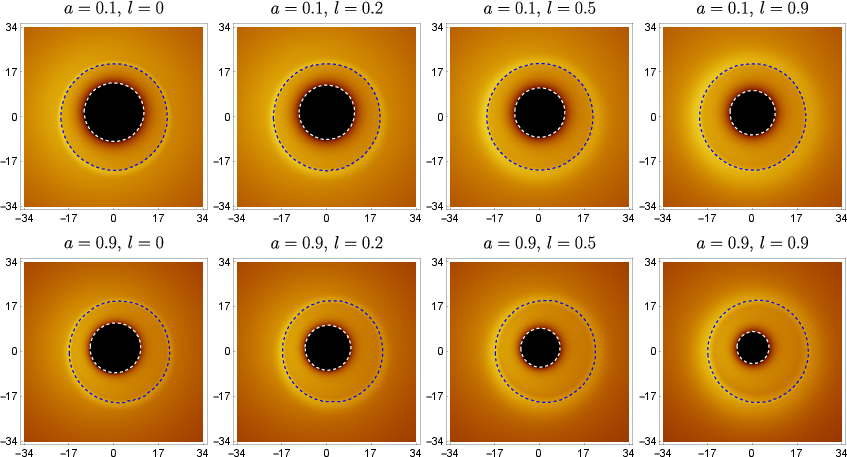
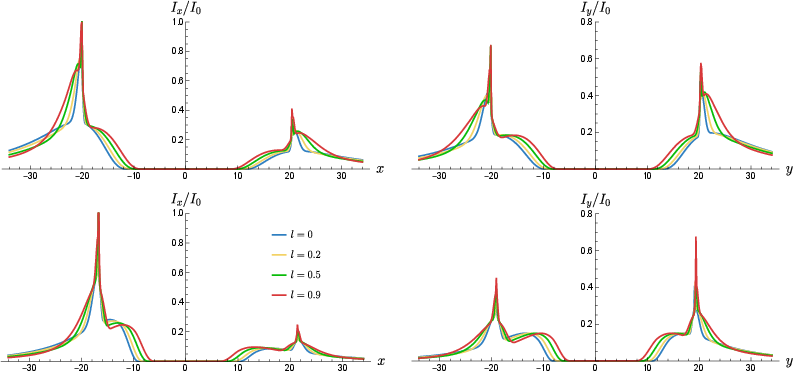
Figure 5: Synthetic images for low-inclination (l6) observers. The inner shadow (white dashed) contracts with growing l7, while the critical curve (blue dashed) is unaffected. Intensity cuts along principal axes reveal enlarged, brighter lensed rings.
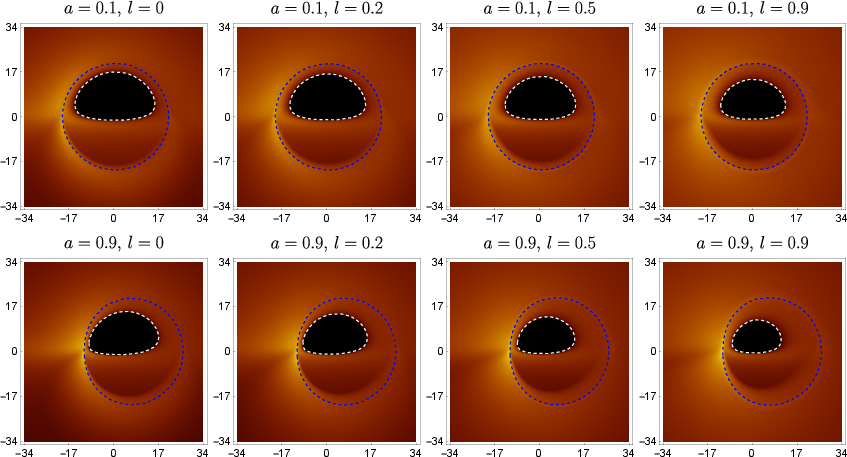
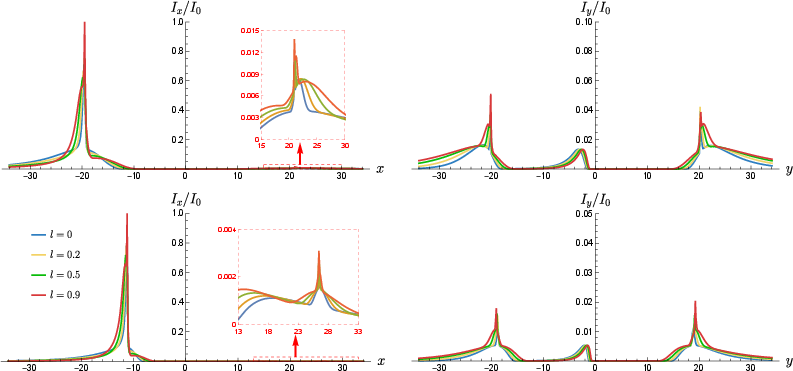
Figure 6: Images at high inclination (l8) display pronounced crescent structures due to strong Doppler effects. Again, the inner shadow shrinks and the lensed ring brightens as l9 increases.
Quantitative analysis shows that the average radius of the inner shadow is highly sensitive to Ωpre0, decreasing substantially (Ωpre136% variation over allowed Ωpre2) even for high spin and modest inclination—a regime relevant for M87* as imaged by the EHT. By contrast, the critical curve and photon ring diameters show negligible variations; this is consistent with their less direct dependence on the modified metric components.
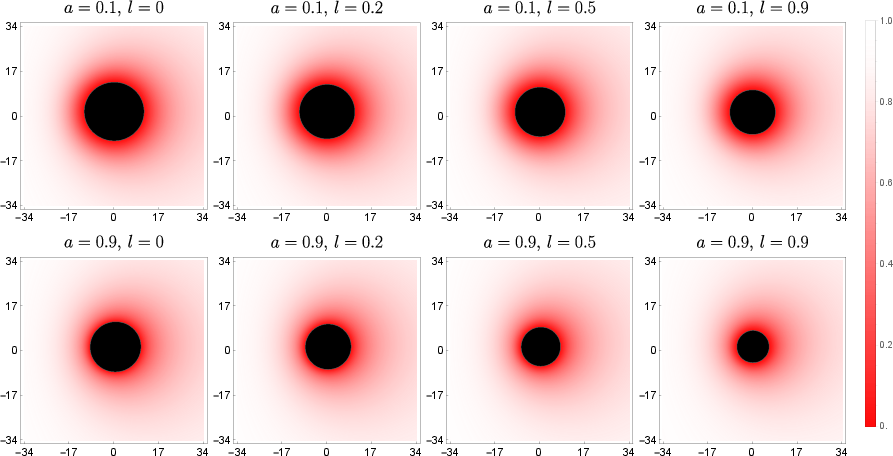
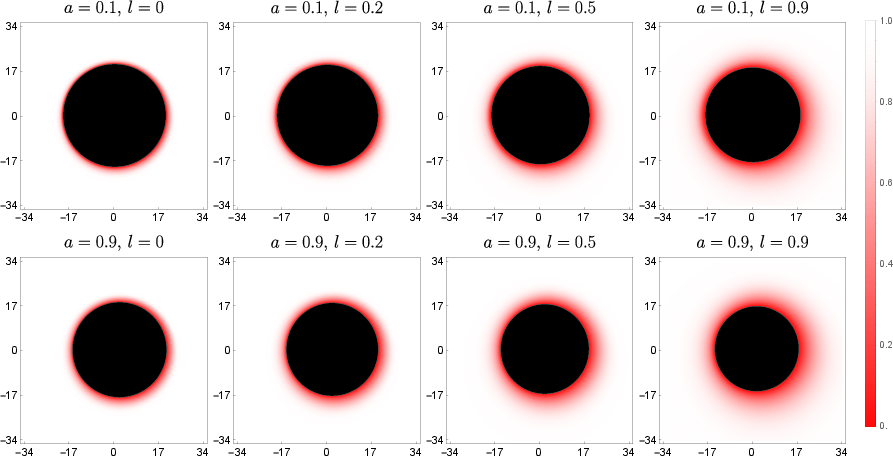
Figure 7: Redshift maps for direct and lensed disk emissions at low inclination. Central redshift is amplified by Ωpre3, expanding the high-redshift region and contributing to overall image brightness.
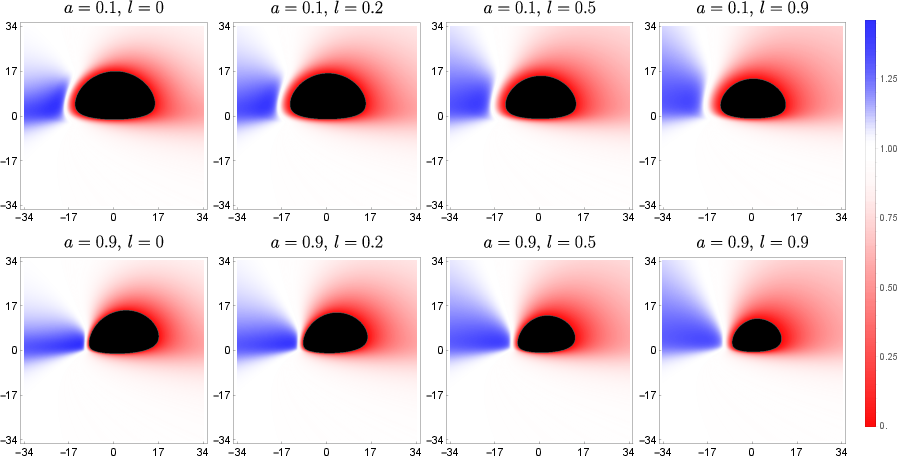
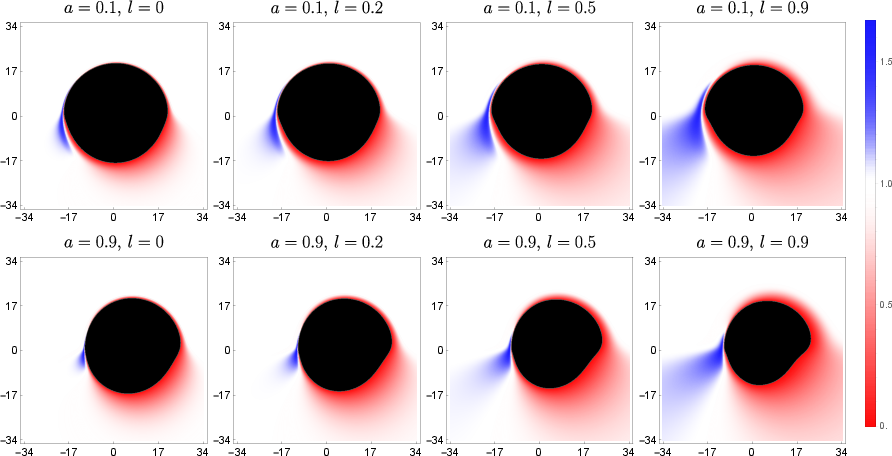
Figure 8: Redshift distribution at high inclination, underlining blueshifted crescents due to rapid equatorial flow. Enhanced Ωpre4 amplifies both redshifted area and magnitude, with the effect strongest on the lensed ring.
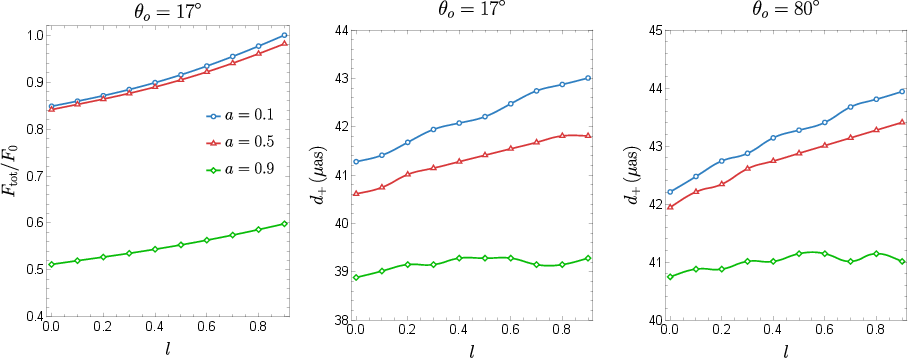
Figure 9: Total normalized flux (left), and photon ring interferometric diameter Ωpre5 (middle, right), as functions of Ωpre6. While total flux grows with Ωpre7, Ωpre8 is only weakly affected, diminishing its utility as a probe of Lorentz violation.
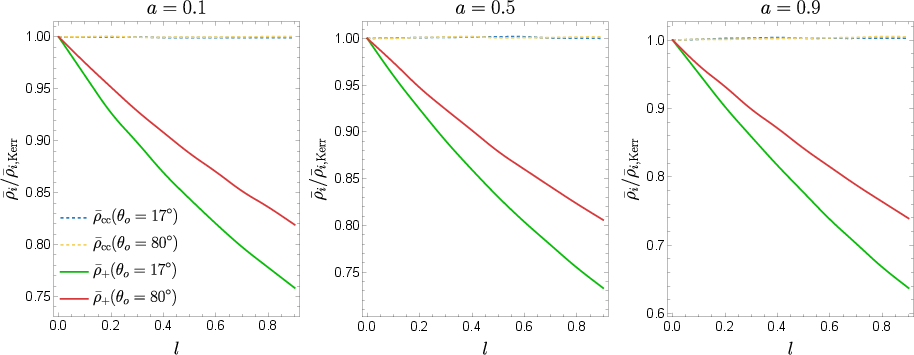
Figure 10: Average radii of inner shadow and critical curve against Ωpre9. The inner shadow radius declines strongly with Ωpre0 at all relevant spins and inclinations, whereas the critical curve remains practically unchanged.
Redshift Factor Distribution
A detailed breakdown along the Ωpre1-axis corroborates the interpretation: the redshift factor’s inner slope flattens for larger Ωpre2, reinforcing excess flux near the black hole and driving observable modifications to both direct and higher-order image structure.
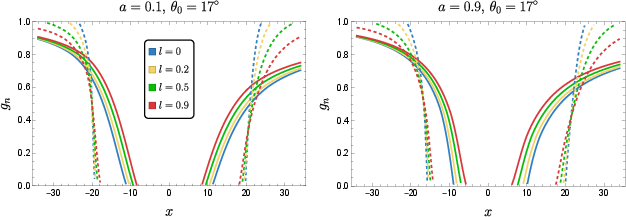
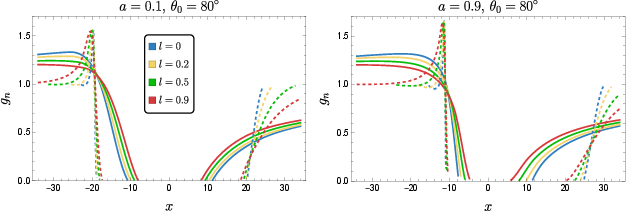
Figure 11: Redshift factors Ωpre3 for direct and lensed photons along observer-Ωpre4, parameterized by Ωpre5 and Ωpre6. Shift and broadening of distribution with increasing Ωpre7 are clear.
Implications and Perspectives
The analysis illuminates the unique fingerprints Lorentz-violation imprints on both precessional dynamics and black hole imaging, specifically in the context of rotating spacetimes:
- Dynamical observables: Strong enhancement of periastron precession, and suppression (enhancement) of LT (geodetic) precession by positive Ωpre8, constitutes a multi-channel test space for strong-field experiments (e.g., S-star orbits, QPO modeling).
- Imaging diagnostics: The inner shadow size is acutely sensitive to Ωpre9, in contrast to the stably sized critical curve and photon ring diameter. The lensed ring’s width and brightness, and redshift features, are also distinctive.
Together, these results point to the complementarity of dynamical and imaging observables in constraining Lorentz-violating deviations from general relativity. Degeneracies between spin and Ωpre0 are clearly broken through joint analysis of precession observables, inner shadow radius, and flux or redshift distribution features.
Future directions include modeling more general classes of bumblebee/vector-tensor theories (relaxing the scalar-gradient restriction), incorporating dissipative accretion physics, and connecting to gravitational wave and pulsar-timing observables, as well as exploring constraints from next-generation VLBI projects such as BHEX and from high-precision S-star astrometry.
Conclusion
The paper establishes that rotating, Lorentz-violating black holes manifest distinct, theoretically robust deviations in both spacetime structure and astrophysical signatures compared to standard Kerr black holes. Observable consequences span increased periastron precession, suppressed frame-dragging, and a marked reduction of the inner shadow. These results underscore the empirical accessibility of Lorentz-violating effects in the strong-field regime and motivate synergistic analysis pipelines integrating EHT-scale imaging, X-ray timing, and stellar-dynamical data.
Reference: "Probing Lorentz-violating effects via precession and accretion disk images of a rotating bumblebee black hole" (2604.00570).