- The paper presents a comprehensive 1D numerical model that integrates time-dependent mechanical feedback, radiative cooling, and mass evaporation in collapsing star-forming clouds.
- It identifies three evolutionary regimes—efficient feedback, collapsing shell, and standing shell—each governed by cloud density, metallicity, and feedback efficiency.
- Findings reveal that lower metallicity weakens stellar winds, leading to prolonged standing shell phases, enhanced secondary star formation, and high overall efficiency.
Model Framework and Physical Processes
The paper develops a comprehensive 1D numerical model to investigate how stellar winds and supernovae feedback modulate star formation in collapsing molecular clouds with varying masses, radii, and metallicities. The key ingredients include time-dependent mechanical feedback, self-gravity, evolving cloud collapse in a Larson–Penston framework, radiative cooling, shell instabilities, and triggered star formation via gravitational fragmentation. The star cluster forming at the cloud core injects energy and mass into the surrounding gas, driving the evolution of feedback-driven bubbles structured as concentric zones: free wind, hot shocked wind, and thin swept-up shell. Crucially, the model incorporates explicit heat transfer at the bubble–shell interface to capture mass evaporation effects, which strongly influence cooling rates and bubble dynamics.

Figure 1: Schematic illustrating the detailed structure and feedback mechanisms governing the evolution of feedback-driven bubbles formed by winds and supernovae from the central star cluster.
The star formation rate (SFR) in the core follows a density-dependent prescription modulated by the star formation efficiency per free-fall time ($\epsilon_{\rm{ff}$), while secondary star formation in the shell is triggered by gravitational instability and fragmentation, governed by the growth rates of perturbations. Energy injection rates are constructed using population synthesis and metallicity-dependent evolutionary tracks, ensuring realistic wind and supernova energetics across metallicity regimes.
Parameter Space and Simulation Regimes
The authors systematically scan a wide parameter space, executing ∼103 simulations per metallicity track using initial cloud gas masses in $5.2 \leq \log[M_{\rm{gas,0}/M_\odot] \leq 6.5$ and radii $14 \leq R_{\rm{cl,0} [\rm{pc}] \leq 31$. Three canonical metallicity tracks are adopted: MW (Z=0.0088), dwarfA (Z=0.00105), and IZw18 (Z=0.00021). For each, multiple $\epsilon_{\rm{ff}$ values are explored, ranging from $0.01$ to $0.3$.
Analysis reveals three distinct evolutionary regimes as a function of metallicity, cloud density, and feedback strength:
- Efficient Feedback Regime: At MW-like metallicity, feedback is potent; shells continuously expand, quickly quenching star formation, and integrated star formation efficiency (∼1030) remains low (∼1031) for ∼1032.
- Collapsing Shell Regime: For the densest clouds at low metallicity, inward forces dominate, shells collapse rapidly, enabling multiple star formation episodes and chemical enrichment. This is pertinent to globular cluster formation scenarios involving multiple stellar generations.
- Standing Shell (StSh) Regime: A significant portion of the parameter space at low/intermediate metallicity features shells stalling at quasi-static equilibrium (standing shell phase), where feedback, gravity, ram pressure, and cooling achieve balance. During StSh phases, shell fragmentation yields efficient secondary star formation—the total stellar mass often two orders of magnitude above core-only formation.
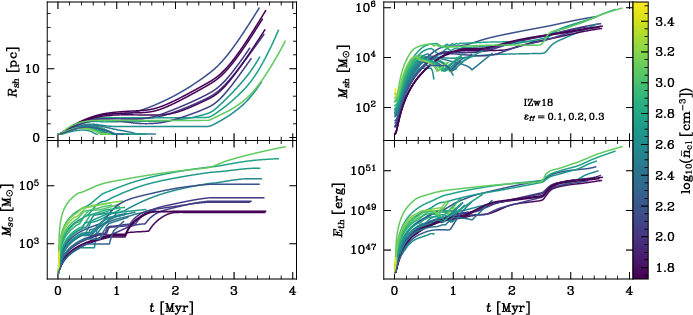
Figure 2: Time evolution of shell radius, mass, stellar mass, and thermal energy for IZw18 models, highlighting prolonged star formation and high ∼1033 in low-metallicity environments.
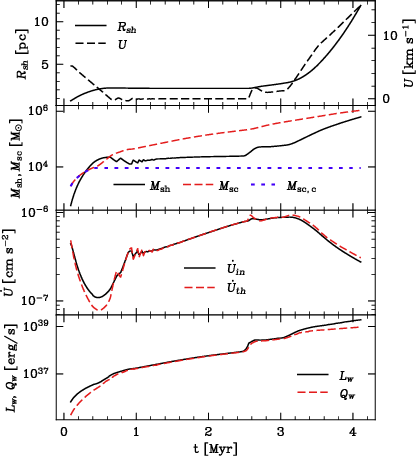
Figure 3: Detailed shell and feedback evolution for a typical StSh model, emphasizing stable shell position and high star formation rates once gravitational instability and fragmentation commence.
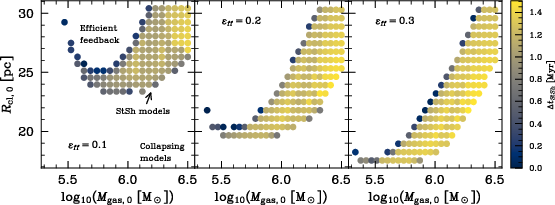
Figure 4: Mapping of StSh models in the initial radius–mass space, color-coded by duration of the StSh phase for three ∼1034 values, underscoring the dependence of standing shell solutions on cloud density and feedback efficiency.
StSh models at low metallicity achieve strikingly high ∼1035, often ∼1036 for clouds with ∼1037, with prolonged star formation timescales of ∼1038 Myr. The final stellar mass correlates strongly with surface density rather than just volume density, aligning with previous multi-physics simulation trends. MW models show exclusively expanding shells with short SFR duration and much lower efficiency.
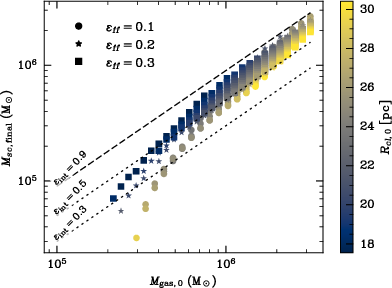
Figure 5: Final stellar mass versus original cloud mass for StSh models at IZw18 metallicity, with distinct efficiency bands (∼1039 up to $5.2 \leq \log[M_{\rm{gas,0}/M_\odot] \leq 6.5$0) and radius-encoded color mapping.
Counterintuitively, lower metallicity yields weaker feedback, not merely due to reduced cooling but owing to diminished wind mechanical power. In low metallicity environments, the cooling rate $5.2 \leq \log[M_{\rm{gas,0}/M_\odot] \leq 6.5$1 approaches the feedback power $5.2 \leq \log[M_{\rm{gas,0}/M_\odot] \leq 6.5$2, stabilizing the shell and facilitating efficient star formation. At higher metallicity, energy injection rate always exceeds cooling rate, enforcing continuous bubble expansion and feedback-driven gas removal.
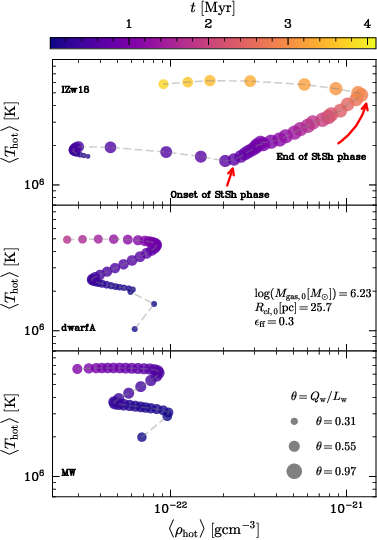
Figure 6: Emission-weighted phase space evolution of hot bubble density and temperature for matched initial conditions across metallicity tracks, plotting feedback efficiency ($5.2 \leq \log[M_{\rm{gas,0}/M_\odot] \leq 6.5$3) and marking StSh phase only in IZw18 case.
Model Limitations and Comparisons
The treatment is 1D, precluding turbulent, filamentary, and anisotropic effects, which could modulate feedback coupling and fragmentation pathways. Radiation pressure is neglected but justified for late-stage wind-dominated regimes. Robust validation is presented via comparison to 1D FLASH hydrodynamics simulations for bubble energetics and cooling, confirming accuracy.
Consistency With Observations and Literature
Results match observed star formation efficiencies and mass scales in local starburst regions (e.g., NGC 5253, Firecracker cloud) and are consistent with high cluster masses and rapid formation times found in JWST studies of high-redshift, metal-poor galaxies. Theoretical comparisons are made to 1D and multi-physics simulations (e.g., [2023MNRAS.521.5686K], [2024A&A...690A..94P]), confirming strong correlations with gas surface density and the physical plausibility of StSh solutions—models robust to star formation prescription details.
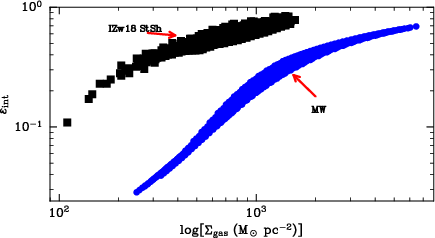
Figure 7: Correlation between integrated star formation efficiency and initial cloud surface density, separately for MW and IZw18 StSh models, demonstrating surface density as the dominant predictor.
Theoretical and Practical Implications
The findings clarify metallicity's dual role in regulating feedback: lowered wind power at reduced $5.2 \leq \log[M_{\rm{gas,0}/M_\odot] \leq 6.5$4 leads to longer, more efficient star formation phases, particularly as StSh solutions become accessible. This mechanism may explain the presence of compact, massive, high-$5.2 \leq \log[M_{\rm{gas,0}/M_\odot] \leq 6.5$5 star clusters and multi-generation clusters in the early universe. Practically, model predictions offer guidance for interpreting JWST observations and refining star cluster formation simulations, especially for globular cluster progenitors.
Future directions include expanding to 3D, incorporating radiation feedback, and more detailed fragmentation physics. The parameter space exploration is extensible to new metallicity regimes as high-$5.2 \leq \log[M_{\rm{gas,0}/M_\odot] \leq 6.5$6 data becomes available, and the explicit cooling treatment enables integration with multi-phase ISM models.
Conclusion
This work rigorously demonstrates that cloud metallicity is as critical as mass and radius in setting feedback strength and star formation fate in collapsing GMCs. At low metallicity, weakened winds allow prolonged standing shell phases, triggering high-efficiency star formation via shell fragmentation. These results robustly predict the diversity of star cluster properties across cosmic time and provide a theoretical foundation for interpreting observations of massive, metal-poor star-forming complexes. The modeling approach, validated by hydrodynamics and consistent with contemporary simulations and extragalactic observations, offers a powerful framework for future studies on metallicity-regulated feedback and cluster formation.

