- The paper presents a unified R2X paradigm leveraging MLLMs to drive task-aware sensing, adaptive communication, and hierarchical computation.
- It details robust architectures with demonstrable benefits, including >20% task completion time reduction and sub-1.1s loop latency in digital-twin warehouse navigation.
- The survey sets a roadmap for future research addressing challenges in semantic compression, mixed-criticality protocols, and dynamic offloading strategies.
Multimodal LLMs for Holistic Multi-Robot Network Orchestration
Introduction and Motivation
This survey provides a systematic and technically rigorous treatment of the robot-to-everything (R2X) paradigm, addressing the integration of sensing, communication, and computation infrastructures for large-scale, multi-robot systems empowered by multimodal LLMs (MLLMs) (2604.00061). The analysis is motivated by emerging industrial, service, and public deployment scenarios, where local autonomy is insufficient and collective, intent-driven orchestration becomes mandatory for robust and efficient operation.
The authors highlight that traditional paradigms—M2M, V2X, URLLC, and “plain” robot collaboration—are insufficient when considered in isolation, as none spans all layers from physical wireless protocols to high-level, language-grounded, multi-robot planning. R2X, in contrast, unifies: (i) task-aware multimodal sensing; (ii) adaptive, semantic- and priority-aware communications; (iii) hierarchical, distributed-to-centralized computation; and (iv) orchestration via an intent-to-resource mapping using MLLMs.
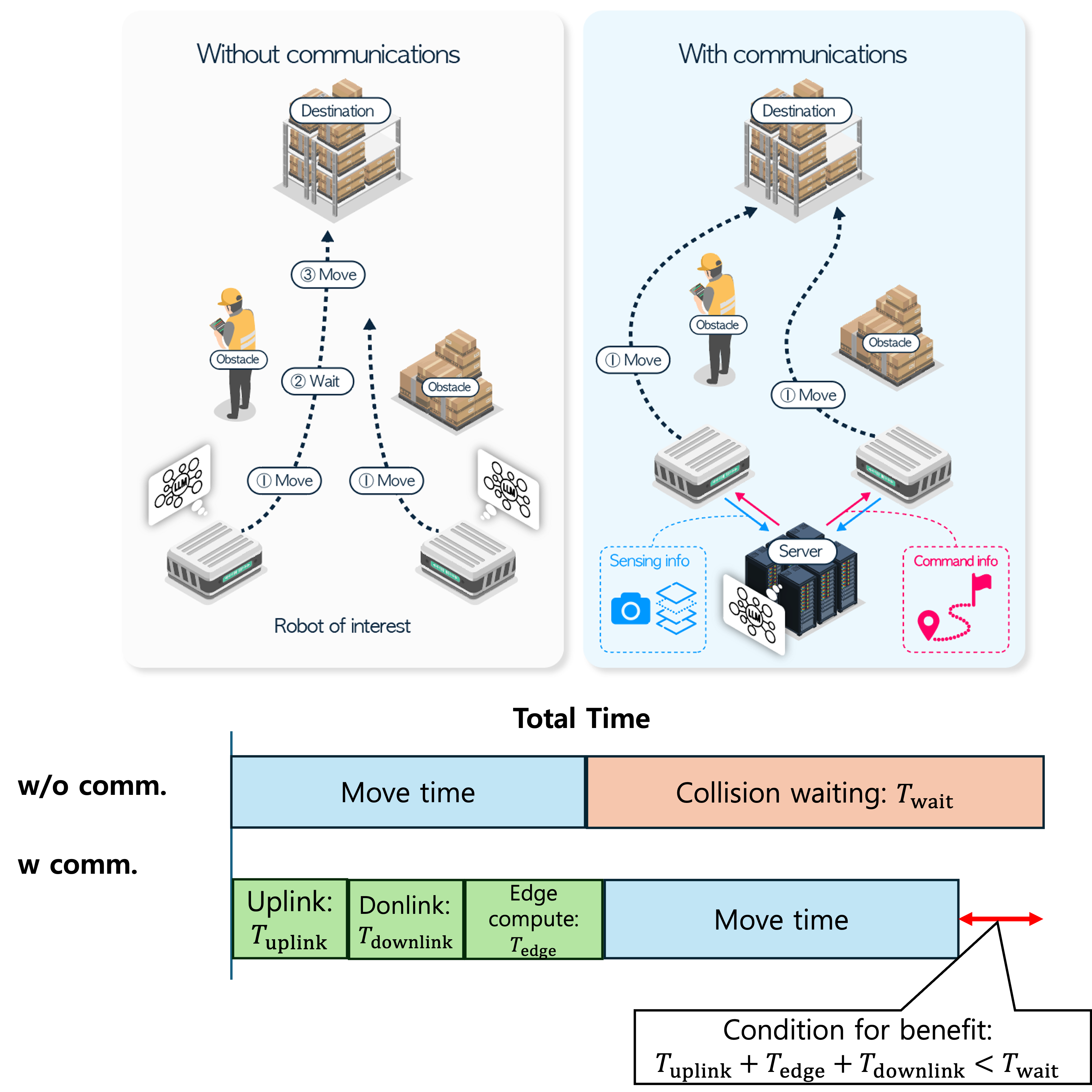
Figure 1: A scenario comparing individually planned robot routes versus communication-based multi-robot collaboration. Bandwidth-adaptive communication outperforms isolated autonomy conditional on communication and compute delays being less than waiting/collision times.
Foundations: MLLM-Based Cognitive Stack for R2X
A detailed MLLM architecture is developed: modality-specific encoders (e.g., CNN/ViT for vision, linear projections for structured data), modality connectors (cross-attention, Q-formers), and a LLM core acting as the central cognitive processor, producing output in both textual and actionable formats. The training recipe is a three-stage pipeline: large-scale paired pretraining for multimodal alignment, instruction tuning for zero-shot task generalization, and alignment tuning (often via RLHF) for response quality control.
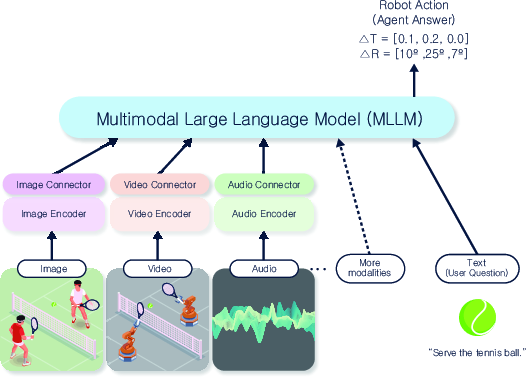
Figure 3: Common block diagram of MLLMs, including modality encoders, connectors, and a language-driven core.
A taxonomy of R2X communication is presented, covering not only robot-to-robot (R2R), but also robot-to-human (R2H), robot-to-infrastructure (R2I), robot-to-vehicle (R2V), and robot-to-device (R2D) communication modes, each linked to specific protocols, traffic classes, and QoS requirements.
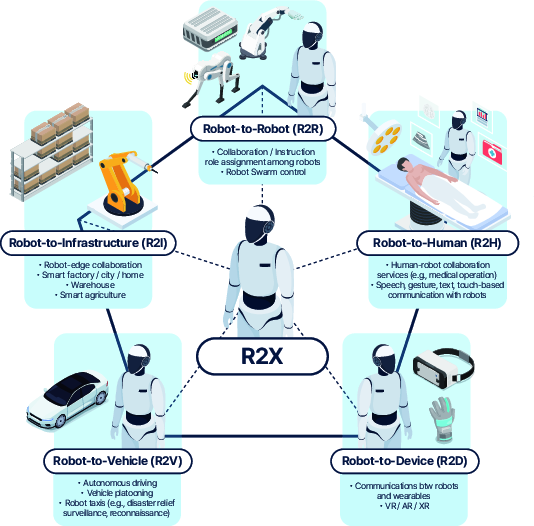
Figure 2: Taxonomy of R2X communications encompassing R2R, R2H, R2I, R2V, and R2D modalities.
Integrated System Stack: Sensing, Communications, and Computation
Sensing
The framework supports a hierarchy of multimodal sensors: vision (cameras), LiDAR, radar, IMU, ultrasonic, tactile, and auditory, with substantial detail on the technical trade-offs in resolution, range, and volume. The architecture emphasizes extracting task-relevant semantic features (e.g., via vector quantization or deep encoding) with quantized representations, achieving compression ratios up to 1024:1 versus raw images, yielding <10 KB per update for typical visual streams.
Communications
The communication layer is designed around ultra-reliable low-latency communication (URLLC) primitives. Communication adaptivity is realized using real-time semantic payload switching, edge/cloud offloading, predictive MCS (modulation and coding scheme) allocation, and fairness policies aware of mission-criticality and deadlines.
Computation
A hybrid, hierarchical computing model underpins the system: on-device inference ensures sub-10 ms reflexes; edge servers manage medium-latency, high-bandwidth tasks (out-of-FOV perception, path-planning); and cloud servers handle large-scale, history-augmented, and cross-site optimization (multi-robot scheduling, continual learning). Dynamic partitioning, guided by the orchestrator, determines offloading strategies, cognizant of queueing, bandwidth, and energy.
System-Level Orchestration: End-to-End Demonstrations
Four closed-loop demonstrations exemplify the orchestration logic:
Demo I: Digital-Twin Warehouse Navigation
R2X orchestration combining semantic compression, predictive link-quality awareness, and server-directed path replanning reduces task completion times by up to >20%, with sub-1.1s end-to-end loop latency and continuous motion under tight collision-avoidance and comms constraints.
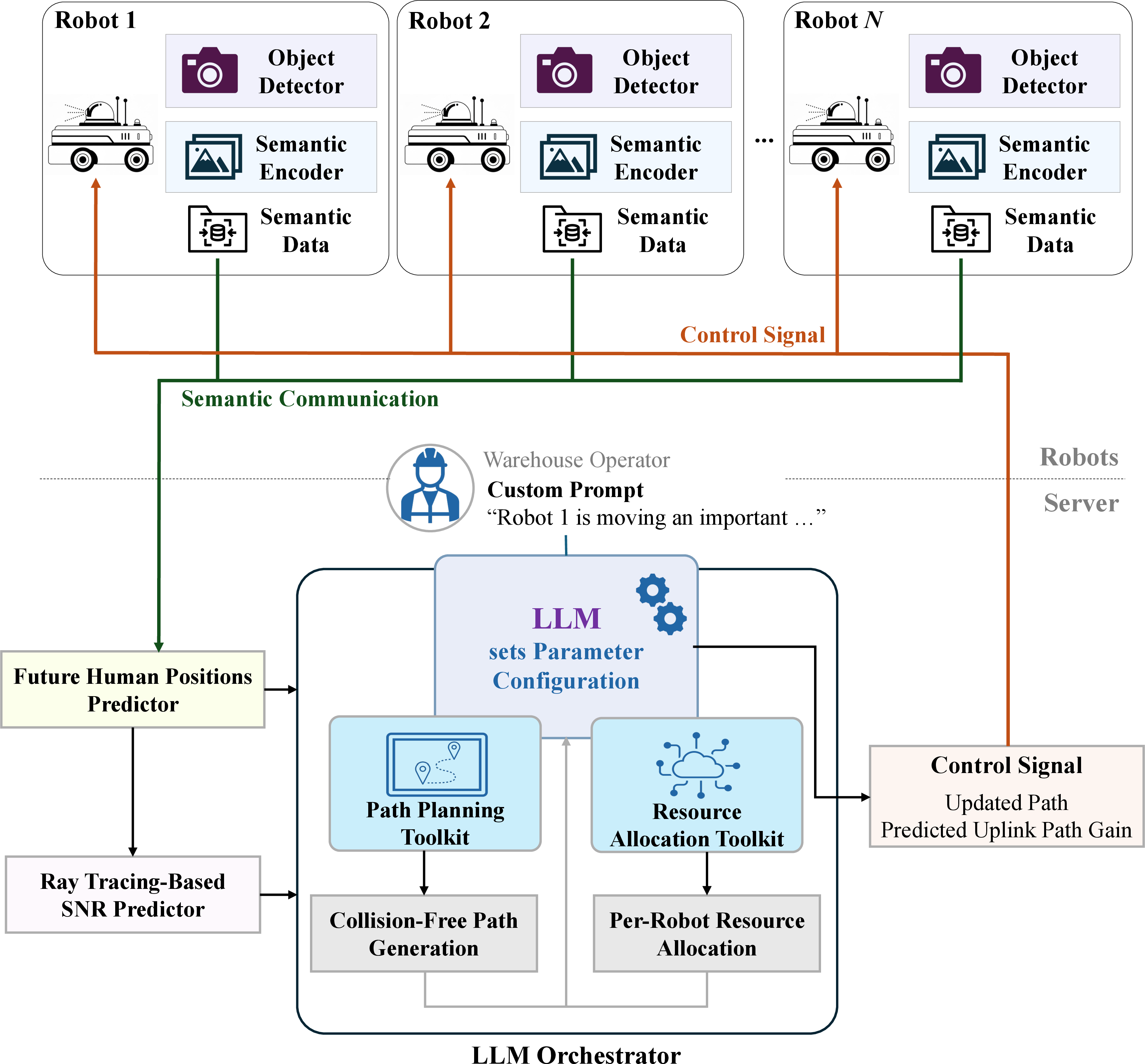
Figure 4: End-to-end architecture of warehouse navigation orchestration—robots communicate semantic observations, and a server fuses sensing with link-state prediction for global replanning.
Demo II: Proactive MCS Control in Mobility
MLLM-driven modulation adaptation, which fuses semantic context and channel feedback, consistently outperforms stale-reactive baselines for BLER, throughput, and latency. Throughput gains of up to 100% and latency reductions >40% are observed as feedback delay increases.
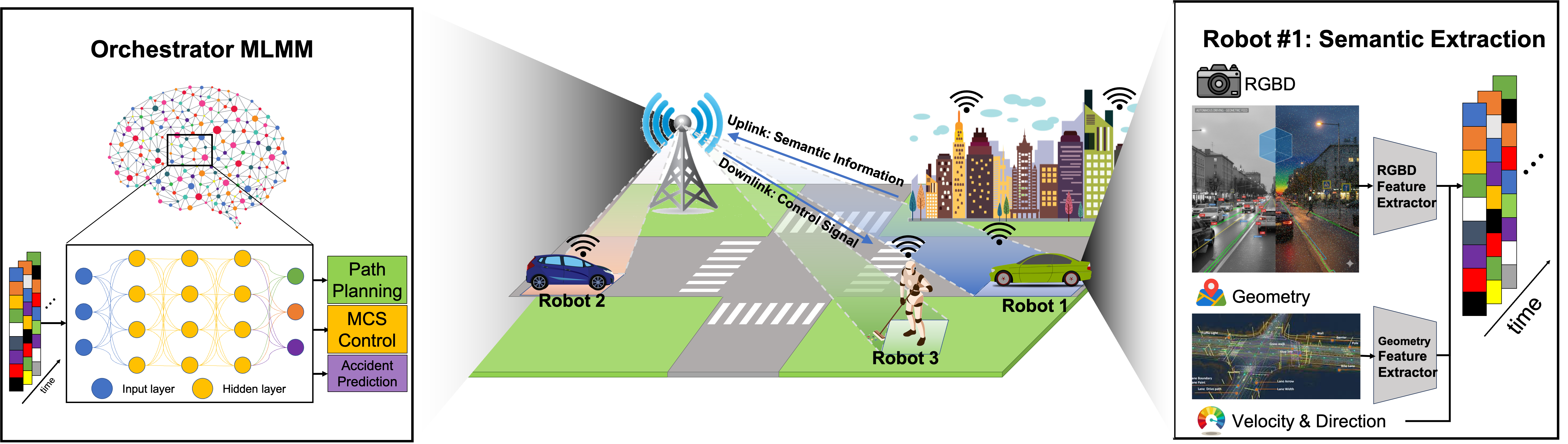
Figure 5: Demo II architecture—agents transmit semantic features; a central MLLM orchestrator configures link parameters for latency/rate optimization.
Demo III: Real-Hardware FollowMe With Semantic Sensing Switch
Dynamic switching between JPEG and ViT/VQG-based visual payloads, orchestrated via RSSI and KPI feedback, stabilizes command-to-action delay, achieving $32.62$ ms real-time operation versus >100 ms and high failure rates in non-adaptive baselines. Network-aware switching reduces control loop latency variance and improves user-tracking success.
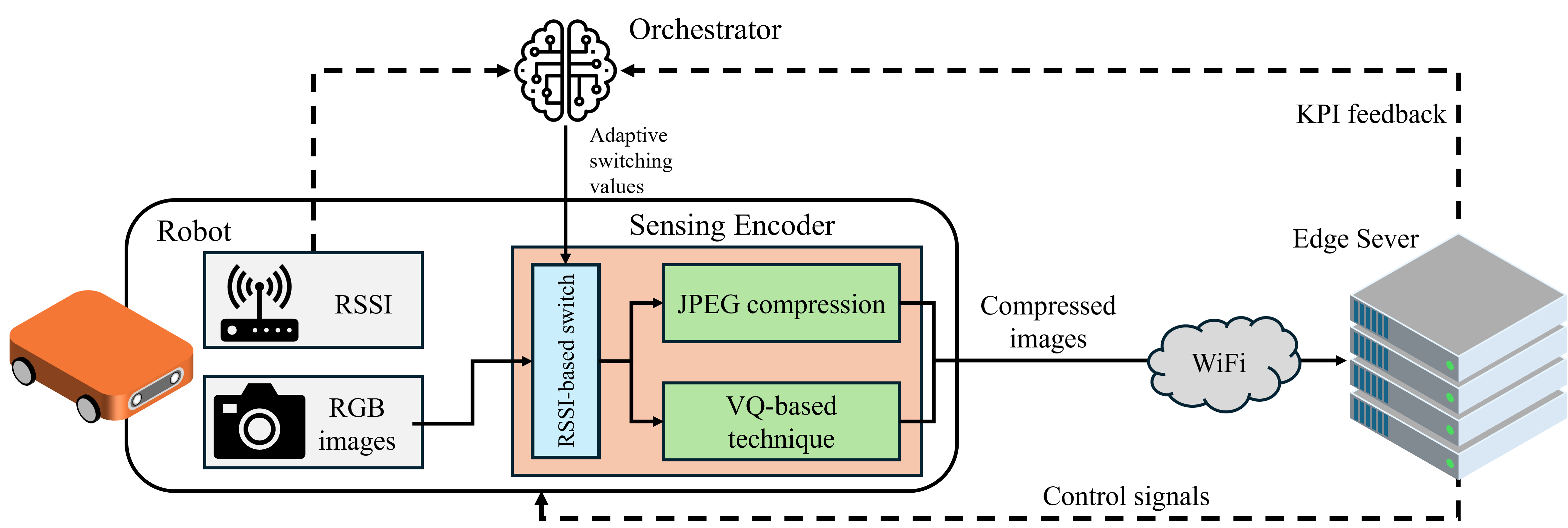
Figure 8: Real-hardware pipeline—edge-based orchestrator adaptively selects sensing representations to maintain closed-loop tracking and control over WiFi.
Demo IV: Open-Vocabulary Trash Sorting
Edge-based MLLM grounding, combined with multi-view sensing (robot + corridor cameras), enables successful open-vocabulary object and bin recognition, reducing average task completion time by >21% and boosting success ratio to >90% compared to closed-set on-device detectors, which often fail in long-tail/unseen classes.
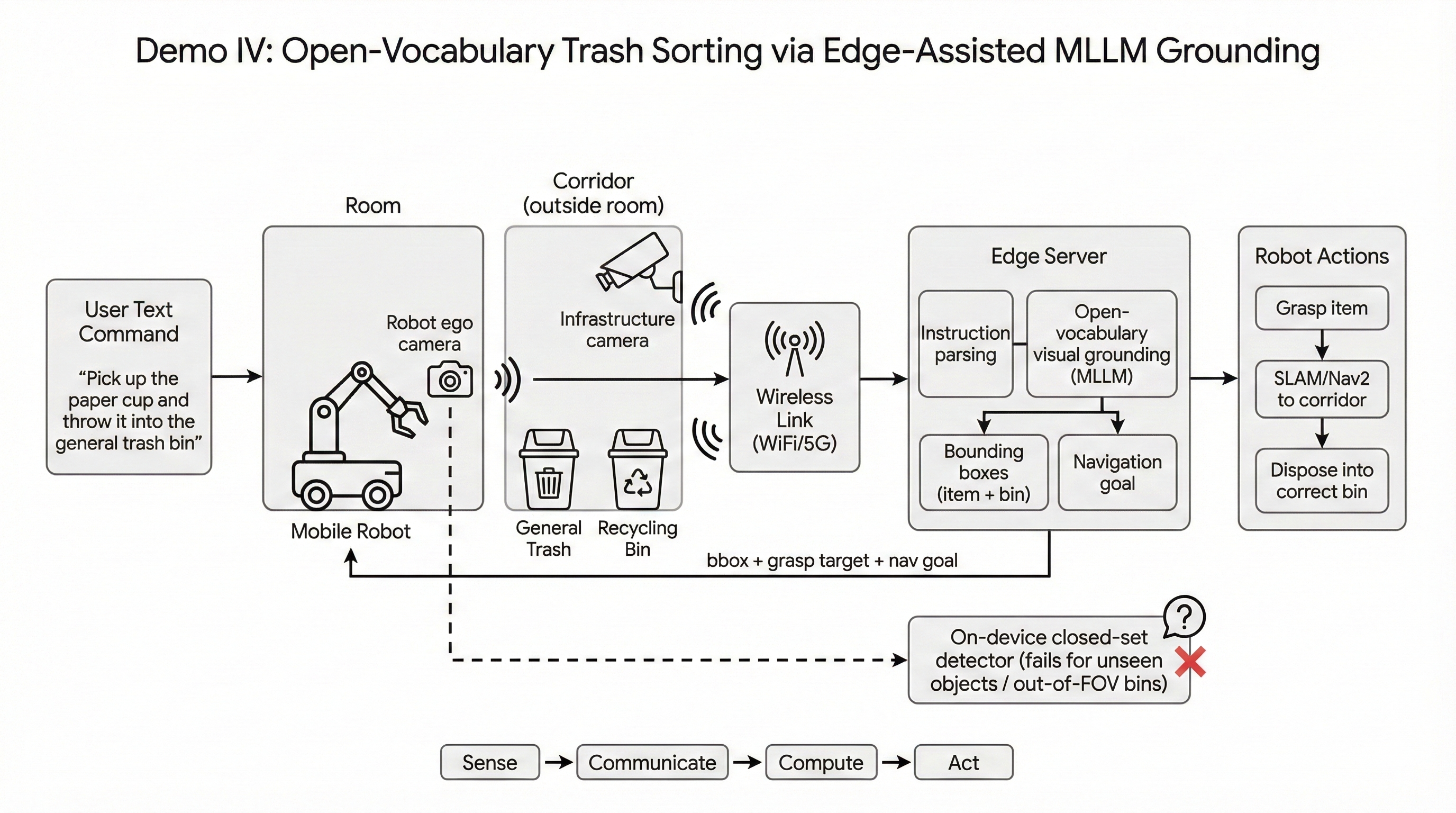
Figure 10: Orchestration overview for open-vocabulary, multi-view trash sorting: edge MLLM grounds arbitrary instructions, returning bounding boxes for grasp/navigation.
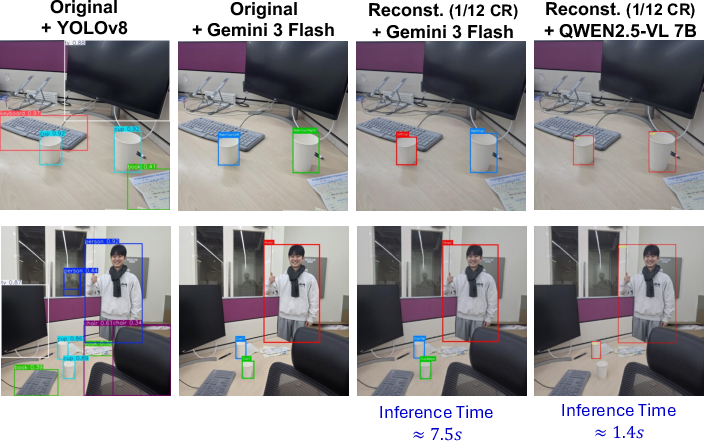
Figure 12: Open-vocabulary grounding on compressed semantic images—with a 1/12 compression ratio, MLLMs localize arbitrary objects specified by text queries.
Broader Implications, Research Challenges, and Future Directions
The R2X paradigm is positioned as a programmable policy interface: an explicit, measurable, closed-loop mapping from high-level natural language goals to concrete sensing/communication/computation configurations. Key observations include:
- Semantic payload reduction is critical when tail/loss/jitter events drive control instability more than perceptual fidelity loss.
- Predictive orchestration consistently outperforms reactive control when feedback is stale and channel or scene dynamics are fast.
- Orchestration must include explicit fallback policies for real-world deployment (safe mode, degraded autonomy under deadline-miss).
Practical and theoretical challenges are articulated as measurable research questions, including:
- Mixed-criticality protocol design for combining ultra-reliable and high-throughput streams.
- Dynamic offloading thresholds considering contention and variable compute/network performance.
- Semantic compression optimization targeting downstream MLLM task metrics, not just fidelity.
- Robustness testing against adversarial sensing and prompt inputs, with deadline-aware fallback.
- Scalable semantic multiple access and compute-aware scheduling for N-robot deployments.
The paper also anticipates emerging directions including orchestration-friendly, non-orthogonal multiple access; predictive, intent-driven resource management; joint communication and perception co-design with MLLMs; and federated/cooperative edge inference. Research in scalable, real-time model compression (quantization, distillation, partitioned inference) is shown to be crucial for QoS and energy.
Conclusion
This work rigorously consolidates the heterogeneous literature and practical experience relevant to integrating MLLMs in multi-robot collaborative networks. By articulating both architecture and KPIs for end-to-end orchestration, specifying explicit technical scenarios, and quantifying performance and failure modes, it provides a definitive technical reference for the next generation of networked robotics. Practical deployment requires a shift from isolated hardware or algorithmic benchmarks to holistic, closed-loop, intent-to-task evaluation—with security, robustness, and fallback assurance not as afterthoughts, but as hard constraints built into the MLLM-driven R2X stack.

