Papers
Topics
Authors
Recent
Search
2000 character limit reached

Conversational Language Models for Human-in-the-Loop Multi-Robot Coordination

Published 29 Feb 2024 in cs.RO | (2402.19166v1)

Abstract: With the increasing prevalence and diversity of robots interacting in the real world, there is need for flexible, on-the-fly planning and cooperation. LLMs are starting to be explored in a multimodal setup for communication, coordination, and planning in robotics. Existing approaches generally use a single agent building a plan, or have multiple homogeneous agents coordinating for a simple task. We present a decentralised, dialogical approach in which a team of agents with different abilities plans solutions through peer-to-peer and human-robot discussion. We suggest that argument-style dialogues are an effective way to facilitate adaptive use of each agent's abilities within a cooperative team. Two robots discuss how to solve a cleaning problem set by a human, define roles, and agree on paths they each take. Each step can be interrupted by a human advisor and agents check their plans with the human. Agents then execute this plan in the real world, collecting rubbish from people in each room. Our implementation uses text at every step, maintaining transparency and effective human-multi-robot interaction.

Definition Search Book Streamline Icon: https://streamlinehq.com
References (22)
  1. Swarm robots in mechanized agricultural operations: A review about challenges for research. Computers and Electronics in Agriculture 193 (2022), 106608.
  2. Do as i can, not as i say: Grounding language in robotic affordances. In Conference on Robot Learning. PMLR, 287–318.
  3. Chateval: Towards better llm-based evaluators through multi-agent debate. arXiv preprint arXiv:2308.07201 (2023).
  4. AgentVerse: Facilitating Multi-Agent Collaboration and Exploring Emergent Behaviors in Agents. arXiv preprint arXiv:2308.10848 (2023).
  5. Industry Led Use-Case Development for Human-Swarm Operations. arXiv:2207.09543 [cs.RO]
  6. Palm-e: An embodied multimodal language model. arXiv preprint arXiv:2303.03378 (2023).
  7. Improving language model negotiation with self-play and in-context learning from ai feedback. arXiv preprint arXiv:2305.10142 (2023).
  8. Metagpt: Meta programming for multi-agent collaborative framework. arXiv preprint arXiv:2308.00352 (2023).
  9. Inner Monologue: Embodied Reasoning through Planning with Language Models. In Conference on Robot Learning. PMLR, 1769–1782.
  10. Camel: Communicative agents for” mind” exploration of large scale language model society. arXiv preprint arXiv:2303.17760 (2023).
  11. An overview of cooperative robotics in agriculture. Agronomy 11, 9 (2021), 1818.
  12. Roco: Dialectic multi-robot collaboration with large language models. arXiv preprint arXiv:2307.04738 (2023).
  13. Self-adaptive large language model (llm)-based multiagent systems. In 2023 IEEE International Conference on Autonomic Computing and Self-Organizing Systems Companion (ACSOS-C). IEEE, 104–109.
  14. Open X-Embodiment Collaboration. 2023. Open X-Embodiment: Robotic Learning Datasets and RT-X Models. https://robotics-transformer-x.github.io.
  15. OpenAI. 2023. Introducing ChatGPT and Whisper APIs. https://openai.com/blog/introducing-chatgpt-and-whisper-apis
  16. A generalist agent. arXiv preprint arXiv:2205.06175 (2022).
  17. Robots that ask for help: Uncertainty alignment for large language model planners. arXiv preprint arXiv:2307.01928 (2023).
  18. Straits Research. 2023. Household Robotics Market: Information by Application (Robotic Vacuum Mopping, Lawn Mowing), Offering (Products, Services), and Region - Forecast till 2030.
  19. Unleashing Cognitive Synergy in Large Language Models: A Task-Solving Agent through Multi-Persona Self-Collaboration. arXiv preprint arXiv:2307.05300 (2023).
  20. Distributed multi-robot algorithms for the TERMES 3D collective construction system. In Proceedings of Robotics: Science and Systems. Institute of Electrical and Electronics Engineers.
  21. Harnessing the power of llms in practice: A survey on chatgpt and beyond. arXiv preprint arXiv:2304.13712 (2023).
  22. Building Cooperative Embodied Agents Modularly with Large Language Models. arXiv preprint arXiv:2307.02485 (2023).
Citations (3)

Summary

  • The paper introduces a decentralized dialogical framework leveraging conversational language models for human-in-the-loop multi-robot coordination.
  • It employs techniques like agent identity initialization and argument-style dialogues to effectively assign tasks and adapt plans in dynamic environments.
  • Demonstrations with TurtleBot3 robots validate the system’s ability to manage cleaning tasks, highlighting its flexibility and potential for scaling complex applications.

Conversational LLMs for Human-in-the-Loop Multi-Robot Coordination

Introduction

The paper "Conversational LLMs for Human-in-the-Loop Multi-Robot Coordination" (2402.19166) addresses the increasing demand for flexible and adaptive robotic systems in real-world environments. With the anticipated growth in household robotics, there is a pressing need for systems that can seamlessly adapt to new tasks without extensive prior training. This paper explores the integration of LLMs in a multimodal framework to facilitate communication and coordination among robots and human operators.

The primary contribution of this research is a decentralized dialogical approach where heterogeneous agents with varying capabilities collaboratively plan solutions through peer-to-peer and human-robot discussions. The methodology contrasts with existing approaches that often rely on a single agent or homogeneous agent teams for simple task coordination. By leveraging argument-style dialogues, the proposed system effectively utilizes each agent's abilities within a cooperative team framework.

Demonstration

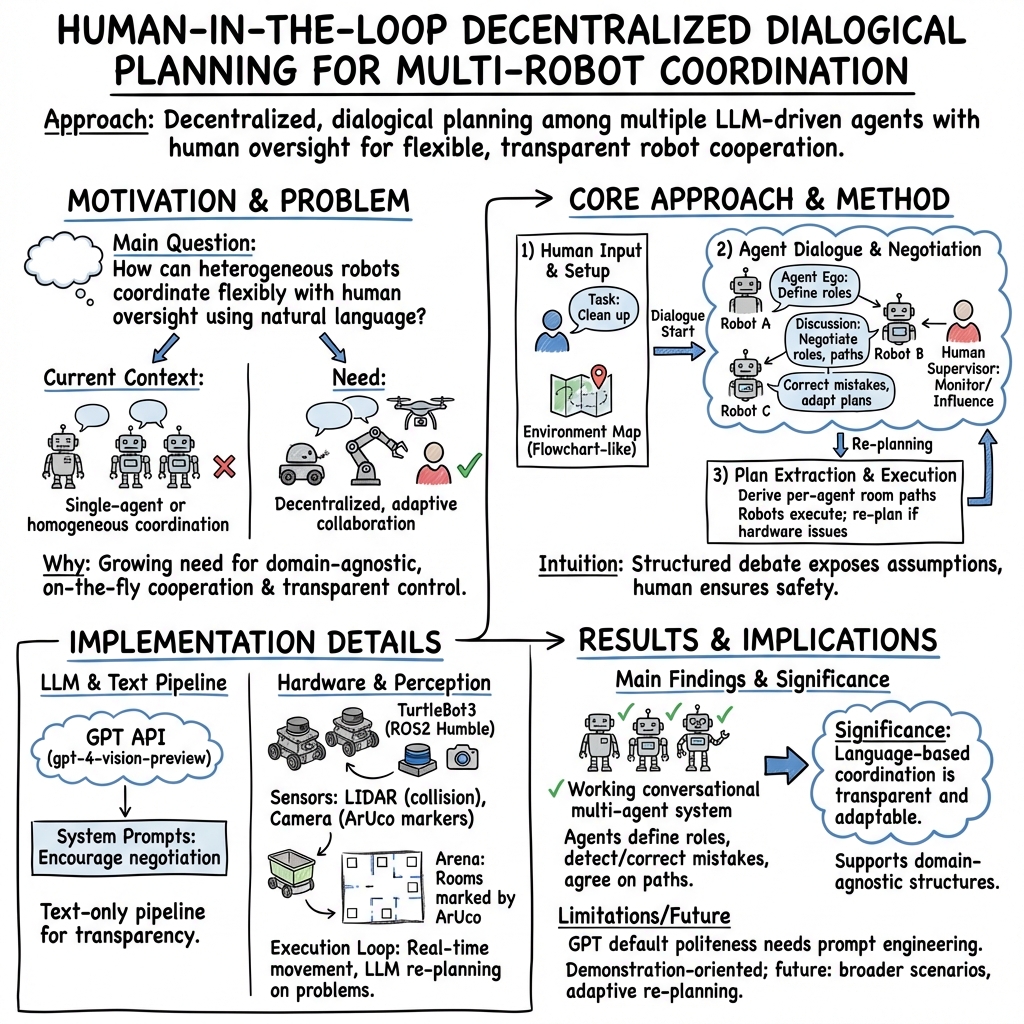
The demonstration section illustrates a practical implementation of the proposed system, involving a human-robot interactive scenario where robots collaboratively solve a cleaning problem. The system employs text-based exchanges at each step, ensuring transparency and effective human-multi-robot interaction. The demonstration highlights several key stages:

  1. Agent Identity and Environment Modeling: Agents are initialized with predefined identities and a flowchart-style environment model (Figure 1). This setup allows agents to understand spatial relationships within the task environment.
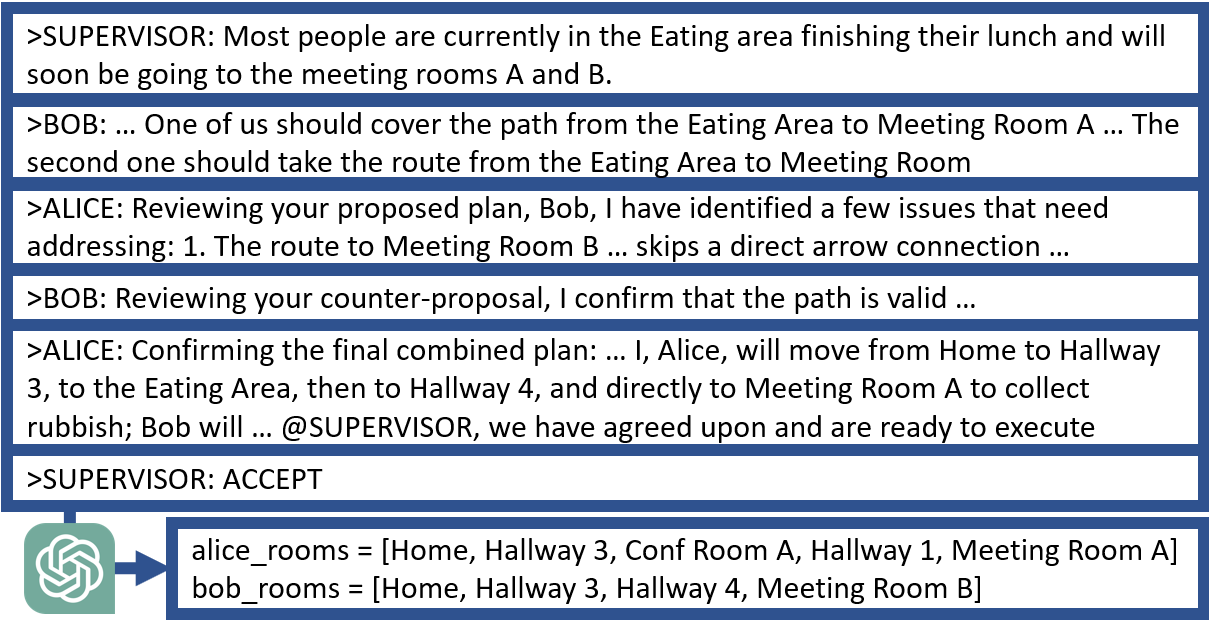
  2. Task Assignment and Discussion: Human supervisors assign tasks, triggering agent discussions on task execution. The agents independently define roles, collaborate on problem-solving strategies, and sequentially validate their plans with human oversight.
  3. Execution and Replanning: The agreed-upon plans are executed by the robotic agents. Agents can autonomously detect execution challenges and request human intervention to replan, showcasing the system's adaptive planning capability. Figure 1

    Figure 1: An example dialogue where the rooms are extracted.

The hardware implementation involves two TurtleBot3 robots equipped with LIDAR for collision avoidance and optical cameras for environmental detection. The robots demonstrate their capabilities by collecting rubbish as part of a simulated waste collection task.

Implications and Future Directions

The integration of pre-trained LLMs for decentralized mission planning introduces significant advantages in terms of flexibility and human readability. The system's ability to interface directly with human operators enhances its applicability in dynamic and uncertain environments, where human input may be crucial for refining objectives and correcting errors.

The proposed framework sets a precedent for future explorations into language-based robotic coordination, potentially facilitating the development of generalist robotics that can leverage LLMs for diverse tasks. While the current proof-of-concept demonstrates feasibility, further research is required to scale these systems for complex, real-world applications involving larger teams of varied robots and more intricate task environments.

Conclusion

This paper presents a novel approach to multi-robot coordination using conversational LLMs. By enabling robots to engage in argument-based dialogues, the proposed system harnesses the interpretative and reasoning strengths of LLMs to plan, coordinate, and execute tasks with human oversight. The demonstration reinforces the potential of this language-based interaction framework to revolutionize multi-agent coordination in robotics. Future research could explore expanding these systems for more complex tasks and larger, more diverse teams of agents.

Paper to Video (Beta)

No one has generated a video about this paper yet.

Whiteboard

Open Problems

We found no open problems mentioned in this paper.

Collections

Sign up for free to add this paper to one or more collections.