- The paper shows that transversal scaling exponents emerge from ensemble statistics rather than reflecting individual city dynamics.
- It introduces a covariance decomposition method to separate average local elasticity from heterogeneity effects in urban metrics.
- Empirical analyses of built area and wages highlight that cross-sectional scaling can misrepresent longitudinal growth patterns.
Authoritative Summary of "On the Meaning of Urban Scaling" (2603.30021)
Introduction: Rethinking Urban Scaling Exponents
The paper "On the Meaning of Urban Scaling" critically examines the relationship between cross-sectional (transversal) and longitudinal (temporal) scaling exponents in urban systems. Traditional analyses consider urban quantities Y (such as wages, area, infrastructure) as scaling with population P via Y∼Pβ. The prevailing assumption has been that exponents β derived from transversal (across cities) fits capture fundamental urban dynamics and can be extrapolated to the evolution of individual cities. This study dissects and rigorously formalizes the conceptual and statistical disconnect between these two perspectives, proving that transversal exponents are not generally indicative of city-level dynamical laws but instead emerge from ensemble effects, city-specific heterogeneity, and statistical artefacts.
Cross-Sectional vs. Longitudinal Scaling: Analytical Framework
Transversal scaling is most commonly estimated by OLS regression in the log-log domain across metropolitan units at a snapshot in time:
Yi(t)≈Y0(t)Pi(t)βT
By contrast, longitudinal dynamics allow for city-specific growth functions:
Yi(t)=Fi(Pi(t),t)
The paper demonstrates that formal mapping between transversal and longitudinal exponents requires stringent, rarely satisfied conditions (homogeneity, path independence, negligible time-varying effects). Specifically, the OLS transversal exponent can be decomposed as:
βT=⟨β⟩+Var(x)Cov(x,α)+Var(x)Cov(x,(β−⟨β⟩)x)
where x=lnP, α is the log-prefactor, and β is the local longitudinal elasticity. This identity proves that P0 is generically a composite of the mean local elasticity and covariance-induced corrections, which may dominate in heterogeneous or path-dependent urban systems. Notably, when longitudinal dynamics exhibit population-dependent or temporally varying prefactors, or when city-level exponents are diverse or correlated with population, P1 ceases to retain a dynamical interpretation.
Linear Longitudinal Trajectories Contrasted with Apparent Cross-Sectional Nonlinearity
Empirical analysis of built area vs. population relations exemplifies the core theoretical argument. Historically and up to the present, individual cities exhibit linear or piecewise-linear P2, where P3 (inverse density) may change at city-dependent thresholds, but with no strong evidence for intrinsic super- or sublinearity in the actual temporal trajectories (Figure 1).
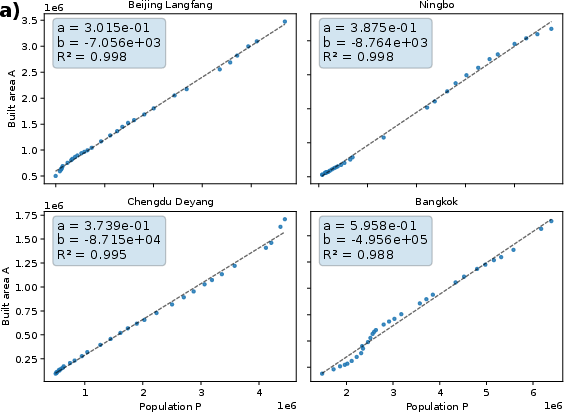
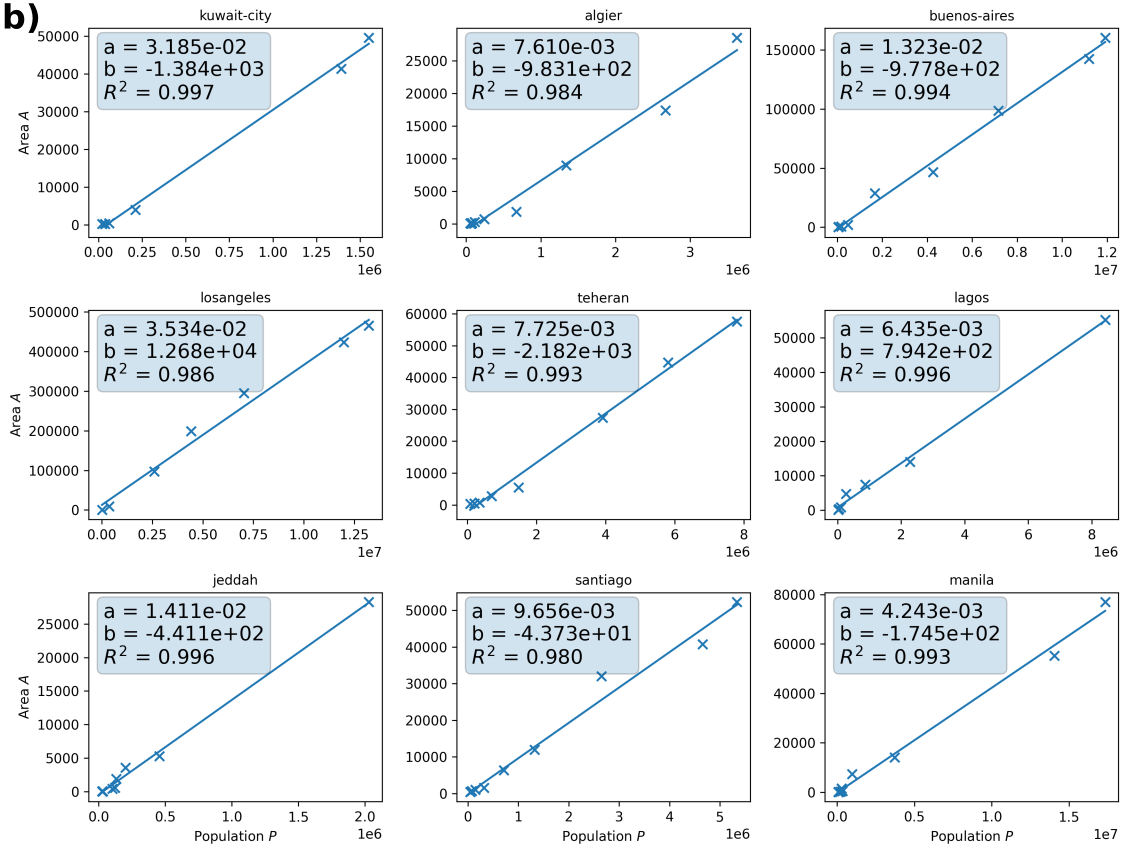
Figure 1: Examples of longitudinal linear dependency between area (P4) and population (P5) for multiple cities, confirming that city-specific trajectories are approximately linear or piecewise linear.
However, the transversal (cross-sectional) analysis provides exponents deviating markedly from unity. For 1985–2015, the measured exponents fall in the sublinear range (P6; see Figure 2), while for 1800–2000 they can be superlinear (P7). This discrepancy emerges despite essentially identical city-level longitudinal laws and is a direct consequence of intercity heterogeneity in P8, population distributions, and their nonlinear cross-sectional interactions.
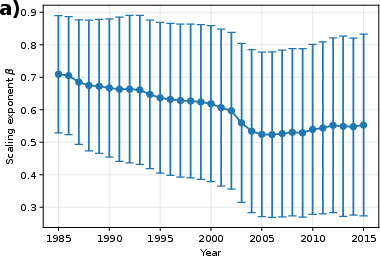
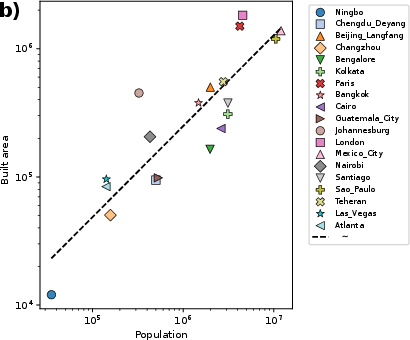
Figure 2: Temporal evolution and snapshot (1985) of the transversal area–population exponent, highlighting substantial deviation from unity and time-dependence unrelated to longitudinal dynamics.
The explicit decomposition of P9 (Figure 3) quantifies that these deviations are dominated by covariance terms, not the average city-level elasticity, and that the measured cross-sectional scaling law may not reflect any individual city’s history.
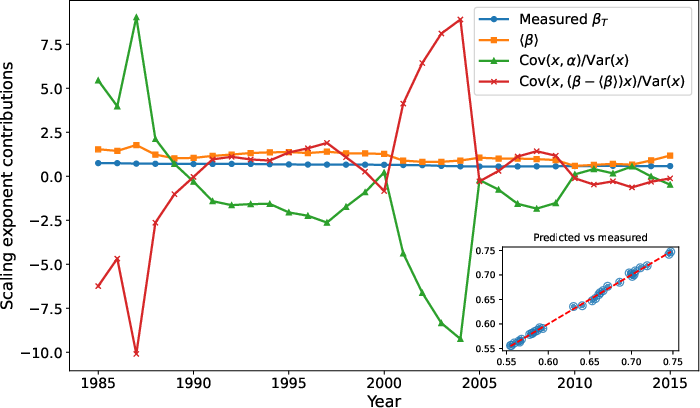
Figure 3: Statistical contributions to the transversal exponent, showing that the gap between transversal and average longitudinal exponent is explained by nontrivial covariance terms in the ensemble.
Wages and Social Quantities: Superlinear Transversal Scaling Decoupled from City Dynamics
Analysis of wage data across U.S. Metropolitan Statistical Areas (MSAs) further demonstrates the core thesis. Transversal fits consistently yield superlinear exponents (Y∼Pβ0), but city-level longitudinal exponents are both highly heterogeneous and generally much larger (Y∼Pβ1). The stability of the transversal exponent over time derives from consistent ensemble-level statistical structure, not universal city dynamics (Figure 4).
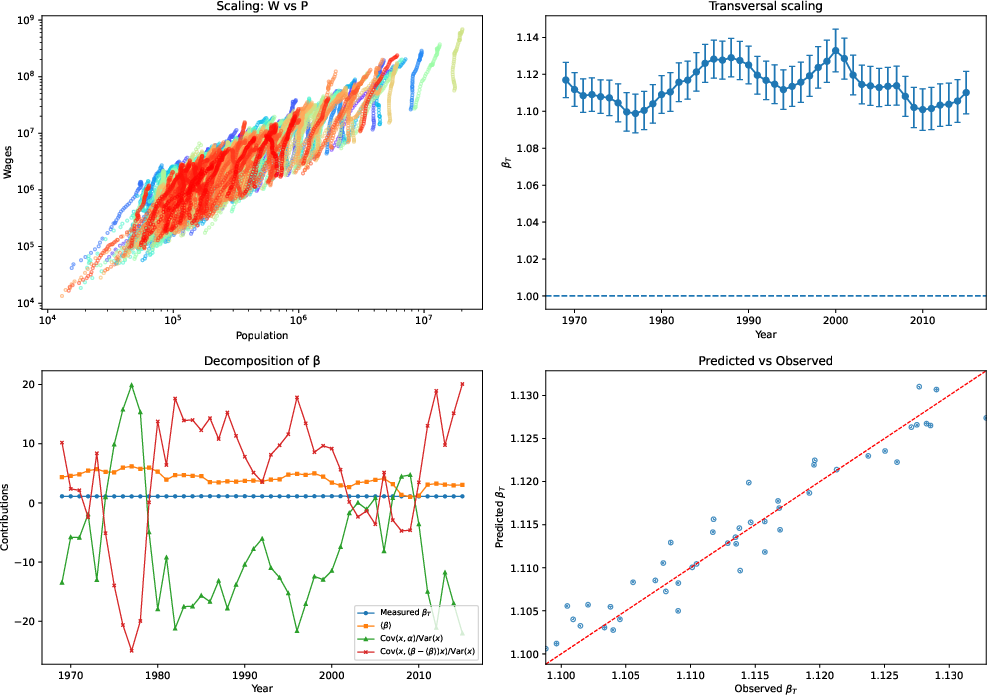
Figure 4: Wages: comparison of transversal exponents, longitudinal exponents, and decomposition, confirming the statistical—not dynamical—nature of the observed cross-sectional scaling.
Theoretical and Practical Implications
This analysis implies that transversal exponents widely reported in the urban scaling literature are generally not interpretable as dynamical laws or as proxies for city-level elasticity. Instead, they must be viewed as emergent ensemble properties—a function of city heterogeneity, path dependence, parameter correlations, and the statistical structure of the system. The existence of apparent super- or sublinear scaling in cross-sectional data can arise without any underlying nonlinear mechanisms at the level of cities. Therefore, inferring causal mechanisms or dynamical laws from Y∼Pβ2 is, in general, methodologically unsound unless the urban system is confirmed to be homogeneous, path-independent, and devoid of meaningful covariance effects.
Furthermore, the analytic approach adopted (covariance decomposition of Y∼Pβ3) provides a generalizable framework to disentangle ensemble-induced artefacts from true dynamical scaling, with implications for allometric studies in other domains (ecology, biology, economics).
Outlook and Future Directions
The separation of transversal and longitudinal scaling, systematically formalized here, calls for a shift in urban science toward greater emphasis on temporal city-level analysis. Future directions involve:
- Systematic collection of longitudinal (temporal) urban data to directly infer dynamical elasticities.
- Statistical and causal modeling of intercity heterogeneity, institutional, and geographical factors underlying diversity in city growth trajectories.
- Extension of the covariance decomposition approach to more complex urban metrics (e.g., emissions, innovation, infrastructure networks).
- Caution when generalizing from cross-sectional ensemble statistics to mechanistic urban models.
Conclusion
The paper provides compelling theoretical and empirical evidence that cross-sectional scaling exponents in urban systems should not be interpreted as city-level dynamical laws. The transversal exponent Y∼Pβ4 is shaped by ensemble statistics, covariances, and path dependence, and its value may be entirely disconnected from the actual longitudinal behavior of individual cities. These results necessitate a reevaluation of the interpretation of urban scaling laws in quantitative urban science, advocating for methodological rigor and caution in inferring mechanisms from ensemble summary statistics.