- The paper introduces the 'funbin' method that adapts arbitrary polygon shapes to data for enhanced conceptual alignment.
- It employs various aperiodic tilings and geographic mappings in Python to capture hidden mathematical structures in complex datasets.
- The framework outperforms traditional methods by enabling tailored, domain-specific representations in fields like astrophysics and particle physics.
Novel Binning Methods for 2D Histograms: The "funbin" Approach
Motivation and Conceptual Foundations
The paper "Enabling fundamental understanding of Nature with novel binning methods for 2D histograms" (2603.30006) addresses the enduring limitations inherent in traditional 2D histogram visualization techniques, which conventionally employ rectangular or hexagonal bin shapes. Despite the ubiquity of these representations in scientific reporting and data analysis, they are often thematically, visually, and conceptually divorced from the natural phenomena they are intended to depict. The authors assert that this dissonance not only disrupts harmony between data and visualization but also perpetuates stagnation in the field.
The conceptual underpinning for their solution, the "funbin" method, is rooted in Hermetic, Paracelsian, and Kantian philosophical traditions. By invoking the principle of microcosm-macrocosm analogy—where scientific plots ("microcosm") should resonate with the entities under study ("macrocosm")—the authors justify the need for visually and conceptually unified bin shapes. They critique the prevalent C4 (square) and C6 (hexagonal) symmetries as unnatural and periodic, contrasting with the irregularity and aperiodicity characteristic of genuine physical systems.
Methodology and Implementation
The "funbin" method constitutes a Python package compatible with Matplotlib, facilitating the construction of 2D histograms using arbitrary polygonal bin shapes. The core algorithm consists of:
- Adapting polygons to the data bounding box via translation and scaling.
- Assigning data points to polygons using spatial indexing and point-in-polygon checks.
- Aggregating sample weights per polygon (with simple counting for unweighted data).
- Computing weight density by normalizing counts over polygon areas.
- Rendering polygons using density-based color mapping.
The package features algorithms for generating polygon sets corresponding to several binning strategies:
- Aperiodic Penrose tilings (P1, P2, P3) [Penrose1979],
- The recently discovered aperiodic monotile (einstein) [Smith2024],
- Stochastic or user-specified Voronoi diagrams [Voronoi1908],
- Geographic map outlines from GeoJSON [rfc7946].
Scientific Applications
The authors demonstrate the versatility and thematic resonance of "funbin" with datasets from astrophysics and particle physics. Aperiodic tilings, notably Penrose and monotile variants, not only break the repetitive monotony of periodic binnings but also facilitate visual connections to the objects studied, thus enhancing interpretability and conceptual unity.
Penrose Tilings in Stellar Evolution
A Hertzsprung-Russell diagram from the HYG stellar database is binned via Penrose P1 tiling, where each tile evokes salient stages or objects in stellar evolution—from pentagons for compact remnants to a literal "star" shape for active stars.
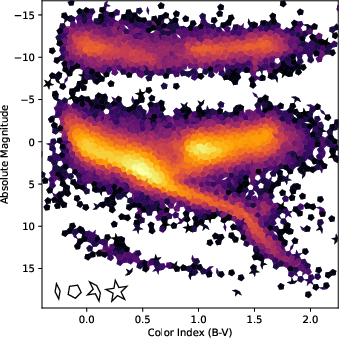
Figure 1: Hertzsprung-Russell diagram binned with Penrose P1 tiling, illustrating conceptually evocative mapping between stellar types and tile shapes.
The compositional granularity of tile shapes aligns symbolically with astrophysical classifications, providing both visual appeal and domain specificity.
Gravitational Wave Astronomy and Penrose P3
Posterior distributions of black hole masses from GW event GW191109_010717 are visualized using Penrose P2 tiling, highlighting emergent geometrical patterns and mathematical relationships, such as the golden ratio, which is both present in the data and encoded in the tiling's structure.
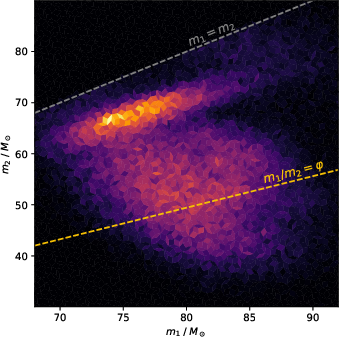
Figure 2: Posterior distribution of black hole masses binned with Penrose P2 tiling; emergent structures mirror mathematical features relevant to binary mergers.
Anomaly Detection in Collider Physics
Simulated jets from the LHCO2020 BlackBox1 dataset are binned with Penrose P3 tiling, exploiting dart and kite tile shapes to represent particle jet profiles, thereby offering an avenue for identifying visually distinct anomalies or structural motifs.
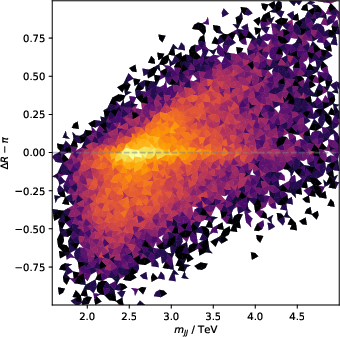
Figure 3: Two-jet invariant mass vs. separation binned via Penrose P3, providing geometric resonance with jet shapes.
Aperiodic Monotile and Pulsar Studies
The aperiodic monotile ("turtle" and "hat") enables binning of inherently aperiodic or periodic astrophysical phenomena. The P-P˙ diagram for pulsars, binned with the "turtle" monotile, captures the aperiodic nature of pulsar period decay.
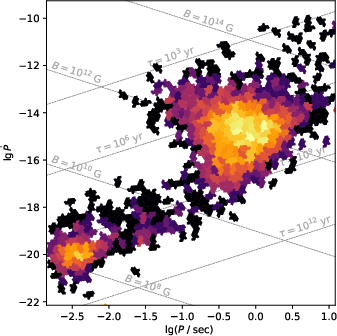
Figure 4: P-P˙ diagram for pulsars using "turtle" monotile binning, highlighting transition between periodic and aperiodic behaviors.
Gamma-ray counts from Fermi LAT around PSR J2032+4127 are visualized with the "hat" monotile, demonstrating adaptability to point-spread functions and irregular sky coverage.
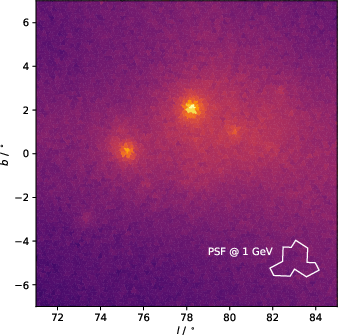
Figure 5: Fermi LAT gamma-ray counts binned with "hat" monotile, accommodating complex astrophysical emission structures.
World Map and Cosmology
For galactic mass distributions within 200 Mpc, "funbin" overlays stellar data onto Earth's political boundaries, integrating Mollweide projection and HEALPix subdivision for oceans. This cross-disciplinary mapping exemplifies microcosm/macrocosm synergy and alludes to epistemic frameworks (e.g., Kantian transcendentalism), as well as the speculative influence of geopolitical pixelation.
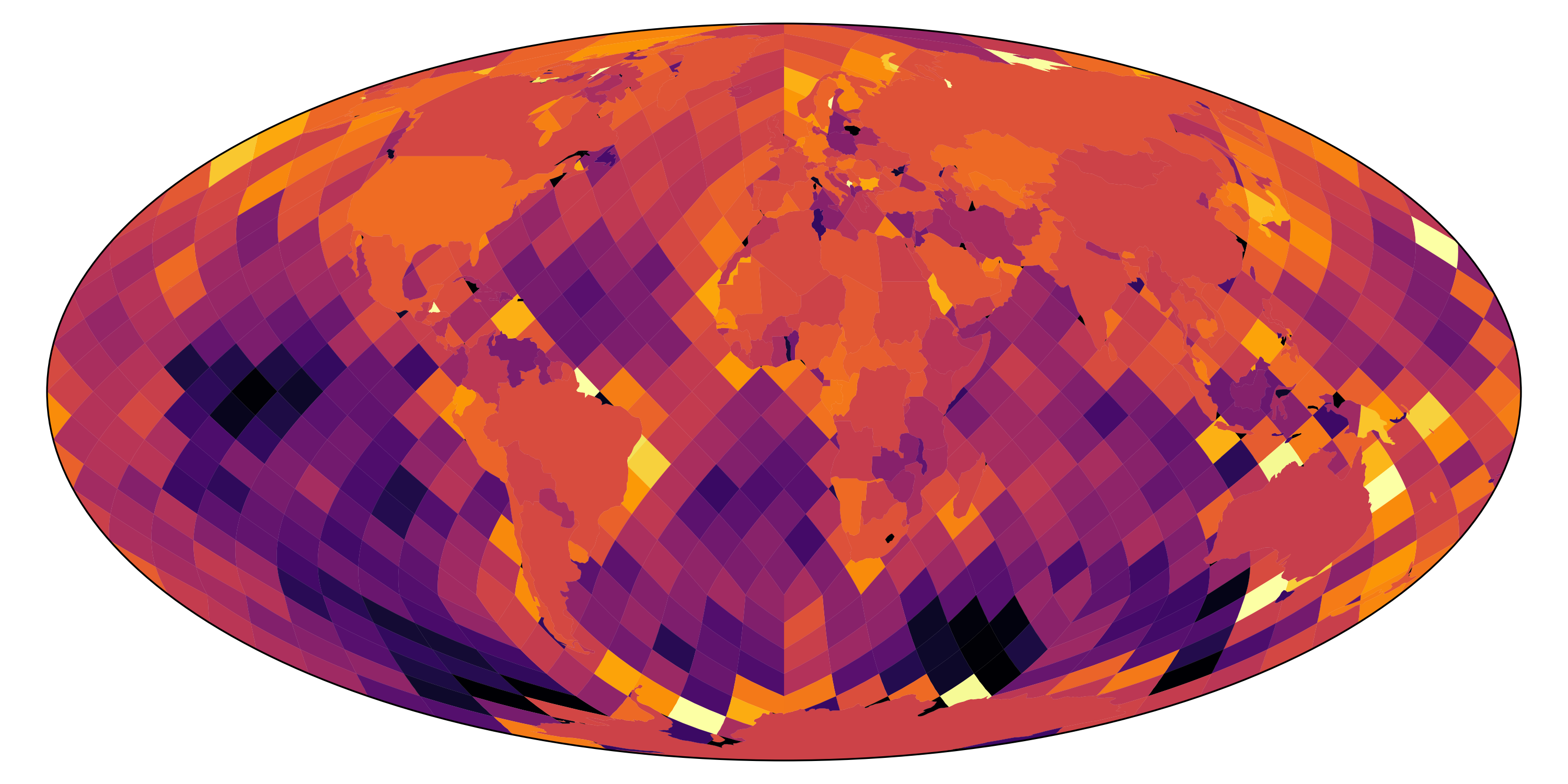
Figure 6: Local Universe galaxies binned with Earth’s countries and HEALPix ocean pixels, merging cosmological and geographical data.
Numerical Results and Claims
The paper reports that "funbin" consistently outperforms conventional methods across a broad spectrum of scientific tasks—including density estimation, conceptual resonance, and thematic unity—though quantitative benchmarks are not exhaustively detailed. Notably, emergent patterns (e.g., golden ratio alignment and higher-dimensional projection analogs) in posterior distributions are highlighted as otherwise inaccessible with standard binning.
Strong claims include:
- Periodic tilings are inherently incompatible with most natural distributions; aperiodic binning improves both conceptual relevance and discovery potential.
- Arbitrary polygonal binning exposes hidden mathematical structures and facilitates domain-specific visualizations unattainable with rectangular or hexagonal bins.
Contradictory claims are not explicitly present; rather, the argumentation is cumulative and philosophical, favoring the "funbin" approach as logically superior given its thematic flexibility and generality.
Practical and Theoretical Implications
Practically, the "funbin" framework enables domain experts to encode physical, mathematical, or sociopolitical structures directly into their visualizations. This not only aids data interpretation but also provides new venues for anomaly identification and scientific insight. Theoretically, the approach foregrounds the importance of epistemic visualization—questioning and expanding conventional paradigms for representing data in science.
Given the flexibility and adaptability of the "funbin" package, potential future developments include:
- Integration with machine learning workflows for automated discovery of optimal bin shapes,
- Expansion to higher-dimensional binning and visualization,
- Systematic benchmarking against state-of-the-art density estimators and anomaly detectors,
- Broader adoption in fields ranging from geosciences to high-energy physics.
Conclusion
The introduction of "funbin" marks a substantive methodological advance in scientific data visualization, facilitating arbitrary binning in 2D histograms with explicit philosophical and thematic alignment to underlying phenomena. By leveraging a wide array of polygonal tilings—including aperiodic and geographic patterns—"funbin" addresses long-standing conceptual limitations in conventional visualization techniques. Its demonstrated utility in astrophysics, particle physics, and cosmology highlights practical benefits and theoretical ramifications, suggesting further research avenues in the optimization and epistemology of scientific plotting.