- The paper shows coherent, all-optical control of transient spin polarization in RuO₂ through polarization-dependent excitation.
- It employs ultrafast tr-MOKE with 40 fs pulses to map Kerr rotation dynamics and extract Raman coherence times of 4.5–7 fs.
- The study highlights substrate-induced anisotropy and symmetry-driven spin splitting, informing scalable spintronic device design.
Femtosecond All-Optical Coherent Control of Spin Polarization in Altermagnets
Introduction and Context
The emergence of altermagnetic materials has redefined paradigms in spintronics by coupling fully compensated magnetic order with robust, ferromagnet-like spin splitting in the electronic band structure. The distinct symmetry of altermagnets produces unconventional phenomena, such as non-relativistic momentum-dependent spin polarization in the absence of net magnetization, circumventing PT-symmetry limitations that constrain traditional collinear antiferromagnets. The central aim is to exploit these peculiar band and spin properties for next-generation energy-efficient, scalable spintronic devices, extending capabilities into magnetoresistive memory, logic, and neuromorphic hardware.
RuO2 has attracted significant focus as a prototypical d-wave altermagnet, but the existence and robustness of its magnetic ordering remain contentious, as experimental signatures are highly sensitive to film thickness, substrate choice, strain, and growth conditions. The present work implements ultrafast, polarization-resolved time-resolved magneto-optical Kerr effect (tr-MOKE) spectroscopy to interrogate the spin dynamics of RuO2 thin films. The study delivers direct evidence for coherent, optically induced, transient spin-polarized states—elucidating their formation mechanisms, symmetry dependencies, and intrinsic timescales.
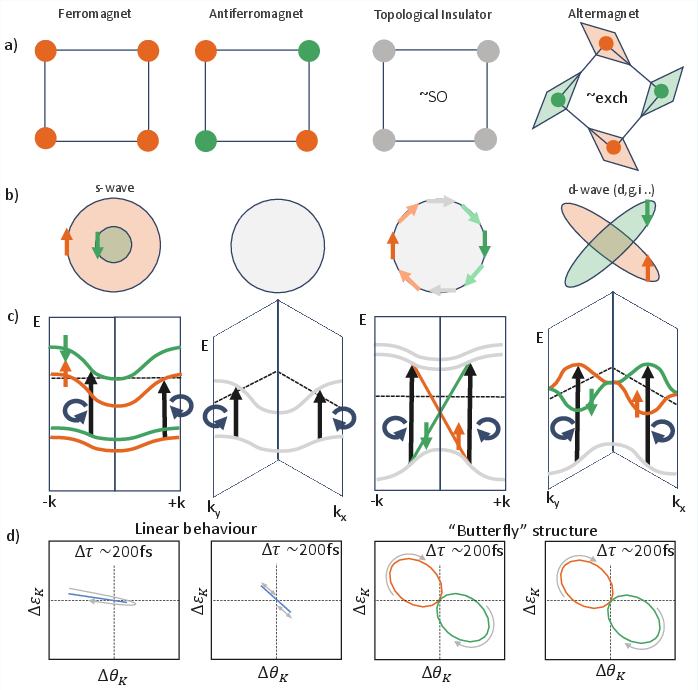
Figure 1: Crystal/magnetic structures, Fermi surfaces, selective optical excitation scheme, and distinct ultrafast Kerr dynamics (including "butterfly" structure) in ferromagnets, antiferromagnets, topological insulators, and altermagnets.
Experimental Methodology
The investigation utilizes 20 nm RuO2 films (Pt capped) on MgO(001) and TiO2(110) substrates, enabling control over crystal orientation, strain, and domain structure. The experimental geometry features precise sample rotation, mapping spin dynamics as a function of the azimuthal angle α, capturing the underlying band anisotropy and magnetic domain effects.
Ultrafast optical excitation is provided by a 40 fs, 800 nm Ti:Sapphire laser, with polarization carefully chosen among linear (π) and left/right circular (σ±) bases. The detection scheme involves double modulation to enhance signal fidelity, distinguishing real (ΔθK) and imaginary (ΔϵK) components of the complex Kerr rotation.
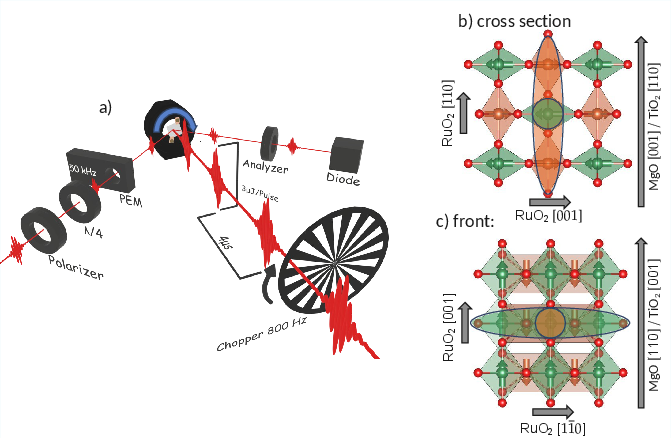
Figure 2: Double-modulation femtosecond tr-MOKE setup and RuO2/substrate crystallographic configuration.
Ultrafast Spin Coherence and Kerr Response
A pronounced, helicity-sensitive coherent Kerr signal is observed exclusively under circularly polarized excitation, with the following key features:
- Temporal structure: The circularly pumped response exhibits a pronounced asymmetric peak-dip sequence with rapid (20200 fs) rise and decay, in contrast to the much slower, weaker response for linear excitation.
- Coherent dynamics: The real and imaginary Kerr components are not synchronized but exhibit a relative time delay, yielding characteristic closed "butterfly" loops in the complex plane during the initial ultrafast excitation window.
- Magnitude and speed: The response to circular polarization is an order of magnitude larger and peaks 21100 fs earlier than the linear response, affirming selective population of spin-polarized bands through angular-momentum transfer from the pump's helicity.
This phenomenology is parametrized by a Raman coherence time 22–7 fs, extracted via analytic fits of the observed Kerr dynamics based on four-level spin-orbit split band models. The presence of the butterfly structure and finite 23 align with predictions for materials possessing momentum-dependent, spin-split bands—corroborated previously in topological insulators and now detected in an altermagnetic system.
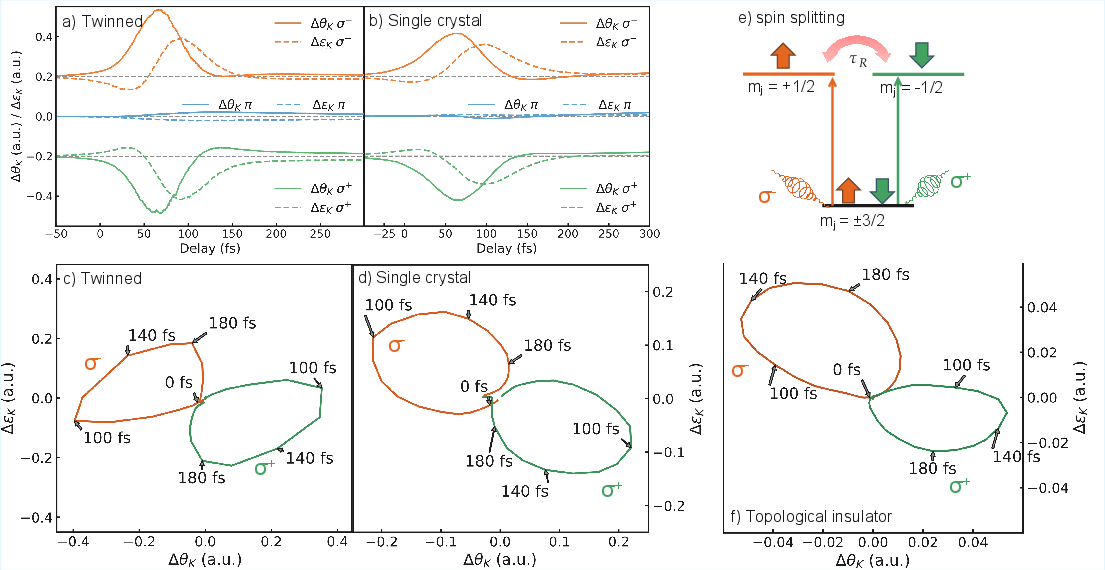
Figure 3: Time-resolved real and imaginary Kerr angle dynamics for RuO24/MgO and RuO25/TiO26 under various pump polarizations, and "butterfly" patterns in the complex plane.
Symmetry, Substrate Effects, and Angular Mapping
Sample rotation scans reveal that the induced Kerr response exhibits dominant twofold periodicity as a function of the crystalline azimuthal angle 27, reflecting the intrinsic d-wave symmetry of RuO28 spin-split bands:
- MgO substrate (twinned domains): The observed signal amplitude follows a 29 modulation, consistent with in-plane anisotropy imposed by twinning and substrate-induced domain configuration.
- TiO20 substrate (single crystal): The Kerr polarity exhibits sharp sign reversals upon 9021 rotation, indicating uncompensated population transfer between orthogonal spin-split domains, closely tracking the calculated switching of the Néel vector and spin texture.
The complex-plane analysis demonstrates that, along high-symmetry crystal directions, the butterfly orientation and handedness switch predictably as 22 is varied, reflecting the underlying topology of the RuO23 spin-split bands.
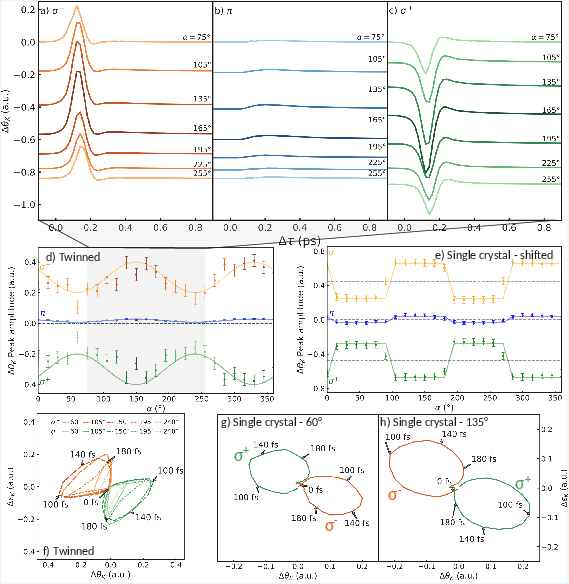
Figure 4: Angular- and polarization-resolved Kerr dynamics, symmetry analysis of transient spin polarization, and evolution of butterfly structures across rotation angles.
Sample Characterization and Structural Considerations
X-ray diffraction and reflectivity measurements confirm high-quality crystalline growth of RuO24 films on both MgO and TiO25, with well-defined Pt capping and low interface roughness. Structural analysis provides direct information on twinning, mosaicity, and possible secondary phase contributions, supporting the attribution of observed Kerr effects to intrinsic RuO26 properties rather than extrinsic defects.
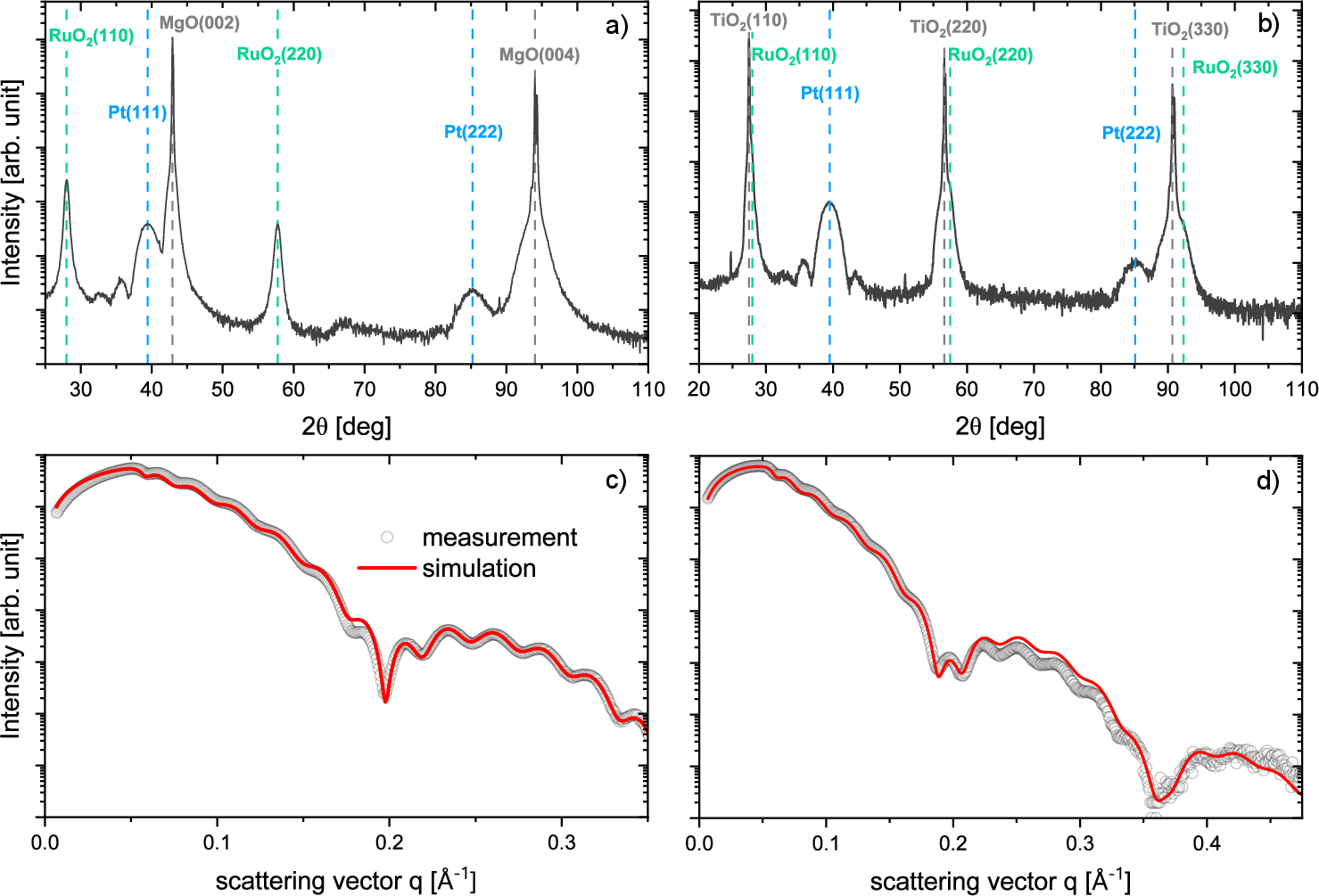
Figure 5: X-ray diffraction and reflectivity data for RuO27 films on MgO and TiO28, confirming structural integrity and phase purity.
Implications and Outlook
The demonstration of ultrafast, all-optically controlled, coherent spin polarization in RuO29 constitutes compelling evidence for the existence of spin-momentum locked, surface-localized transient states arising from altermagnetic band splitting. The measured Raman coherence times are of the same order as, but somewhat shorter than, those observed in topological insulators and oxide Mott systems, likely reflecting strong 20-orbital mixing and enhanced scattering rates in RuO21.
These results imply:
- Functional control: The ability to trigger and reversibly control ultrafast spin polarization on the femtosecond timescale via optical helicity is highly relevant for non-contact, energy-efficient spin injection and manipulation in device architectures where electrical access is limited or undesirable.
- Metrology advance: The tr-MOKE methodology and the "butterfly" coherence signature presented establish a rapid, contactless approach to benchmarking spin-split bands and coherence properties in emergent altermagnetic materials.
- Substrate engineering: The pronounced dependence on the substrate and orientation corroborates the delicate balance of strain, domain formation, and surface effects in maximizing the altermagnetic ordering, highlighting pathways for engineering spintronic materials with tailored coherence and anisotropy.
From a theoretical perspective, the connection between symmetry-protected spin textures and coherent all-optical control extends the understanding of light–matter interaction beyond the field of conventional ferromagnets and antiferromagnets, informing the design of new quantum materials where non-relativistic mechanisms can be harnessed for information processing.
Conclusion
Ultrafast time-resolved MOKE measurements of RuO22 demonstrate femtosecond all-optical coherent control of transient spin polarization, substantiating the existence of symmetry-driven, momentum-dependent spin-polarized surface states characteristic of d-wave altermagnets. These results resolve aspects of the debate over altermagnetism in RuO23, establish robust methods for benchmarking spintronic functionality in complex oxides, and open routes for exploiting coherent optical control in the next generation of ultrafast spintronic technologies.