- The paper shows that chaos is not required for macroscopic thermalization, as dephasing in high-dimensional integrable systems suffices to achieve equilibrium behavior.
- Dynamical analysis reveals that aggregation of extensive observables and large system size enable convergence to Maxwell-Boltzmann distribution even in non-chaotic regimes.
- A weakly nonlinear FPUT model illustrates that chaos speeds up thermalization but remains secondary to the role of collective observables and system size for achieving equipartition.
Thermalization in High-Dimensional Systems: Revisiting the Role of Chaos
Introduction and Conceptual Framework
The paper "Thermalization in high-dimensional systems: the (weak) role of chaos" (2603.29614) systematically analyzes the mechanisms underpinning thermalization in macroscopic Hamiltonian systems and critically examines the necessity of chaos for the emergence of statistical mechanical behavior. The authors focus on both integrable (harmonic) and weakly non-integrable (FPUT-like) oscillator chains, exploring the dynamics of relaxation to equilibrium for various classes of extensive observables under nonequilibrium initial conditions.
The discussion is anchored in the foundational debate on the relevance of chaos, ergodicity, and the large N limit for the validity of statistical mechanics (SM). Three traditional perspectives are contrasted: (1) the dynamical/chaos-based view, (2) the maximum entropy approach, and (3) the Boltzmann-Khinchin framework, where the main ingredients are the system's dimensionality and the choice of collective (extensive) observables. The authors pursue a detailed dynamical analysis aligned with the latter viewpoint, extending Khinchin's typicality arguments to nonequilibrium scenarios and dissecting the subtleties that arise for both integrable and chaotic dynamics.
Irreversibility Without Dynamical Chaos
The authors construct analytical and numerical paradigms that demonstrate macroscopic irreversibility for physically relevant observables in the absence of chaos. These comprise both exactly solvable models (e.g., the Kac ring and Ehrenfest dog-flea model) and high-dimensional integrable systems.
A paradigmatic illustration is given by the non-interacting ("non-chaotic") piston problem: when initialized far from equilibrium, the collective variable representing the macroscopic piston position relaxes to its equilibrium value with damped oscillations and microscopic fluctuations that scale down with N. The same qualitative behavior is observed whether or not the underlying many-body dynamics is chaotic. The essential mechanism is a dephasing—effective randomization due to heterogeneity of mode frequencies or indirect couplings—which becomes dominant for N≫1.
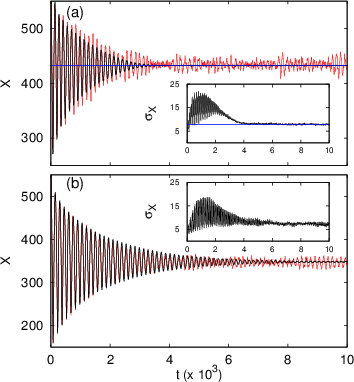
Figure 1: X(t) for N=1024 and initial displacement X(0)=Xeq+10σeq, showing relaxation and small fluctuations around the equilibrium piston position both for chaotic and non-chaotic systems.
This result underlines the lack of necessity for microscopic chaos for macroscopic irreversibility—provided the observables are sufficiently collective and the system is initialized far from equilibrium.
Integrable Chains: Dephasing and Observable-Dependent Thermalization
The analysis is extended to high-dimensional harmonic chains, which are fully integrable and thus trivially non-ergodic. For specific observables, even when prepared in out-of-equilibrium states with all energy localized in a subset of degrees of freedom, the evolution leads to precise agreement with equilibrium SM predictions. The primary dynamical mechanism is phase randomization (dephasing) among normal modes, and the characteristic relaxation time grows linearly with system size N.
This is quantitatively demonstrated using the Kullback-Leibler divergence K[Pe(p,t)∣PMB] between the empirical momentum distribution and the Maxwell-Boltzmann equilibrium, which decays to zero as t→∞, with a relaxation timescale ∼N.
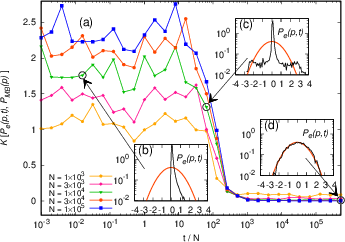
Figure 2: Kullback-Leibler divergence N0 as a function of N1 for different N2, showing linear scaling of relaxation times; lower panels display convergence of the momentum distribution to Maxwell-Boltzmann for N3.
The convergence to equilibrium holds for observables constructed as collective sums over a large fraction of the system—consistent with Khinchin's notion of "typicality" in high dimensions. Nevertheless, for functionals depending on integrals of motion (such as the energy in a single normal mode) or other non-extensive observables, the system does not thermalize. This observable-dependence marks a crucial limitation of both integrability and typicality concepts.
Thermalization and Energy Equipartition in the FPUT Model
To assess the effect of weak chaos, the FPUT chain with quartic anharmonicity is studied. In the weakly nonlinear regime, the system remains in a long-lived metastable state mimicking the integrable limit—prethermalization—before mode interactions induce a slow evolution towards genuine equipartition, in agreement with equilibrium SM for all extensive observables.
The analysis involves tracking time-averaged on-site energies and their components. For harmonic chains, these quantities relax to ensemble predictions for typical initial conditions. However, for atypical initial conditions (e.g., all energy in a single site), long-time averages deviate from thermal values, instead displaying equipartition without thermalization for specific observables. The inclusion of nonlinear terms in the FPUT system restores true thermalization for all observables, but on timescales highly sensitive to both N4 and the initial condition—often much longer than observation windows.
Figure 3: Kullback-Leibler divergence N5 for the FPUT chain, illustrating the slow relaxation and the difference in timescales with increasing N6.
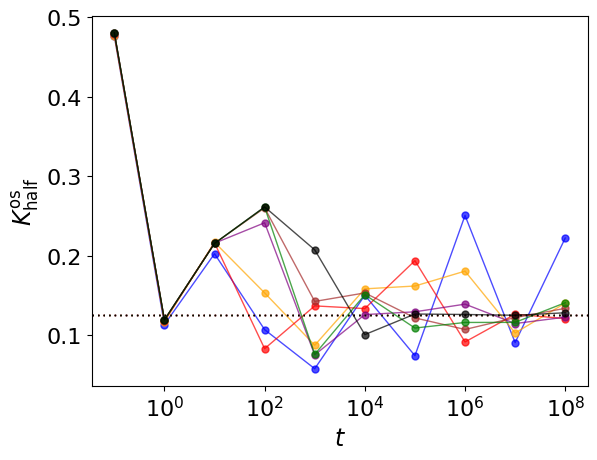
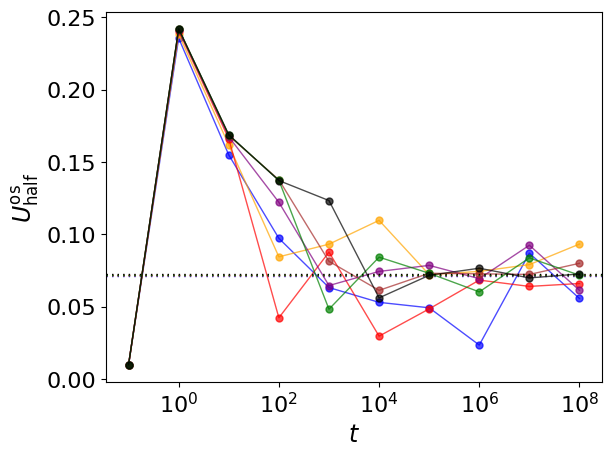
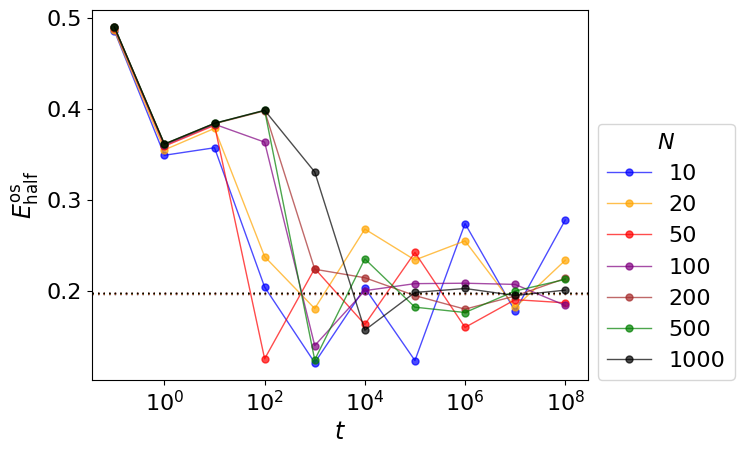
Figure 4: Evolution of the half-chain on-site energy N7 and its kinetic and potential contributions as a function of time for various N8, demonstrating decay of fluctuations and approach to equilibrium.
This slow prethermalization-to-thermalization transition supports the conclusion that chaos is sufficient but not necessary for macroscopic relaxation; more fundamentally, the large N9 limit and the focus on physically meaningful observables are the essential criteria.
Characteristic Timescales and Practical Implications
The paper quantifies the scaling of relaxation times in both integrable and weakly chaotic regimes. In the pure FPUT case, for standard initial conditions, relaxation to equipartition exhibits a power-law scaling with system size and specific energy, rejecting any universal exponential scenario. This further diminishes the practical role of chaos as a required ingredient for equilibrium properties in macroscopic systems.
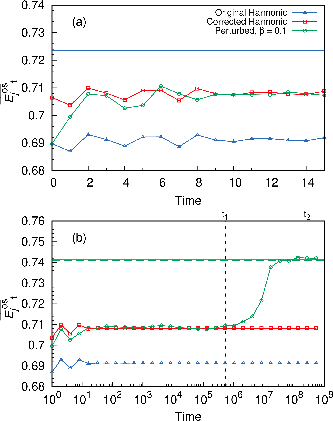
Figure 5: Time average of the observable N≫10 as a function of time and N≫11, illustrating the scaling and universality of macroscopic relaxation even with varying chain length.
These findings bear significant implications:
- For experimental and computational studies, the identification of the relevant observables and the recognition of metastable (prethermal) states is critical for accurate interpretation.
- For theoretical SM, the results reinforce the Khinchin/typicality paradigm, where chaos and ergodicity play a limited or delayed role in nonequilibrium relaxation in the thermodynamic limit.
Conclusion
The study provides robust evidence that the traditional linkage between chaos and the emergence of irreversibility and thermalization in macroscopic systems is not fundamental. The large number of degrees of freedom and the collective character of the relevant observables are the key factors controlling relaxation to equilibrium. Weak chaos, introduced via anharmonic perturbations, is sufficient to eventually ensure thermalization for all observables, but plays a secondary, rate-determining role, particularly for persistent metastable regimes.
These insights refine the foundations of nonequilibrium statistical mechanics and motivate future work on nonequilibrium relaxation in both classical and quantum many-body systems, with a focus on the interplay between system size, choice of observable, and microscopic dynamics [Cattaneo et al., Phys. Rev. Research 7, L032002 (2025)]. The practical import spans from the analysis of large-scale simulations (where observation time is finite and system size is large) to the modeling of high-dimensional quantum systems, including those relevant in contemporary AI hardware and information processing.
References:
- M. Baldovin, M. Cattaneo, D. Lucente, P. Muratore-Ginanneschi, and A. Vulpiani, "Thermalization in high-dimensional systems: the (weak) role of chaos" (2603.29614).
- M. Cattaneo et al., "Thermalization is typical in large classical and quantum harmonic systems," Phys. Rev. Research 7, L032002 (2025).

