- The paper shows a significant decadal rise in Sgr A* mass at roughly 0.06×10^6 M⊙ per year using a linear evolution model with outlier control.
- The analysis reveals an anomalous deceleration of the Galactic bar, with pattern speed decreasing by about 1 km s⁻¹ kpc⁻¹ yr⁻¹, far exceeding standard predictions.
- A piecewise-linear shift in the Sun–Galactic Centre distance indicates rapid orbital repositioning, suggesting global resonance effects driven by SIDM core collapse.
Secular Evolution of the Milky Way on Human Timescales
Introduction
"Milky Way evolution on a human timescale" (2603.29503) addresses a fundamental limitation in galactic astronomy: the inability to directly observe the temporal evolution of galactic-scale properties owing to their canonical Myr-Gyr dynamical timescales. Contravening standard expectations, this work conducts a quantitative meta-analysis of archival measurements over the past several decades for three canonical Milky Way parameters—the SMBH mass at Sgr A⋆, the pattern speed of the Galactic bar, and the Sun-Galactic Centre distance—arguing that all three exhibit statistically significant secular evolution on timescales of mere decades. Theoretical implications are discussed, with a strong emphasis on self-interacting dark matter (SIDM) core collapse driving synchronous evolution of these parameters.
Time Evolution of the Central Black Hole Mass
A comprehensive compilation of approximately 30 independent Sgr A⋆ mass measurements over the last 30 years indicates a robust and monotonic secular increase rather than the expected stationary value. The analysis employs a mixture likelihood model to demonstrate that the probability the sequence is consistent with a constant SMBH mass is exceedingly small: χ2/d.o.f.\ >10. Models introducing flexible error inflation fail to reconcile the chronology of improved measurements and demand unphysical error bars. By contrast, a linear time evolution model with outlier control provides superior statistical likelihood, isolating the growth at ∼0.06×10⁶M⊙ yr−1.
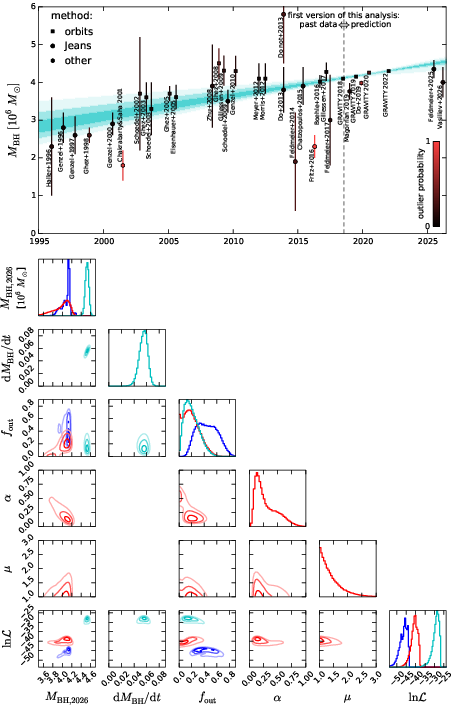
Figure 1: Decadal evolution of Sgr A⋆ mass, with cyan region denoting linear fit including outliers; lower panels provide the posterior distributions for constant, error-inflated, and linearly evolving mass models.
This rate, if sustained, implies orders-of-magnitude mass growth on astrophysically short timescales, achieving MBH∼107M⊙ in less than a century and MBH∼1011--1013M⊙ in ⋆0--⋆1 years. Super-Eddington baryonic accretion is excluded due to violation of radiative limits by many orders of magnitude. Theoretical plausibility is only restored for a SIDM scenario experiencing core collapse, in which central DM densities rise dramatically, boosting accretion to the requisite rates. This scenario obviates the radiative feedback constraint applicable for baryonic inflows and aligns with certain models of early SMBH formation in high-⋆2 quasars.
Rapid Deceleration of the Galactic Bar
A systematic reanalysis of the pattern speed (⋆3) literature, using consistent mixture models, reveals a strong, statistically significant secular decrease in bar angular velocity. The inferred deceleration rate, ⋆4 km\,s⋆5\,kpc⋆6\,yr⋆7, exceeds standard predictions from dynamical friction by ⋆8 orders of magnitude. Notably, measurements of both the pattern speed and the bar's major axis orientation support the same trend.
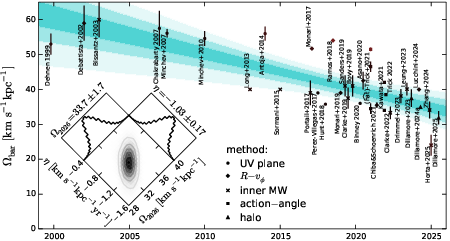
Figure 2: Decadal compilation of bar pattern speed measurements confirms a statistically significant monotonic slowdown.
Additional investigation using time-sequenced artistic reconstructions, informed by survey data, reveals a paradoxical backward rotation of the bar with respect to Galactic rotation, with angular offsets decreasing from ⋆9 to χ2/0 in just 15 years—a rate vastly discrepant relative to standard corotating resonance migration.
The link to DM-driven processes again emerges. Under the SIDM core-collapse hypothesis, the rapidly increasing central density would dramatically enhance dynamical friction, providing a feasible mechanism for such anomalously high bar deceleration rates and potentially pathological resonant migration.
Secular Change in Sun–Galactic Centre Distance
A meta-study of the Sun–Galactic Centre distance (χ2/1) measurements since the 1980s finds a piecewise-linear trend: an initial inward migration (60 pc yrχ2/2) transitions circa 2000 to an even more rapid apparent outward migration (23 pc yrχ2/3). While these values far exceed expectations based on Solar epicycle theory and violate local kinematic constraints and even special relativity (given that χ2/4 pc yrχ2/5), the authors note that, within the context of global resonance sweeps and systemic frame conventions, the measurements are internally self-consistent.
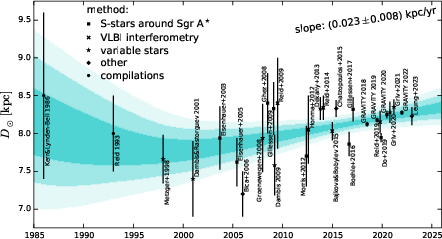
Figure 3: Meta-analysis of four decades of Sun–Galactic Centre distance measurements; post-2000 outward migration is unambiguously detected at χ2/6.
It is proposed that both the initial inward drift and rapid outward transition are driven by the same processes as for Sgr Aχ2/7 and the bar, namely the centralization of mass and migration of strong dynamical resonances in the disk, which would rapidly sweep stellar orbits and produce global rearrangement observable in χ2/8.
Theoretical and Practical Implications
The paper advances the bold claim that multiple independent Galactic parameters are evolving on observable decadal timescales, implying that the canonical paradigm of Galactic evolution as a quasi-static process is no longer tenable. If corroborated, the results necessitate:
- Reconsideration of static equilibrium-based Galactic structure inference, including mass models and dynamical measurements derived from assumption of long term stationarity.
- Substantial modification of SIDM phenomenology, as such rapid central condensation and resultant nonlinear baryonic responses have far-reaching consequences for both Milky Way-specific and general galaxy evolution theory.
- A global interpretation of secular parameter migration as inherently coupled via feedback between baryons and nonstandard DM microphysics.
Practically, continued monitoring of these parameters using missions like Gaia and advanced IR interferometry may further resolve secular trends, support or falsify the SIDM-induced acceleration scenario, and provide real-time insights into hitherto ultra-long-term processes.
Conclusion
"Milky Way evolution on a human timescale" (2603.29503) presents a high-confidence, meta-analytic argument for rapid, secular drift in three central Milky Way parameters. The hypothesis of an ongoing SIDM core collapse provides a unifying physical origin, but generates numerous paradoxes and demands reevaluation of Milky Way and generic galaxy evolutionary timescales. Future instrumental advances and theoretical work aimed at multiparametric, time-resolved Galactic dynamics will be essential to rigorously test or refute the claims set forth.