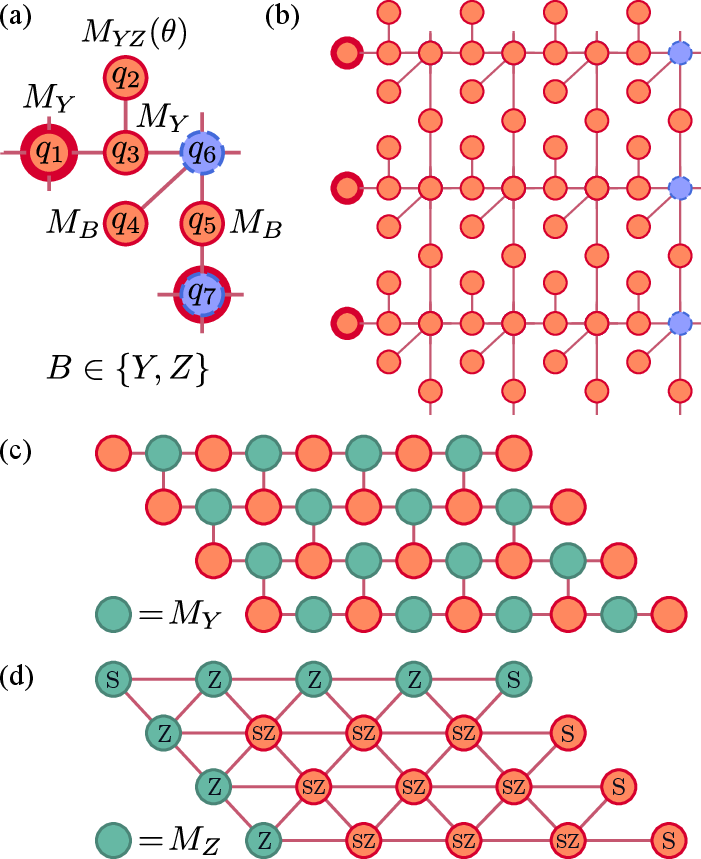
- The paper reveals that YZ-plane MBQC, structured as register-logic graphs, ensures deterministic computation with coinciding inputs and outputs.
- It demonstrates that universality is achieved by employing Pauli flow and adaptive corrections to compile a universal gate set on planar architectures.
- The work bridges theory and practice by linking RL graphs with Parity Architecture, guiding efficient designs for hardware-constrained quantum processors.
Universality and Parity Architectures in YZ-Plane Measurement-Based Quantum Computation
Introduction and Context
The paradigm of measurement-based quantum computation (MBQC) leverages single-qubit measurements on entangled resource states—graph states—to realize quantum algorithms. Historically, universality proofs and practical implementations have revolved around specific measurement planes, notably the XY plane, on particular graph topologies such as the rectangular cluster state. A longstanding question is the role of other principal planes in the Bloch sphere, specifically the YZ plane, and their expressive power for MBQC. The paper "YZ-plane measurement-based quantum computation: Universality and Parity Architecture implementation" (2603.29379) offers a definitive answer: it characterizes the precise circumstances where YZ-plane-only MBQC realizes universality and embeds these insights into hardware-efficient architectures via the Parity Architecture framework.
The work begins with a structural result anchored in the notion of gflow—the correction strategy that ensures uniform determinism (i.e., deterministic evolution regardless of individual measurement outcomes). Focusing on open graphs where the set of input qubits coincides with the set of output qubits (I=O), the authors show that deterministic MBQC patterns measured exclusively in the YZ plane are feasible if and only if the underlying graph is of the register-logic (RL) form: the subgraph induced on non-outputs has no internal edges, and each non-output qubit (node) connects only to outputs.
This is formalized as follows: if a measurable pattern is uniformly deterministic and involves YZ-plane measurements, then the input and output sets must coincide, and the open graph must be RL. Conversely, any RL graph with all non-outputs measured in the YZ plane and I=O admits gflow and thus uniform determinism.
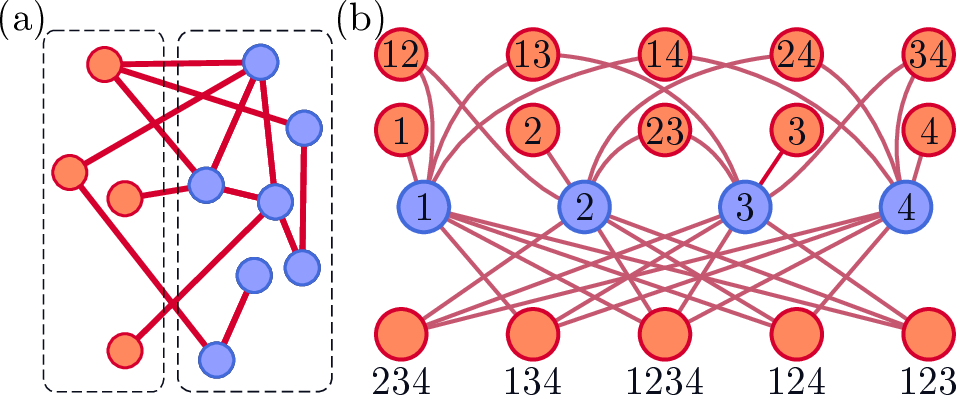
Figure 1: (a) General RL graph with outputs as nodes in the right box; (b) bRL graph for unitaries diagonal in Z.
This strictly limits the nontrivial MBQC patterns in the YZ plane under strong determinism to diagonal unitaries in the computational (YZ0) basis. The absence of universality in this regime echoes similar 'no-go' theorems established for certain classes of real MBQC on bipartite graphs [perdrix_determinism_2017].
Parity Architecture: Mapping Parity Computation to MBQC
The RL structure aligns naturally with the Parity Architecture [lechner_quantum_2015, fellner_universal_2022], an approach to parity-based quantum computing wherein multiqubit parity constraints enable the reduction of circuit depth and hardware connectivity requirements. The mapping is explicit: each non-output (parity) qubit mediates a controlled-phase gate (diagonal in YZ1) on a subset of the output (base) qubits. This correspondence is represented by associating parity labels with parity qubits, which reflect the subset of base qubits they couple.
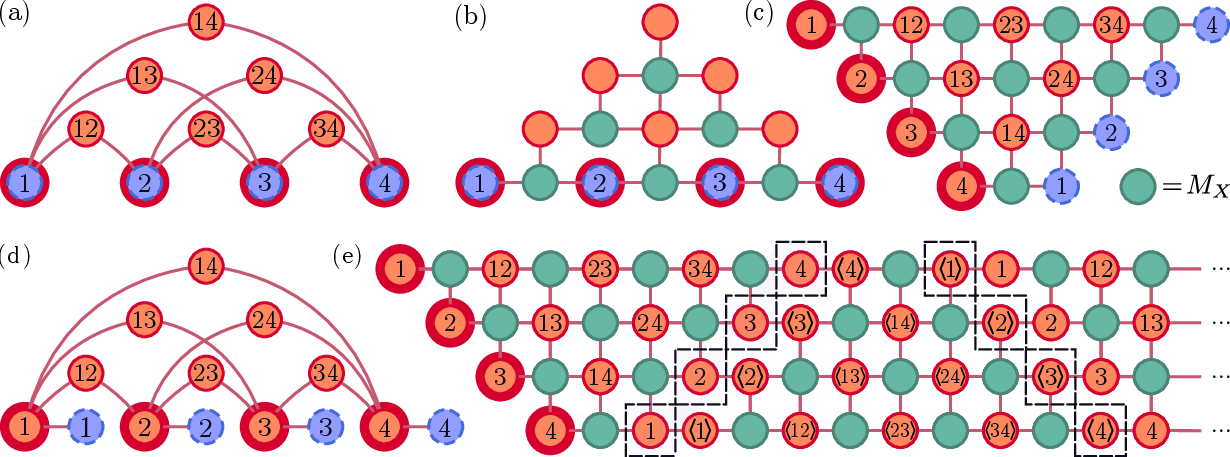
Figure 3: (a) MBQC representation of the LHZ triangle encoding; (b)-(e) Lattice transformations to local, hardware-constrained graphs supporting parity-based MBQC.
The work details how the LHZ-encoded triangular cluster, when subjected to systematic measurements (particularly in the YZ2 basis on one sublattice), yields RL graphs (LHZ triangles) supporting the Parity Architecture's native gates. Further, they show that attaching 'beveled' clusters allows separation of inputs and outputs—crucial for practical implementations where coherence times limit the lifetime of quantum information.
In large-scale layouts, alternating beveled clusters correspond to an alternation between layers diagonal in YZ3 and YZ4, thereby supporting the construction of universal gate sets when supplemented by suitable resource states and measurement choices.
Relaxed Determinism: Pauli Flow and Universality with YZ5-plane Measurements
By relaxing from uniform determinism (gflow) to the more general Pauli flow, the authors demonstrate that universal quantum computation becomes possible with YZ6-plane-only measurements. Pauli flow accommodates a richer set of correction strategies, allowing the construction of universal MBQC patterns that do not require all inputs to coincide with outputs.
The paper provides two orthogonal universality constructions:
These constructions highlight both gate set expressiveness and the flexibility of MBQC correction strategies when uniform determinism is no longer required. Importantly, they clarify that the non-universality observed under gflow does not limit the capability of YZ3-plane-only MBQC in the Pauli flow regime.
Structural and Theoretical Implications
These results complete the landscape of MBQC universality classifications with principal-plane measurement restrictions. The YZ4-plane (on square clusters) [mantri_universality_2017], YZ5-plane (on triangular clusters) [mhalla_graph_2012], and now YZ6-plane (on hexagonal and related clusters) all admit universal MBQC when determinism criteria are carefully considered.
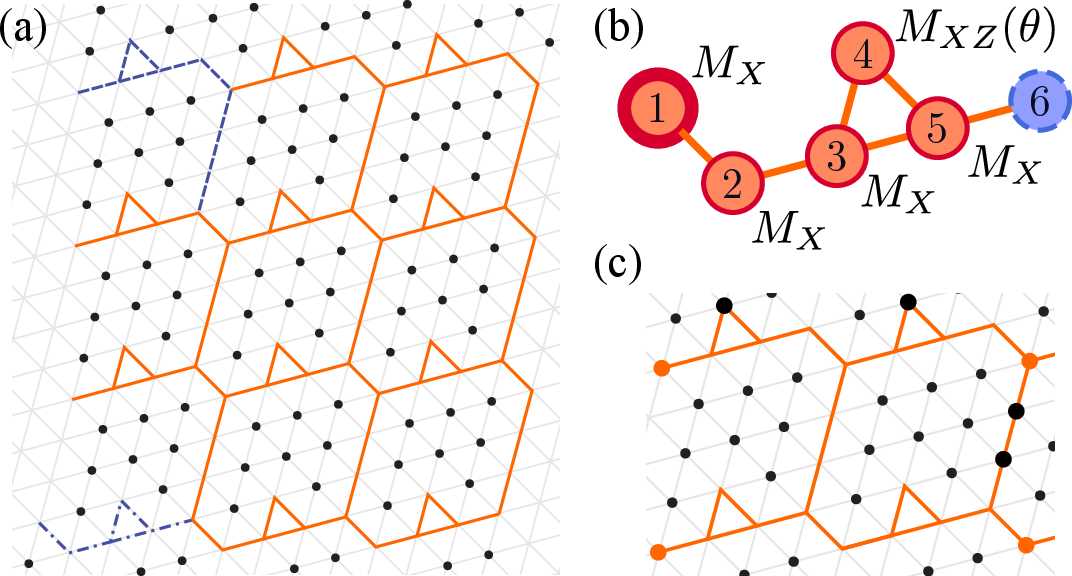
Figure 4: Resource-efficient, universal real-valued MBQC in the YZ7 plane on a triangular grid.
The register-logic formalism rigorously identifies the boundary between deterministically computable classes and universal classes under relaxed correction conditions. This informs both the theoretical structure of MBQC and the practical design of quantum hardware and control sequences.
Hardware and Practical Outlook
From a practical standpoint, the embedding of RL graphs into hardware-constrained lattices (rectangular or triangular grids) via local measurements and code deformations demonstrates feasibility for platforms with limited-range interactions. The direct translation of Parity Architecture circuits to MBQC patterns with local connectivity positions this approach as an attractive target for superconducting, ion trap, and especially photonic architectures [Bartolucci2023, bourassaBlueprintScalablePhotonic2021, Gliniasty2024], where cluster state preparation and one-way computation are natural primitives.
The concept of beveled clusters, in particular, directly addresses coherence limitations by decoupling inputs from outputs in both space and time. This has considerable benefits for photonic MBQC, where ballistic operation and parallel state preparation are instrumental for scalable, fault-tolerant devices.
Conclusion
This work provides a definitive account of MBQC with measurements restricted to the YZ8 plane. It rigorously delineates the precise conditions under which strong determinism is possible (RL graphs with YZ9), and extends the frontier of MBQC universality by showing that I=O0-plane-only measurement patterns are universal under Pauli flow. The structural insights into register-logic graphs and their embedding via the Parity Architecture supply a foundation for hardware-optimized quantum computing approaches capable of exploiting both measurement-based and parity-based primitives. By closing the classification of universal MBQC with plane-restricted measurements, this research will inform future architectures, correction strategies, and the synthesis of resource-efficient quantum algorithms.
References:
- YZ-plane measurement-based quantum computation: Universality and Parity Architecture implementation (2603.29379)
- Universality of quantum computation with cluster states and (X, Y)-plane measurements [mantri_universality_2017]
- Graph States, Pivot Minor, and Universality of (X, Z)-measurements [mhalla_graph_2012]
- Parity Quantum Computing as I=O1-Plane Measurement-Based Quantum Computing [smith_parity_2024]
- Constant Depth Code Deformations in the Parity Architecture [messinger_constant_2023]
- A quantum annealing architecture with all-to-all connectivity from local interactions [lechner_quantum_2015]
- Universal Parity Quantum Computing [fellner_universal_2022]
- Fusion-based quantum computation [Bartolucci2023]
- Blueprint for a Scalable Photonic Fault-Tolerant Quantum Computer [bourassaBlueprintScalablePhotonic2021]
- A Spin-Optical Quantum Computing Architecture [Gliniasty2024]