- The paper demonstrates that altermagnetic spin anisotropy combined with carrier doping enhances d-wave pairing in the Hubbard model.
- It employs a mapping to an anisotropic t–J model and uses QMC to reveal optimal pairing near n≈0.88 and t_A≈0.6.
- The study reveals a mixed d+p phase with a predicted Leggett mode, offering design principles for higher T_c superconductors.
Altermagnetic-Doping Cooperation for Enhanced d-Wave Pairing in the Hubbard Model
Introduction
The study by Liu et al. investigates the cooperation of altermagnetic order and carrier doping as a mechanism for stabilizing and enhancing unconventional superconducting pairing within the paradigmatic Hubbard model. With altermagnetism established as a distinct collinear magnetic phase characterized by zero net moment but robust, momentum-odd spin splitting protected by crystalline symmetry, the interplay between altermagnetic correlations and charge doping is analyzed using a combination of analytical and numerical approaches. The results delineate the emergent phase behavior and provide insight into the relevance of spin anisotropy for d-wave and p-wave superconductivity—an issue directly connected to cuprates and altermagnetic candidate materials.
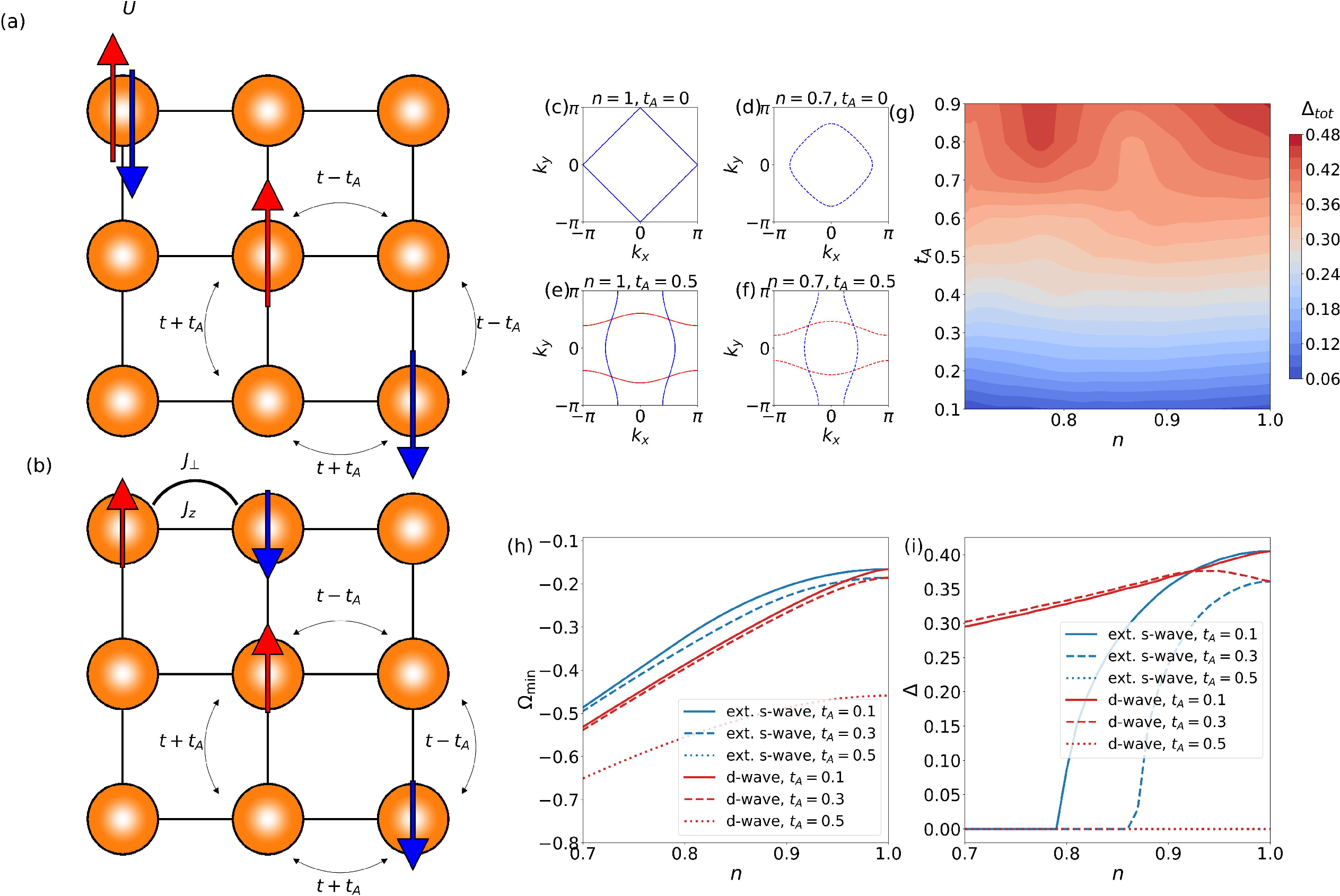
Figure 1: The Hubbard model with spin-anisotropic hopping t±tA under onsite repulsion U, its mapping to an anisotropic t–J model with couplings Jz and J⊥, Fermi surface reconstructions, and pairing analysis as a function of filling and anisotropy.
Model Construction and Analytical Mapping
The core of the approach is a square-lattice Hubbard model with spin-dependent, anisotropic nearest-neighbor hoppings described by tA, encoding the effect of symmetry-constrained altermagnetic spin splitting. For strong coupling (d0), the model maps onto an anisotropic d1–d2 Hamiltonian with superexchange couplings d3 and d4. The altermagnetic anisotropy suppresses long-range antiferromagnetism while preserving short-range fluctuations, creating a background favorable for superconductivity.
The mapping reveals two key interaction channels:
- Singlet channel (d5): Enhanced by d6, promoting d7-wave and extended d8-wave pairing.
- Triplet channel (d9): Activated by spin anisotropy and symmetry reduction, enabling p0-wave pairing.
These effects are illustrated by the Fermi surface evolution: increasing p1 drives a reconstruction from a perfectly nested, spin-degenerate Fermi surface to strongly distorted and spin-split topologies, as confirmed by the calculation of the total pairing strength p2.
Mean-Field and Quantum Monte Carlo Results
Mean-field analysis of the p3–p4 Hamiltonian demonstrates that moderate p5 stabilizes robust p6-wave superconductivity. For small p7, the p8-wave solution dominates, with a gap opening and increasing in magnitude with anisotropy. At larger p9, singlet and triplet channels coexist, and eventually, the t±tA0-wave component dominates. The t±tA1-wave instability is optimal at moderate anisotropy, after which the system evolves into a mixed t±tA2 phase.
Quantum Monte Carlo (QMC), specifically constrained-path QMC, is used to non-perturbatively treat the full Hubbard model with doping. The QMC evaluation of the vertex t±tA3-wave pairing correlation function reveals a pronounced enhancement at intermediate doping and t±tA4, precisely where the density-wave (SDW and CDW) order parameters are concurrently suppressed—a prerequisite for robust unconventional superconductivity.
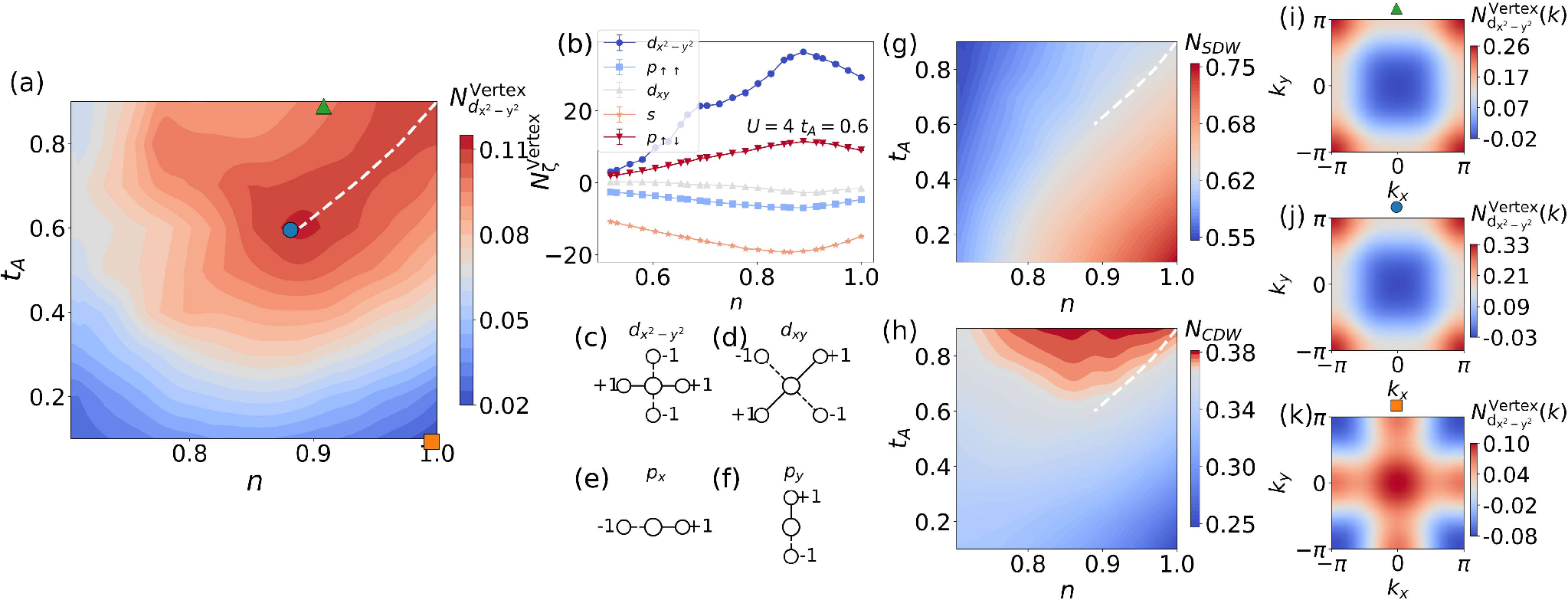
Figure 2: QMC vertex t±tA5-wave pairing function t±tA6 in the t±tA7 plane; finite doping and moderate anisotropy yield a pronounced peak, flanked by suppressed SDW and CDW structure factors.
Additionally, the suppression of SDW and CDW correlations is quantified via the momentum-resolved structure factors, supporting the mechanism in which short-range spin fluctuations mediate superconductivity when density-wave instabilities are reduced. Notably, the peak t±tA8-wave response is observed near t±tA9 and U0.
Emergence of Mixed U1+U2 Pairing and Phase Diagram
Mean-field free energy landscapes as a function of both singlet and triplet order parameters, U3, elucidate the evolution of the superconducting state with increasing anisotropy and doping. At weak anisotropy, a pure U4-wave state is stable; at larger U5 and/or high filling, a demonstrable crossover (and eventual dominance) to U6-wave and U7 coexistence appears. In the coexistence regime, the order parameter is multi-component, and the phase stiffness between singlet and triplet components gives rise to a neutral, massive Leggett mode, whose detection is a target for Raman and THz spectroscopy.
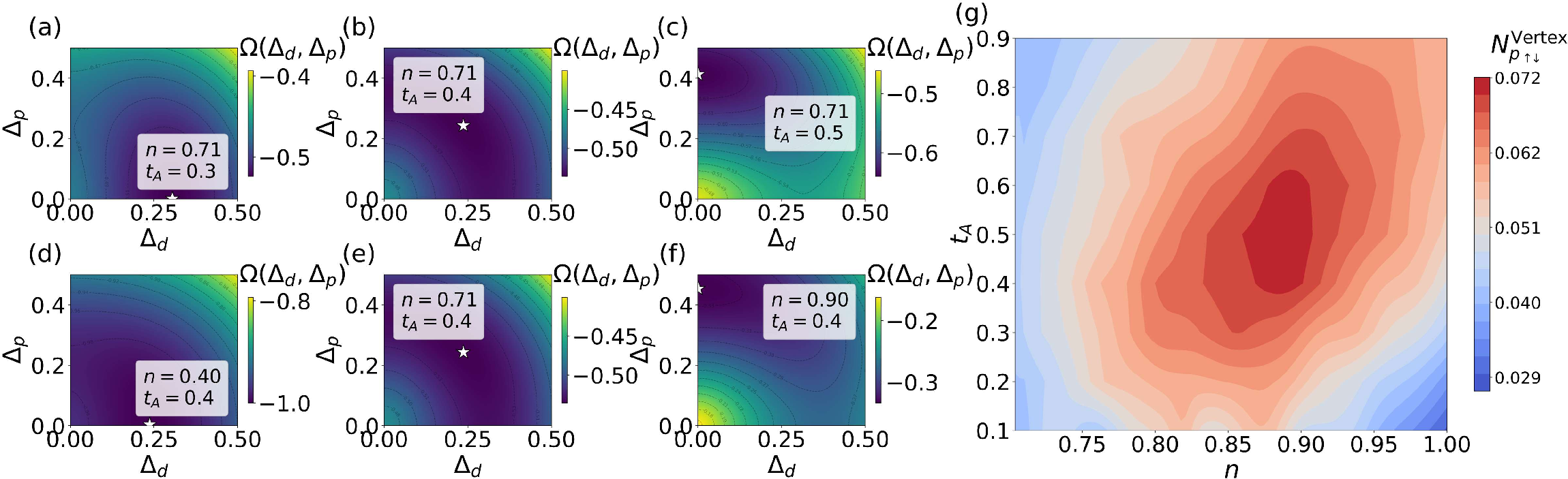
Figure 3: Evolution of the mean-field free energy landscape in U8 space shows a transition from pure U9-wave, to a t0+t1 coexistence, to pure t2-wave with increasing t3 and/or filling; QMC confirms the enhancement and overlap of t4- and t5-wave vertex functions.
QMC results reinforce the presence of strong t6-wave vertex enhancement at moderate t7 and near-optimal doping, directly mirroring the regime where t8-wave correlations are also strong. Thus, the calculations robustly indicate that the t9 mixed phase is a robust feature of the altermagnetic-doped Hubbard model, and is expected to support higher J0 due to the cooperative enhancement of the total pairing amplitude.
Implications and Outlook
The study presents direct evidence that weak to moderate altermagnetic spin anisotropy, when combined with doping, is a potent route to optimal J1-wave superconductivity, and that the admixture of triplet (J2-wave) components naturally emerges due to the reduced (from J3 to J4) point group symmetry and spin-split Fermi surfaces. These results provide a unifying mechanism for the dominance of J5-wave pairing in cuprates and establish key design principles for engineered systems, e.g., oxide heterostructures or ultracold optical lattices, where spin-anisotropic hopping is tunable.
In the context of recent experimental progress in the observation and control of altermagnetic order [Phys. Rev. X 12, 040501 (2022); Nature 636, 348 (2024)], the results of this work point to direct routes for the realization of higher J6 unconventional superconductors. Furthermore, the predicted Leggett mode in the J7 regime provides a concrete dynamical observable to distinguish these multi-component condensates.
These findings motivate future work applying multiorbital extensions, incorporating longer-range interactions, and ab initio parameterizations to assess the quantitative relevance for cuprates, nickelates, and engineered heterostructures. The possible synergy with other emergent phenomena (pair density waves, topological superconductivity, and nonreciprocal transport) in altermagnetic systems warrants exhaustive exploration.
Conclusion
Liu et al. provide compelling theoretical and numerical evidence for the cooperative effect of altermagnetic order and charge doping as a stabilizing and enhancing factor for unconventional superconductivity—especially J8-wave—in the Hubbard model. The emergence of robust mixed J9 pairing, tunable via spin anisotropy and doping, is a direct consequence of the interplay between momentum-odd spin splitting and the suppression of competing density-wave orders, predictive of enhanced superconducting transition temperatures and emergent collective modes in altermagnetic materials and strongly correlated electron systems (2603.29377).