- The paper introduces delta-axis spectroscopy (DAXS) to directly measure both diagonal and off-diagonal Hamiltonian parameters in a 15-level double quantum dot system.
- The paper demonstrates that DAXS surpasses traditional techniques by resolving state hybridization and anticrossing features via dense spectroscopic mapping.
- The paper quantitatively extracts multiple tunnel couplings and on-site energies, revealing systematic variations with barrier voltage and highlighting charge noise effects.
Direct Measurement of the Double Quantum Dot Energy Spectrum via Delta-Axis Spectroscopy
Introduction
The paper "Direct measurement of the energy spectrum of a quantum dot qubit" (2603.29229) proposes and experimentally validates delta-axis spectroscopy (DAXS), a technique that enables direct, Hamiltonian-agnostic measurement of the energy eigenstates in a semiconductor double quantum dot (DQD) system. The method provides dense spectroscopic information across a wide energy range as a function of detuning and other relevant parameters, and facilitates the extraction of both diagonal and off-diagonal elements of a generalized Hubbard-type Hamiltonian. The data demonstrate precise extraction of multiple tunnel couplings and on-site energies in a 15-level DQD system, offering a substantial advance over established, more limited spectroscopic approaches such as pulsed-gate spectroscopy (PGS) and detuning axis pulsed spectroscopy (DAPS).
Experimental Regime and DAXS Methodology
The device under study is a Si/SiGe double quantum dot formed in an Intel Tunnel Falls heterostructure, with electrons accumulated under plunger gates and barriers electrostatically defining the dot-reservoir landscape. The relevant regime is the (1,3)-(0,4) charge configuration, with two electrons in the right dot forming a closed-shell singlet. The device's geometry and measured stability diagram articulate the correspondence between the experimentally adjustable gate voltages and physical system parameters, specifically detuning ε and the symmetric delta axis δ.
Using the DAXS protocol, square wave voltage pulses are applied simultaneously to both plunger gates along the δ axis. This approach directly projects the energy-level spectrum and excited-state anticrossings as a function of ε, allowing the observation of not only ground state transitions, but also highly excited, hybridized states that are not accessible via one-dimensional energy sweeps or PGS. The DAXS measurement yields a time-averaged response of a proximal charge-sensing quantum dot, reporting the occupancy and tunneling of the relevant DQD states.
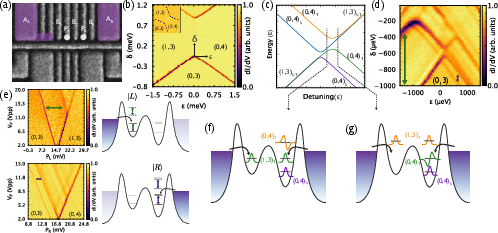
Figure 1: Overview of the device architecture, relevant charge stability diagram, theoretical energy dispersion, averaged DAXS data, and comparative PGS measurement in the (1,3)-(0,4) configuration.
The DAXS data reveal an intricate set of spectral lines corresponding to a variety of charge and spin configurations, with clear signatures of state hybridization and anticrossing behavior as a function of detuning. Comparison with PGS underlines the superiority of DAXS in capturing non-trivial hybridization phenomena and resolving the anticrossing structure, critically enabling comprehensive Hamiltonian reconstruction.
Extraction and Analysis of Hamiltonian Parameters
The core advance of DAXS is the ability to extract multiple, independent tunnel couplings and on-site energies from a single two-dimensional dataset. The spectral features are quantitatively analyzed by a multi-step process: Lorentzian fits to resonance peaks in the DAXS data yield energy eigenvalues, which are then matched to the numerically computed eigenvalues of a Hubbard-like 15×15 Hamiltonian. This fitting allows simultaneous extraction of diagonal terms (on-site energies, detuning, orbital splittings) and off-diagonal tunnel couplings—including those involving excited states.
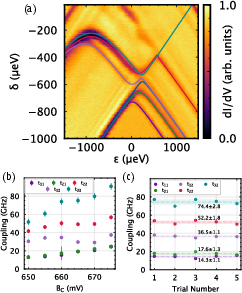
Figure 2: DAXS data (averaged over reservoir voltages) overlaid with eigenvalues from the best-fit Hubbard Hamiltonian; tunnel coupling strengths extracted as a function of center barrier voltage and the inter-scan variability at fixed tuning.
A salient result is the systematic mapping of tunnel coupling strengths tij as a function of the electrostatically controlled center barrier gate voltage BC. The dataset demonstrates that, typically, tunnel couplings are larger for higher-lying excited states due to their reduced spatial localization. Several couplings exhibit monotonic dependence on BC, though non-monotonicities appear, likely emerging from orbital structure sensitivity to atomic disorder. Experiment-to-experiment variation and fitting uncertainties are quantitatively reported, with one-sigma errors of 1.6–3.9 GHz attributed to charge noise and variance in the fitting procedure.
Discrimination of Dot-Intrinsic Versus Reservoir-Induced Features
The experimental context involves finite-size reservoirs, which generate a non-uniform, quasi-1D density of states (DOS) leading to spurious resonance lines in spectroscopic maps. To isolate eigenstate resonances intrinsic to the DQD, the paper employs gate modulation protocols that shift the energy of reservoir states independently from quantum dot transitions and applies post-processing averaging over multiple DAXS measurements at varying reservoir gate voltages. Dot-intrinsic transitions remain fixed, whereas reservoir resonances disperse, enabling differentiation.
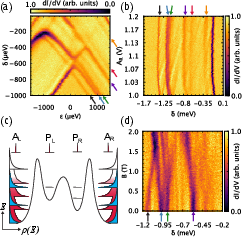
Figure 3: DAXS dataset with vertical arrows highlighting quantum dot resonances; series of DAXS scans as a function of reservoir gate voltage distinguishes vertical (dot) from sloped (lead-induced) lines; schematic of DOS structure and magnetospectroscopy for spin characterization.
Magnetospectroscopy further substantiates state assignments, with Zeeman splitting observed only in expected triplet states, while singlet states remain degenerate—directly confirming state character and supporting the Hamiltonian mapping.
Hamiltonian Fitting Details and Uncertainty Considerations
The supplementary analysis details the Hamiltonian block structure, fitting methodology, and error quantification. A representative fitting pipeline starts with hand-drawn guides marking spectral peaks, followed by Savitzky-Golay filtering and Lorentzian peak fits. The centers of these peaks are then matched to eigenvalues of the full Hamiltonian via nonlinear least-squares optimization.
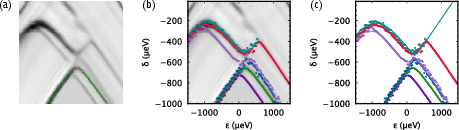
Figure 4: Steps of the DAXS fitting procedure—manual curve assignment, Lorentzian fits, and final eigenvalue fitting to extract all relevant parameters.
The robustness of tunnel coupling sign assignments is assessed by exploring all relevant sign combinations in the subspace of singlet and triplet blocks, finding percent errors between sign choices generally <5%, with a minority up to 20% (within overall experimental error). Notably, for several high-lying tunnel couplings, limitations in peak resolution due to temperature and tunnel broadening preclude unambiguous parameter assignment.
Consecutive DAXS scans at fixed settings allow direct quantification of random errors due to charge noise, confirming repeatability of parameter extraction and internal consistency in the absence of significant drifts or device instability.
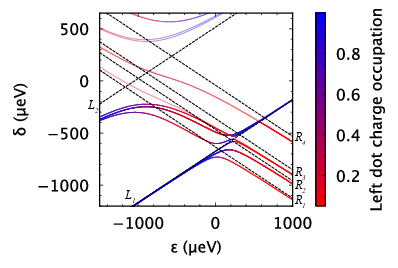
Figure 5: Plot of Hamiltonian eigenvalues over extended parameter range for detailed basis state assignment and demonstration of model fidelity.
Implications for Quantum Dot Qubit Metrology and Theory
The DAXS technique provides unique leverage for comprehensive quantum dot Hamiltonian characterization, directly measuring matrix elements critical to precise modeling and coherent qubit control. The ability to extract multiple tunnel couplings—including those involving excited orbitals—from a single experiment obviates the need for complicated multimodal protocols and supports identification of leakage mechanisms, anticrossing positions, and state hybridization relevant for quantum error correction and dynamical control.
This protocol generalizes to arbitrary charge configurations, provided energy scales exceed the electron reservoir temperature, and is not contingent on the presence of simple, isolated ground-state transitions. DAXS could be further extended to larger multi-dot arrays (with either dot or reservoir sources), and to more complex Coulomb landscapes, facilitating the metrology of Hamiltonian engineering in large-scale quantum dot processors.
Conclusion
This work establishes DAXS as a powerful spectroscopic methodology for direct energy spectrum measurement in complex quantum dot systems (2603.29229). The approach yields both diagonal and off-diagonal parameters of generalized Hubbard Hamiltonians, robustly resolves state hybridization and anticrossing structure, and discriminates intrinsic device physics from reservoir-induced artifacts. The method's compatibility with scalable, low-frequency instrumentation and its applicability to arbitrary quantum dot configurations position DAXS as an essential tool for future quantum device characterization and theoretical investigation.