- The paper introduces a convex quadratic programming framework that maps human input to robot joint increments with explicit safety constraints via Control Barrier Functions.
- It achieves millisecond-scale response with an average computational latency of 9.05 ms, significantly enhancing motion preservation and real-time feasibility compared to prior methods.
- Safety is enforced through linearized collision avoidance constraints, ensuring over 95% of control steps exceed a safety threshold, validated both in simulation and on the Wuji Hand platform.
Kilohertz-Safe: A Scalable Framework for Constraint-Aware Dexterous Retargeting
Introduction
Dexterous robotic hand teleoperation presents high-dimensional mapping, latency, and stringent safety constraints, especially where millisecond-level control and collision avoidance are paramount. Traditional optimization-based retargeting pipelines exhibit computational inefficiencies, limiting their scalability to kilohertz-level rates, while learning-based approaches lack robust formal guarantees for safety and constraint satisfaction. "Kilohertz-Safe: A Scalable Framework for Constrained Dexterous Retargeting" (2603.29213) addresses these challenges by reformulating the retargeting process as a convex quadratic program operating in joint differential space, enabling efficient integration of heterogeneous geometric, kinematic, and safety constraints with provable safety via Control Barrier Functions (CBFs). The framework is extensively validated through simulation and real-world experiments on the Wuji Hand platform, demonstrating high-frequency, stable, and safe teleoperation performance.
Framework Overview
The system pipeline of Kilohertz-Safe unifies high-frequency human input and robot state feedback through velocity-level constraint linearization, casting the entire retargeting process as a structured convex optimization problem. Task-space keypoint alignment, physical joint limits, and heterogeneous constraints are all expressed and enforced through consistent linearization at each control cycle, translating previously nonlinear retargeting objectives into tractable QPs suitable for kilohertz-level operation.
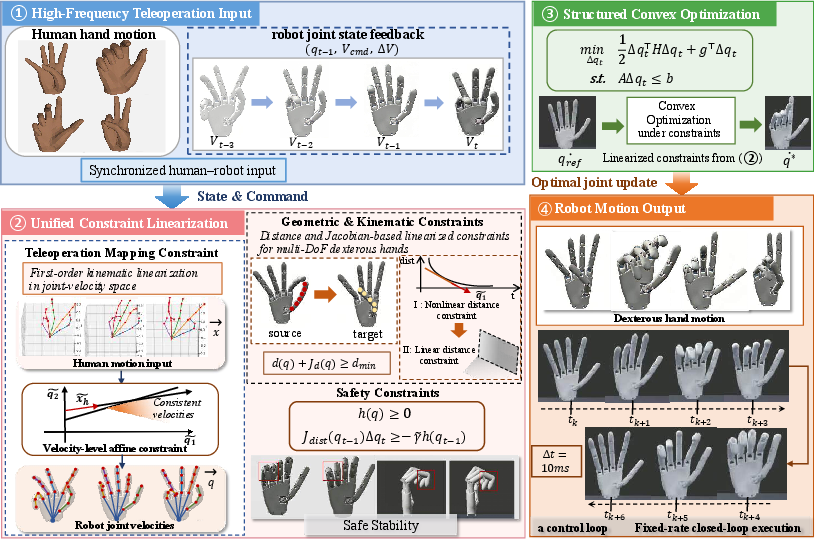
Figure 1: System pipeline of the proposed high-frequency retargeting framework, unifying inputs into a convex QP under geometric, kinematic, and safety constraints.
Unlike prior approaches that impose safety objectives heuristically or as soft constraints, Kilohertz-Safe formulates CBF-based collision avoidance as explicit linear inequalities in the QP, guaranteeing forward invariance of safe sets under real-time execution.
At each control timestep, human hand keypoints are mapped to robot joint increments Δqt by minimizing a quadratic cost combining alignment fidelity and smoothness, subject to linearized physical constraints. Denote J as the Jacobian stacked over all relevant robot keypoints, and Δv as the target displacement in Cartesian keypoint space. The QP objective is
Δqtmin∥JΔqt−Δv∥22+β∥Δqt∥22
with joint limit constraints recast as simple box inequalities. The convexity and low computational complexity of the resulting QP ensure consistent millisecond-scale latency.
Safety constraints are incorporated as affine inequalities via CBFs. Pairwise capsule-based geometric distances between finger links are utilized, with each potentially colliding pair contributing a constraint of the form
Jdist(qt−1)Δqt≥−γ~h(qt−1)
where h(qt−1) encodes the minimum collision-free clearance at the last configuration, and γ~ governs safety margin enforcement. This CBF integration retains QP convexity while enabling provable safety guarantees.
Simulation Results
Computational Latency and Real-Time Feasibility
Kilohertz-Safe achieves an average computation latency of 9.05 ms per control step—significantly outperforming Dex-Retargeting and GeoRT. Over 85% of control steps satisfy a 100Hz (10 ms period) real-time threshold, enabling robust kilohertz-scale operation.
Motion Preservation
Across diverse teleoperation sequences, the framework demonstrates consistently superior alignment between human and robot hand postures, outperforming both Dex-Retargeting and learning-based GeoRT in framewise and cumulative motion preservation error metrics. High-fidelity retargeting is maintained even in fine-grained, contact-rich gesture transitions.
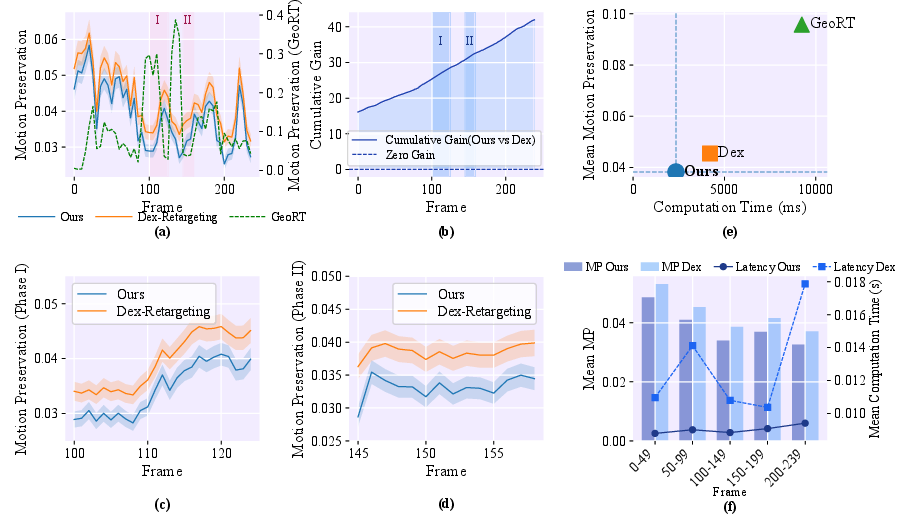
Figure 2: Motion preservation comparison: (a) lower global error, (b) cumulative gain over Dex-Retargeting, (c-d) fine-grained preservation in critical phases, (e-f) favorable efficiency-fidelity trade-off and segment-wise analysis.
Qualitative experiments further show robust generalization across a range of articulated hand poses.
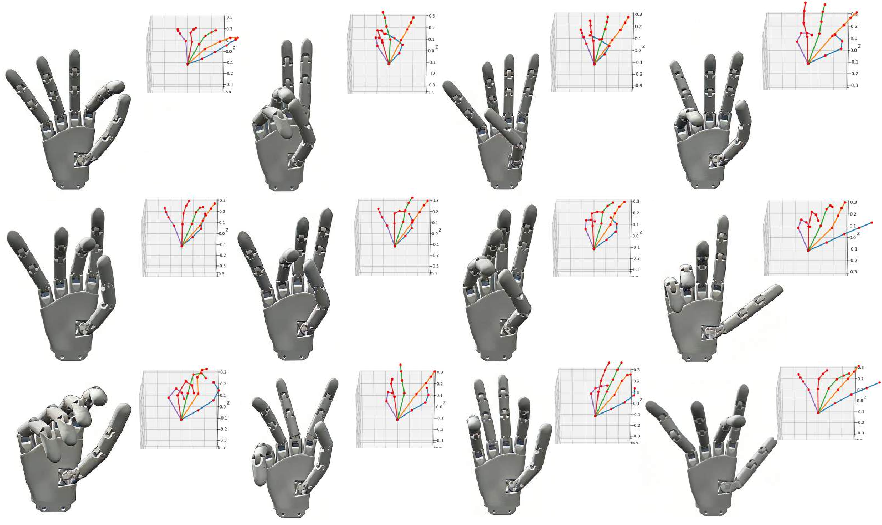
Figure 3: Robust human-to-robot retargeting across diverse hand gestures.
Collision Safety and Ablation
The system maintains high safety scores throughout interaction sequences; over 95% of control steps exceed a safety threshold of 0.8. Time-aligned analyses reveal that, unlike alternative pipelines, Kilohertz-Safe avoids sharp safety degradations during dynamic phases involving finger crossing or rapid adduction.
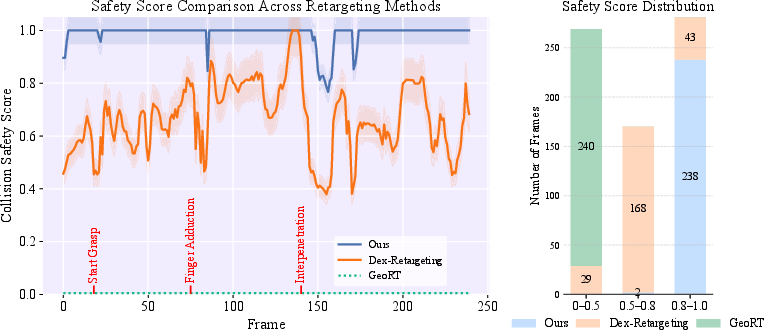
Figure 4: Safety score comparison across different retargeting pipelines during annotated motion stages.
Ablation studies confirm the efficacy of explicit CBF constraints: disabling safety terms leads to frequent threshold violations and reduced minimum inter-finger distances.
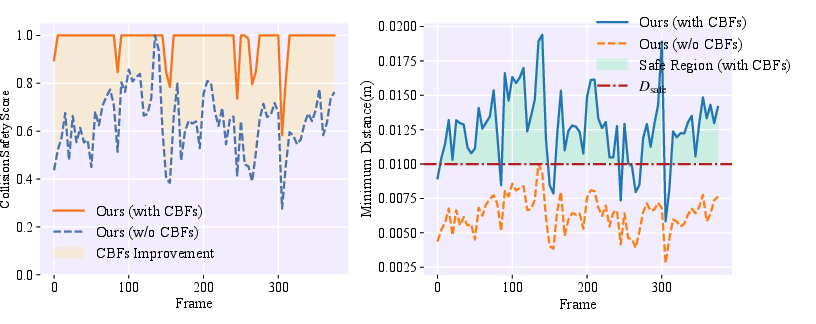
Figure 5: CBF ablation—consistent safety is maintained with CBF constraints; ablation increases collision and threshold violations.
Grasping experiments demonstrate the role of activation distance in early intervention for collision avoidance; increased activation improves collision mitigation at the cost of earlier intervention, a trade-off tunable per application.
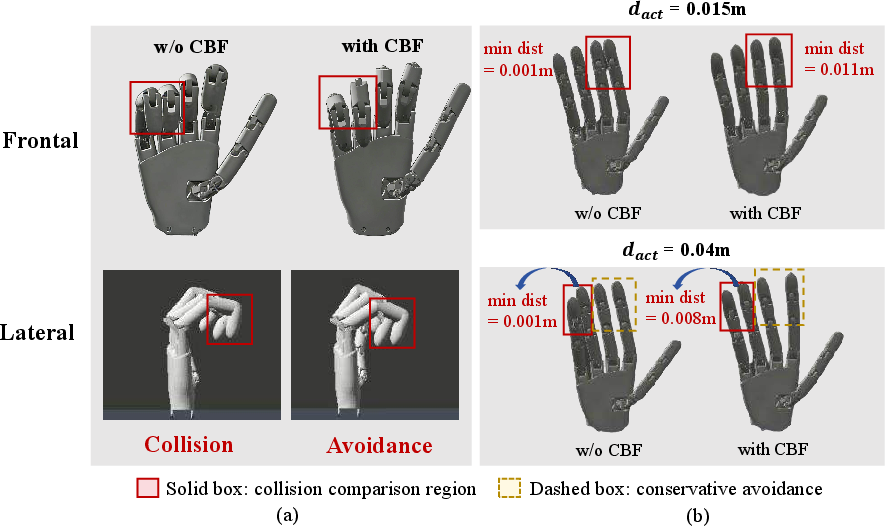
Figure 6: Safety evaluation in grasping and contact: activation distance adjustment modulates early intervention and collision avoidance.
Real-World Hardware Validation
The method is validated on the Wuji Hand platform, showing real-time, stable, and collision-free execution of challenging gesture sequences, including rapid finger crossing and complex grasping. Continuous closed-loop control is preserved without noticeable lag or instability, indicating its practicality in authentic sensorimotor environments and noisy perception conditions.
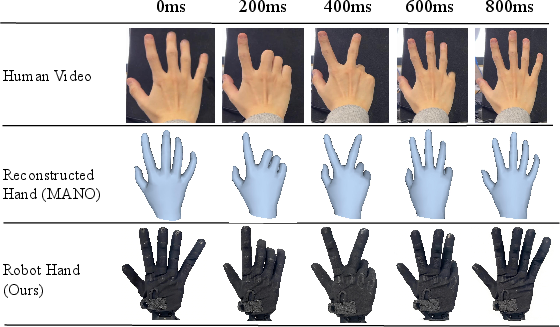
Figure 7: Real-time retargeting snapshots showing stable closed-loop execution in hardware at 200ms intervals.
Collision risk analysis during realistic hand closure experiments reveals that the proposed pipeline retains greater inter-finger clearance compared with previous approaches and CBF-ablated baselines.
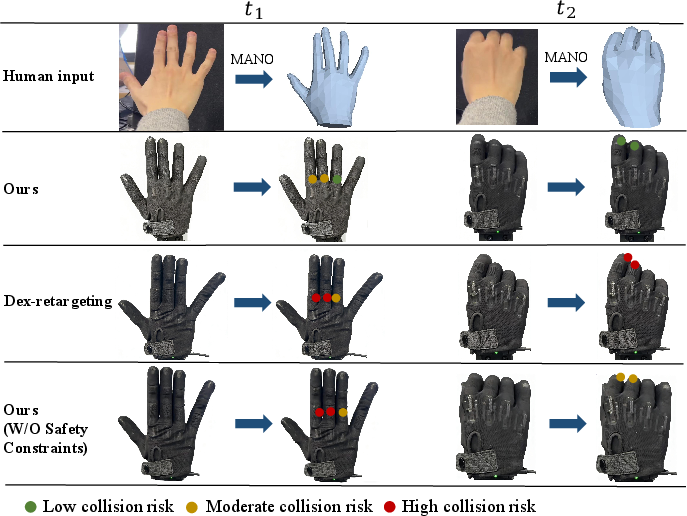
Figure 8: Collision risk comparison (inter-finger region) during hand closing; Kilohertz-Safe sustains lower risk relative to baselines.
Implications and Future Directions
Kilohertz-Safe establishes a scalable paradigm for real-time dexterous hand teleoperation with formal safety guarantees—addressing computational limitations of traditional optimization frameworks while overcoming the safety ambiguity of end-to-end learning-based systems. Its underlying differential-space QP formulation, together with explicit CBF-based constraints, generalizes naturally to a wide range of kinematic morphologies and high degree-of-freedom robotic hands. This unification of efficiency, fidelity, and safety is highly relevant for manipulation in safety-critical and contact-rich domains.
Theoretically, the integration of CBFs within the QP retargeting pipeline marks a principled advance for provably safe control in real-time, high-DOF systems. Practically, it opens avenues for secure telemanipulation in unstructured or dynamic environments and for shared autonomy where human input reliability may vary.
Future work is suggested in the extension toward tactile impedance-aware control constraints to modulate closed-loop force and torque distribution, promising further robustness in interactive object handling and manipulation under actuation limits.
Conclusion
Kilohertz-Safe delivers a unified, convex optimization-based retargeting framework for dexterous hand teleoperation, simultaneously achieving millisecond-scale responsiveness, high motion preservation, and provable geometric safety via embedded CBF constraints. Experimental evidence from both simulation and hardware demonstrates the framework’s advanced performance over existing methods, underlying its potential as a foundational system for practical, safe, and high-frequency dexterous telemanipulation (2603.29213).