- The paper presents AOT-TCNet, a multimodal deep learning model that fuses atmospheric, oceanic, and terrain data to improve tropical cyclone track and intensity forecasts, notably for abnormal deflections.
- It employs a mode-adaptive mixture-of-experts architecture to decompose complex TC trajectories, reducing prediction error by 10–13 km in 6–18 hour forecasts.
- Experimental results on the comprehensive AOT-TCs dataset show 53–71.8% improvement in intensity predictions, highlighting its potential for operational rapid-response deployment.
Improving Ensemble Forecasts of Abnormally Deflecting Tropical Cyclones with Fused Atmosphere-Ocean-Terrain Data
Motivation and Challenges
The increasing frequency and unpredictability of extreme tropical cyclone (TC) events in the context of global climate variability emphasize the urgent need for enhanced forecasting approaches. Traditional numerical weather prediction (NWP) models, despite their comprehensive physical basis, suffer from high computational costs and limited short-term accuracy, especially when rapid atmospheric changes and anomalous track behaviors are involved. Deep learning (DL)-based TC forecasting models have emerged with substantial computational efficiency and competitive predictive performance—yet, they typically process only homogenous meteorological or trajectory data and exhibit significant deficiencies in forecasting abnormally deflected TC tracks. These challenging cases occur under complex physical couplings across ocean, atmosphere, and terrain, leading to abrupt trajectory changes driven by heterogeneous environmental factors (Figure 1).
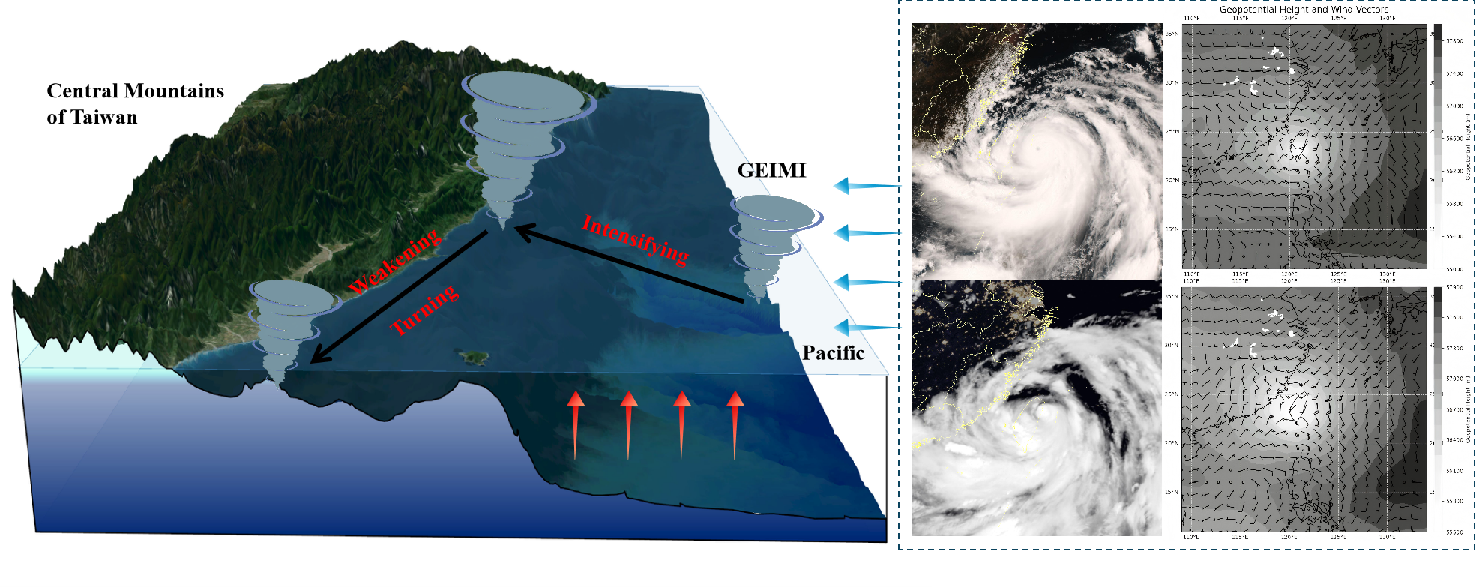
Figure 1: Abnormal deflection of TC GEIMI during Taiwan landfall, illustrating terrain-induced venturi effect and eye dissolution.
Multimodal Dataset Construction
Central to this work is the creation of the AOT-TCs dataset, the most extensive and information-rich TC dataset for the Western North Pacific basin. This dataset integrates atmospheric variables (ERA5: wind fields, geopotential height at multiple pressure levels), oceanic observations (CODCv1: SST and SSS), and high-resolution terrain information (GEBCO: elevation data). It further includes essential non-spatial variables such as translational speed, historic movement direction, intensity variability, month, and the NiÑo3.4 index to capture ENSO-induced track variability.
AOT-TCs enables explicit modeling of physical mechanisms relevant to TCs, including terrain-lifted wind acceleration, anomalous deflection, and oceanic thermodynamic regulation, thereby supporting an unprecedented level of multidimensional meteorological analysis. The dataset spans from 1950 to 2024, offering complete coverage for holistic TC lifecycle studies.
AOT-TCNet Model Architecture
AOT-TCNet introduces a multimodal deep learning architecture explicitly coupling atmospheric, oceanic, and terrain variables for TC track and intensity forecasting. The model employs hypothesis-reflecting encoders based on LSTM, MLP, and 3D-UNet for feature extraction from sequential TC data, categorical/environmental variables, and spatiotemporal atmospheric fields, respectively. The cross-modal fusion mechanism aligns and concatenates these heterogeneous features, yielding a unified representation suitable for physically informed prediction.
The core innovation lies in the mode-adaptive Mixture-of-Experts (TMA-MoE) subarchitecture, which decomposes complex TC trajectory distributions into distinct sub-modes (e.g., straight, recurving, abruptly deflecting). A router network, implemented as a probabilistic 3-layer MLP, selects the most relevant expert for each input based on matching scores between predicted and ground truth trajectories. The experts, constructed as independent generative networks, specialize in distinct TC behavior modes. This prevents mode collapse, improves prediction robustness, and enhances the model's capacity to capture the multimodal nature of TC tracks.
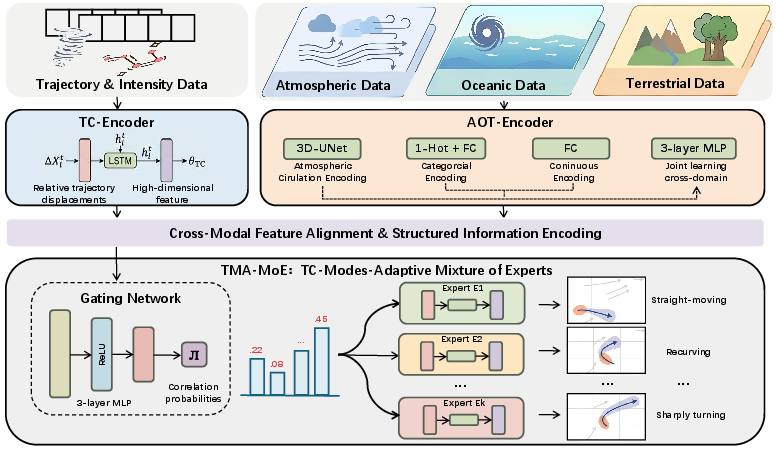
Figure 2: End-to-end architecture of AOT-TCNet with multimodal encoders and TMA-MoE for trajectory and intensity prediction.
Training Loss Design
The optimization process harmonizes reconstruction (Huber and MSE losses for trajectory and meteorological variables), distribution contrastive loss (to align generative output with ground truth distribution manifold), and a mode classification loss (to enforce expert specialization and semantic mode differentiation). The final joint objective leverages Jensen-Shannon Divergence (JSD) to both approximate data and maximize inter-expert diversity, crucial for accurate modeling of anomalous behaviors.
Experimental Evaluation and Comparative Results
Comprehensive evaluations conducted on the AOT-TCs dataset (2017–2024) demonstrate that AOT-TCNet delivers state-of-the-art accuracy in track and intensity forecasting, notably outperforming both traditional NWP models and deep learning baselines in ultra-short-term scenarios, especially for challenging abnormally deflected TCs.
- In 6–18 hour forecasts, AOT-TCNet achieves trajectory errors 10–13 km lower than operational CMO baselines and maintains consistent advantages in intensity forecasting (53–71.8% improvement across all horizons).
- At longer (24h) horizons, NWP models regain parity or slight superiority, a known limitation due to the inherent uncertainty and data-driven forecast constraints.
- Advanced deep learning models developed originally for pedestrian/vehicle trajectory prediction (e.g., SGAN, MMSTN) fail to achieve comparable performance on TC forecasting, highlighting the unique environmental complexity of meteorology.
Ablation studies validate the synergistic effect of multimodal variables and TMA-MoE; the introduction of terrain and ocean variables leads to substantial accuracy gains in both track and intensity prediction, while multimodal expert routing further alleviates mode mixing and instability.
Figure 3: Forecast results for selected TCs in 2024 with historical (red), ground truth (blue), and model predictions (green).
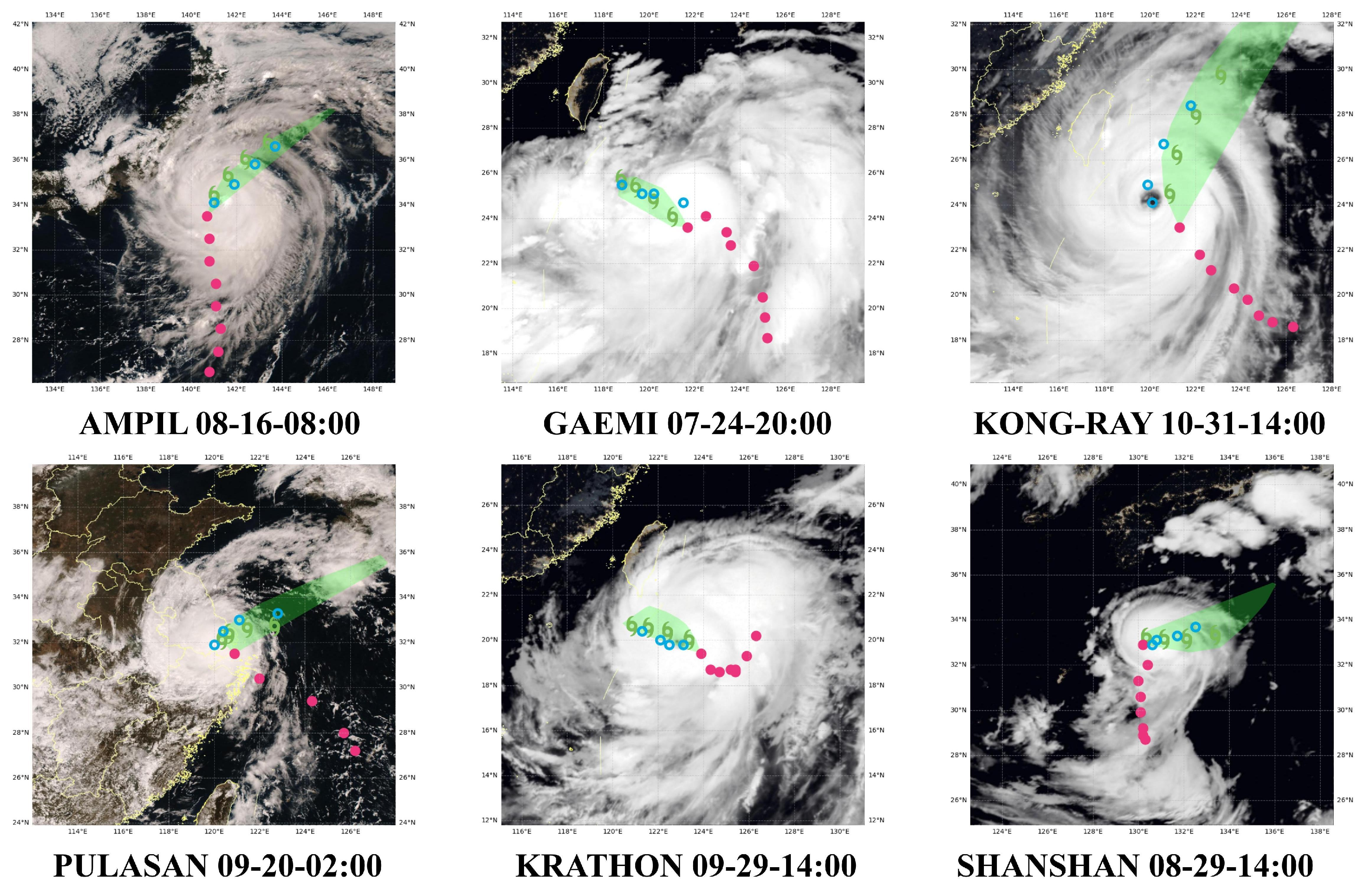
Figure 4: Ensemble forecasting for abnormally deflected TCs in 2024, capturing abrupt path shifts and projected trends.
Abnormally Deflecting TC Case Study
AOT-TCNet is specifically evaluated on abnormally deflected TC cases—defined as exhibiting >45° rightward or >30° leftward turns within 12 hours. Previous models tend to over-smooth predictions and fail to capture sharp turning dynamics. Leveraging multi-generator architectures and terrain information, AOT-TCNet achieves the best precision across all competitive methods, predicting both abrupt trajectory changes and ensemble uncertainty regions.
Detailed Case: Super TC YAGI (2024)
AOT-TCNet's performance is showcased on TC YAGI, which underwent multiple landfalls and abrupt track changes, causing severe impacts. Unlike operational models (e.g., NCEP-GFS, ECMWF-IFS), which exhibited systematic northward bias due to subtropical high initialization error, AOT-TCNet captured the westward movement accurately, aligning predictions with observed ground truth both in spatial track and intensity evolution.
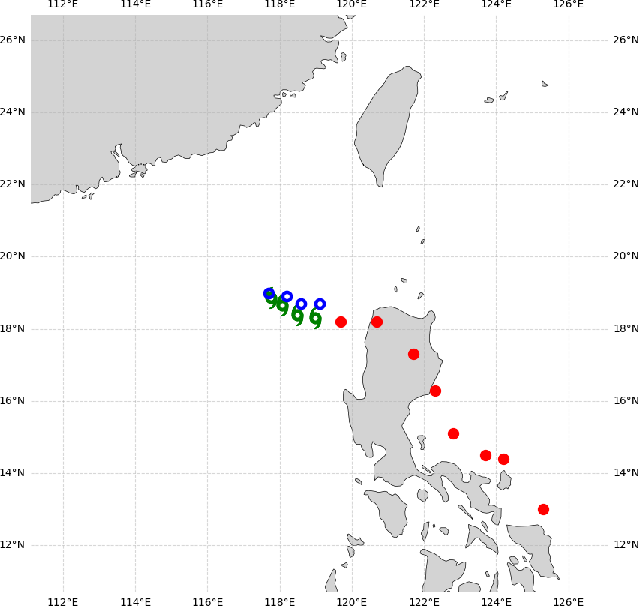
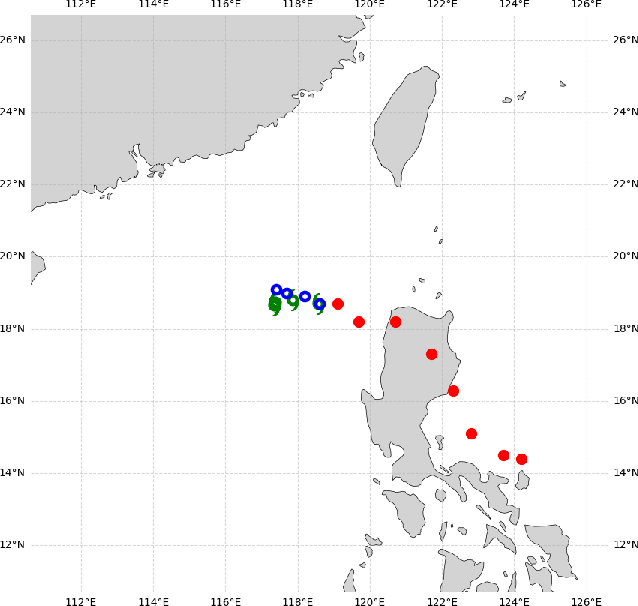
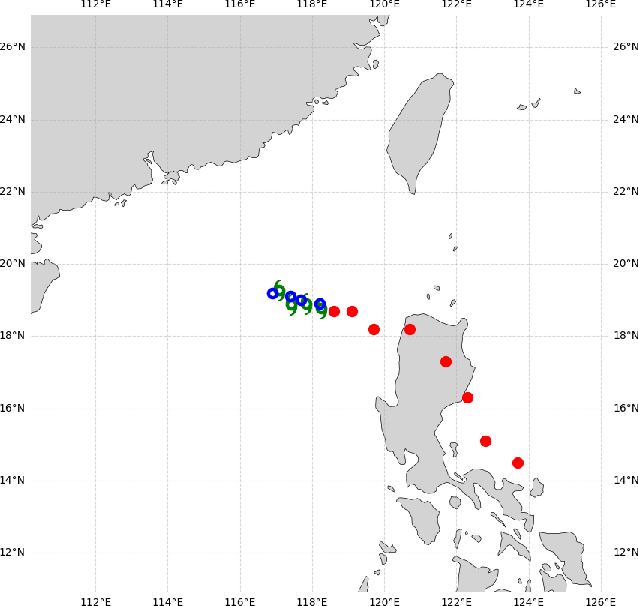
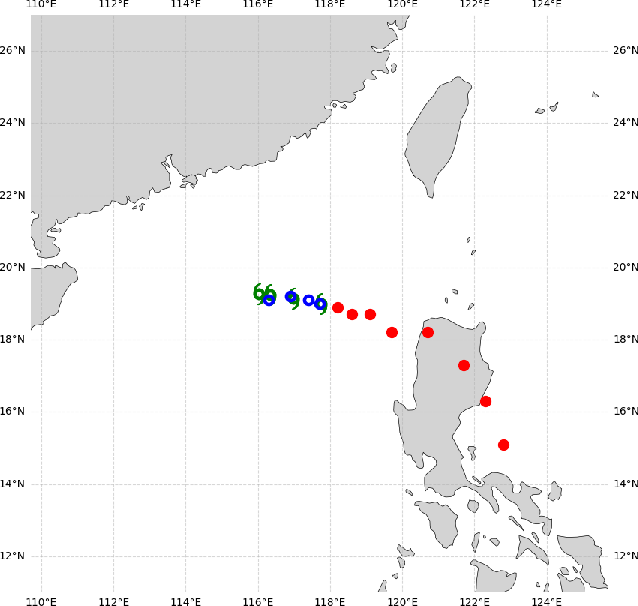
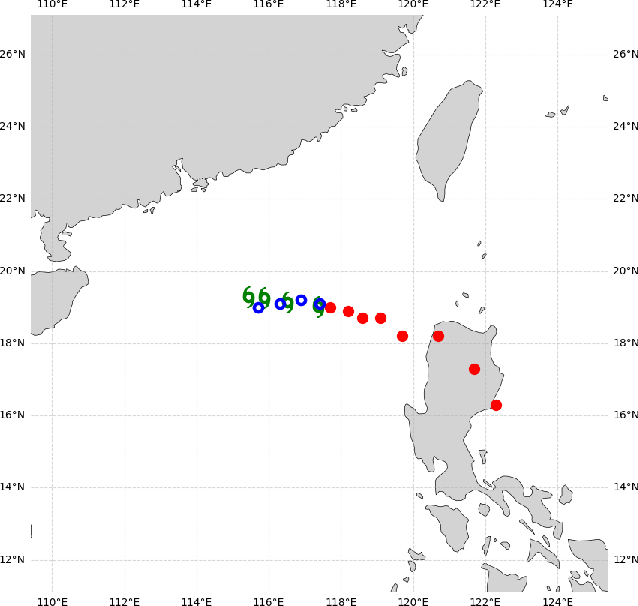
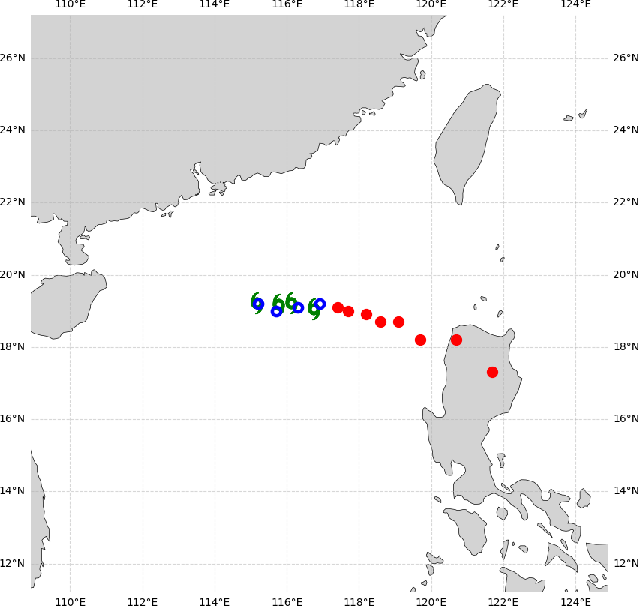
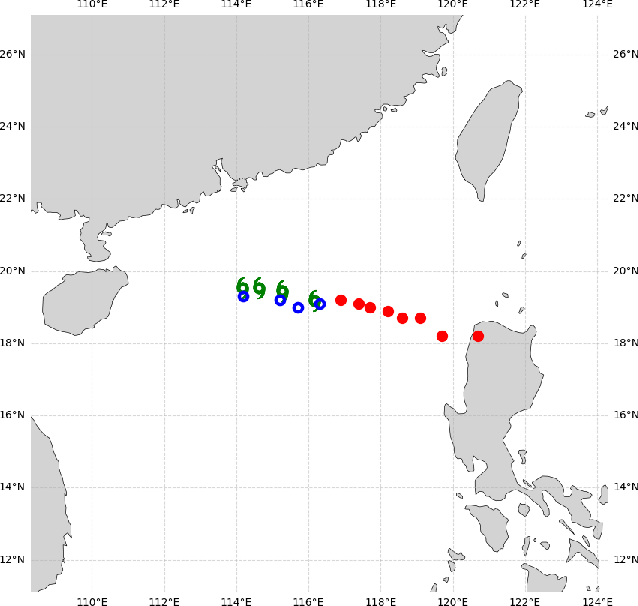
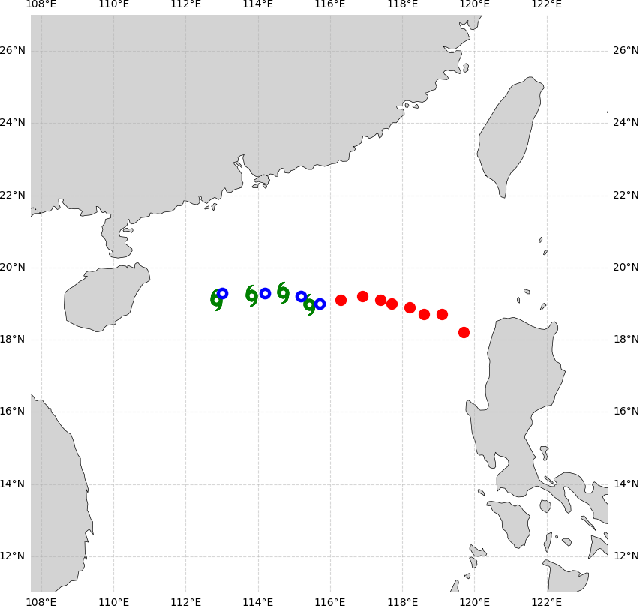
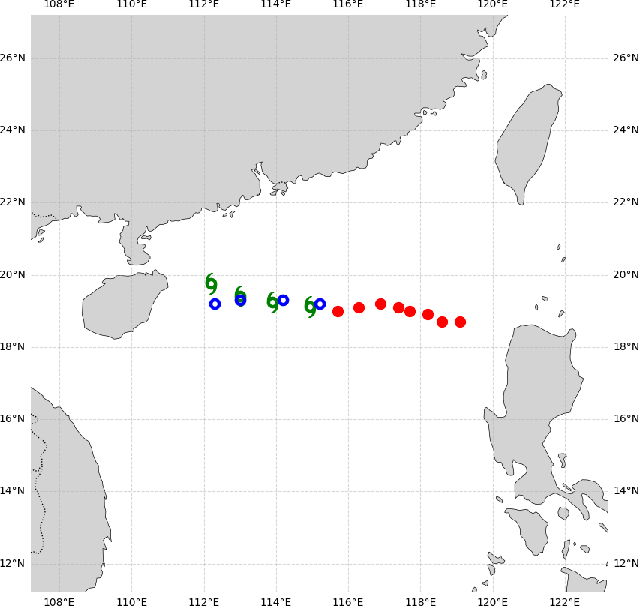
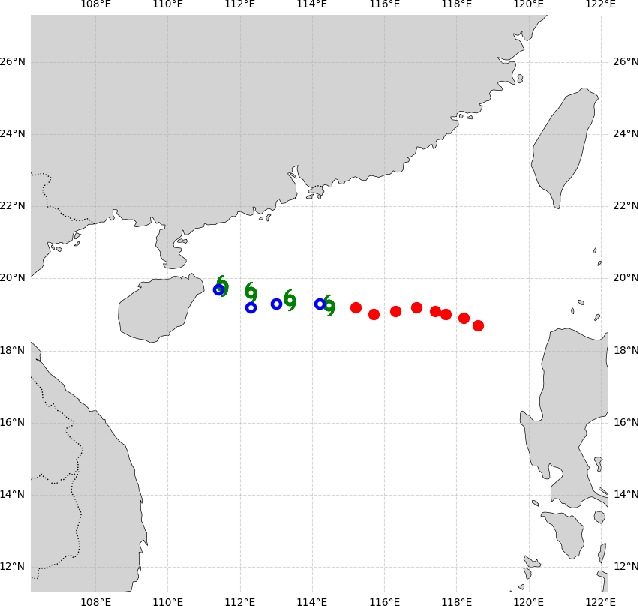
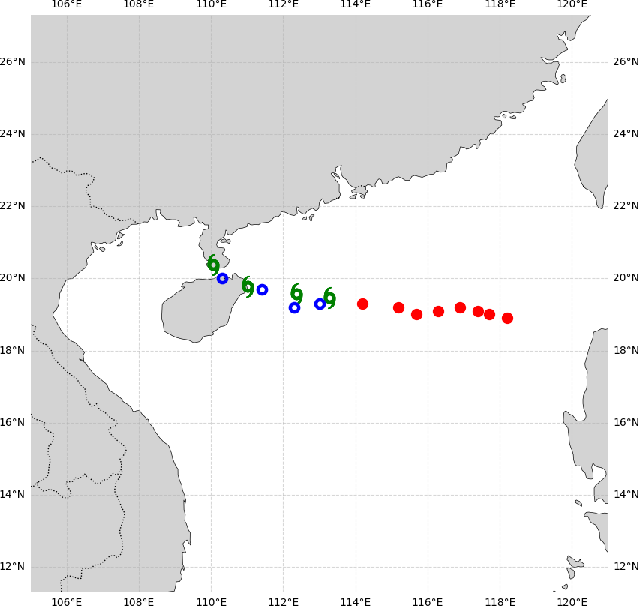
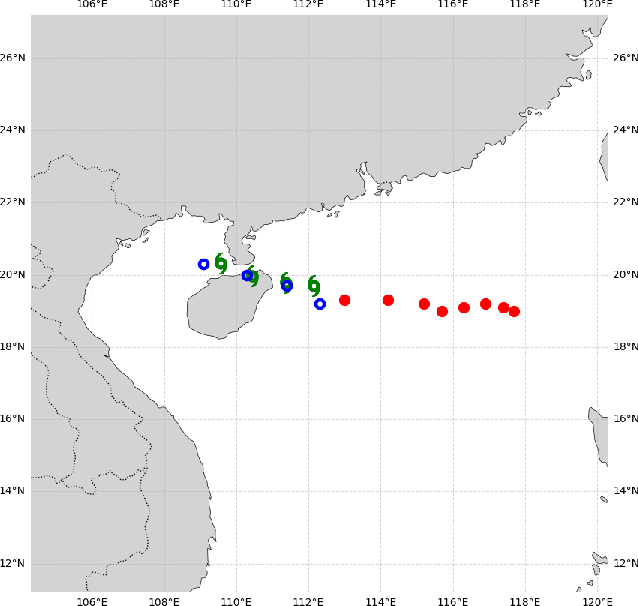
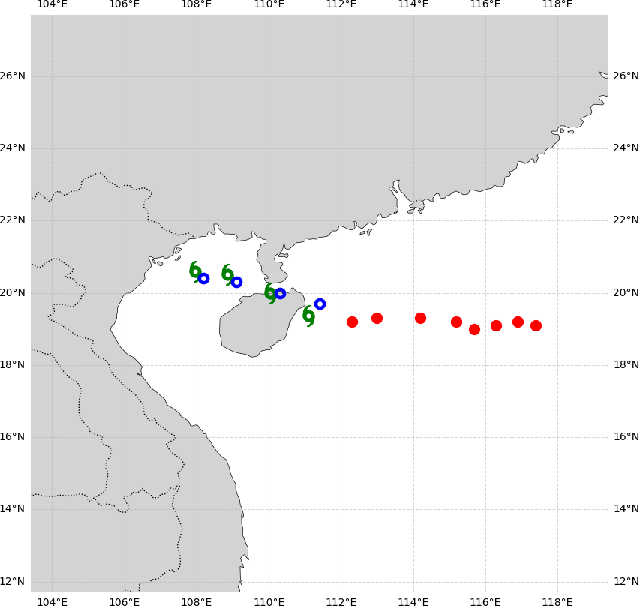
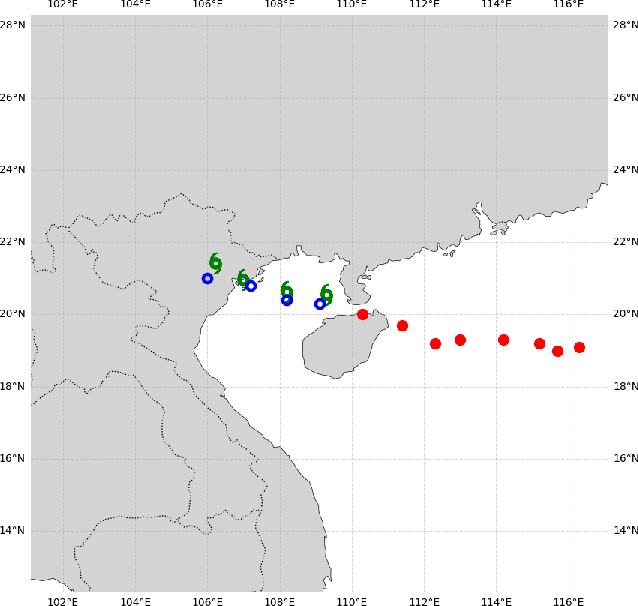
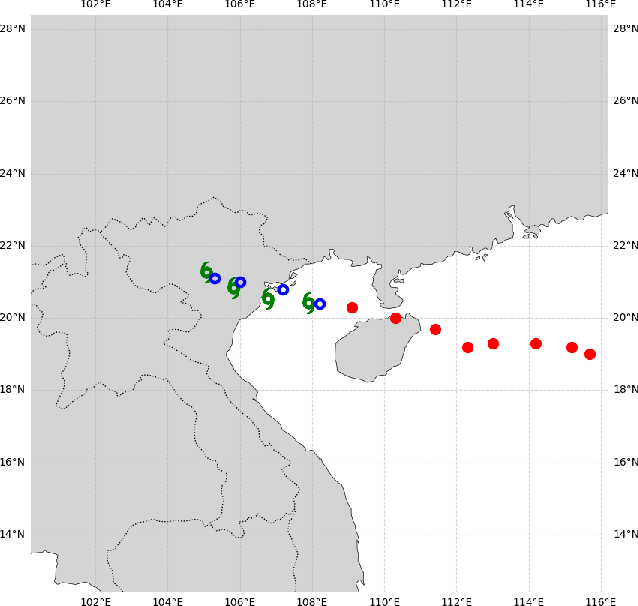
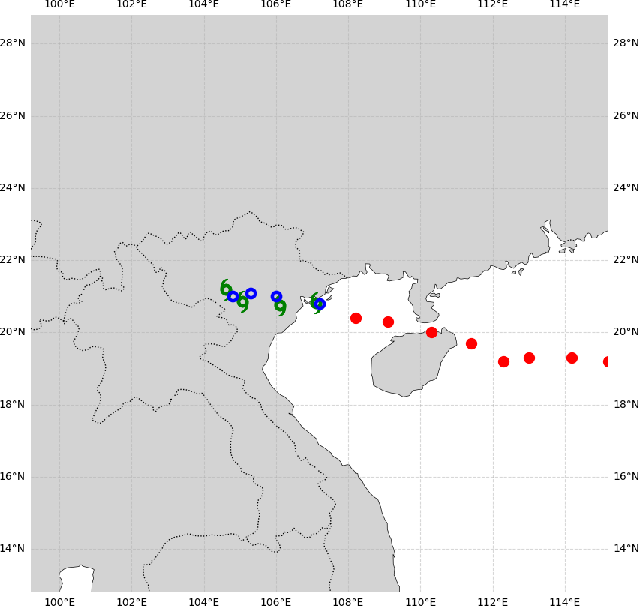
Figure 5: Time-sequential trajectory predictions for TC YAGI using AOT-TCNet—input (red), prediction (green), ground truth (blue).
Implications and Future Directions
This study provides a robust multimodal DL framework for coupled atmosphere-ocean-terrain TC forecasting, with explicit physical interpretability and competitive accuracy in challenging anomalous-track scenarios. The integration of TMA-MoE and the AOT-TCs dataset advance both methodological and operational capacity for rapid-response disaster mitigation.
Practically, the demonstrated robustness and efficiency suggest deployment in resource-constrained forecasting centers, enabling improved real-time prediction under climate change-induced variability and extremes. Theoretically, the architecture offers a template for further multi-physics fusion in high-impact weather events, and generative multi-expert design may extend to other domains characterized by strong multimodality and abrupt transitions.
Future research may converge on:
- Extending multimodal fusion to include additional geophysical variables (e.g., hydrological, biospheric).
- Upgrading ensemble prediction strategies with uncertainty quantification and probabilistic causality modeling.
- Integrating online learning for real-time adaptation as environmental data streams evolve under warming climate conditions.
Conclusion
AOT-TCNet, leveraging the comprehensive AOT-TCs dataset and a physically coupled mode-adaptive mixture-of-experts architecture, sets a new benchmark in TC forecasting, especially for abnormally deflecting scenarios. The approach significantly advances both short-term predictive accuracy and physical consistency, facilitating reliable operational deployment and laying a foundation for further innovation in multimodal geophysical forecasting (2603.29200).