- The paper introduces an algebraic framework defining polar matrices and products that are commutative and diagonalizable via the DFT.
- It establishes invertibility conditions (Aurora’s Theorem) ensuring robust operator design through rigorous spectral decomposition.
- The study demonstrates practical implications in enhancing model parallelism and rotation-equivariant deep learning performance on benchmarks like MNIST.
Foundations of Polar Linear Algebra: Algebraic, Spectral, and Computational Framework
Introduction
"Foundations of Polar Linear Algebra" (2603.28939) introduces a formal operator-theoretic and spectral linear algebraic framework for data and transformations defined on discrete polar grids. Motivated by the ubiquity of rotational symmetries in both natural and engineered signals, the framework develops tensor, product, and operator structures that respect the cyclic, periodic nature of the angular domain, while decoupling it from the linear, non-cyclic radial dimension.
The work is notable for its explicit algebraic formalization, operator-classification results (commutativity, diagonalizability), foundations for invertibility (Aurora's Theorem), and practical consequences for the architecture, training, and parallelization of rotation-equivariant deep learning models. The author systematically demonstrates that designing operators and neural architectures aligned with polar and spectral structure leads to interpretable parameterizations, provable algebraic guarantees, and significantly more parallel computational pipelines.

Figure 1: A natural example of polar symmetry: a pomegranate cross-section. Radial layers and angular segmentation align with a polar grid.
Algebraic Structure: Polar Matrices, Products, and Symmetries
The central mathematical innovation is the formalization of polar matrices A[r,θ], where r indexes radial levels and θ indexes discrete angular samples. The key operator—the polar product ⊗—is defined as a radius-wise circular convolution along the angular dimension:
(A⊗B)[r,θ]=k=0∑Nθ−1A[r,k]B[r,(θ−k)modNθ]
This operator satisfies linearity, commutativity (Elisa's Theorem), and associativity, forming a commutative algebra. The analogous polar transpose ATp reflects angular indices, while self-adjointness is characterized as polar symmetry with respect to angular inversion. The algebra mirrors classical structures, yet enforces angular periodicity at all levels.
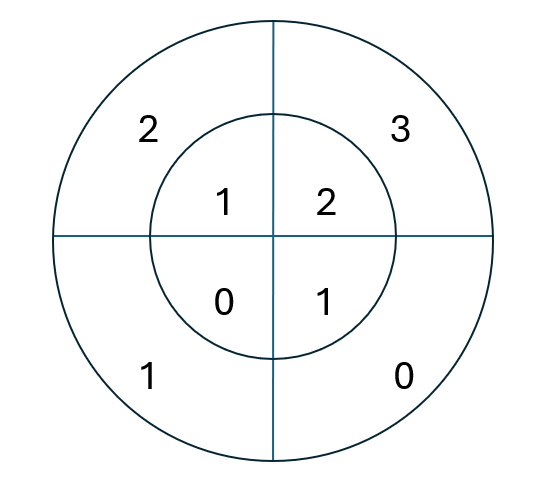
Figure 2: A polar matrix represented in its natural radial–angular form. The inner ring contains values (2,1,0,1) and the outer ring (3,2,1,0).
Spectral Theory: Fourier Diagonalization and Invertibility
A fundamental consequence of the polar product structure is that angular circular convolution is diagonalized by the discrete Fourier transform (DFT). Each operator decomposes into independent frequency-wise actions on the angular spectrum per radius, with the Fourier basis providing a simultaneous diagonalizer for the entire commutative operator algebra.
Aurora's Theorem formalizes invertibility: a polar matrix is invertible under the polar product iff none of its angular DFT coefficients vanish at any (r,m), with the polar inverse given spectrally as
A−1[r,θ]=Fθ−1(A^[r,m]1)[θ]
This provides both an algebraic and computational guarantee for information preservation, critical for constructing stable linear and nonlinear learning architectures.
Operator Basis and Equivariance
The work further proves that all rotation-equivariant linear operators (i.e., those commuting with angular shifts/rotors) must be circular convolutions and therefore belong to the algebra generated by the polar product and the set of angular rotors. This result, a direct consequence of spectral diagonalization and commutativity, gives a minimal and complete parameterization for linear rotation-equivariant models: only the angular Fourier spectrum per radius needs to be learned.
Self-adjointness, analyzed via Chiara's Theorem, ensures real-valued spectra and is shown to play a dual role as an inductive bias that improves optimization dynamics, convergence rates, and interpretability, without reducing expressivity.
Computational and Parallelization Implications
By construction, the polar algebra naturally exposes model parallelism beyond traditional data and expert parallelism. Radial and angular (frequency) indices decompose independently, enabling spectral tensor parallelism. FFT-based implementations of the polar product reduce asymptotic computational complexity from r0 to r1, and all learning steps (including gradient propagation) can be performed efficiently in the spectral domain.
This structure, unique to the polar framework, becomes increasingly impactful as signal or model resolution grows, or in settings where many independent operator instances are trained or composed.
Neural Operator Realization and Empirical Validation
The paper presents a fully explicit implementation pipeline for polar tensors, spectral/convolutional operators, and rotor-based symmetries, including minimal Python code and guidance for integration into learning frameworks. Dense and convolutional layers are shown to decompose frequency-wise in the angular spectral domain. Notably, nonlinearities (activation operators) are replaced by structured angular gates—periodic convolutional modulations—further reinforcing the geometric consistency of the spectral pipeline.
The framework is validated on the MNIST benchmark. Despite the simplicity of the dataset, strong performance is achieved with compact, parameter-efficient models relying solely on a small set of low-frequency polar modes for classification. Transitioning from spatially hybrid to fully spectral, and finally self-adjoint-inspired architectures, the author demonstrates that increasing alignment with polar–spectral structure yields improved convergence, more rapid early learning, and stable generalization. Empirical results (e.g., 96.5% MNIST accuracy in the self-adjoint-inspired model) are competitive with spatial baselines.
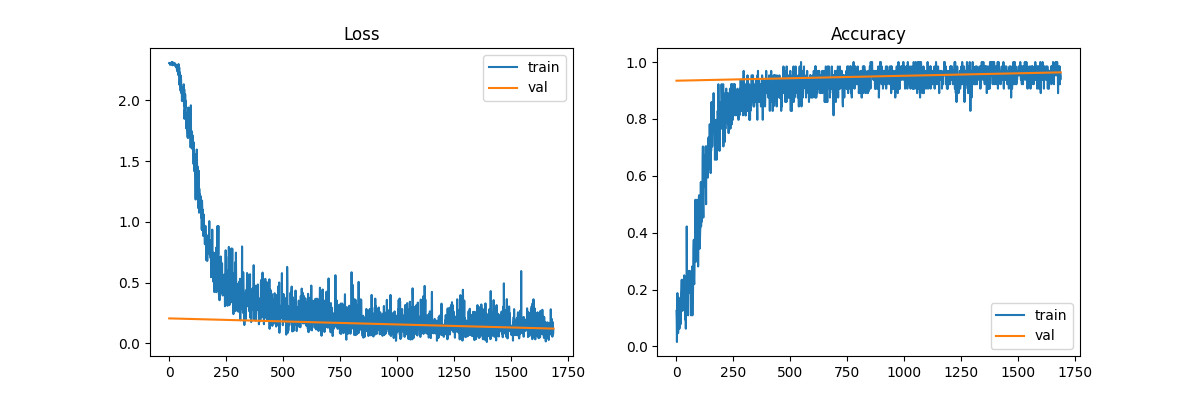
Figure 4: Training and validation curves (loss and accuracy) for the MNIST PolarFNO proof-of-concept. The horizontal axis tracks training progression, and the vertical axes show the corresponding loss and accuracy values.
Spectral Nonlinearities: Periodic Gates
Nonlinear gating in the spectral domain is implemented using periodic, fixed, band-limited convolutional operators, replacing conventional value-wise activations. These spectral gates are shown to enhance numerical stability and regularity, aligning the nonlinear component of the network with the polar operator algebra and preventing destructive low-mode attenuation or feature explosion.
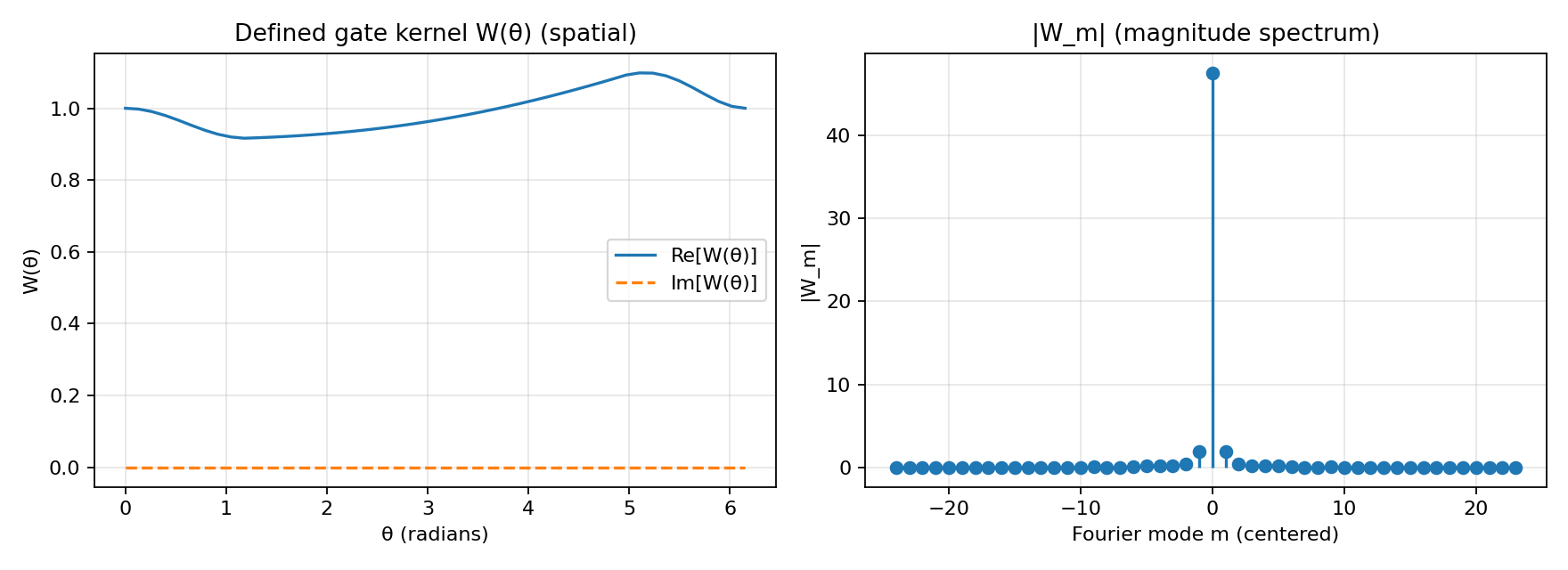
Figure 6: Periodic spectral gate used in the self-adjoint experiment. The left panel shows the spatial domain r2; the right shows the magnitude of corresponding Fourier coefficients r3.
Theoretical and Practical Implications
The framework provides several significant implications:
- Operator-Theoretic Foundation for Rotation-Equivariant Models: The commutative algebraic structure enables full characterization and parameterization of any rotation-equivariant linear model, with guaranteed invertibility and norm-preservation under standard regularity conditions. These properties transfer directly to learning pipelines, enhancing both expressivity and training stability.
- Model Parallelism: Modal and radial decoupling offers a canonical model-parallelization axis, facilitating scalable deployment on contemporary hardware. Frequency-wise learning, both theoretically and empirically, leads to rapid, robust optimization.
- Spectral Interpretability: Learned parameters admit direct interpretation as frequency response maps in the angular domain, aiding in understanding and regularizing model behavior.
- Nonlinearity and Regularization: The framework forces reconsideration of nonlinearity in learning, replacing value-based activations with directionally structured, interpretable gates in the frequency domain.
Future Directions
Potential developments include extending the framework to multiple angular dimensions or additional non-commutative symmetry groups, constructing more sophisticated self-adjoint and normal operator classes, and scaling to high-resolution or multi-channel, multi-modal settings. The theoretical guarantees on invertibility, stability, and parallelism provide a foundation for further investigations into spectral operator learning and its limits in both classical and deep learning contexts.
Conclusion
This paper establishes a structured algebraic and spectral framework for polar linear algebra, fully characterizing the space of polar domain operators, their spectral diagonalization, and their practical role in rotation-equivariant learning. The formal results—including the invertibility criterion (Aurora's Theorem), commutativity and simultaneous diagonalizability (Elisa's Theorem), and self-adjoint spectral structure (Chiara's Theorem)—are reinforced by explicit implementation and strong empirical performance. The polar formulation provides not only a provably robust foundation for angular-structured operator learning, but also exposes new directions for parallelization and model design that emerge from foundational mathematical properties rather than ad hoc heuristics.