- The paper provides a rigorous asymptotic formula for murmuration densities in families of Hecke newforms with prime power levels.
- It employs a synthesis of the Eichler–Selberg trace formula and prime equidistribution techniques for sparse moduli to achieve precise error estimates.
- The study reveals oscillatory behavior in the density plots, validating Sarnak’s heuristics and deepening insights into automorphic L-functions.
Murmurations in the Depth Aspect: An Asymptotic Analysis
Introduction and Context
This paper considers the phenomenon of "murmurations" in families of L-functions, with a particular focus on the arithmetic "depth aspect"—namely, sequences of Hecke eigenforms of fixed weight k and level N given by a large power of a fixed odd prime ℓ, i.e., N=ℓa with a→∞. Murmurations refer to the emergence of structured, oscillatory patterns in statistics averaged over large arithmetic families, such as correlations between signs of functional equations (root numbers) and Hecke eigenvalues, when parameterized by arithmetic invariants such as level, weight, or spectral parameter.
While murmurations have previously been studied and experimentally observed in various aspects (e.g., level, weight, and for elliptic curves) [z23, hlop, BLLDDSHZ, bbld], the theoretical analysis of their behavior as the arithmetic depth (i.e., the exponent a in N=ℓa) becomes large remained open. This work provides a direct computation of the limiting murmuration density in this regime, rigorously establishing an explicit formula for the corresponding limiting object. The approach synthesizes trace formula technology and arithmetic harmonic analysis, notably leveraging the Eichler–Selberg trace formula for modular forms of high prime power level.
Definition and Main Theorem
Let Hknew(N) be a Hecke basis of newforms of weight k and level k0, and let, for each k1, k2 denote its root number and k3 its normalized k4th Hecke eigenvalue. For a fixed window k5 and as k6, consider the murmuration density:
k7
where k8 is an explicit normalizing factor.
The main theorem provides the asymptotic formula as k9 for odd exponents: N0
where N1 denotes the N2nd Chebyshev polynomial of the second kind.
This density is an explicit oscillatory integral, its arithmetic content manifest in the product over primes and the combinatorial weights appearing in the sum and the integrand.
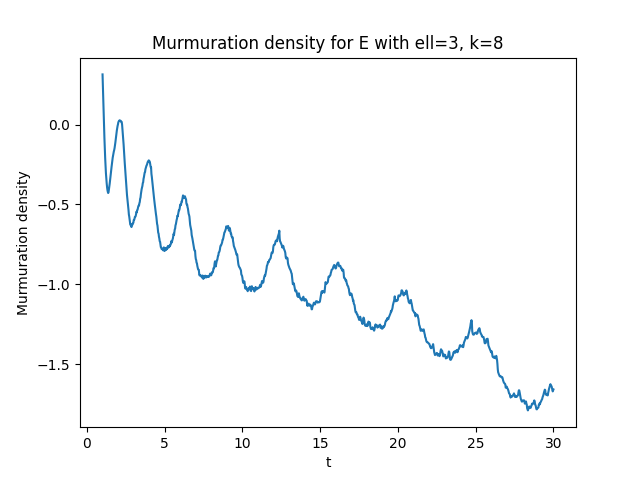
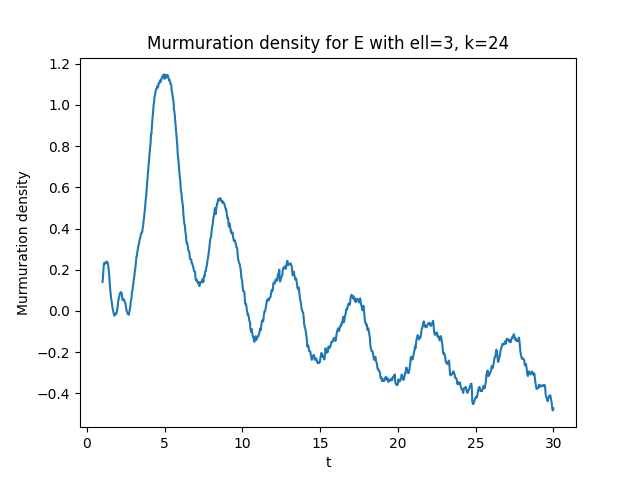
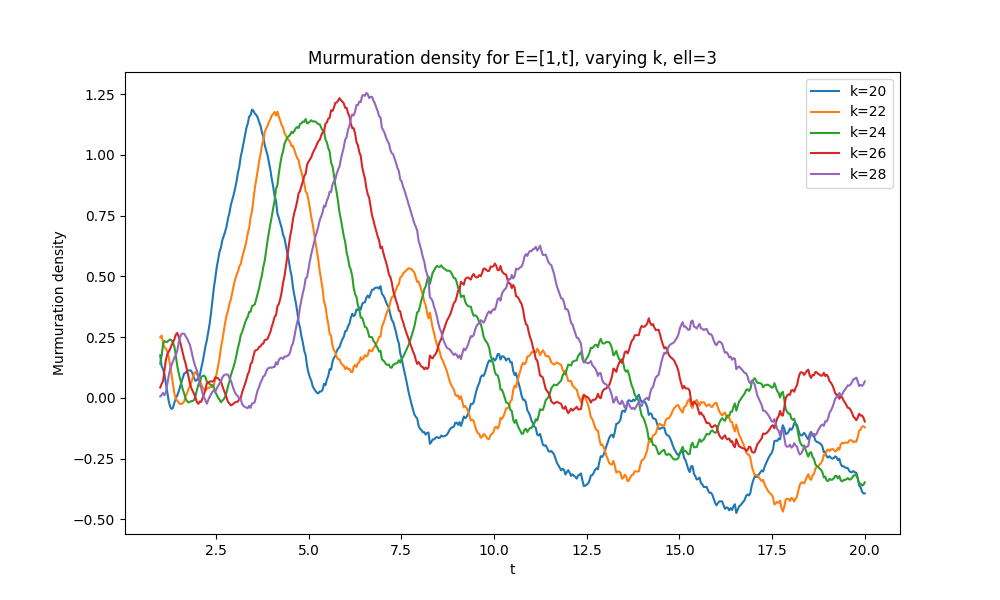
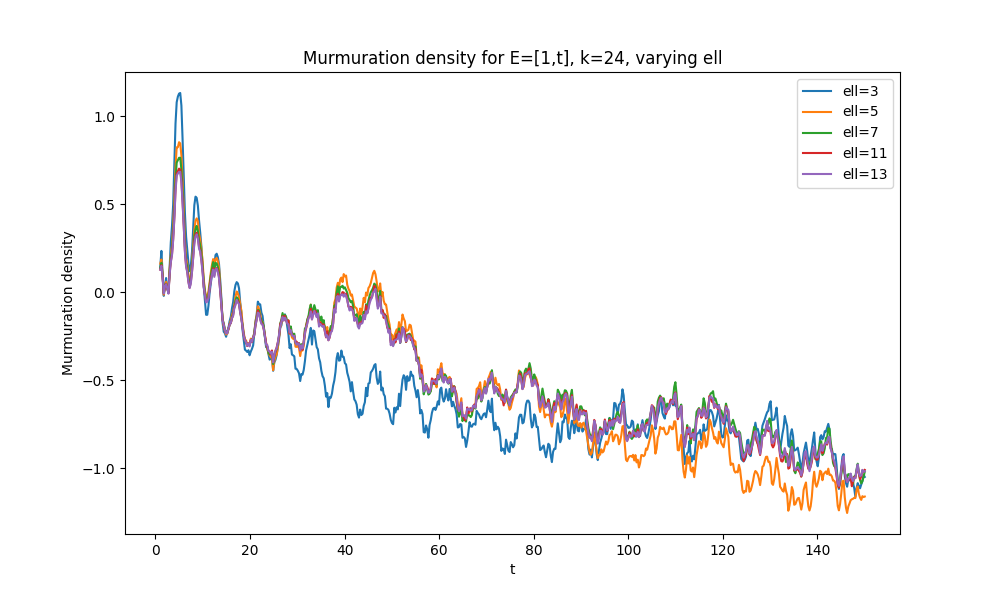
Figure 1: Plots of the asymptotic murmuration density function in Theorem 1 for various N3, N4, and window N5.
Analytical Techniques
The proof of the main theorem is achieved by synthesizing trace formula methods and analytic techniques for sums of primes in sparse progressions. The core approach involves:
- Trace Formula Evaluation: The first key reduction is expressing the core sum over newforms and Hecke eigenvalues via a variant of the Eichler–Selberg trace formula, particularly in the presence of an Atkin–Lehner involution at high power levels. The calculation specializes to new (twist-minimal) forms at levels N6, strategically chosen to minimize complications from oldforms.
- Arithmetical Decomposition: The trace formula outputs are then decomposed explicitly into sums involving Ramanujan sums, Chebyshev polynomials, and class numbers (or equivalently, Dirichlet N7-values), with precise arithmetic weights. Multiplicative extensions and local average behaviors are carefully analyzed (e.g., by relating averages involving discriminant twists and Kronecker symbols to shifted convolution sums over primes).
- Bombieri–Vinogradov Theorem for Sparse Moduli: The evaluation of prime sums requires uniform equidistribution estimates for primes in arithmetic progressions to square moduli, a scenario where the moduli are particularly sparse (as all are squares of integers). The requisite version of Bombieri–Vinogradov for square moduli [MR3670199-baker] is deployed to obtain strong average-error bounds, providing unconditional results. Where applicable, conditional improvements based on GRH are discussed, with error terms in the density sharpened accordingly.
Numerical and Phenomenological Observations
Theoretical expressions are supplemented by plots of the limiting densities for various combinations of N8, N9, and integration windows ℓ0. Notable features observed include:
- Oscillatory Behavior: The density plots are highly oscillatory, with the structure and apparent "fuzziness" reflecting the piecewise nature of the t-sum and the Chebyshev polynomial in the integrand.
- Distributional Effects: For larger ℓ1, oscillations become more uniformly distributed about the real axis, indicating increased cancellation at high weight.
- Window Stabilization: Broader integration windows ℓ2 yield smoother large-scale features, suggesting averaging over a wider spectral range attenuates micro-oscillations.
These observations are consistent with the heuristic insights outlined by Sarnak and explored experimentally in previous work [sarnak, bbld].
Theoretical Implications
The main results extend the conceptual framework for murmurations in automorphic families to the depth aspect. Key implications include:
- The explicit computation confirms Sarnak’s general philosophy: the nature of the averaging (windowing over the prime or level aspect) is dictated by the growth rate of the family’s analytic conductor.
- The formulas obtained showcase the deep interplay between trace formula combinatorics, prime distribution in specialized progressions, and special values of ℓ3-functions.
- The error analysis demonstrates that unconditional results of analytic number theory—specifically, strong average theorems for primes in sparse progressions—are sufficient for precise asymptotics in this context, reducing reliance on unproven hypotheses like GRH.
Practical Consequences and Future Directions
From a computational standpoint, the direct calculation of ℓ4 for experimentally relevant ℓ5 is limited by the paucity of precomputed data for very high-level newforms in databases such as the LMFDB. This restricts the empirical verification of the asymptotic regime. However, the present results clarify the theoretical asymptotics and should guide future computational and theoretical explorations.
Future avenues include:
- Interpretation of the observed oscillatory structure, particularly understanding the emergence and distribution of large deviations in the density plots.
- Extension to more general families (e.g., non-prime power levels, other reductive groups) and to joint aspects (e.g., combined weight and depth growth).
- Further statistical or probabilistic modeling of the limiting densities, potentially connecting to random matrix heuristics or non-vanishing results for ℓ6-functions.
Conclusion
This paper establishes the limiting structure of murmuration densities in the arithmetic depth aspect for families of Hecke newforms with prime power levels. Through a detailed application of the Eichler–Selberg trace formula and advanced prime equidistribution theorems in sparse progressions, the authors provide an explicit and computable formula for the asymptotic density. The observed fine oscillations, their dependency on arithmetic data, and the analytic techniques used, lay the groundwork for further developments in the statistical analysis of automorphic ℓ7-functions and their families.
References:
- "Murmurations in the depth aspect" (2603.25564)
- Zubrilina, "Murmurations" [z23]
- Bober et al., "Murmurations of modular forms in the weight aspect" [bbld]
- He et al., "Murmurations of elliptic curves" [hlop]
- Baker, "Primes in arithmetic progressions to spaced moduli. III" [MR3670199-baker]
- Sarnak, "Letter to Drew Sutherland and Nina Zubrilina on murmurations and root numbers" [sarnak]

