- The paper presents an O(n log n) algorithm for 4-coloring planar graphs, significantly reducing the previous O(n²) bound.
- It leverages linearly many disjoint D-reducible configurations and deterministic Kempe chain extensions to efficiently decompose and color the graph.
- The method offers new structural insights into planar triangulations and paves the way for future research on general surfaces and parallel algorithms.
Near-Linear Time 4-Coloring of Planar Graphs via Linearly Many Reducible Configurations
Overview
The paper "The Four Color Theorem with Linearly Many Reducible Configurations and Near-Linear Time Coloring" (2603.24880) presents a substantial theoretical and algorithmic advance in 4-coloring planar graphs. The authors provide the first algorithm achieving O(nlogn) time for 4-coloring planar graphs, improving on the O(n2) bound previously set by Robertson, Sanders, Seymour, and Thomas (RSST, 1996).
They achieve this by proving that every planar triangulation contains linearly many pairwise non-touching, D-reducible configurations or non-crossing obstructing cycles of constant length, allowing the problem size to be reduced by a constant fraction in each recursion. This yields not only the improved algorithmic bound but also offers stronger structural insights into planar graphs and the Four Color Theorem (4CT).
Structural Extension of the Four Color Theorem
A central structural result is that, contrary to prior approaches (which established only the existence of one reducible configuration or obstructing cycle per minimal counterexample), every planar triangulation in fact contains linearly many such configurations or cycles. The classic proofs rely on the discharging method and combinatorial curvature, but these only guarantee reducibility in regions of positive curvature.
The authors show that reductions extend robustly into “flat” regions (i.e., where the redistributed curvature is identically zero)—an area previously opaque with traditional curvature-based methods. This is nontrivial: planar triangulations arising from hexagonal tilings, for example, contain large flat zones, and the existence of a linear number of reductions in these regions essentially overcomes the bottleneck inherent in earlier combinatorial proofs.

Figure 1: A D-reducible configuration (Z,δ) with a cut-vertex and its free completion.
This insight generalizes the scope of reducibility and the inductive step in the 4CT from merely finding a constant-size reduction at each step, to obtaining many that are spatially well-separated.
Algorithmic Implications
The algorithm applies the following high-level strategy:
- Compute a set of linearly many disjoint D-reducible configurations or non-crossing obstructing cycles.
- Reduce the input by removing all reducible configurations, replacing their boundaries with new triangulations, and recurse.
- Upon unwinding recursion, extend the partial coloring to the removed configurations using local Kempe chain manipulations, taking advantage of their extendibility properties.
Key to efficiency is that all reductions found are D-reducible, which admits deterministic and robust coloring extensions after recursive calls via bounded sequences of Kempe chain changes. The division by a constant factor at each step ensures logarithmic recursion depth, and the restricted radius and size of the reducible configurations (maximum diameter 4, ring size at most 18) keeps extensions tractable.
The method for extending colorings over all removed configurations simultaneously leverages conditional expectations to deterministically choose Kempe changes that improve a linear fraction of the configurations at each stage, incurring only a logarithmic number of global color switches.
Configurations, Discharging, and Unavoidability
The core structural analysis builds on formal definitions of configurations as pairs (Z,δ) comprising a near-triangulation Z and a degree function δ, with conditions for embedding and induced substructure. Reducibility is formulated in terms of extendibility of 4-colorings across the “ring” of a configuration—made practical via computer enumeration and verification for all cases of interest.

Figure 2: Shapes used to designate vertices of specific degrees in configuration diagrams.
Historically, proofs used hundreds to thousands of configurations (Robertson et al.: 633; Steinberger: 2822 D-reducible), but here over 8200 distinct D-reducible configurations are used, handled by exhaustive computer verification. Robustness comes from the property that all configurations used are D-reducible (i.e., reduction does not rely on arbitrary colorings external to the configuration, as is the case with some C-reducible configurations). This is crucial for the parallel reduction strategy.

Figure 3: (a) Birkhoff diamond, (b) diamond with increased degrees, (c) Franklin's 6-regular configuration; classic reducible/C-reducible examples.
The new reduction theorem applies even in locally "flat" neighborhoods—where prior discharge theorems would be powerless—by considering neighborhoods of size up to 12 in diameter and deploying an expanded configuration set.
Decomposition into Disjoint Local Reductions
The authors formulate a local partitioning of the triangulation into neighborhoods (degree-bounded balls) such that:
- Each neighborhood of bounded radius contains either a non-touching D-reducible configuration or a non-crossing obstructing cycle.
- The system of neighborhoods collectively covers a linear fraction of the graph's vertices.
By careful analysis and computer-aided enumeration, they show that such decompositions are always possible, even after removing already-handled vertices with positive or high degree. They achieve this by recursive, local, and global accounting arguments.
Parallel and Distributed Implications
A natural question is whether the presence of many disjoint reductions admits efficient parallelization. The negative answer is supported by lower bounds in the LOCAL model [Chechik and Mukhtar, SODA 2019], requiring Ω(n) rounds for planar graph 4-coloring—even under the new structural theory—leaving little scope for direct parallel speedup.
Illustrative Example: Cartwheel and Flat Configurations
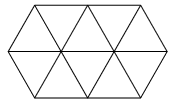
Figure 4: The configuration in D for the 6-regular (flat) case, necessary for reductions in large flat zones of triangulations.
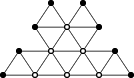
Figure 5: Exceptional configuration in D with radius 3 (diameter 4), manifesting in the analysis of reductions in neighborhoods with all degrees at most 7 or 8.
Key Technical Lemma: Derandomized Kempe Change Application
To ensure O(nlogn) coloring without randomization, the authors design a method using conditional expectations: at each step, the algorithm deterministically chooses color pairs and swaps for Kempe chains so as to maximize the expected number of configurations improved. The reduction of outstanding configurations by a constant fraction in each round leads to logarithmic convergence, with Kempe changes implemented by linear-time sweeps.
Computer-Assisted Proofs and Verification
The complexity of the combinatorial case analysis (more than O(n2)0 neighborhoods for full enumeration) necessitated computer verification. All source code and pseudocode for the case analyses and configuration checks are released, enabling independent auditing and rerunning on modern hardware within feasible time.
Implications and Future Directions
This work fundamentally strengthens the combinatorial structure underlying the 4CT, opening possibilities for further research in:
- Extending the approach to graphs on more general surfaces using analogous decompositions;
- Linear-time deterministic algorithms for 4-coloring via further data structure and algorithmic advances to handle Kempe chain changes more efficiently;
- Applying the method of “linearly many reductions” to other inductive proofs in structural graph theory and algorithm design.
The paper sets a new bar for both theoretical understanding and algorithmic tractability of coloring planar graphs.
Conclusion
The authors’ results mark a significant refinement in our understanding of provable local structure and efficient 4-coloring of planar graphs. By unlocking linearly many well-separated reductions, extending reducibility into flat regions, and tightly integrating combinatorial, algorithmic, and computational components, the paper advances both foundational theory and practice for graph coloring.
Figure 1: A D-reducible configuration O(n2)1 with a cut-vertex and its free completion.
Figure 2: Shapes used to designate vertices of specific degrees in configuration diagrams.
Figure 3: (a) Birkhoff diamond, (b) diamond with increased degrees, (c) Franklin's 6-regular configuration; classic reducible/C-reducible examples.
Figure 4: The configuration in O(n2)2 for the 6-regular (flat) case.
Figure 5: Exceptional configuration in O(n2)3 with radius 3 (diameter 4), manifesting in the analysis of reductions in neighborhoods with all degrees at most 7 or 8.
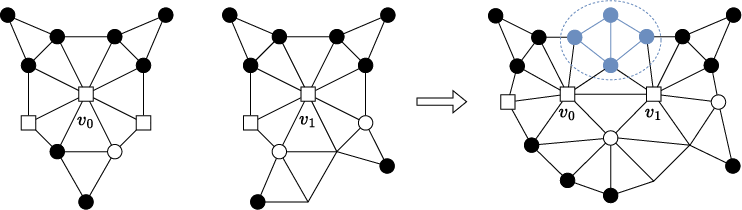
Figure 6: An example combining two cartwheels, neither of which contains a reducible configuration, but where the combination contains one (Birkhoff diamond).
References
- "The Four Color Theorem with Linearly Many Reducible Configurations and Near-Linear Time Coloring" (2603.24880)