Finite-Degree Quantum LDPC Codes Reaching the Gilbert-Varshamov Bound
Published 25 Mar 2026 in quant-ph and cs.IT | (2603.24588v1)
Abstract: We construct nested Calderbank-Shor-Steane code pairs with non-vanishing coding rate from Hsu-Anastasopoulos codes and MacKay-Neal codes. In the fixed-degree regime, we prove relative linear distance with high probability. Moreover, for several finite degree settings, we prove Gilbert-Varshamov distance by a rigorous computer-assisted proof.
The paper introduces a novel finite-degree quantum LDPC code construction that achieves the Gilbert-Varshamov bound using nested MN/HA codes.
It details a rigorous methodology with explicit parameter certifications, leveraging socket-based ensembles and computer-assisted proofs.
The approach paves the way for practical sparse decoders and inspires future research on spatially coupled variants.
Finite-Degree Quantum LDPC Codes Achieving the Gilbert-Varshamov Bound
Introduction and Context
The construction of quantum LDPC codes with both non-vanishing rate and extensive minimum distance has been a fundamental research goal in quantum information theory. Classical LDPC codes, since Gallager, are known for their capacity-approaching performance and linear minimum distance under certain regularity regimes. In the quantum domain, the Calderbank-Shor-Steane (CSS) framework has allowed the translation of classical codes into quantum error-correcting codes (QECCs), with the Hypergraph Product construction by Tillich and Zémor yielding codes with distance scaling as Θ(n) at constant rate. More recently, constructions by Panteleev-Kalachev and Dinur-Hsieh-Lin-Vidick, and the quantum Tanner codes by Leverrier-Zémor, have provided explicit families of LDPC-QECCs with asymptotically positive rate and linear distance.
This paper develops a novel LDPC-based quantum CSS code construction that—at strictly finite, bounded degrees—provably achieves the quantum Gilbert-Varshamov (GV) bound, not just in an asymptotic or large-degree regime, but with concrete parameter sets certified by computer-assisted proof. This is facilitated by a nested pairing of Hsu-Anastasopoulos (HA) codes and MacKay-Neal (MN) codes, with all matrices sampled from random regular (socket-based) ensembles. The construction framework, rate and distance analysis, and explicit finite-degree parameter certification set this paper apart from prior work.
Construction Framework and Structural Properties
The proposed family is based on nested CSS pairs (CX,CZ), where CZ (the Z-side code) is derived from HA design and CX (the X-side code) from a novel stacked MN structure. The principal ingredient is the design of extended and compressed parity-check matrices with hidden (auxiliary) and visible variables, ensuring the crucial nested property Row(AZ)⊆Row(AX) for the corresponding matrices.
The construction specializes to regular LDPC matrices and imposes a "balanced" condition to guarantee matching classical rates on both X and Z sides and a positive quantum rate. The random socket-based ensemble guarantees bounded graphical complexity and supports rigorous combinatorial enumerator analysis.
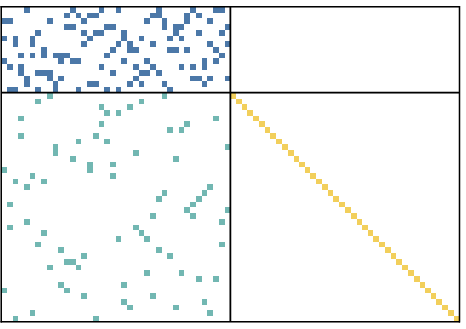
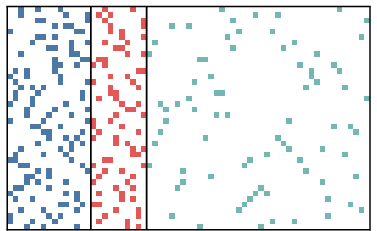
Example configuration: For (jZ,kZ,jΔ,kΔ,k)=(3,8,2,8,2), n=40, mZ=15 (Z-checks), mΔ=10 (additional X-checks), mX=25 (total X-checks), the explicit matrix block structures are displayed in the following figures.
Figure 1: Z-side extended parity-check matrix for the illustrative example, showing the blockwise composition and variable partitioning.
Figure 2: X-side extended parity-check matrix for the same parameters, highlighting the stacked (MN-type) structure on the left-hand side.
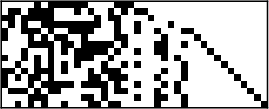
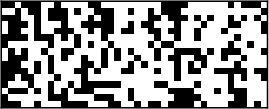
Compressed parity-check matrices (used for syndrome measurement and decoding) are obtained via projections and basis selection but are generally dense:
Figure 3: Z-side compressed parity-check matrix (CX,CZ)0 for the same parameters, each row a generator of (CX,CZ)1.
Figure 4: X-side compressed parity-check matrix (CX,CZ)2 with rows as generators of (CX,CZ)3.
The design rates for these codes coincide with the asymptotic rates, as proved via probabilistic convergence, and the quantum rate is given by (CX,CZ)4 under the homogeneous balanced condition ((CX,CZ)5).
Minimum Distance and Attainment of the Gilbert-Varshamov Bound
The paper provides full minimum-distance analysis for both the HA and MN sides:
HA Side (Z-Code)
A rigorous first-moment argument extends Hsu-Anastasopoulos's classical linear-distance analysis to the present regular ensemble. Enumerative bounds make explicit use of the socket-based configuration model to count the number of low-weight logical operators. For all fixed parameters in a finite set of balanced degree triples, the minimum distance is shown to approach the classical GV bound with high probability as blocklength (CX,CZ)6.
MN Side (X-Code)
The X-code, being a stacked-structure MN code (not a standard regular ensemble), requires new enumerator decompositions to account for the block composition. Similar first-moment and combinatorial pairing bounds are developed and proved, controlling both the low-weight (via pairing arguments) and linear-weight (via trial exponent bounds) regimes. Completeness is ensured by an exact analytic reduction to finite-dimensional exponent negativity checks, certified by rigorous computer-assisted methods.
Certified degree sets include:(CX,CZ)7, all with blocklength-independent, finite degrees.
CSS Minimum Distance
The relative minimum distances of the CSS code are then bounded below by those of their classical constituents, and for balanced triples with both HA and MN sides attaining their classical GV points at finite degree, the CSS code achieves the quantum GV bound already for these explicit degree choices, not only asymptotically. The design quantum rate enters exactly as in the Calderbank–Shor–Steane existence bound.
Numerical Results and Certified Parameter Examples
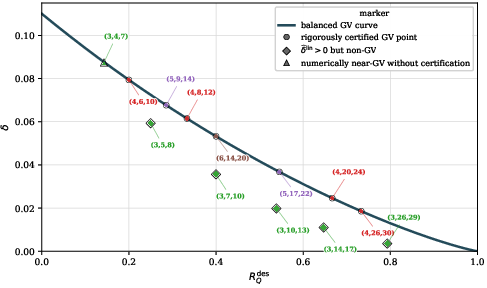
Numerical proxy analysis is provided for the finite-degree linear-distance thresholds, rigorously establishing that, at low degrees (e.g., (CX,CZ)8, (CX,CZ)9), the certified triples lie precisely on the quantum GV trade-off given by CZ0.
Figure 5: Comparison between the finite-degree numerical proxy CZ1 and the Gilbert-Varshamov curve for small balanced triples, indicating parameter regions with certified (circles), near-GV (triangles), and non-GV (red points) performance.
Practical and Theoretical Implications
The construction shows that quantum LDPC codes with bounded degree—and thus truly sparse decoders—can saturate the quantum Gilbert-Varshamov bound at moderate, explicit degrees. This challenges previous narratives that only asymptotically large or growing degrees could achieve such performance. It provides extremely strong evidence (including computer-assisted theorem proofs) that nested MN/HA constructions are not merely asymptotically good but "finitely good": at practical blocklengths and realistic hardware constraints, high-performance quantum LDPC codes with certified properties are constructible.
On the decoding side, while the syndrome measurement matrices are generally dense — complicating belief-propagation (BP) decoding — the authors clarify that after syndrome injection, the recovery equations can be rewritten into sparse affine systems preserving bounded graphical complexity. The main open problem is the practical design of BP decoders operating directly on the measured (compressed) syndromes, which, in the present framework, remains unresolved due to the adjacency structure of check nodes.
The modular independence of the blocks CZ2, CZ3, and CZ4 preserves substantial degree/girth design flexibility, relevant for future attempts at optimizing not only distance and rate, but also cycle structure for improved iterative decoding performance.
Prospective Directions
A natural extension would be the development of spatially coupled variants of the nested family, inheriting the threshold saturation and universality properties from the classical domain (multi-edge LDPCs, SC-MN, SC-HA) and seeking to resolve the practical decoding bottleneck for quantum LDPCs. Early work in this direction already indicates compatible improvements in threshold and girth, and such variants could combine the present framework's bound saturation with scalable, efficient decoding strategies.
Conclusion
This work establishes, with full rigor and explicit finite-degree construction, that nested CSS quantum LDPC codes based on regular MN/HA matrices can exactly achieve the quantum Gilbert-Varshamov bound in distance-rate trade-off at bounded degree, with all underlying matrices sampled from standard socket-based random regular ensembles. This result closes a significant gap in both existential and practical design theory for quantum LDPC codes, and lays groundwork for genuinely sparse, high-rate, high-distance quantum error correcting codes.