The Economics of War: Militarization and Growth in an AK Economy
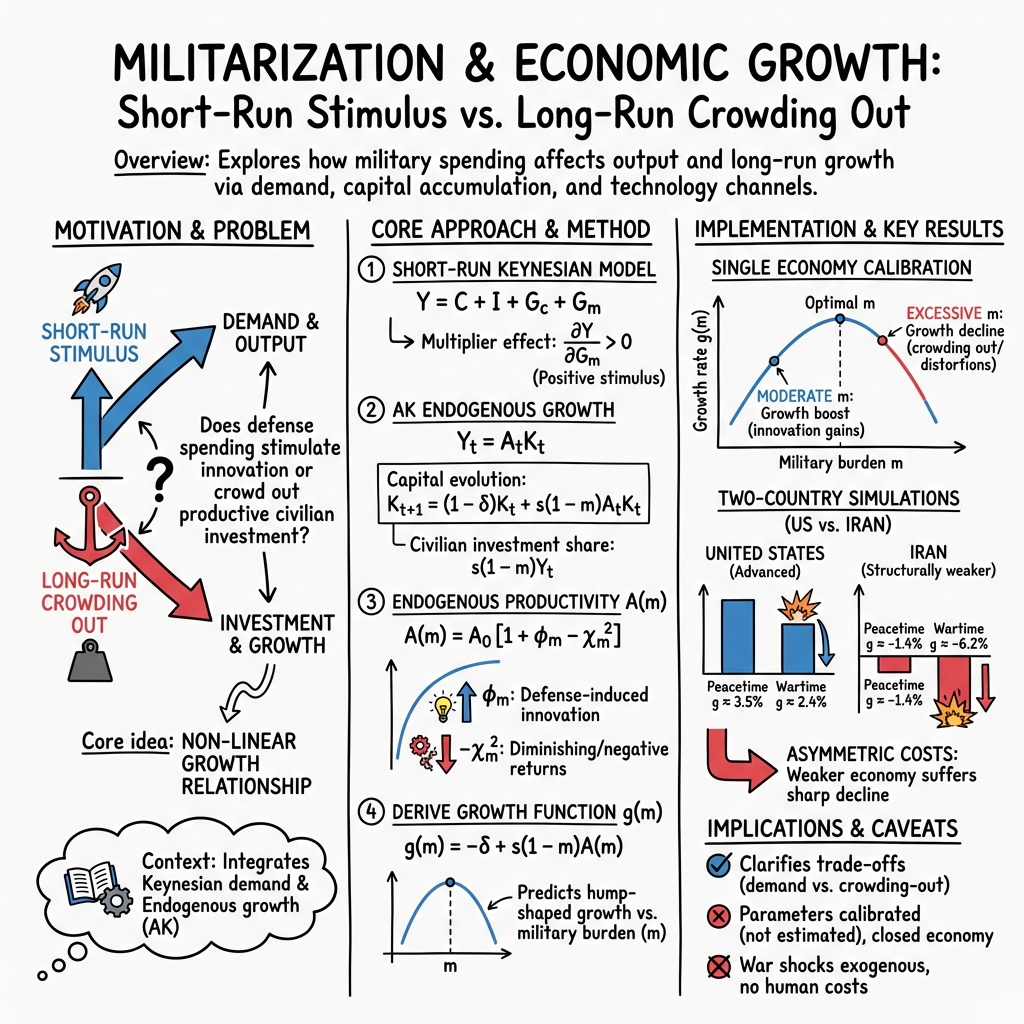
Abstract: This paper analyzes the macroeconomic consequences of military spending and militarization within a dynamic growth framework. Building on a Keynesian goods-market model, we examine how the allocation of government expenditure between civilian and military sectors affects capital accumulation and technological progress. Military spending generates opposing effects: it stimulates aggregate demand and may support innovation through defense-related research, but it also crowds out civilian investment and creates structural rigidities. We formalize these mechanisms in a stylized endogenous-growth model in which productivity depends on the degree of militarization, producing a non-linear relationship between the military burden and long-run growth. Calibrated simulations show that moderate levels of military spending can temporarily support growth, whereas excessive militarization reduces long-run development. We further illustrate the asymmetric growth costs of conflict using a simple two-country war simulation between an advanced economy and a sanctioned middle-income economy.
Paper Prompts
Sign up for free to create and run prompts on this paper using GPT-5.
Top Community Prompts
Explain it Like I'm 14
Overview
This paper asks a big question: how does spending more money on the military affect a country’s economy, both right now and in the long run? The author builds simple economic models to show that military spending can give the economy a short-term boost, but if it gets too big for too long, it can slow down long-term growth. The paper also compares what happens in a war to a rich, advanced country versus a middle-income country under sanctions.
What questions does the paper ask?
The paper focuses on three easy-to-understand questions:
- In the short run, does higher military spending help an economy by creating jobs and demand?
- In the long run, does putting more money into the military help or hurt growth, especially compared to spending on civilian things like schools, health, and infrastructure?
- During a war, do rich and poorer countries suffer the same economic costs from higher military spending and destruction?
How does the paper study the problem?
The paper uses two linked approaches, one for the short run and one for the long run, and then runs simple computer simulations to see what could happen under different levels of military spending.
Short run: a “demand” model
- Think of the economy like a car that needs fuel to move. The “fuel” is total spending: what families buy (consumption), what businesses buy (investment), and what the government buys (both civilian and military).
- In this view, if the government suddenly spends more on the military, it is like pressing the gas pedal—the car speeds up. Economists call this the “multiplier” effect: one person’s spending becomes another person’s income, which becomes more spending, and so on.
- Bottom line in the short run: more military spending usually raises output and jobs, especially when the economy is weak.
Long run: a growth model (“AK” model)
- For the long run, the paper uses a simple growth model where the economy’s output depends on how much “capital” it has—machines, buildings, and know-how. You can picture the economy as an engine that grows faster when you invest more in it.
- Key idea: Every dollar can go to either military needs or civilian needs. Only civilian investment (like building factories, upgrading power grids, training workers) grows the engine that makes future goods. If too much goes to the military, less is left to grow the engine—this is called “crowding out.”
- But there’s a twist: some military spending can help technology (think GPS, the internet, aerospace). So the paper lets productivity depend on militarization: a little bit of defense spending can push innovation up, but too much can twist the economy toward narrow military uses and secrecy, hurting overall progress.
- When you combine these effects, you get a hump-shaped relationship: a small-to-moderate military share can support growth, but high militarization slows it down.
Simulations (“what-if” experiments)
- The author “calibrates” the model—picks reasonable numbers for things like how much people save, how fast machines wear out, and how much defense spending helps or hurts productivity.
- The simulations show how growth changes as the military share of the economy goes up.
- The paper also simulates a simple two-country case—an advanced economy (like the US) and a middle-income economy under sanctions (like Iran)—to see how war (higher military spending plus destruction of capital) affects each.
What are the main findings?
Here are the central results, explained simply:
- Short run: More military spending raises demand and can lift output and jobs when the economy is sluggish. It works like a jump-start.
- Long run: There’s a trade-off.
- At low-to-moderate military spending, growth can be helped by defense-related innovation.
- At high military spending, growth falls because civilian investment is squeezed and technology gets pulled in narrower directions. The result is a hump-shaped curve: growth rises at first with militarization and then falls after a point.
- “Permanent war economy”: If a country keeps military spending above the growth-maximizing level for political or institutional reasons, it locks itself into lower long-term growth.
- Two-country war example:
- Advanced economy (like the US): In peace, long-run growth is healthy. In war, higher military spending and some destruction reduce growth but keep it positive. The country is resilient because it saves more, has higher productivity, and turns defense R&D into broader innovations more efficiently.
- Middle-income, sanctioned economy (like Iran): In peace, growth is already weak or slightly negative in the model. War pushes military spending very high and adds destruction. Growth drops sharply into negative territory, meaning the economy shrinks year after year.
- Why this matters: The same level of militarization can be manageable for a rich, diversified economy but dangerous for a weaker one. War imposes asymmetric costs: the weaker side suffers much more.
Why are these results important?
- For policymakers: Military budgets can boost the economy in recessions, but relying on high military spending for long periods can slow future growth by cutting into civilian investment. There is likely a “sweet spot” that is lower than what a permanent war economy requires.
- For development: Countries with lower productivity, lower savings, and more vulnerability to damage are hit harder by war and high militarization. For them, shifting resources toward education, health, infrastructure, and civilian R&D can make a bigger difference for long-run prosperity.
- For public debate: The paper gives a clear, theory-based way to think about the trade-offs—security and some innovation benefits versus lost civilian investment and distorted technology paths.
Key terms in simple words
- Militarization: Making a larger share of the economy focus on defense and the military.
- Crowding out: When more money goes to one thing (military), less is left for others (schools, hospitals, roads), which can slow future growth.
- Productivity: How much output you get from your inputs. Higher productivity means getting more done with the same resources.
- Depreciation: Wear and tear—machines and buildings become less useful over time and need replacing.
- AK model: A simple growth model where output grows in direct proportion to capital. Think of it as: the more you invest, the faster you can grow, without assuming big slowdowns from “running out of easy gains.”
Final takeaway
Military spending is a bit like medicine: a small, well-timed dose can help when the economy is weak, and some defense R&D can spark innovation. But too much, for too long, can harm the economy’s long-term health by starving civilian investment and bending technology in less useful directions. In wars, rich and diversified economies can absorb the hit better, while weaker, sanctioned economies can face deep and lasting damage. The challenge for leaders is to balance security needs with sustained investment in the civilian foundations that make economies grow.
Collections
Sign up for free to add this paper to one or more collections.

