Rethinking MLLM Itself as a Segmenter with a Single Segmentation Token
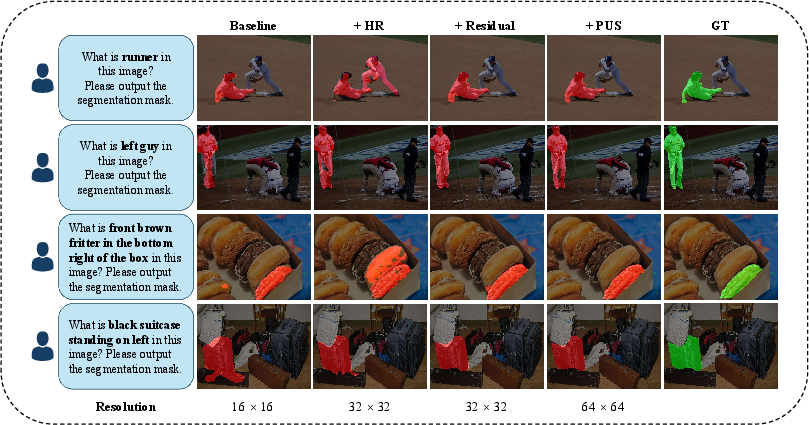
Abstract: Recent segmentation methods leveraging Multi-modal LLMs (MLLMs) have shown reliable object-level segmentation and enhanced spatial perception. However, almost all previous methods predominantly rely on specialist mask decoders to interpret masks from generated segmentation-related embeddings and visual features, or incorporate multiple additional tokens to assist. This paper aims to investigate whether and how we can unlock segmentation from MLLM itSELF with 1 segmentation Embedding (SELF1E) while achieving competitive results, which eliminates the need for external decoders. To this end, our approach targets the fundamental limitation of resolution reduction in pixel-shuffled image features from MLLMs. First, we retain image features at their original uncompressed resolution, and refill them with residual features extracted from MLLM-processed compressed features, thereby improving feature precision. Subsequently, we integrate pixel-unshuffle operations on image features with and without LLM processing, respectively, to unleash the details of compressed features and amplify the residual features under uncompressed resolution, which further enhances the resolution of refilled features. Moreover, we redesign the attention mask with dual perception pathways, i.e., image-to-image and image-to-segmentation, enabling rich feature interaction between pixels and the segmentation token. Comprehensive experiments across multiple segmentation tasks validate that SELF1E achieves performance competitive with specialist mask decoder-based methods, demonstrating the feasibility of decoder-free segmentation in MLLMs. Project page: https://github.com/ANDYZAQ/SELF1E.
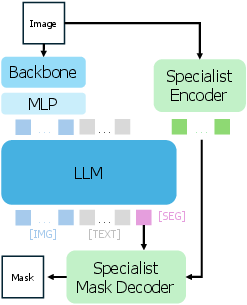
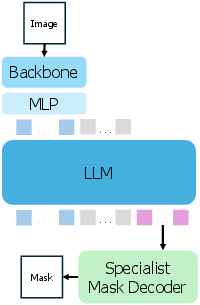
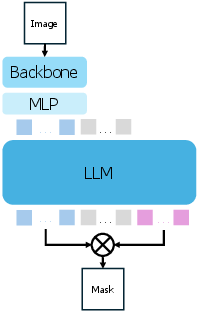
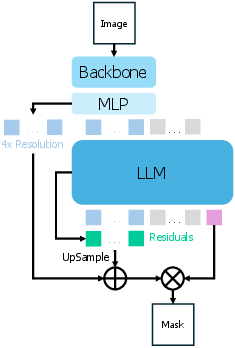
Paper Prompts
Sign up for free to create and run prompts on this paper using GPT-5.
Top Community Prompts
Explain it Like I'm 14
Rethinking MLLM Itself as a Segmenter with a Single Segmentation Token — Explained Simply
What is this paper about?
This paper shows how a big AI model that understands both pictures and text (an MLLM) can draw object masks in images by itself, using just one special “segmentation token,” and without any extra helper networks. The authors call their method SELF1E (read like “selfie”), short for “unlocking segmentation from the MLLM itself with 1 Embedding.”
Segmentation means coloring in exactly the pixels that belong to something in a picture, like “the dog” or “the person in a red hat.”
What questions are the researchers trying to answer?
They focus on three simple questions:
- Can a single special token be enough to segment objects, without using extra, specialized decoders?
- If yes, what stops current models from doing this well?
- How can we fix that problem while keeping the system simple and fast?
Their core idea: the main problem isn’t the single token—it’s that many MLLMs shrink image details to save space and speed, which hurts pixel-precise masks.
How did they do it? (Methods in everyday language)
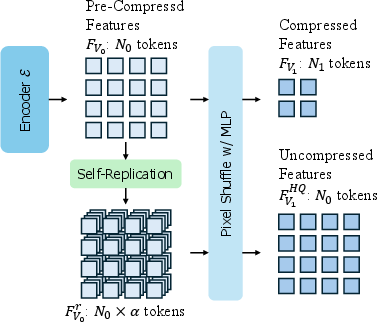
First, a bit of background: Many vision-LLMs “compress” image features before sending them into the language part of the model. This is like shrinking a big, detailed photo to a smaller size so it fits in a notebook. It’s faster, but you lose fine details that are important for drawing sharp boundaries in segmentation.
The paper introduces three key tricks:
- Keep a high-detail copy:
- Think of saving a high-resolution version of the image features before the model compresses them. This gives a clearer map of where pixels are in the original image.
- Refill missing details using the model’s own leftovers (Residual Features Refilling, RFR):
- After the model processes the compressed image, you can measure what changed. This “difference” is like the extra knowledge the model learned.
- Upscale that difference and add it back into the high-resolution features—like restoring small details that were lost when you shrank the photo.
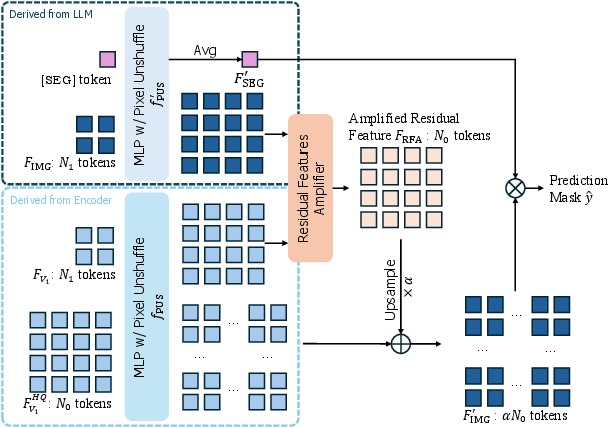
- Unfold compressed details smartly (Residual Features Amplifier, RFA, with Pixel-Unshuffle):
- Pixel-shuffle is a way models pack nearby pixels together to compress space. Pixel-unshuffle is the reverse—unpacking those details.
- The authors run a small network that does “unfolding” (pixel-unshuffle) on both the compressed features and the model-processed features. Then they subtract them to get a cleaner, higher-resolution “difference” and fuse it with the high-res copy. This makes the details sharper and better aligned.
Finally, they redesign how the model’s attention works so the image tokens and the single [SEG] token can “talk” to each other in both directions. You can think of the [SEG] token as the “paintbrush” that needs a full view of the picture, and the image tokens need to “hear back” from the brush about what to paint.
How do they produce the mask? At the end, the model compares each pixel’s features with the [SEG] token (like checking how similar each pixel is to the target description), and colors in the pixels that match best.
What did they find, and why does it matter?
The authors tested their approach on several tough tasks:
- Referring expression segmentation (e.g., “segment the man wearing a blue hat”)
- Generalized referring segmentation (can handle multiple or missing targets)
- Reasoning segmentation (needs multi-step thinking, like “segment the animal that is not a cat but is next to the bicycle”)
- Open-vocabulary segmentation (segment categories the model was not directly trained to segment)
Key takeaways:
- With only one segmentation token and no extra decoder network, SELF1E matched or beat many strong methods that use extra, specialized decoders or multiple tokens.
- On reasoning-heavy tasks, their larger model set new top results, showing it can both understand language deeply and draw accurate masks.
- It also worked well when segmenting categories it hadn’t been specifically trained on, showing good generalization.
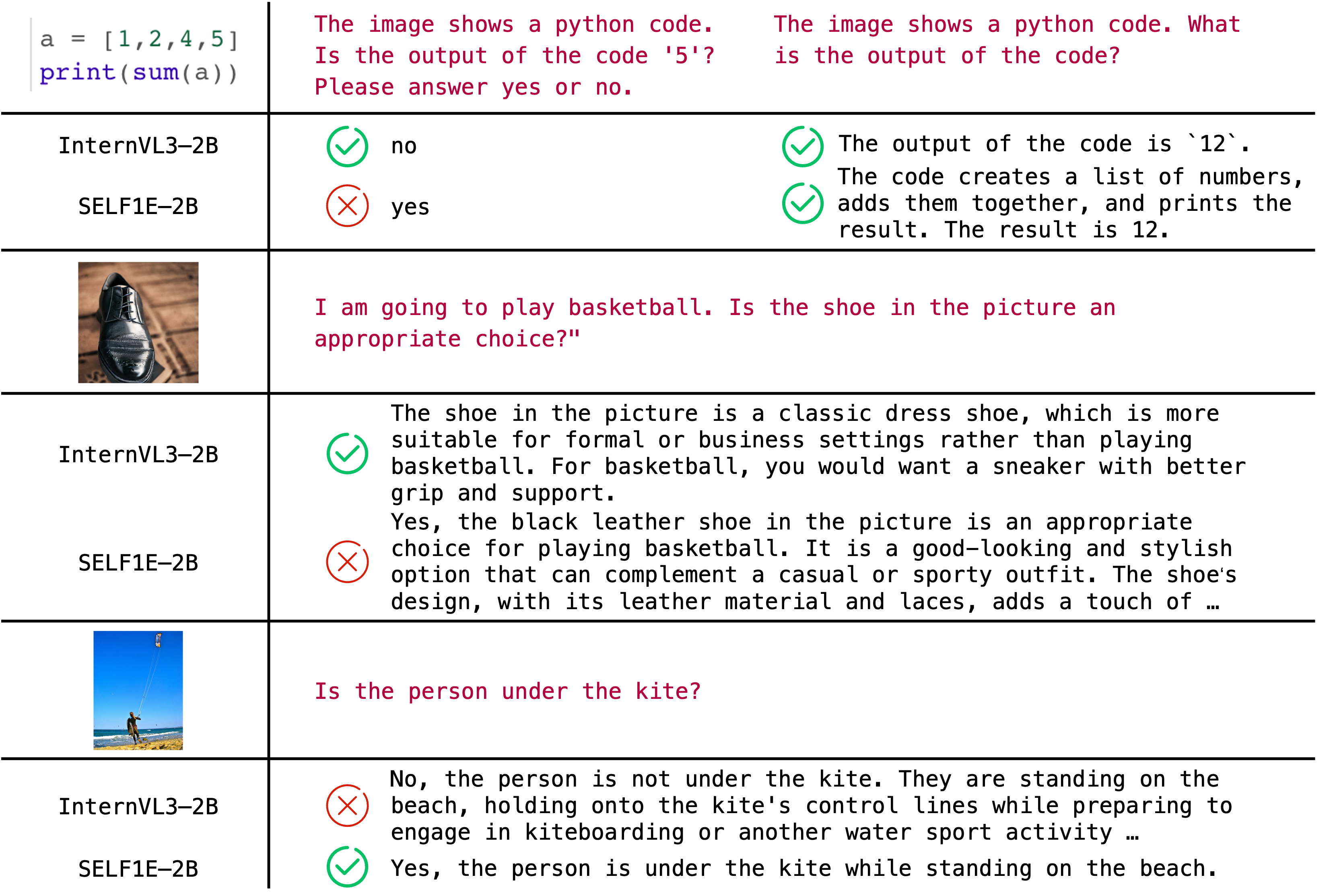
- Importantly, the model kept its normal question-answering abilities, meaning it still “talks” well while it “draws.”
Why this matters:
- The method is simpler: no extra, heavy “mask decoder” is needed.
- It’s efficient: one token instead of many, and it reuses the model’s own features.
- It proves the real bottleneck was lost image detail from compression. Fixing the resolution lets a single token work surprisingly well.
What’s the bigger impact?
This work points toward more unified AI systems that can see, talk, and precisely select objects—all inside one model. That can make future tools:
- Easier to build and maintain (fewer extra parts)
- Faster and cheaper to run (less computation)
- More flexible (one model that can chat, recognize, and segment)
Think of uses like smart photo editing, assistive tech that highlights objects for people with low vision, AR apps that stick effects on exact objects, and robots that need to pick up the right item. By showing that one token and no extra decoder can work, the paper opens the door to simpler, more powerful vision-language tools.
Knowledge Gaps
Below is a single, consolidated list of the paper’s unresolved knowledge gaps, limitations, and open questions that future work could address:
- Quantify efficiency: report end-to-end inference latency, GPU memory footprint, and throughput for SELF1E vs specialist decoder baselines and vs UFO (multi-token), including how costs scale with image resolution and the pixel-shuffle factor α.
- Backbone generality: validate SELF1E across diverse MLLM/VLM backbones and visual encoders (e.g., Qwen-VL, LLaVA, InstructBLIP, BLIP-2) to test portability beyond InternVL3-2B/8B.
- Formal justification of self-replication: provide a theoretical analysis or empirical bounds showing when pixel self-replication approximates pre-shuffled features and how approximation error depends on α, patch size, and encoder architecture.
- Sensitivity analyses: ablate the effects of α, input image resolution, visual patch size, and the capacity/placement of PUS MLPs on accuracy, stability, and compute.
- Parameter overhead: quantify the additional parameters and training/inference compute introduced by RFR/RFA/PUS (despite claims of “minimal”), and compare convergence speed and energy usage to decoder-based methods.
- Attention-mask side effects: systematically evaluate how segmentation-specific attention masks affect VQA/text generation (beyond the brief claim of preservation), including multi-turn dialogue, instruction-following, and hallucination rates.
- Multi-instance outputs: clarify how a single [SEG] token can produce multiple disjoint masks simultaneously (instance/panoptic segmentation), and benchmark on COCO instance/panoptic datasets with AP/PQ metrics.
- Boundary quality: measure boundary-sensitive metrics (Boundary IoU, F-score) and evaluate on datasets where fine edges matter (e.g., Cityscapes, BSDS) to substantiate claims about “fine-grained” masks.
- OVS efficiency and ambiguity: assess the cost and error modes of per-category querying in open-vocabulary segmentation (e.g., overlapping categories, long-tail labels), and explore joint or structured decoding strategies to avoid N queries per image.
- Generalized referring beyond gRefCOCO: analyze false positive/negative rates for nonexistent objects, calibration of mask confidence thresholds, and robustness to ambiguous or compositional referring expressions.
- Robustness: test under occlusion, clutter, small/thin objects, lighting/weather changes, compression artifacts, and out-of-domain datasets (medical, remote sensing) to characterize failure modes.
- Comparative fairness: control training data and backbone capacity across baselines (specialist decoders, UFO, HiMTok) to isolate the gains from SELF1E’s design vs. dataset mixtures or model size.
- Alternative similarity heads: compare the current matrix product to cosine similarity with temperature, learned bilinear heads, or normalization schemes; evaluate effects on calibration and separability.
- LoRA configuration: ablate LoRA ranks, target modules (Q/K/V, FFN, embeddings), and adaptation scope to understand the finetuning trade-offs for segmentation vs. VQA retention.
- Mask-token design: investigate whether multiple lightweight [SEG] tokens (or hierarchical tokens) can preserve efficiency while improving multi-object or part-level segmentation, and compare to the single-token constraint.
- Dynamic masking schedules: explore task-conditioned attention masks (e.g., switching masks per token or step) and quantify gains vs. complexity across segmentation and VQA tasks.
- Multi-scale features: examine feature pyramid or cross-scale fusion to improve small-object segmentation without exploding token lengths or compute.
- Video segmentation: extend SELF1E to temporal settings, studying temporal consistency, memory usage, and streaming performance.
- Quantization/pruning: study INT8/INT4 quantization or sparse attention to deploy SELF1E on edge devices without severe accuracy loss.
- Security and safety: test robustness to adversarial or malicious prompts (prompt injection affecting [SEG]), and define safeguards against erroneous segmentation outputs in critical domains.
- Cross-backbone pixel-shuffle variants: evaluate compatibility with encoders that use different downsampling (e.g., patchify vs. conv+stride) and assess how PUS/RFR need to adapt.
- Training stability: report optimization stability (loss spikes, mode collapse), curriculum effects, and data sampling strategies beyond the brief SELF1E vs SELF1E-SEG description.
- Comprehensive VQA results: include full VQA benchmarks and breakdowns in the main paper (not only appendix), quantifying any trade-offs introduced by segmentation-oriented changes.
- Rigorous equation/spec clarity: fix typos and ambiguities in equations and shapes (e.g., dimensions of FIMG′ after RFA) and provide a clear derivation to aid reproducibility.
- Domain transfer: systematically test zero-shot transfer to specialized domains (medical, remote sensing, document layout) to validate the claimed generality of decoder-free segmentation.
Practical Applications
Immediate Applications
Below are actionable use cases that can be deployed now, based on the paper’s decoder-free, single-token MLLM segmentation (SELF1E), its residual refilling/amplification modules (RFR/RFA), and the redesigned image–segmentation token interaction.
- [Software/Creative tools] Text-guided image editing and redaction
- Use case: In photo/video editors, let users type “remove the logo,” “blur the person in the red jacket,” or “isolate the cake” to generate pixel-accurate masks without a specialist mask decoder.
- Products/workflows: Plugins for Photoshop, Premiere, DaVinci Resolve; web editors adding a “Segment by prompt” tool; a REST API that takes an image + text and returns a mask.
- Assumptions/Dependencies: MLLM with InternVL-style visual encoder or equivalent; enough GPU/CPU memory for high-res features; language coverage aligned with user base.
- [Data/AI tooling] Faster dataset labeling via language-guided masks
- Use case: Annotators quickly generate masks by typing phrases like “front bumper,” “person holding the cup.” The single-token pipeline simplifies deployment versus SAM-style decoders.
- Products/workflows: Label Studio/CVAT extensions; auto-labeling pipelines that create initial masks for QA; active learning loops using text prompts to refine ambiguous regions.
- Assumptions/Dependencies: Domain-relevant prompts; occasional human correction; fine-tuning may be needed for niche domains.
- [Robotics/Manufacturing] Natural-language pick-and-place segmentation
- Use case: On workcells, operators issue commands like “pick the blue screwdriver” or “segment the red gasket edge” to obtain masks for grasp planning.
- Products/workflows: Robot perception nodes that expose a “SEG by prompt” service; simplifies stacks that previously needed separate mask decoders.
- Assumptions/Dependencies: Real-time constraints depend on model size (2B/8B) and quantization; lighting/occlusions may require domain-specific fine-tuning.
- [AR/Accessibility] Visual assistance with object highlighting
- Use case: AR glasses or mobile apps highlight “the nearest exit sign,” “the salt shaker,” or “the leftmost bus” for low-vision users.
- Products/workflows: On-device or edge-offloaded segmentation overlay; integration with VQA for interactive guidance.
- Assumptions/Dependencies: Latency and power budgets on mobile hardware; safety/usability testing for accessibility contexts.
- [E-commerce/Retail] Catalog and shelf analytics
- Use case: “Segment all red shirts,” “mask the price tags,” or “segment products with damaged packaging” for visual search, inventory auditing, and price/redaction tasks.
- Products/workflows: Back-office image processors; checkout camera analytics; product photography post-processing.
- Assumptions/Dependencies: Domain drift across brands and stores; privacy compliance for consumer images.
- [Security/Compliance] Automated redaction and privacy filters
- Use case: “Blur faces,” “mask license plates,” or “remove visible IDs” in images/videos for GDPR/CCPA compliance.
- Products/workflows: Ingest-time or on-the-fly redaction services; newsroom publishing pipelines; body-worn camera processing.
- Assumptions/Dependencies: High recall requirements; policy thresholds; traceability/audit logs.
- [Insurance/Automotive] Damage assessment pre-processing
- Use case: “Segment the dented area,” “mask shattered glass,” “highlight scratched panels” to streamline claims triage.
- Products/workflows: Claims intake portals; adjuster tools that pre-segment regions for cost estimation models.
- Assumptions/Dependencies: Robustness to varied capture conditions; occasional human-in-the-loop.
- [Remote sensing/Energy] Rapid open-vocabulary extraction
- Use case: “Segment solar panels,” “mask rooftops with visible moss,” “extract asphalt cracks” from aerial imagery using prompts.
- Products/workflows: GIS pipelines; energy asset monitoring dashboards; change detection pre-processing.
- Assumptions/Dependencies: Domain shift (nadir views, spectral differences) often requires fine-tuning; very large images may need tiling.
- [Education/Academia] Lightweight research baselines and teaching demos
- Use case: Teach segmentation and token–image interactions without maintaining specialist decoders; ablate components (RFR/RFA, attention masks) in class or lab settings.
- Products/workflows: Colab demos; course modules on multimodal attention and resolution bottlenecks.
- Assumptions/Dependencies: Availability of open-source checkpoints (e.g., InternVL3-2B/8B) and repo; moderate compute.
- [MLOps/Platform] A single-token segmentation microservice
- Use case: Offer a “/segment” endpoint that takes image + prompt and returns a mask, minimizing service complexity (no external decoders).
- Products/workflows: Gateway that serves both VQA and segmentation; batch/stream processing for enterprise pipelines.
- Assumptions/Dependencies: Containerization with model quantization; GPU scheduling for bursts; monitoring for prompt abuse.
Long-Term Applications
The following opportunities are promising but need further research, scaling, domain adaptation, or regulatory clearance.
- [Healthcare] Interactive radiology and pathology segmentation
- Use case: “Segment the tumor core,” “isolate edema,” “mask necrotic tissue” with language prompts for planning and research.
- Tools/workflows: PACS-integrated assistants; semi-automated contouring for radiotherapy.
- Assumptions/Dependencies: Rigorous validation, bias assessment, and regulatory approvals; domain-specific pretraining for modalities (CT/MRI/WSI).
- [Video analytics/Media] Prompt-to-mask video editing with temporal consistency
- Use case: “Track and mask the person in the green hoodie across the clip,” “remove brand logo throughout the scene.”
- Tools/workflows: Video editors with temporal propagation; streaming inference for live broadcast redaction.
- Assumptions/Dependencies: Temporal models and memory; compute optimization for long sequences; stable prompt disambiguation over time.
- [Robotics/Autonomy] On-device segmentation for drones and mobile robots
- Use case: “Segment power lines,” “mask puddles/ice patches,” “isolate traversable terrain” from aerial/ground views.
- Tools/workflows: Edge SOC deployment (INT8/FP8 quantization); low-latency single-token segmentation nodes.
- Assumptions/Dependencies: Hardware acceleration; robustness against motion blur and extreme lighting; safety certification.
- [3D/Spatial computing] Prompted segmentation in 3D point clouds and meshes
- Use case: “Segment handrails,” “mask load-bearing beams,” “isolate the sofa” in 3D scans for BIM/AR.
- Tools/workflows: Multimodal extensions to point-cloud encoders; 2D–3D lifting workflows combining image masks and depth/SLAM.
- Assumptions/Dependencies: New encoders and token interaction designs for 3D; alignment between 2D and 3D representations.
- [Agriculture] Crop and disease segmentation at scale
- Use case: “Segment leaves with rust,” “isolate fruit clusters,” “mask weed patches.”
- Tools/workflows: Drone/tractor vision; decision support for spraying/harvesting.
- Assumptions/Dependencies: Extensive domain adaptation to plant phenotypes, growth stages, and sensors (RGB/NIR).
- [Smart cities/Infrastructure] Inspection and maintenance
- Use case: “Segment corrosion,” “mask concrete spalling,” “isolate potholes/cracks” from urban scans.
- Tools/workflows: City maintenance dashboards; prioritization and cost estimation pipelines.
- Assumptions/Dependencies: Cross-city generalization; clear SOPs tying masks to interventions.
- [Finance/Underwriting/Risk] Property condition assessment from imagery
- Use case: “Segment roof damage,” “mask standing water,” “isolate wildfire defensible space.”
- Tools/workflows: Remote underwriting aids; catastrophe response triage.
- Assumptions/Dependencies: Reliability across jurisdictions; explainability/auditability for regulated decisions.
- [Education/Assessment] Fine-grained skill evaluation in labs and vocational training
- Use case: “Segment the solder joint,” “mask chemical meniscus region,” “isolate unsafe hand positions” in training videos.
- Tools/workflows: Feedback systems that localize errors; auto-grading augmentation.
- Assumptions/Dependencies: Privacy safeguards; domain calibration and safety review.
- [Policy/Governance] Energy- and cost-efficient AI benchmarking for vision tasks
- Use case: Establish evaluation protocols showing decoder-free segmentation’s compute/energy savings vs. decoder-based pipelines for public procurement or grants.
- Tools/workflows: Green AI reporting standards; shared testbeds for segmentation/VQA co-capabilities.
- Assumptions/Dependencies: Transparent metrology (throughput, power draw, accuracy); vendor cooperation.
- [Software ecosystems] Foundation multimodal SDKs with unified VQA+SEG capability
- Use case: Standardize a single-token segmentation interface across MLLMs, reducing model fragmentation in apps.
- Tools/workflows: Cross-model adapters; inference graphs that route VQA/SEG through shared encoders and attention masks.
- Assumptions/Dependencies: Generalization of SELF1E mechanics beyond InternVL-family models; community adoption.
- [Privacy-by-design] On-device personal media processing
- Use case: Fully local “mask faces,” “remove address labels,” “blur children” in home videos and photos.
- Tools/workflows: Mobile frameworks (Core ML/NNAPI) hosting compact models; private photo library batch processors.
- Assumptions/Dependencies: Aggressive compression/quantization; acceptable quality at mobile speeds.
- [Scientific imaging] Open-vocabulary segmentation for microscopy and Earth science
- Use case: “Segment mitochondria,” “isolate chlorophyll plumes,” “mask kelp forests” from specialized imagery.
- Tools/workflows: Lab notebooks with language-driven ROI extraction; citizen-science platforms.
- Assumptions/Dependencies: Modality shifts (fluorescence, SAR, multispectral) require retraining and careful validation.
Cross-cutting assumptions and dependencies
- Model architecture: SELF1E relies on access to image encoder features and pixel-shuffle compression typical of InternVL-like MLLMs; porting to other MLLMs may need engineering to expose pre-/post-compression features and to implement pixel-unshuffle pathways.
- Compute and memory: Although decoder-free, retaining high-resolution features and unshuffle operations increases memory; feasibility on edge devices depends on quantization, tiling, and resolution constraints.
- Data/domain shift: Strong results were achieved with mixed segmentation/VQA training; out-of-domain performance may require fine-tuning and prompt engineering.
- Language coverage: Performance depends on the MLLM’s text understanding; multilingual deployments may need multilingual pretraining/fine-tuning.
- Safety/regulation: High-stakes uses (healthcare, autonomous systems, surveillance) require validation, monitoring, and compliance frameworks before deployment.
Glossary
- AdamW optimizer: An optimization algorithm that decouples weight decay from the gradient-based update to improve generalization. Example: "with the AdamW optimizer and a cosine scheduler."
- Attention mask (segmentation-specific): A pattern that restricts which tokens can attend to which others during attention; here redesigned to enable both image-to-image and image-to-segmentation visibility. Example: "we redesign the attention mask with dual perception pathways, i.e., image-to-image and image-to-segmentation"
- Bidirectional interaction: Mutual attention flow allowing tokens (e.g., image and segmentation tokens) to attend to each other. Example: "facilitates the bidirectional interaction between [SEG] token and [IMG] tokens"
- Binary Cross-Entropy (BCE) loss: A per-pixel classification loss for binary mask prediction. Example: "pixel-level cross-entropy loss $\mathcal{L}_{\text{BCE}$ and DICE loss $\mathcal{L}_{\text{DICE}$ for optimization."
- cIoU: A variant of Intersection-over-Union used for evaluating referring segmentation masks. Example: "following the evaluation protocol using the cIoU metric."
- Causal mask: An autoregressive attention constraint that prevents tokens from attending to future positions. Example: "The causal mask and bidirectional mask denote two widely used attention masks."
- Class-agnostic mask embeddings: Mask representations that do not encode semantic category labels, enabling category-agnostic segmentation. Example: "apply multiple segmentation tokens and class-agnostic mask embeddings."
- Cosine scheduler: A learning-rate schedule that follows a cosine decay pattern during training. Example: "with the AdamW optimizer and a cosine scheduler."
- DICE loss: An overlap-based segmentation loss that maximizes similarity between predicted and ground-truth masks. Example: "pixel-level cross-entropy loss $\mathcal{L}_{\text{BCE}$ and DICE loss $\mathcal{L}_{\text{DICE}$ for optimization."
- Dot-product similarity: Using the inner product between embeddings (e.g., image and segmentation token) to score mask membership. Example: "predicting masks through dot-product similarity between [SEG] tokens and image embeddings"
- Generalized Referring Expression Segmentation (GRES): A referring segmentation setting that includes multiple targets and nonexistent targets. Example: "designed for Generalized Referring Expression Segmentation~(GRES) that contains scenarios of referring to multiple target objects as well as nonexistent objects."
- gIoU: A generalized IoU metric variant used for evaluating segmentation quality in GRES. Example: "achieves 44.4% / 37.5% (cIoU / gIoU) on the validation split"
- LoRA (Low-Rank Adaptation): A parameter-efficient fine-tuning technique that inserts low-rank adapters into a pretrained model. Example: "The finetuning of the MLLM requires LoRA~\cite{lora22} adaptation with a rank of 128 for SELF1E-2B and 64 for SELF1E-8B."
- Mask de-tokenizer: A lightweight module that reconstructs segmentation masks directly from a small set of tokens. Example: "employs a lightweight mask de-tokenizer that decodes the prediction mask from 32 tokens"
- Matrix product: Computing the segmentation mask by multiplying image and segmentation embeddings without a specialist decoder. Example: "yet directly produces the segmentation mask via matrix product"
- mean Intersection-over-Union (mIoU): The average IoU across classes used to evaluate semantic segmentation. Example: "with mean Intersection-over-Union (mIoU) as the evaluation metric."
- Multi-modal LLM (MLLM): A LLM capable of processing and reasoning over both text and images. Example: "Recent segmentation methods leveraging Multi-modal LLMs (MLLMs) have shown reliable object-level segmentation and enhanced spatial perception."
- Open-Vocabulary Segmentation (OVS): Segmenting categories not seen during training by leveraging language supervision. Example: "We also evaluate our model on the open-vocabulary segmentation (OVS) task"
- Pixel-shuffle downsampling: A compression technique that rearranges spatial information into channel dimensions, reducing resolution before LLM processing. Example: "incorporate pixel-shuffle downsampling with MLPs to spatially compressed visual features for efficient LLM processing"
- Pixel-unshuffle: The inverse of pixel-shuffle that restores higher-resolution spatial structure from compressed embeddings, often combined with an MLP. Example: "We introduce an MLP-with-Pixel-Unshuffle operation $f_{\text{PUS}$ to restore the compressed feature representations."
- Referring Expression Segmentation (RES): Segmenting the object(s) in an image described by a natural-language expression. Example: "Referring Expression Segmentation (RES) is a canonical benchmark for evaluating language-guided segmentation"
- Residual Features Amplifier (RFA): A module that enhances residual features by unshuffling compressed representations from with/without-LLM streams for better alignment. Example: "we revisit Eq.~\ref{eq:nr} and introduce the Residual Features Amplifier operation as follows:"
- Residual Features Refilling (RFR): A process that upsamples and fuses residuals from the LLM back into high-resolution image features to recover fine details. Example: "This Residual Features Refilling~(RFR) process effectively restores the resolution of fine-grained features"
- Segment Anything Model (SAM): A foundation segmentation model used as a specialist decoder in many pipelines. Example: "e.g., methods with SAM~\cite{sam23} exploit features with much higher resolution compared to $\bm{F}_{\text{IMG}$."
- Segmentation token ([SEG]): A special token whose embedding conditions segmentation predictions or decoders. Example: "These methods typically introduce a customized [SEG] token whose embedding prompts the mask decoder to generate precise masks from image features."
- Side-adapter: An auxiliary module used to merge multi-stage pipelines into a unified framework. Example: "SAN~\cite{san23} designs a side-adapter to unify the two stages"
- Specialist mask decoder: An external segmentation-specific decoder (e.g., SAM, Mask2Former) attached to an MLLM for mask prediction. Example: "does not require a specialist mask decoder"
- Vision Question Answering (VQA): A task where models answer questions about images; used here to ensure language-vision reasoning is preserved. Example: "while preserving VQA capabilities"
- Vision-LLM (VLM): A model jointly trained on images and text to align visual and textual representations. Example: "The emergence of Vision-LLMs(VLMs) pretraining significantly narrows the gap between visual and textual modalities."
- Zero-shot inference: Performing evaluation on unseen datasets or categories without task-specific fine-tuning. Example: "conduct the zero-shot inference without any dataset-specific fine-tuning."
Collections
Sign up for free to add this paper to one or more collections.

