- The paper introduces a black-box Stability Monitor that employs energy distance and e-values to detect behavioral shifts in LLM endpoints.
- The paper validates its methodology by demonstrating prompt detection of discrete interventions and infrastructure-induced variations using controlled experiments.
- The paper highlights that continuous behavioral monitoring is essential for maintaining security, reproducibility, and compliance in AI-native applications.
Behavioral Fingerprinting of LLM Endpoints: Operational Stability and Identity
Motivation and Problem Statement
Reliability metrics for AI-native applications—such as uptime and latency—do not encapsulate the behavioral consistency central to LLM endpoint stability. Endpoint behavior can drift due to discrete changes (model architecture, version, quantization, inference stack) and system-level nondeterminism (hardware routing, batch sizes, caching) beyond user control. These shifts, even with fixed hyperparameters, undermine reproducibility and evaluation coherence, yielding significant production and benchmarking variance. The operational reality is that endpoints can appear “healthy” while silently serving altered models, breaking downstream application contracts.
Methodology: Behavioral Fingerprinting and Change Detection
The proposed Stability Monitor system operates in a black-box, high-cadence manner. It constructs fingerprints by sampling outputs from a fixed natural-language prompt set, then embedding responses into real-valued vectors. Fingerprints (sets of sets of vectors) are compared longitudinally using a summed energy distance statistic across prompts. Change detection is driven by permutation-test p-values, sequentially aggregated with e-values—enabling streaming detection suitable for continuous monitoring.
A baseline fingerprint F0 is established and new fingerprints Fi are collected periodically from the endpoint. For each Fi, the aggregate energy distance to F0 is computed; the corresponding p-value quantifies evidence for distributional change. Sequential accumulation of these p-values with e-values methods allows prompt and robust change event detection. When evidence exceeds a threshold, a new baseline is set, marking stability periods and creating a verifiable audit trail.
Controlled Validation of Behavioral Change Detection
Empirical validation was performed by locally hosting models and applying discrete interventions: changing model family, version, inference stack, quantization, and temperature (see Table 1 in the original paper). Stability Monitor consistently detected all but the smallest temperature shift immediately after the intervention, demonstrating high sensitivity to behavioral disruption. Post-detection, stability periods were observed with respect to newly established baselines, confirming the efficacy of sequential evidence aggregation.
Real-World Endpoint Comparisons and Provider Divergence
Stability Arena extends the monitoring pipeline with a live web interface, facilitating visualization and comparative analysis across providers. Cross-provider fingerprinting enables two operational modes: pairwise provider similarity and individual endpoint divergence relative to the aggregate provider population.
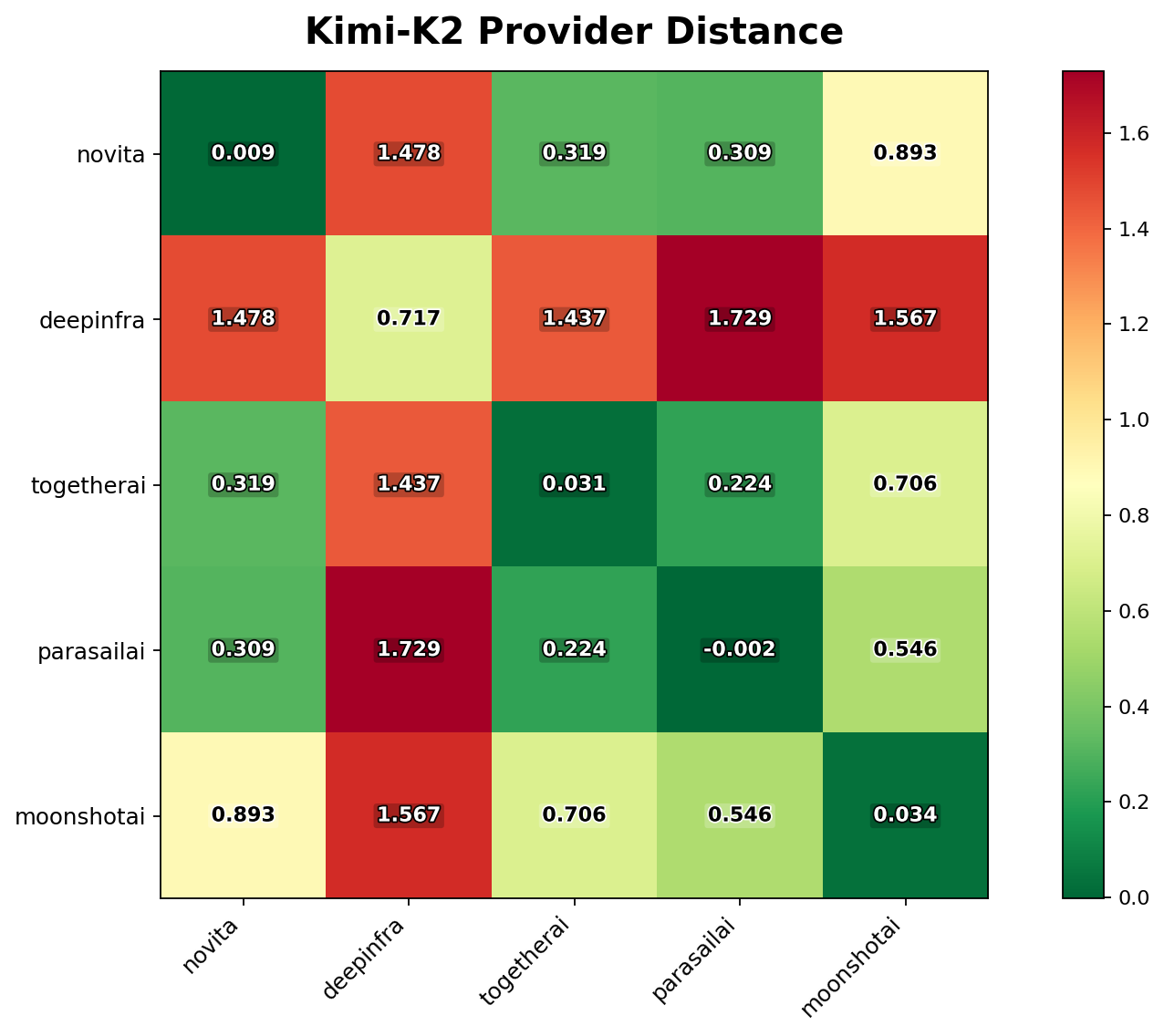
Figure 1: Pairwise energy distance comparisons between selected providers serving Kimi-K2-0905-Instruct in late November 2025.
Pairwise analysis reveals that fingerprints from a provider are most similar to their own historical distributions (diagonal dominance in distance matrices), reliably identifying endpoint provenance. Individual provider divergence is quantified by normalizing the energy distance of a provider to the aggregate population’s distribution, surfacing outliers and transient instability. The analysis surfaced substantial provider-to-provider and within-provider behavioral variation for nominally identical models. Notably, the creator-hosted endpoint exhibited maximal stability; other providers displayed frequent drift and change events, sometimes corresponding to infrastructure shifts (e.g., hardware failure-induced rerouting).
Operational Implications and Limitations
Behavioral instability at the endpoint level has direct security and compliance ramifications: silent model change invalidates prior guardrails and safety validations. Stability Monitor provides actionable audit trails, supporting engineering, security, and compliance requirements. Cross-provider behavioral divergence implies that model identity cannot be relied upon at face value for production or benchmarking purposes.
Infrastructure-induced nondeterminism—including batch-size variation and non-batch-invariant kernels—can result in persistent randomness even for fixed models and temperature settings. This blurs the distinction between discrete change events and ongoing instability, complicates attribution, and necessitates continuous, high-frequency monitoring.
Theoretical Extensions and Future Directions
The black-box approach operationalized here aligns with emerging paradigms in streaming statistical change detection (energy distance, e-values), diverging from prior model ownership fingerprinting approaches (IPGuard, watermarking) and tailored probe construction (B3IT). The parameters-free, interpretable nature of energy distance, coupled with streaming evidence aggregation, enables scalable monitoring across heterogeneous providers and models.
Extending behavioral fingerprinting to structured outputs, tool-driven agentic workflows, or multimodal endpoints would further generalize operational stability monitoring. Integrating stability audit trails with automated compliance and security frameworks could advance trustworthiness in LLM-powered systems. Mechanisms for real-time provider selection or endpoint failover based on measured behavioral drift remain promising avenues for robust AI deployment.
Conclusion
Behavioral fingerprinting via Stability Monitor and Stability Arena operationalizes endpoint stability as a distinct metric from traditional reliability, quantifies behavioral change using black-box statistical methods, and exposes significant variance across providers for nominally identical models. This approach provides both theoretical and practical safeguards against silent model identity changes, and surfaces provider-induced behavioral divergence critical for production and benchmarking contexts. Continuous behavioral monitoring is foundational for secure, reproducible, and compliant AI-native applications.