Lectures on Open Quantum Systems
Abstract: These notes are a short introduction to the mathematical theory of open quantum systems. They are meant to serve as an entry point into a broad research area which has applications across the quantum sciences dealing with systems subjected to external noise. The guiding idea is to let the key structures of the theory emerge from a concrete model. By working through the dissipative Jaynes-Cummings model the reader will dis- cover explicitly how irreversible dynamics arises from a unitary system-reservoir evolution. The notions of the continuous mode limit, correlation functions, spectral density appear in a natural manner and lead to the evolution equation of the open system in form of a master equation. This sets the stage for the more general analysis of completely positive, trace preserving (CPTP) maps and the study of quantum dynamical semigroups. We motivate and prove the Kraus representation theorem, the dilation theorem and the Gorini-Kossakowski-Sudarshan-Lindblad (GKSL) theorem. Working through the exercises (for which full solutions are supplied) will reinforce the ideas introduced in the main text.
Paper Prompts
Sign up for free to create and run prompts on this paper using GPT-5.
Top Community Prompts
Explain it Like I'm 14
What is this paper about?
This paper is a friendly set of lecture notes about “open quantum systems.” That’s a fancy way of saying: What happens to a small quantum object (like a two-level atom, or “qubit”) when it interacts with its surroundings (like light in a cavity or the air around it)? The big idea is that even though the whole universe follows neat, reversible rules, a small part of it can look noisy and irreversible when you ignore the rest. The notes show how that happens in a concrete example and then build up the general math tools used across quantum science.
What are the main goals, in simple terms?
- Show, with a clear example, how a tiny quantum system loses energy and “forgets” information when it’s coupled to an environment.
- Turn the messy, full “system + environment” evolution into a simpler equation that only tracks the system (a “master equation”).
- Explain what makes a quantum process physically valid (no cheating!), introducing maps called CPTP maps and how they can always be represented in a clean, standard way (Kraus and dilation theorems).
- Describe how continuous-time noisy evolution is built (quantum dynamical semigroups) and pin down its most general shape (the GKSL, or Lindblad, theorem).
How do they approach it?
The authors let the key ideas “fall out” of a concrete model and then generalize.
1) Starting from the basics
They review the foundations of quantum theory:
- States are vectors (or more generally, density matrices) in a Hilbert space.
- Observables (things you can measure) are special operators.
- Time evolution of closed systems follows the Schrödinger equation.
- When you have a “system + environment,” you describe the system alone by tracing out (ignoring) the environment’s details. This produces the system’s reduced density matrix.
Everyday analogy: Think of recording only the main actor in a movie and ignoring the background. You still see changes in the actor (the system), even if you don’t track the whole set (the environment).
2) A concrete model: the dissipative Jaynes–Cummings model
- System: a two-level atom (like a light switch with only ON/OFF).
- Environment: many light modes in a cavity (a bunch of harmonic oscillators).
- The atom can absorb or emit a photon, exchanging energy with the field.
They start with simple initial states (at most one excitation) and write the evolving state using a few time-dependent amplitudes. One key amplitude, c₁(t), tells you the “probability amplitude” that the atom is still excited.
3) From “many modes” to a “continuum”
Real cavities can have tons of closely spaced light frequencies. Instead of summing over each mode, they pass to a “continuous mode limit,” replacing the sum by an integral. Two crucial quantities appear:
- Correlation function: tells you how much the environment “remembers” past interactions.
- Spectral density: tells you how strongly the system couples to different frequencies (like an equalizer curve in audio).
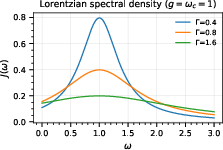
With a standard, bell-shaped (Lorentzian) spectral density, they get explicit formulas for c₁(t).
4) The master equation
They derive an exact evolution equation for the atom alone (a “master equation”). It has:
- A Hamiltonian part (unitary, like ordinary quantum evolution).
- A dissipative part (describing decay and decoherence caused by the environment).
When the environment’s memory is short, the equation simplifies to a “Markovian” form (memoryless), often called a Lindblad or GKSL form.
5) Abstract viewpoint: CPTP maps and their structure
The authors step back and ask: What’s a valid quantum “process” that maps one density matrix to another?
- CPTP map = Completely Positive, Trace-Preserving map. This guarantees the output is a legitimate quantum state, even if your system is entangled with something else.
- Kraus Representation Theorem: Any CPTP map can be written as a sum of simple “Kraus operators.”
- Dilation Theorem: Any CPTP map can be realized as an ordinary (unitary) evolution on a bigger system (“system + environment”), followed by tracing out the environment. This beautifully ties the abstract math back to the physics of open systems.
6) Continuous-time noise: Quantum dynamical semigroups and the GKSL theorem
For processes that run continuously in time (like a steady leak of energy), the evolution can be written as e{tL}, where L is a generator. The GKSL (Gorini–Kossakowski–Sudarshan–Lindblad) theorem says exactly what L must look like to keep the state valid at all times. This is the universal form of “Markovian” quantum noise.
What are the main findings, and why do they matter?
- From the Jaynes–Cummings model, they explicitly show how an atom’s excited state amplitude c₁(t) decays over time because of the coupling to many field modes. For short times, the decay is roughly Gaussian; for long times, it’s exponential. The atom ends up in its ground state (it “relaxes”), and off-diagonal terms of its density matrix fade (it “decoheres”).
- They present and prove the Kraus Representation Theorem: all valid quantum processes (CPTP maps) can be written using Kraus operators that add up in a way that preserves probabilities.
- They prove the Dilation Theorem: any valid quantum process on a system can be seen as unitary evolution on a larger “system + environment,” then ignoring the environment. This bridges abstract math and physical models.
- They motivate and (in the notes) derive the GKSL theorem: the general shape of the generator L for memoryless (Markovian) continuous-time noise. This is the backbone for modeling real-world quantum devices.
Why it matters:
- Quantum tech (computers, sensors, communication) faces noise and loss. Understanding how and why systems decohere helps you design better devices, error correction, and control strategies.
- Theorems like Kraus, Dilation, and GKSL tell you which mathematical models are physically allowed, so simulations and algorithms don’t wander into “impossible” physics.
What’s the broader impact?
These notes give students and researchers a clear path from:
- Basic quantum rules,
- Through a hands-on, solvable model that shows how irreversibility emerges,
- To general, powerful theorems that classify all valid quantum processes and continuous-time noise.
That journey equips you to:
- Model real experiments (like atoms in cavities or superconducting qubits in circuits),
- Predict how quickly information leaks away,
- Choose or design environments (spectral densities) that help or hurt performance,
- And make sure any “black box” quantum operation you write down is actually physically realizable.
Quick jargon-to-plain-language guide
| Term | Plain meaning |
|---|---|
| Open quantum system | A small quantum thing interacting with its surroundings |
| Reduced density matrix | The system’s “state” after ignoring the environment |
| Master equation | A rule for how the system’s state changes in time |
| Markovian vs. non-Markovian | Memoryless environment vs. one that remembers the past |
| Correlation function | A measure of the environment’s “memory” over time |
| Spectral density | How strongly different frequencies of the environment affect the system |
| CPTP map | A “legal” quantum process that always outputs valid states |
| Kraus operators | Building blocks that describe any CPTP map |
| Dilation theorem | Any CPTP map = unitary on system+environment + ignore the environment |
| GKSL (Lindblad) form | The universal shape of memoryless, continuous-time quantum noise |
In short, the paper shows how noise arises from perfectly good quantum mechanics, then gives you the math toolbox to describe, analyze, and control that noise in real quantum systems.
Knowledge Gaps
Knowledge gaps, limitations, and open questions
The paper offers a concise, pedagogical treatment of open quantum systems via the dissipative Jaynes–Cummings model and basic CPTP/GKSL theory. The following concrete gaps and open questions remain:
- Clarify the domain of validity and provide rigorous error bounds for the Markovian (semigroup) approximation e{tℒ} to the exact non-Markovian dynamics across coupling strengths, detunings, and time scales (short, intermediate, long), using operational distances (trace/diamond norms).
- Extend the analysis beyond the single-excitation manifold: characterize dynamics, solvability, and master equations when multiple excitations are allowed (including stimulated emission/absorption and saturation effects).
- Replace the vacuum initial reservoir by finite-temperature (KMS), coherent, or squeezed states; derive the corresponding time-local and time-nonlocal master equations, steady states, and temperature-dependent Lamb shifts; quantify when detailed balance holds.
- Analyze initial system–reservoir correlations (non-product initial states), and determine conditions ensuring CPTP reduced dynamics (or appropriate generalizations via assignment maps/process tensors).
- Assess the impact of counter-rotating terms (full quantum Rabi model, beyond the rotating-wave approximation): excitation non-conservation, ultrastrong-coupling effects, changes to memory kernels, and the structure/positivity of time-local generators.
- Provide conditions under which the time-local generator in the “exact non-Markovian master equation” maintains complete positivity (e.g., constraints ensuring γ(t) ≥ 0 or CP-divisibility), and characterize regimes where transient negative rates arise and how CP of the overall map is preserved.
- Make the continuous-mode limit mathematically precise: specify assumptions on the density of modes and form factors ensuring convergence of sums to integrals, control finite-size errors (discrete cavity vs continuum), and track ultraviolet cutoffs/renormalization of the Lamb shift.
- Derive spectral densities (J(ω)) from explicit cavity geometries and boundary conditions, rather than assuming a Lorentzian; compare Ohmic/sub-Ohmic/super-Ohmic and photonic-bandgap cases; classify long-time decay (exponential vs algebraic), non-Markovian oscillations, and conditions for bound states/population trapping.
- Quantify the crossover between short-time Gaussian decay and long-time exponential decay; relate to quantum Zeno/anti-Zeno regimes and establish scaling laws in terms of J(ω), bandwidths, and coupling constants.
- Provide numerical benchmarks comparing exact amplitudes (e.g., c1(t)) to Born–Markov, secular, Redfield, TCL, and Nakajima–Zwanzig approximations for representative spectral densities; include error metrics and parameter maps.
- Generalize to multi-level atoms and multi-qubit systems coupled to common/independent reservoirs: derive generators capturing collective effects (super/subradiance), analyze entanglement generation/degradation, and identify conditions for decoherence-free subspaces/subsystems.
- Incorporate time-dependent drives and controls (Floquet settings) and derive controlled GKSL/TCL generators; determine when periodic driving restores/erodes Markovianity and how to engineer target steady states (reservoir engineering).
- Explore strong-coupling and long-memory regimes (g comparable to or exceeding linewidths): characterize non-divisible dynamics, information backflow, revival phenomena, and breakdown of secular approximations; identify robust reduced descriptions.
- Address infinite-dimensional technicalities: rigorously handle unbounded field operators and domains; state precise conditions for Kraus/dilation theorems and GKSL structure in infinite dimensions (beyond the brief remarks/citations).
- Detail Lamb-shift regularization and renormalization: specify how divergences are handled for broad spectral densities and how physical parameters depend on cutoffs.
- Discuss limitations of CPTP modeling for correlated initial states and non-Markovian processes; connect to process-tensor/quantum-comb frameworks and identify when non-CP intermediate maps are physically meaningful.
- Provide a derivation of detailed balance conditions and thermodynamic consistency (first/second laws, Spohn inequality, entropy production) for the derived generators; analyze thermalization rates and steady-state uniqueness.
- Examine robustness to disorder and parameter uncertainty in cavity frequencies/couplings (random J(ω)); quantify their effect on decay rates and coherence.
- Characterize minimal Kraus ranks for the introduced channels, their non-uniqueness, canonical forms (via Choi states), and symmetry constraints; connect to experimental process tomography.
- Map theoretical parameters (g, Γ, detuning, J(ω)) to experimentally measurable quantities in cavity/circuit QED and nanophotonics; propose protocols to extract spectral densities and validate the predicted crossover behaviors.
- Investigate structured reservoirs with spectral gaps or localized modes (e.g., waveguide QED, photonic crystals): existence of atom–photon bound states, incomplete relaxation, and non-exponential long-time tails within the same framework.
- Clarify the precise assumptions and scope of the GKSL theorem as presented (finite vs infinite dimensions, bounded vs unbounded generators), and state uniqueness/identifiability of Lindblad operators under different choices of operator bases.
- Explore measurement-induced dynamics and unravelings (quantum trajectories, quantum jumps) consistent with the derived dissipators; relate trajectory statistics to non-Markovian features and to experimental continuous monitoring.
Practical Applications
Immediate Applications
The paper’s concrete modeling of the dissipative Jaynes–Cummings system, the derivation of exact (non-Markovian) and approximate (GKSL/Lindblad) master equations, and the foundations of CPTP maps/Kraus/dilation provide immediately deployable modeling, analysis, and tooling for current quantum technologies and education.
- Noise modeling and calibration for quantum hardware (quantum computing, trapped ions, superconducting qubits)
- Description: Use the GKSL (Lindblad) structure and Kraus representations to model amplitude damping, phase damping, and generalized noise channels; fit experimental relaxation/decoherence data to extract rates and validate Markovian vs non-Markovian regimes.
- Sectors: Software, hardware (quantum computing)
- Tools/products/workflows:
- Noise-channel libraries parameterized by Lindblad operators (amplitude damping via σ±, dephasing via σz)
- “GKSL parameter estimator” pipelines using convex optimization/least squares to fit γ(t), S(t), and effective Hamiltonians
- Gate- and process-tomography suites that enforce CPTP via Kraus-operator parameterizations
- Assumptions/dependencies:
- Validity of the Markovian approximation for the target device/time window
- Access to high-fidelity experimental datasets (Rabi, T1/T2, spectroscopy)
- Finite-dimensional modeling for theorems; rotating-wave approximation (RWA) in Jaynes–Cummings-like systems
- Cavity QED and photonics design and analysis (single-photon sources, cavity–emitter systems)
- Description: Fit cavity experiments using Lorentzian spectral densities to extract coupling g, cavity linewidth Γ, detuning Δ; predict Purcell-enhanced emission and relaxation dynamics using the provided solutions for c1(t).
- Sectors: Hardware (quantum optics/photonics)
- Tools/products/workflows:
- Cavity design/optimization tools that map target spectral density J(ω) to expected dissipative dynamics
- Automated Purcell factor calculators and stability checks from spectral density parameters
- Assumptions/dependencies:
- Continuous mode limit holds; cavity spectra approximated by Lorentzian lineshapes
- Weak coupling and near-resonant conditions as required by the model
- Noise-aware quantum software stacks and simulators
- Description: Implement master equation solvers (time-local GKSL and memory-kernel forms) and CPTP channel libraries for realistic simulation of algorithms and error-mitigation strategies.
- Sectors: Software (quantum simulation platforms)
- Tools/products/workflows:
- SDK modules for non-Hermitian effective Hamiltonians and dissipators
- Plug-ins for popular libraries (e.g., QuTiP-style master equation solvers) that support non-Markovian kernels derived from correlation functions f(τ)
- Assumptions/dependencies:
- Numerical stability/accuracy for memory kernels; validated noise model selection (Markovian vs non-Markovian)
- Reservoir engineering for state preparation and cooling
- Description: Use Lindblad dissipators (e.g., σ−-based) to drive systems toward target steady states (ground-state cooling, optical pumping).
- Sectors: Quantum hardware (AMO physics, trapped ions), quantum control
- Tools/products/workflows:
- Dissipative state-preparation protocols specified by GKSL parameters
- Calibration routines that tune engineered dissipation rates for desired steady states
- Assumptions/dependencies:
- Ability to implement specific jump operators experimentally
- Sufficient separation of timescales for controlled steady-state preparation
- Process tomography and validation under CPTP constraints
- Description: Use Kraus/dilation theorems to structure and certify tomographic reconstructions, ensuring channels are CPTP (project reconstructions onto the nearest CPTP map).
- Sectors: Software, metrology for quantum hardware
- Tools/products/workflows:
- CPTP projection tools for reconstructed channels
- Dilation-based visualizations (system+ancilla unitary embeddings) for interpretability and debugging
- Assumptions/dependencies:
- Sufficient measurement statistics; finite-dimensional channel assumptions
- Standards and benchmarking frameworks based on GKSL/CPTP
- Description: Report and compare device noise via standard GKSL parameter sets and CPTP channel metrics for procurement, certification, and benchmarking.
- Sectors: Policy/standards, hardware benchmarking
- Tools/products/workflows:
- Standardized reporting formats for Lindblad rates and channel distances (e.g., diamond norm under CPTP)
- Compliance checklists ensuring positivity and trace preservation in reported channels
- Assumptions/dependencies:
- Community agreement on metrics and reporting; consistent experimental procedures
- Quantum sensing and metrology optimization
- Description: Use decoherence models to choose interrogation times and pulse sequences that maximize sensitivity under known spectral densities and correlation times.
- Sectors: Healthcare (biosensing), defense, precision navigation
- Tools/products/workflows:
- Sensitivity calculators that fold in γ(t) and C(τ) to optimize measurement schedules
- Filter-function design tools tailored to measured spectral densities
- Assumptions/dependencies:
- Accurate noise spectral density characterization; stable environmental conditions
- Education and workforce development
- Description: Adopt the notes’ structured derivations and exercises for undergraduate/graduate courses and industrial training.
- Sectors: Education, corporate training
- Tools/products/workflows:
- Modular teaching kits (slides, notebooks, exercises with solutions)
- Internal upskilling programs for quantum startups and labs
- Assumptions/dependencies:
- Basic linear algebra/quantum mechanics prerequisites
Long-Term Applications
As devices scale and control improves, the paper’s methods support advanced control in non-Markovian settings, engineered environments, and sector-spanning technologies.
- Non-Markovian noise control and error correction
- Description: Leverage exact memory-kernel equations (via reservoir correlations) to design optimal control and error-correction strategies that exploit or mitigate memory effects, beyond Markovian approximations.
- Sectors: Quantum computing, control engineering
- Tools/products/workflows:
- Controllers that estimate and adapt to f(τ) in real time
- Non-Markovian error-correcting codes and recovery maps designed with CPTP/dilation insights
- Assumptions/dependencies:
- Real-time estimation of environmental correlations; sufficient actuation bandwidth; scalable identification algorithms
- Dissipative quantum computing and autonomous error correction
- Description: Engineer Lindbladian dynamics that stabilize logical codespaces and perform computation via steady-state manifolds.
- Sectors: Quantum computing (architectures)
- Tools/products/workflows:
- Hardware-level implementation of targeted jump operators
- Design suites mapping logical protections to implementable GKSL generators
- Assumptions/dependencies:
- Precise multi-qubit dissipation engineering; minimal unwanted cross-couplings
- Quantum network nodes and memories with tailored environments
- Description: Use spectral-density engineering and dilation-based modeling to design nodes with targeted coherence times and interface properties for quantum internet architectures.
- Sectors: Communications, networking
- Tools/products/workflows:
- Node/quantum-repeater design tools selecting optimal Γ, Δ, and mode densities
- Channel-stacking frameworks that compose CPTP maps for network analysis
- Assumptions/dependencies:
- Fabrication of devices with reproducible spectral densities; stable coupling to photonic modes
- Quantum thermodynamic devices (engines/refrigerators) and energy transport
- Description: Model and design nanoscale engines, heat pumps, and excitonic transport using GKSL generators and reservoir correlations tailored to target performance.
- Sectors: Energy, materials/chemistry
- Tools/products/workflows:
- Design simulators for steady-state heat currents and efficiency bounds under CPTP constraints
- Material discovery workflows that target beneficial dissipative pathways
- Assumptions/dependencies:
- Reliable nanoscale fabrication; integration with thermal reservoirs at controlled temperatures
- Advanced quantum sensors for healthcare and robotics
- Description: Deploy noise-optimized magnetometers/gyroscopes (NV centers, atomic sensors) in medical imaging and autonomous navigation by co-designing hardware and control with open-system models.
- Sectors: Healthcare, robotics, aerospace
- Tools/products/workflows:
- Co-design pipelines that match device geometry and control to environmental spectral densities
- Certification protocols linking sensor performance to CPTP-modeled decoherence
- Assumptions/dependencies:
- Robust operation in real-world environments; improved device stability and calibration
- Policy: International standards for quantum device certification grounded in CPTP/GKSL
- Description: Establish global norms for reporting, verifying, and certifying noise properties of quantum devices using completely positive, trace-preserving models and Lindblad parameter sets.
- Sectors: Policy/standards, procurement
- Tools/products/workflows:
- Reference test suites (process tomography + CPTP validation) for vendor certification
- Interoperability schemas for channel descriptions in cloud quantum services
- Assumptions/dependencies:
- Industry and standards-body consensus; test reproducibility across platforms
- Integrated software ecosystems for memory-kernel simulation and model discovery
- Description: Build scalable non-Markovian solvers and data-driven spectral-density inference engines integrated into cloud platforms for R&D and production.
- Sectors: Software (cloud, HPC), R&D
- Tools/products/workflows:
- Machine-learning tools that infer J(ω) and C(τ) from time-series data
- Hybrid symbolic–numeric packages that map physical assumptions to solvable kernels
- Assumptions/dependencies:
- High-quality data streams; compute resources; validated ML generalization
- Secure quantum communication channel design and verification
- Description: Model realistic channels as CPTP maps (with dilation interpretations) to analyze security, error rates, and mitigation in QKD and quantum networks.
- Sectors: Communications, cybersecurity
- Tools/products/workflows:
- Security analyses that incorporate experimentally inferred Kraus operators
- Middleware that composes, bounds, and certifies channel operations under CPTP constraints
- Assumptions/dependencies:
- Accurate channel identification; integration with protocol-level security proofs
Notes on cross-cutting assumptions:
- The Jaynes–Cummings-based derivations assume RWA, low excitation (one-excitation manifold in worked example), and often vacuum/zero-temperature reservoirs; extending to finite temperature and multi-excitation regimes requires additional modeling.
- The continuous mode limit and decaying correlation functions rely on sufficiently smooth spectral densities; strongly structured or slow-decaying environments may invalidate Markovian approximations.
- Finite-dimensional proofs for Kraus and GKSL are standard; infinite-dimensional extensions are more delicate and may add technical constraints in field-theoretic systems.
Glossary
- Anti-commutator: For operators x,y, the operation {x,y}=xy+yx. Example: "the anti-commutator of two operators ."
- Annihilation operator: Operator that lowers the excitation number of a mode. Example: "creation and annihilation operators "
- Bohr frequency: Energy level spacing (in angular frequency units) of a two-level system. Example: "the system Bohr frequency"
- Bosonic: Refers to particles or fields obeying Bose–Einstein statistics (symmetric under exchange). Example: "(scalar, bosonic) quantum field"
- C*-algebra: A norm-closed, self-adjoint algebra of bounded operators with an involution. Example: "unital -algebra"
- Commutator: For operators x,y, the operation [x,y]=xy−yx. Example: "the commutator"
- Completely positive (CP) map: A map that preserves positivity even when tensored with the identity on any ancilla dimension. Example: "a completely positive (CP) map"
- Continuous mode limit: Transition from discrete mode sums to integrals over a continuum of frequencies. Example: "We now perform the continuous mode limit."
- Correlation function: Time-dependent expectation capturing temporal correlations of reservoir/system operators. Example: "The correlation function is the Fourier transform of the spectral density"
- CPTP map: A completely positive, trace-preserving quantum channel. Example: "completely positive, trace preserving (CPTP) maps"
- Creation operator: Operator that raises the excitation number of a mode. Example: "creation and annihilation operators "
- Decoherence: Loss of quantum coherence via suppression of off-diagonal density-matrix terms. Example: "the process of decoherence"
- Density matrix: Positive, trace-one operator representing a (possibly mixed) quantum state. Example: "called density matrices"
- Density of modes: Function counting available field modes per frequency interval. Example: "the density of modes"
- Detuning: Frequency mismatch between system and field/cavity. Example: "the detuning "
- Dilation Theorem: Result linking CPTP maps to unitary evolution on a larger system-plus-environment space. Example: "the {\it Dilation Theorem}"
- Dissipator: The non-Hamiltonian part of a master equation generating irreversible dynamics. Example: "the {\it dissipator}"
- Fock space: Hilbert space for variable-number bosonic excitations built from symmetrized tensor powers. Example: "is {\it Fock space}"
- Fourier transform: Integral transform relating time-domain correlations and frequency-domain spectra. Example: "Fourier transform"
- Generalized eigenvectors: Extensions of eigenvectors for operators with continuous spectrum. Example: "the theory of generalized eigenvectors is required"
- Gibbs state: Thermal equilibrium density matrix e{-βH}/Z. Example: "(Gibbs state)"
- GKSL theorem: Characterization of generators of quantum dynamical semigroups (Lindblad form). Example: "Gorini-Kossakowski-Sudarshan-Lindblad (GKSL) theorem"
- Interaction picture: Representation factoring out free evolution to focus on interactions. Example: "the {\it interaction picture} dynamics"
- Jaynes-Cummings model: Model of a two-level atom interacting with a quantized field mode(s). Example: "The Jaynes-Cummings model is a paradigmatic model for an atom in an optical cavity"
- Kraus operators: Operator-sum elements representing a CPTP map’s action. Example: "The operators are called {\it Kraus operators}."
- Kraus representation theorem: Every CPTP map admits an operator-sum (Kraus) representation. Example: "the Kraus representation theorem"
- Lindblad operator: Generator of a Markovian quantum master equation (GKSL form). Example: "a Lindblad (super)operator"
- Lorentzian spectral density: Spectrum with a Lorentzian (Cauchy) lineshape. Example: "Lorentzian spectral density"
- Markovian approximation: Memoryless approximation leading to semigroup dynamics. Example: "The semigroup approximation is called a {\it markovian approximation} of the true dynamics."
- Markovian master equation: Time-local equation dρ/dt=L(ρ) generating CPTP semigroup dynamics. Example: "the {\it markovian master equation}"
- Non-Markovian master equation: Time-nonlocal equation reflecting memory effects. Example: "the exact (non-Markovian) master equation"
- Number operator: Operator counting total excitations in system plus field. Example: "the total number operator"
- Partial trace: Trace over an environment to obtain the reduced state of a subsystem. Example: "the {\it partial trace}"
- Peres-Horodecki (PPT) criterion: Entanglement test via positivity of the partial transpose. Example: "the so-called Peres-Horodecki, or PPT criterion (positive partial transpose)"
- Propagator: One-parameter unitary group e{-itH} implementing time evolution. Example: "is called the {\it propagator}"
- Quantum dynamical semigroup: Family of CPTP maps with semigroup composition law. Example: "{\it quantum dynamical semigroups}"
- Reduced density matrix: State of a subsystem obtained by tracing out the environment. Example: "the {\it reduced density matrix}"
- Reservoir correlation function: Two-point correlation of bath operators determining system memory. Example: "the reservoir correlation function"
- Riemann-Lebesgue Lemma: Result implying decay of Fourier transforms of regular functions. Example: "By the Riemann-Lebesgue Lemma"
- Spectral density: Frequency distribution J(ω) encoding coupling strength to modes. Example: "spectral density"
- Spectral projection: Projection onto the eigenspace of an operator for a given eigenvalue. Example: "the spectral projection of "
- Spectral subspace: Invariant subspace associated with a part of an operator’s spectrum. Example: "the spectral subspaces of are invariant"
- Stinespring dilation theorem: Characterization of CP maps via an isometry and a representation. Example: "The Stinespring dilation theorem"
- Superoperator: Linear map acting on operators (e.g., density matrices). Example: "They are both superoperators, that is, operators acting on density matrices."
- Symmetrized tensor product: Tensor product symmetrized over particle exchange for bosons. Example: "The symmetrized tensor product "
- Thermalization: Approach of a system to a thermal equilibrium state due to a bath. Example: "the process of thermalization"
- Trace preserving: Property that a map keeps tr(ρ)=1. Example: "trace preserving (PTP)"
- Vacuum correlation function: Correlator evaluated in the field’s vacuum state. Example: "called the {\it vacuum correlation function}"
- Vacuum sector: Zero-particle subspace of Fock space. Example: "called the vacuum sector (absence of particles)"
Collections
Sign up for free to add this paper to one or more collections.