Benasque Lectures on Gaussian Bosonic Systems and Analogue Gravity
Abstract: These notes are adapted from six lectures that I delivered at Analogue Gravity in Benasque 2023. They present the unified Gaussian (phase-space) framework to describe linear bosonic quantum systems, the standard tool in quantum optics and continuous-variable quantum information, emphasizing its simplicity and platform independence, with applications to semi-classical black holes and analogue gravity. Parts (I-III) develop the formalism: from harmonic dynamics and Gaussian transformations to state characterization via moments, Wigner functions, and entanglement measures. Part (IV) applies these tools to semi-classical black holes, discussing Hawking radiation and quantum superradiance in rotating black holes, and laboratory analogues in light-matter systems via toy models.
Summary
- The paper presents a rigorous synthesis of the Gaussian phase-space formalism for linear bosonic quantum systems, enabling analysis of analogue gravity and black hole phenomena.
- It details the mapping from Hilbert-space to phase-space using symplectic transformations and Gaussian channels, with network diagrams for mode interactions.
- The paper demonstrates practical applications in CV quantum information, quantum field theory, and laboratory analogue setups for Hawking radiation and superradiance.
Unified Gaussian Bosonic Systems and Analogue Gravity: A Technical Review of (2512.24344)
Introduction and Motivation
The lecture notes "Benasque Lectures on Gaussian Bosonic Systems and Analogue Gravity" (2512.24344) provide a comprehensive technical synthesis of the phase-space (Gaussian or CV) formalism for linear bosonic quantum systems, with applications spanning quantum optics, continuous-variable QIP, quantum field theory in curved spacetime (QFCS), and analogue gravity models. The author systematically develops the formalism from single and multimode harmonic oscillators to the description of open Gaussian channels and quantum measurement, culminating in applications to semi-classical black holes, Hawking radiation, superradiance, and their laboratory analogues. The presentation is mathematically rigorous, emphasizing the platform-independent, universal structure of Gaussian dynamics and its direct applicability to both fundamental and emergent settings in quantum physics.
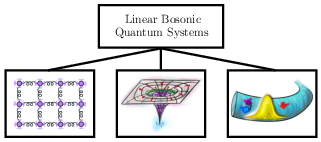
Figure 1: A network of coupled quantum harmonic oscillators, Hawking radiation from a black-hole event horizon, and photonic quantum fluctuations propagating near an analogue white-black hole in a dielectric medium---all fall under the umbrella of linear bosonic systems and can be described through the phase-space formalism.
Phase-Space Formalism: From Quantum Oscillators to Gaussian Channels
Quantum Harmonic Oscillators and Multimode Networks
The foundation is the construction of a network of quantum harmonic oscillators, each characterized by canonical quadrature operators obeying the CCR. The transition from Hilbert-space to phase-space descriptions is realized via the mapping of density matrices to mean vectors μ and covariance matrices σ in R2N, enabling significant simplifications for both state characterization and dynamics. Symplectic transformations S∈Sp(2N,R) govern linear evolution, capturing all bilinear Hamiltonians and Gaussian unitaries.

Figure 2: Network of interacting quantum harmonic oscillators, with linear couplings and measurement described in the phase-space framework.
Basic symplectic elements such as single- and two-mode squeezers, phase shifters, beamsplitters, and SUM-gates are formalized (Bloch-Messiah and Reck-Zeilinger decompositions), providing a diagrammatic language to represent arbitrary Gaussian processes.

Figure 3: Symplectic diagrams for fundamental multimode operations: squeezing, phase rotation, beamsplitting, and quantum gates relevant to CV information.
Open Quantum Systems and Gaussian Channels
Generalization to non-unitary, open-system dynamics is achieved by Gaussian channels, formulated through unitary dilations (coupling to environment modes via symplectic transformations). The Heisenberg–Langevin formulation of system-bath dynamics (and the corresponding Lindblad master equations) provides analytic constructs for lossy channels, amplifiers, and thermal noise processes, with input-output relations reducing to linear maps on (μ,σ).
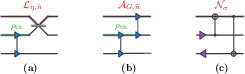
Figure 4: Unitary dilations of canonical single-mode Gaussian channels, including thermal loss, amplifier, and additive noise, with explicit symplectic circuit structure.
Characterization, Evolution, and Measurement of Gaussian States
Wigner Functions, Moments, and Gaussian Measurements
A Gaussian state is uniquely characterized by (μ,σ), with its Wigner function a multivariate Gaussian distribution in phase space. The analysis exploits symplectic diagonalization (Williamson's theorem) to extract mode decompositions relevant for entropy, purity, and separability.
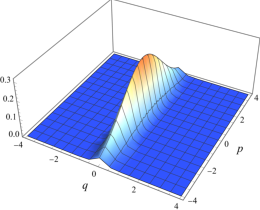
Figure 5: Wigner functions for the vacuum (left) and squeezed vacuum (right) states, illustrating first and second moment structure.
All physically valid covariance matrices are required to satisfy the Robertson–Schrödinger uncertainty relation.
Gaussian quantum evolution—both unitary and by Gaussian channels—acts via μout=Xμin+d and σout=XσinX⊤+Y, with (X,Y,d) encoding channel action.
Quantum measurement protocols include both Gaussian (homodyne, heterodyne, ancilla-assisted) and non-Gaussian (photon counting, click detection) strategies, each with explicit impact on the output state.
Entanglement Structure and Quantification in Gaussian Systems
Entropy, Extremality, and Pairwise Decomposition
For Gaussian states, von Neumann entropy—a function of symplectic eigenvalues—fully quantifies mixedness. Notably, Gaussian extremality holds: at fixed covariance, Gaussian states maximize entropy.
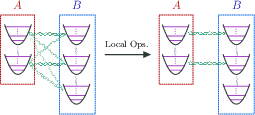
Figure 6: Modewise entanglement structure: a general multimode Gaussian state can be locally transformed (for isotropic noise or pure states) into a direct sum of correlated TMSV pairs and uncorrelated modes.
For pure or isotropically noisy multimode states, all intersystem entanglement can be concentrated into two-mode-squeezed vacuum pairs via local symplectic operations ("modewise entanglement"), generalizing the Schmidt decomposition to the CV setting.
PPT Criterion and Logarithmic Negativity
The Peres–Horodecki PPT criterion is both necessary and sufficient for Gaussian separability in 1 vs N partitions; for two-mode Gaussian states, negativity of a single PT symplectic eigenvalue signals entanglement, and the logarithmic negativity EN gives an operational monotone:
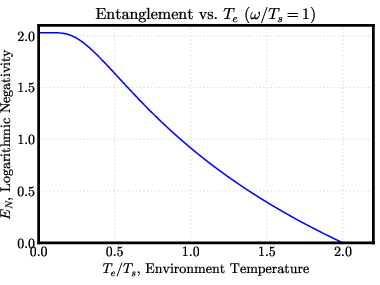
Figure 7: Log-negativity as a function of environment temperature for a thermally seeded TMSV, showing threshold decoherence-induced entanglement sudden death.
Decoherence (thermal noise, loss) rapidly suppresses output entanglement, with the log-negativity providing explicit thresholds (e.g., Te<2Ts for thermal TMSV). Experimentally practical witnesses based on Cauchy–Schwarz inequalities and PPT-constructible invariants are also provided, though with limitations for quantitative assessment, especially in high-noise regimes.
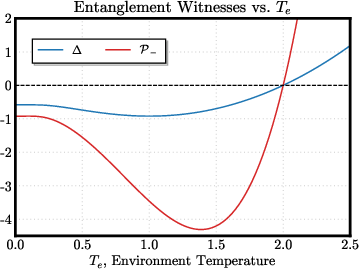
Figure 8: Comparison of PPT and Cauchy-Schwarz witnesses as functions of the environmental temperature, highlighting their structure and pitfalls.
Gaussian Dynamics in Semi-Classical Gravity and Analogue Models
Black Hole Hawking Radiation and Superradiance
The QFCS setting is reduced via symmetry decomposition and mode filtering to finite Gaussian subsystems per sector. Hawking emission and superradiance arise as Gaussian input-output channels: Schwarzschild black holes yield thermal-loss channels (Lη,nˉH), while the superradiant Kerr regime gives thermal amplifiers (AGJ,nˉH), with nˉH set by the local surface gravity and Killing frequencies.
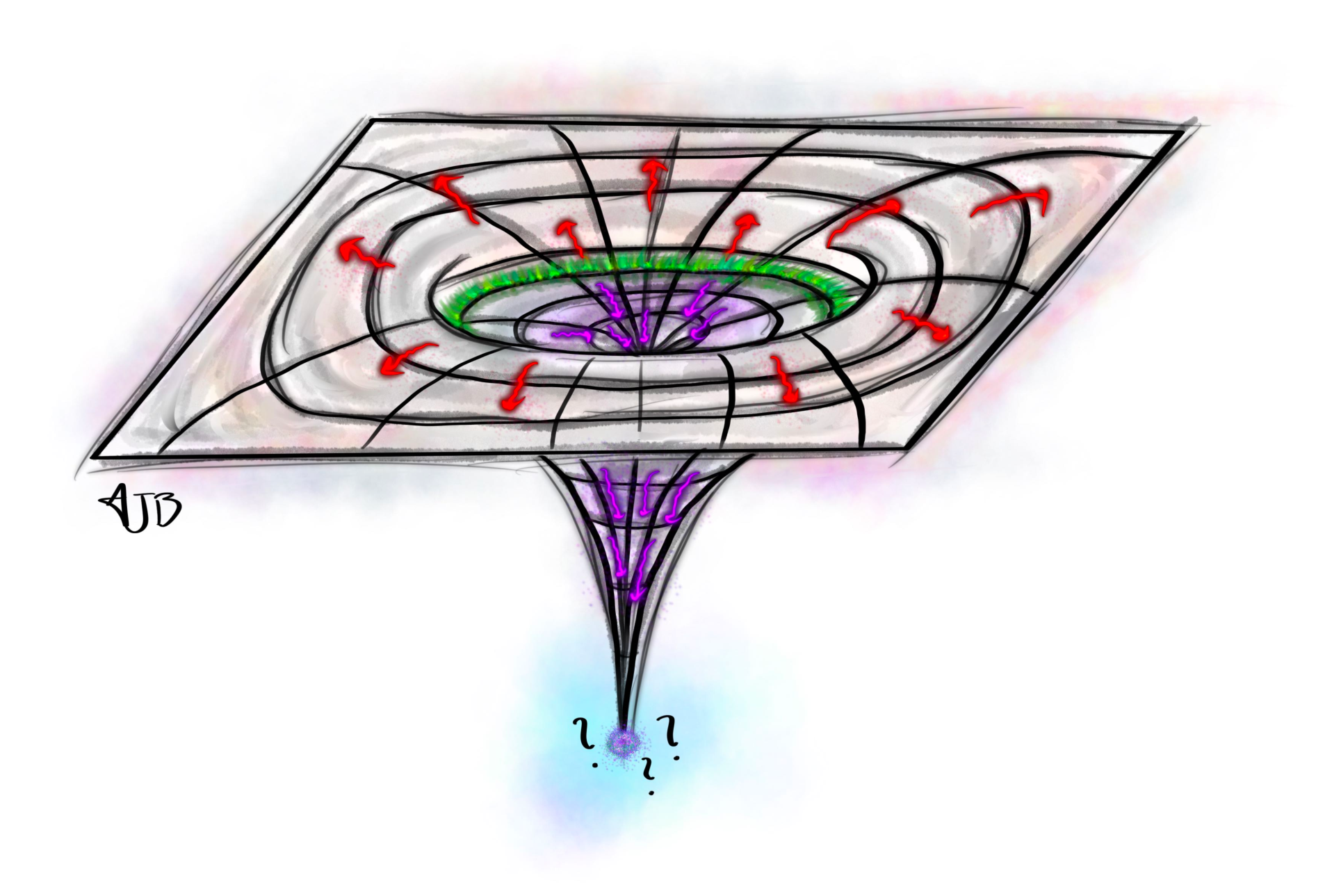
Figure 9: Black hole evaporation scenario with outgoing Hawking quanta and interior partners—fundamental for entropy and information puzzles.
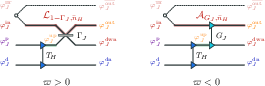
Figure 10: Symplectic circuit diagrams for black hole input-output channels, separating non-superradiant (lossy) and superradiant (amplifying) regimes.
The outgoing radiation statistics, entropy flux, and log-negativity between interior and exterior are all computable via the Gaussian machinery, facilitating detailed study of thermodynamic and information-theoretic aspects of black hole evaporation.
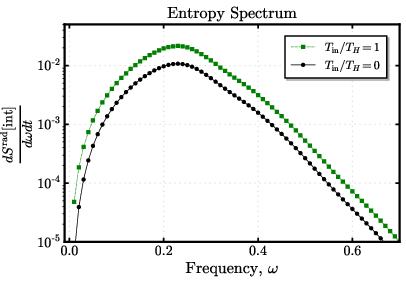
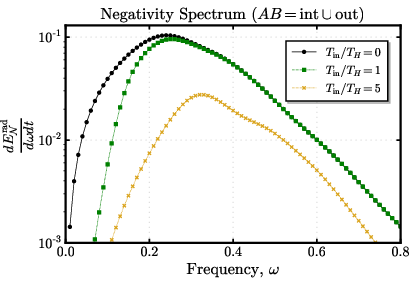
Figure 11: Entanglement (log-negativity) and entropy spectra for radiation emitted from a black hole in contact with an external thermal bath.
Analytical and numerical results confirm that, while entropy of outgoing modes increases with environment temperature, entanglement between interior and exterior falls, vanishing above a critical threshold.
Page Curve and Information Aspects
The notes critically discuss the "Page curve" as an externally-imposed upper bound (from the central dogma, not semi-classical physics) on the growth of radiation entropy—emphasizing that, in Gaussian QFCS, entropy can always increase if the notion of black hole microstates is not directly enforced.
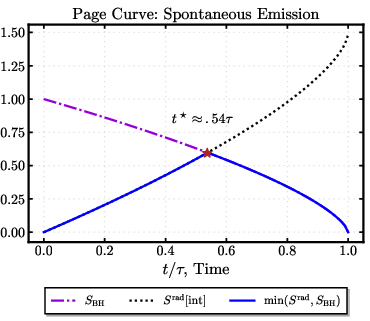
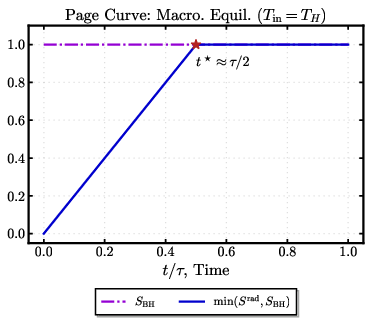
Figure 12: Schematic Page curves illustrating the rise-and-fall structure for radiation entropy in black hole evaporation and the constraints imposed by the microscopic Hilbert space dimension.
Analogue Gravity: Optical and Polaritonic Realizations
A major technical focus is the rigorous mapping of laboratory analogue systems (e.g., in dispersive dielectric media or driven polariton fluids) onto the Gaussian formalism. In such setups, event horizons and ergoregions for bosonic excitations can be engineered via tunable background profiles, leading to robust analogue Hawking and superradiant processes.
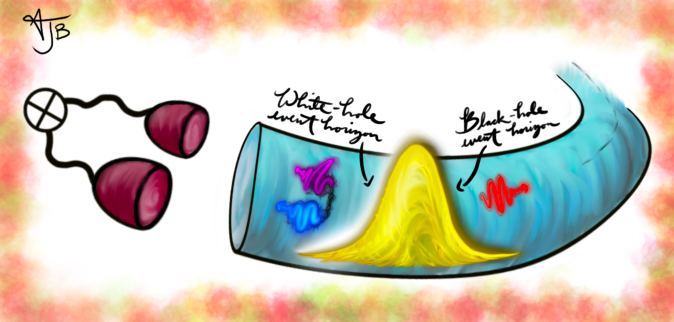
Figure 13: Optical white-black hole analogue: moving refractive index perturbations generate laboratory horizons and correlated spontaneous particle creation.
Mode structures are elucidated in detail, including the multibranch dispersion and the translation of horizon kinematics into diagrammatic symplectic circuits.
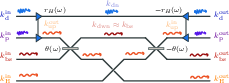
Figure 14: Symplectic circuit for a dielectric white-black hole pair: essential structure for the optical Hawking and stimulated emission process.
Robustness of entanglement in optical analogues under strong laboratory thermal noise is quantitatively demonstrated. The extreme frequency separation between modes in the comoving and laboratory frames, induced by Lorentz boosts and material dispersion, ensures that high-frequency progenitor modes remain virtually unpopulated even at elevated lab temperatures.
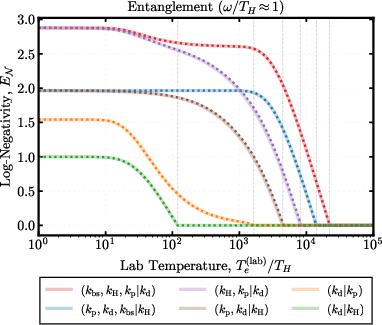
Figure 15: Log-negativity in the Hawking process as a function of the ambient laboratory temperature, showing exceptional robustness to thermal decoherence in optical analogues.
Driven-dissipative polariton platforms further illustrate the interplay between controlled radiative relaxation (enabling efficient measurement and stabilization) versus phonon-induced diffusion (which can erase quantum correlations even at vanishing bath temperature). Theoretical open-system toy models—based on Heisenberg–Langevin equations for BdG excitations—yield analytic criteria for output entanglement and demonstrate that phonon vacuum fluctuations present an intrinsic decoherence channel limiting observable quantum signatures.
Implications and Outlook
The formalism advanced in these lectures coherently bridges fields from QIP, quantum optics, and high-energy theory, establishing the universality of the Gaussian paradigm for quantum dynamics wherever linear bosonic modes dominate. The results have major implications:
- In quantum field theory and gravitational physics, Gaussian methods render black hole thermodynamics, entropy production, and information dynamics computationally tractable and conceptually transparent, with the capacity to calculate entropy, negativity, and all fluxes for arbitrary in/out configurations.
- In analogue gravity and quantum simulation, the phase-space formalism provides predictive power for assessing visibility of quantum phenomena (entanglement, pair production) under realistic laboratory conditions, identifying the fundamental noise thresholds and structure of emergent Gaussian channels.
- In CV quantum information and quantum technologies, the results reinforce the central role of symplectic structure, diagrammatic circuits, and channel theory for the design, optimization, and benchmarking of continuous-variable processors and measurements.
Looking forward, the confluence of theory and experiment in laboratory analogue systems—especially in driven open quantum fluids of light—demands further advances in Gaussian open-system techniques, engineering of robust nonclassical resources, and development of scalable entanglement certification under nonideal conditions. The technical bridge to QFCS calculations from laboratory platforms elucidated in these lectures will continue to underpin progress in quantum simulation of spacetime, quantum thermodynamics, and quantum information in curved backgrounds.
Conclusion
This work provides a methodologically rigorous and quantitatively precise synthesis of the Gaussian phase-space formalism, its foundational operations, and its application to semi-classical gravity and laboratory analogue platforms. Through explicit technical detail, illustrative symplectic circuits, and direct computation of entropic and entanglement quantities under nonideal conditions, it delivers the analytical toolkit required to tackle both foundational and applied challenges at the interface of quantum optics, information theory, and emergent spacetime physics.
Paper to Video (Beta)
No one has generated a video about this paper yet.
Whiteboard
No one has generated a whiteboard explanation for this paper yet.
Paper Prompts
Sign up for free to create and run prompts on this paper using GPT-5.
Top Community Prompts
Continue Learning
- How does the Gaussian phase-space formalism simplify the analysis of linear bosonic quantum systems?
- What role do symplectic transformations play in the transition from Hilbert-space to phase-space descriptions?
- How are Gaussian channels used to model open quantum systems and account for thermal noise?
- What experimental techniques are proposed for realizing analogue gravity models in laboratory settings?
- Find recent papers about analogue gravity experiments.
Related Papers
- Symplectic circuits, entanglement, and stimulated Hawking radiation in analog gravity (2022)
- Bosonic and fermionic Gaussian states from Kähler structures (2020)
- Lectures on Gravity and Entanglement (2016)
- Lectures in Quantum Gravity (2024)
- Black holes and Hawking radiation in spacetime and its analogues (2012)
- Analogue gravitational phenomena in Bose-Einstein condensates (2012)
- Lecture Notes on Operator Algebras and Quantum Field Theory (2025)
- Analogue gravity with Bose-Einstein condensates (2025)
- An introduction to nonlinear fiber optics and optical analogues to gravitational phenomena (2025)
- Introduction to black hole thermodynamics (2025)
Authors (1)
Collections
Sign up for free to add this paper to one or more collections.
Tweets
Sign up for free to view the 1 tweet with 10 likes about this paper.

