- The paper reveals that layered dark patterns across intra-page, inter-page, and system-level interactions contribute to an 11–30% increase in order value.
- The study employs the Temporal Analysis of Dark Patterns (TADP) framework and detailed walkthroughs to map manipulative interface strategies.
- The analysis underscores regulatory gaps in EU consumer protection, calling for policies that address cumulative exposure in hybrid digital-physical environments.
Temporal Audit of Dark Patterns in McDonald's Self-Ordering Kiosk Flow
Introduction
This essay analyzes the structured audit of the McDonald's self-ordering kiosk (SOK) interface in Germany as presented in "Deception by Design: A Temporal Dark Patterns Audit of McDonald's Self-Ordering Kiosk Flow" (2603.03218). The authors employ the Temporal Analysis of Dark Patterns (TADP) framework to decompose the kiosk flow into intra-page, inter-page, and system-level manipulative strategies, focusing on the accumulation and escalation of dark patterns during a typical hurried, low-reflection customer interaction. The study contextualizes its findings within the regulatory landscape of EU consumer protection and the Digital Services Act, revealing regulatory gaps associated with hybrid physical-digital environments.
Methodology and Analytical Procedure
The audit involved in situ walkthroughs and comprehensive interface reconstruction, annotating interaction costs, navigation dependencies, and dark pattern occurrences across 12 distinct steps. The user simulation model operationalized a time-pressured persona, always selecting the most salient (usually default) options to approximate realistic public kiosk behavior. Analysis utilized TADP alongside the ontology by Gray et al., systematically tagging high- and low-level dark patterns at three temporal strata:
- Intra-page: Within individual screens
- Inter-page: Across sequential screens
- System-level: Encompassing the overall flow and physical contextual constraints
Intra-Page Layering of Dark Patterns
Interface screens were reconstructed and annotated to reveal occurrence and layering of high-level dark pattern strategies. Early stages of the kiosk flow prominently feature social engineering, interface interference, sneaking, and obstruction.
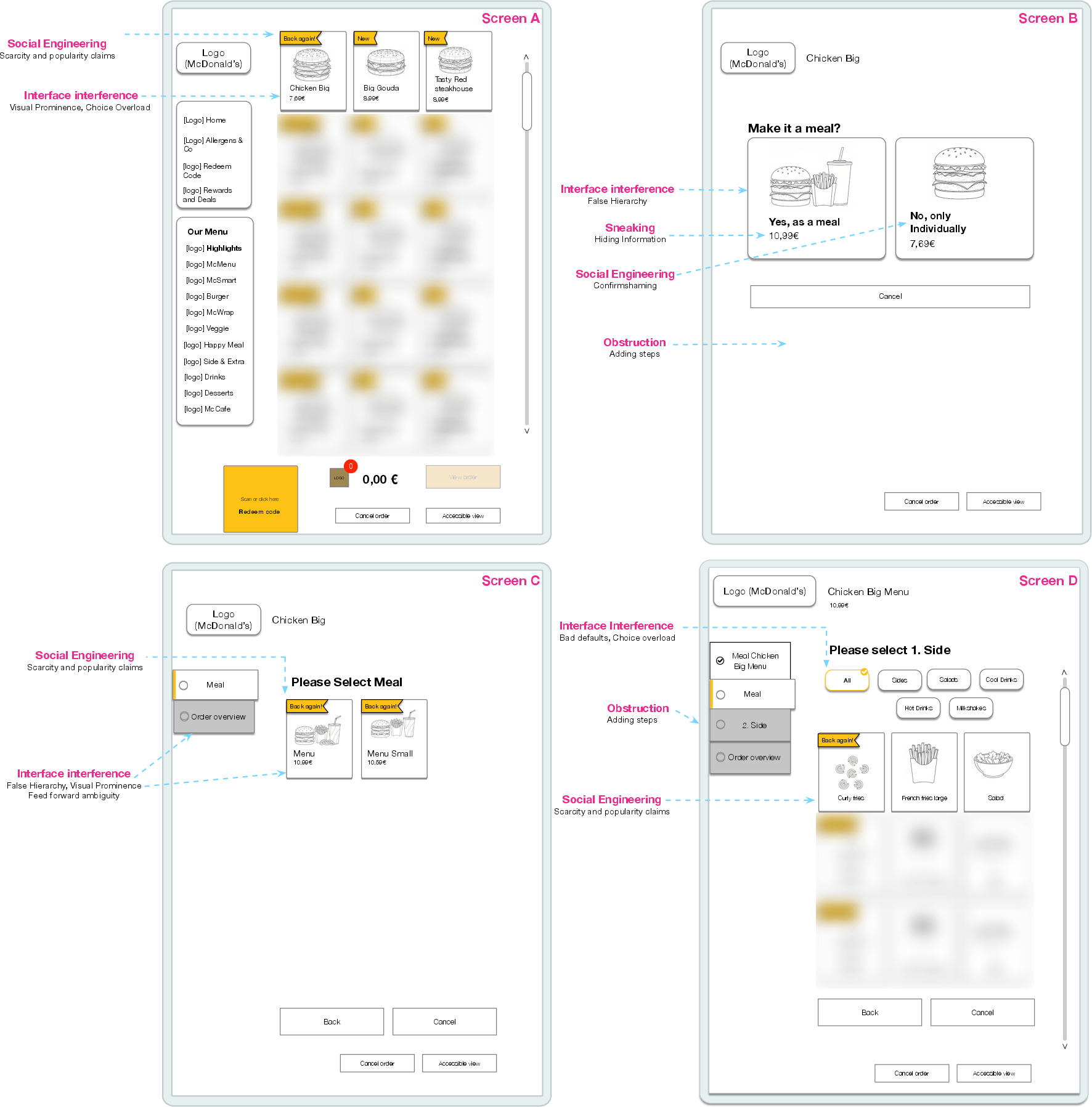
Figure 1: Intra-page analysis reveals layered dark patterns including social engineering and interface interference in early product selection and meal upsell stages.
On initial screens, scarcity cues, social proof, and visual prominence drive attentional capture. Cognitive overload is induced by presenting numerous ungrouped menu items with competing visual badges, degrading decision autonomy and increasing susceptibility to hierarchy manipulations. Meal options are configured to be the first visually salient choices, reinforcing economic upsell strategies, compounded by confirmshaming labels and classic drip pricing for bundled offers. These tactics persist as the flow moves into meal customization, cross-sell, and side selection screens.
Escalation Across Sequential Screens
The audit identifies the progressive accumulation and reinforcement of dark patterns as users navigate through consecutive screens during high-velocity task progression.
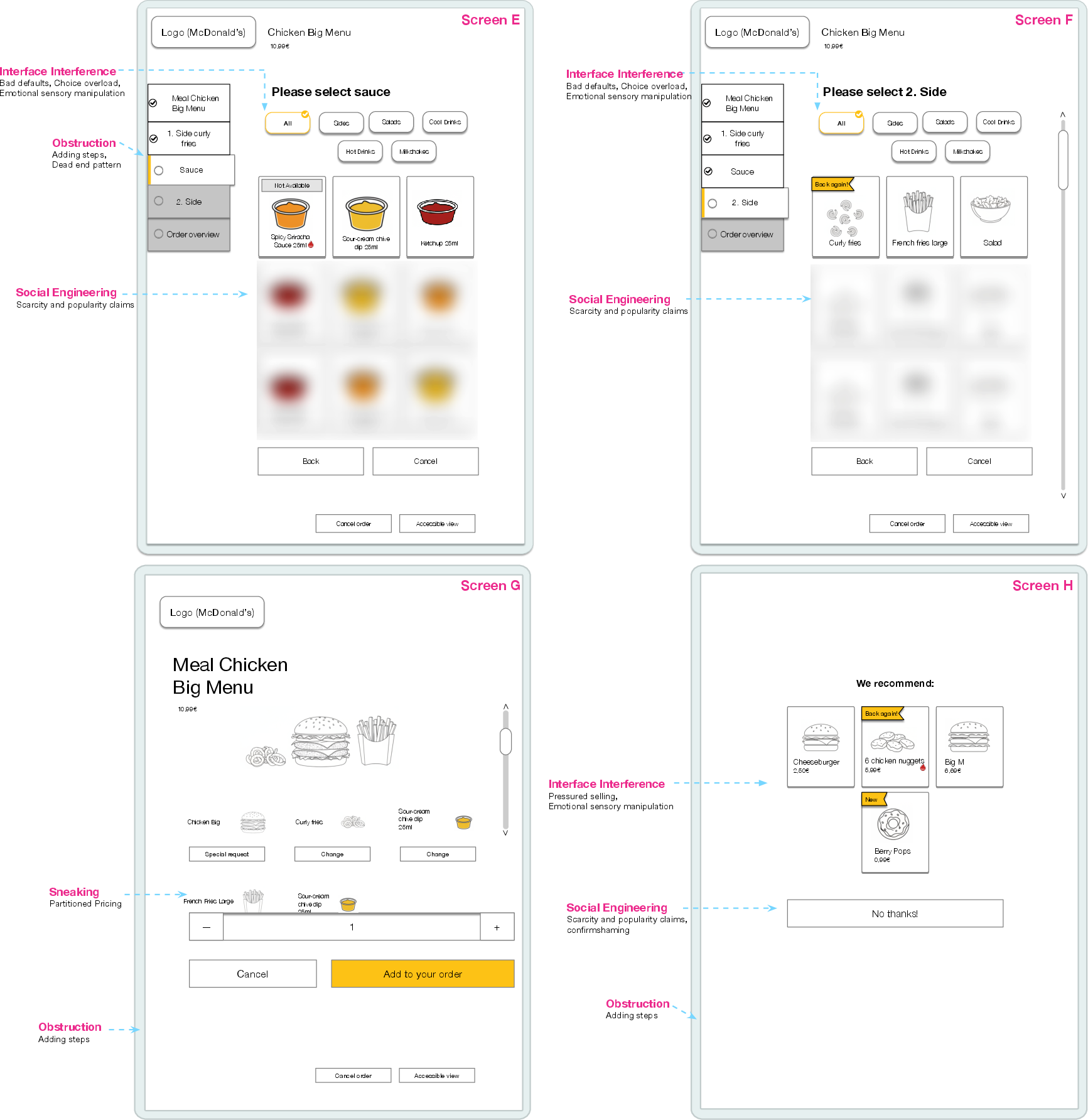
Figure 2: Intra-page analysis continues with meal configuration and cross-sell screens, highlighting bad defaults, choice overload, partitioned pricing, pressured selling, and the introduction of additional upsell steps.
Layered manipulative mechanisms include feedforward ambiguity (unclear progress indicators), forced traversal (obstruction), and partitioned pricing (visibility manipulation through below-the-fold content). Upsell prompts increasingly exploit pressured selling and confirmation friction, hiding order details and escalating compliance likelihood via cumulative exposure.
Late-stage screens (modals, donation requests, payment confirmation) intensify reversal costs through confirmshaming, scarcity cues, and additional steps for decline or cancellation.
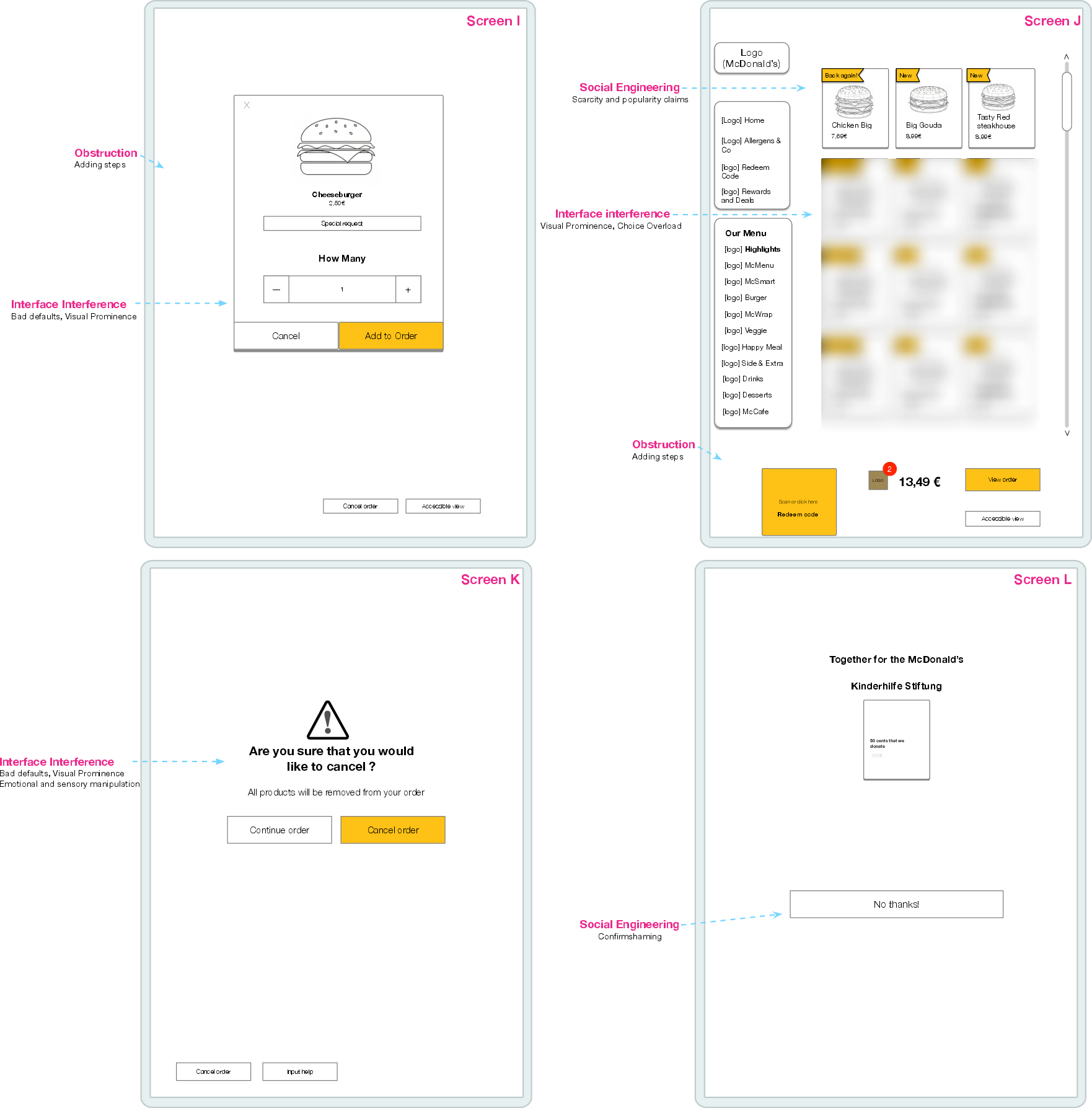
Figure 3: Late-stage dark patterns escalate user reversal costs via upsell modals, cancellation prompts, confirmshaming, and scarcity cues.
System-Level Amplification and Architectural Context
Beyond discrete interface manipulations, the study demonstrates that physical context and kiosk architecture exacerbate dark pattern effectiveness. Queue-based, public environments heighten time pressure and decrease deliberation, making users more vulnerable to visually salient cues and manipulated defaults. Linear flow and mandatory traversal through multiple upsell stages embed obstruction and friction at a systemic level, asymmetrically increasing interaction costs for refusing promoted items.
The interface is structured such that acceptance actions are always easier and more salient than declination, and architectural features (large touch targets, vertical stacking, scroll-based visibility) further bias order progression and add complexity to cancellation or reversal.
Regulatory Implications and Recommendations
Findings urge reconsideration of regulatory frameworks focused primarily on isolated online elements, as temporally layered manipulations in physical-digital environments elude such scrutiny. EU regulatory directives (UCPD, DSA) inadequately address escalation sequences and cumulative exposure inherent in kiosk flows. The audit emphasizes the need for temporal and contextual sensitivity in future consumer protection guidelines, particularly as physical-digital hybrid platforms proliferate.
Numerical Results and Claims
Industry data referenced in the paper indicates SOKs at McDonald's increase average order value by 11–30%, attributed to the extended browsing time and digitally mediated upsell prompts. The audit demonstrates, through annotated walkthroughs, that manipulative strategies—obstruction, social engineering, pressured selling—can exploit reduced deliberation and escalate monetary commitment via repeated upsell steps.
Practical and Theoretical Implications
This work substantially advances understanding of dark pattern manifestation in hybrid environments, illustrating how interface strategies, flow structure, and embodied user context interact to amplify manipulation. The method sets groundwork for regulatory audits and comparative studies across geographies, QSR chains, and interface modalities. Practical implications include the necessity for public health and consumer protection interventions targeting digital nudges and manipulative choice architectures in food environments. Theoretically, the study extends ontological frameworks for dark patterns to account for temporality, flow dependency, and system-level effects.
Future Developments in AI and Human-Computer Interaction
Speculation for future research directions includes cross-cultural audits of kiosks in diverse regulatory landscapes and design architectures, comparative analysis across QSR chains, and mapping nutritional and caloric distributions of promoted products. Integration of explainable AI methodologies in interface audit tools may enhance detection of manipulative modality and inform compliance with region-specific consumer law. Application of reinforcement learning frameworks could be leveraged to quantitatively model user susceptibility and escalation dynamics in complex flows, informing design mitigation strategies and regulatory evaluation mechanisms.
Conclusion
The temporal audit of McDonald's SOK interface reveals that dark patterns are not confined to isolated screens but are temporally layered, systemically embedded, and contextually amplified within hybrid physical-digital environments. Escalation sequences and cumulative exposure facilitate manipulation of hurried users, challenging the adequacy of prevailing regulatory frameworks. The study lays the foundation for future audits, interdisciplinary research, and regulatory advancement targeting deceptive design in digitally mediated food environments.

