- The paper demonstrates that introducing the KR field (characterized by parameter ℓ) significantly modifies the black hole spacetime, shifting extraction regions and critical radii.
- It employs the Hamilton-Jacobi formalism to derive particle geodesics, quantifying how spin, charge, plasma magnetization, and field orientation affect extraction power and efficiency.
- The findings imply that high-energy jet observations near the photon sphere can act as probes for Lorentz-violating effects, while the plunging region shows weaker sensitivity.
Introduction and Motivation
This paper presents a detailed analysis of the Comisso-Asenjo magnetic reconnection mechanism for extracting energy from rotating charged black holes within the framework of Kalb-Ramond (KR) gravity (2602.21555). The study targets modifications introduced by the KR field, an antisymmetric tensor field native to string theory, which causes spontaneous Lorentz symmetry breaking characterized by a dimensionless parameter ℓ. The work explores two distinct regimes — the circular orbit region and the plunging region — and rigorously investigates how parameters such as black hole spin (a), charge (Q), plasma magnetization (σ), field orientation (ξ), and the Lorentz-violating parameter (ℓ) affect both the feasibility and efficiency of energy extraction.
KR gravity alters the spacetime geometry and the dynamics of astrophysical black holes by modifying standard metrics and shifting critical radii such as the event horizon, ergosphere, ISCO, and photon sphere. This study aims to quantify these modifications and highlight the potential of energy extraction processes as probes for Lorentz-violating effects in observational black hole astrophysics.
Rotating Charged Black Holes in Kalb-Ramond Gravity
The KR-modified black hole metric incorporates the Lorentz-violating parameter ℓ in the definition of Δ and Σ. At ℓ=0, the metric reduces to Kerr-Newman. The horizon radii and the ergosphere boundaries are parametrically affected by a0, a1, and a2. The equations of motion for particles on the equatorial plane are derived via the Hamilton-Jacobi formalism, with these parameters directly entering the geodesics. Crucially, the radial location of energy extraction and the nature of plasma dynamics are sensitive to a3 through its impact on frame-dragging and the geometry within the ergosphere.
Energy extraction via magnetic reconnection requires (a) accelerated plasma to escape with positive energy at infinity and (b) decelerated plasma to acquire negative energy and plunge into the horizon, i.e., Penrose-type conditions. The ZAMO frame is used to simplify the analysis, allowing for transparent computation of hydrodynamic energies per unit enthalpy.
The allowed parameter space for energy extraction is presented as a function of a4 and a5, with detailed analysis of the effects of a6, a7, a8 and a9. The numerical results demonstrate:
- Increasing Q0 (field orientation angle) shrinks the extraction region, while higher plasma magnetization Q1 expands it.
- Larger charge Q2 reduces the allowed region and shifts it inward.
- Most notably, increasing Q3 strongly restricts and shifts the extraction region; even moderate changes in Q4 lead to non-overlapping regions, thus amplifying the discriminative power for probing Lorentz violation.
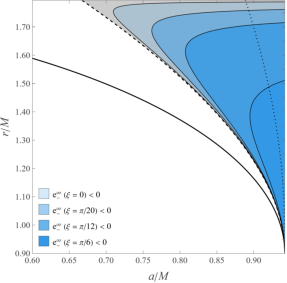
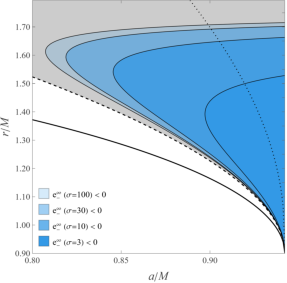
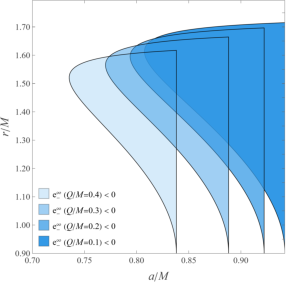
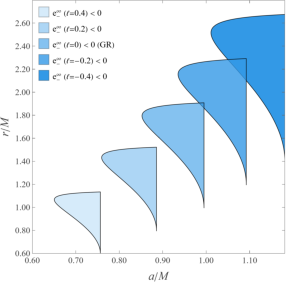
Figure 1: Energy extraction region in the circular orbit region for varying Q5, Q6, Q7, and Q8; demonstrating the parameter space sensitivity, particularly to the Lorentz-violating parameter Q9.
Energy extraction power σ0 and efficiency σ1 are calculated and show similar dependencies:
- Power increases monotonically with decreasing σ2 and increasing σ3; for fixed X-point radial locations, the maximal power occurs near the photon sphere.
- σ4's effect on power is non-monotonic and depends on σ5.
- σ6 has a pronounced effect; distinct values produce disjoint power curves and efficiency profiles.
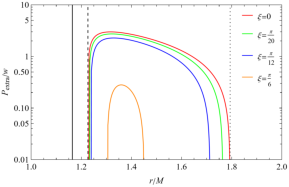
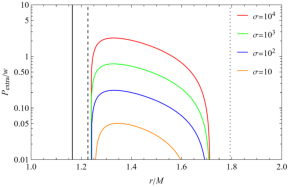
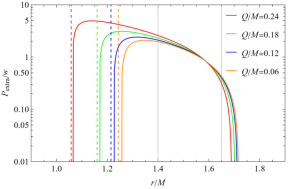
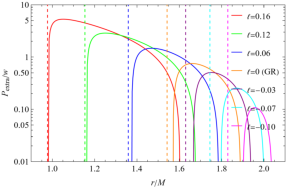
Figure 2: Energy extraction power per unit enthalpy density σ7 in the circular orbit region — manifesting peak values and shifts dependent on parameter combinations.
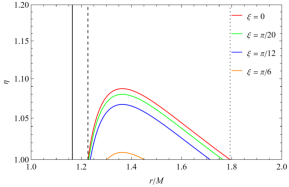
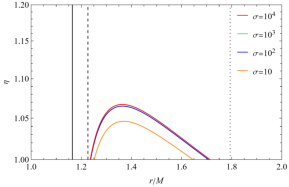
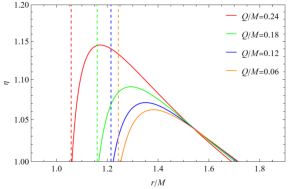
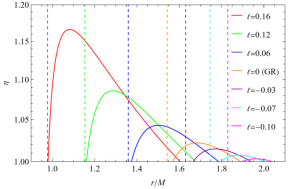
Figure 3: Energy extraction efficiency σ8 in the circular orbit region, exhibiting similar parameter dependence as σ9, with peak efficiencies in narrow bands near the ergosphere boundary.
When plasma migrates inward from ISCO into the plunging region, its radial velocity dominates and modifies extraction criteria. The hydrodynamic energy per unit enthalpy includes corrections for the plunging motion.
A key result is that the minimum spin required for energy extraction in the plunging region is much lower than in the circular orbit regime, and the inner spatial boundary of extraction now extends down to the event horizon rather than the photon sphere. The permitted extraction region is less sensitive to ξ0; only large variations in ξ1 yield distinct parameter spaces, meaning constraints are weaker.
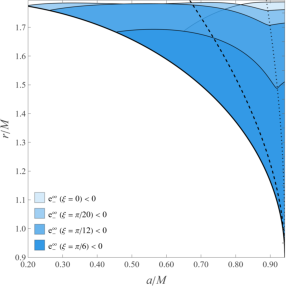
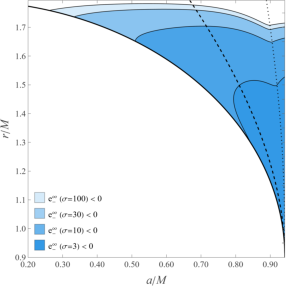
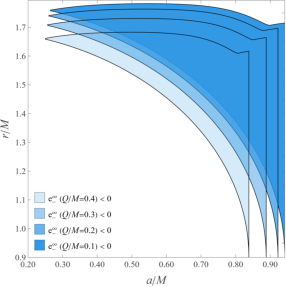
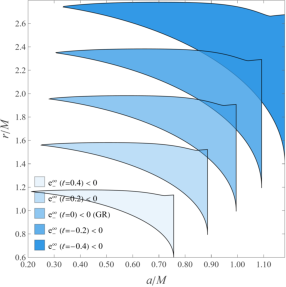
Figure 4: Energy extraction region in the plunging region, with broader allowed spin intervals and weaker sensitivity to ξ2 compared to the circular orbit region.
Energy extraction power and efficiency in the plunging region exhibit:
- Nonzero power at the event horizon, with more complex dependence on ξ3 and ξ4.
- The effect of ξ5 is dampened; overlapping power curves are common unless ξ6 varies considerably.
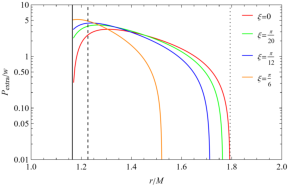
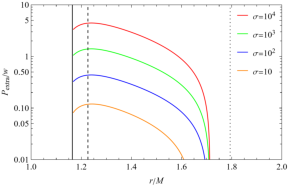
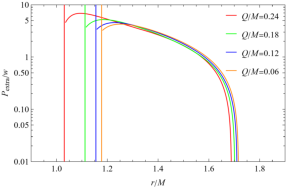
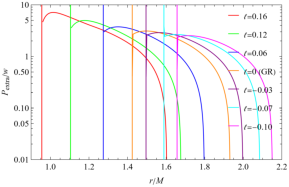
Figure 5: Energy extraction power per unit enthalpy density ξ7 in the plunging region, with the event horizon as the inner boundary, and less pronounced parameter dependence, especially for ξ8.
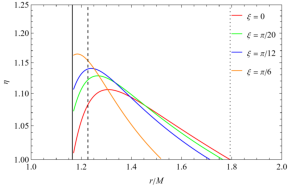
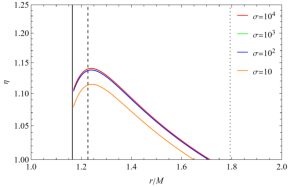
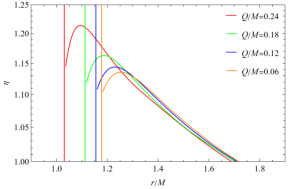
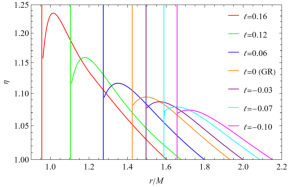
Figure 6: Energy extraction efficiency ξ9 in the plunging region, mirroring power trends and showing reduced sensitivity to Lorentz-violating effects.
Implications and Theoretical Significance
The results quantitatively establish that KR-induced Lorentz violation yields observable modifications to the energetics and parameter space of black hole plasma outflows. Energy extraction from the circular orbit region is shown to be especially sensitive to ℓ0, suggesting high-energy astrophysical jet observations, or detailed measurements of extraction efficiency and power, can serve as probes for string-inspired antisymmetric tensor fields and low-energy Lorentz violation.
For the plunging region, the broader spin interval required for extraction and weaker ℓ1 dependence imply that observed energetic phenomena from low-spin black holes are likely associated with this regime. However, discrimination of the KR field effects is far less effective here.
The dual-region comparison underscores that magnetic reconnection not only remains a robust energy transfer mechanism in modified gravity but also offers a testbed for quantum gravity motivated field effects in strong gravity environments.
Conclusion
This paper provides a systematic, parameter-sensitive study of energy extraction via the Comisso-Asenjo mechanism in Kalb-Ramond gravity, detailing the influence of Lorentz-violating effects on extraction regions, power, and efficiency. The analysis demonstrates the circular orbit region’s potential as a precise probe for KR fields, while the plunging region, though astrophysically relevant, offers weaker constraints. These results deepen understanding of black hole energetics in string-motivated gravity extensions and motivate future observational campaigns aiming to constrain Lorentz violation and probe quantum fields in strong gravity.

