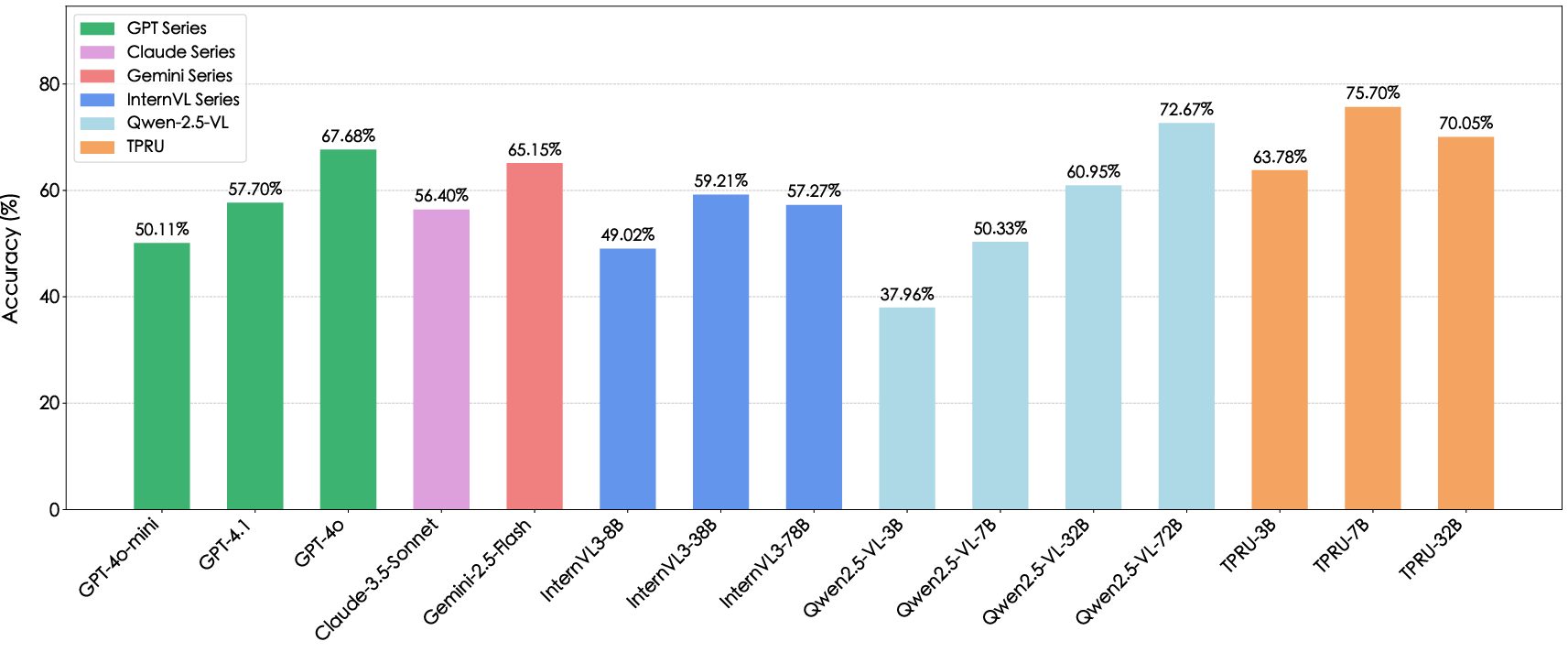
- The paper introduces a novel dataset and training paradigm—TPRU—that effectively improves temporal sequencing and procedural reasoning in multimodal models.
- The methodology leverages real-world embodied scenarios and reinforcement learning via GRPO to optimize tasks like temporal ordering and next frame prediction.
- Empirical results show significant accuracy improvements and robust transfer across applications, narrowing performance gaps with larger models.
TPRU: A Dataset and Training Paradigm for Temporal and Procedural Understanding in Multimodal LMs
Motivation and Problem Framing
The paper "TPRU: Advancing Temporal and Procedural Understanding in Large Multimodal Models" (2602.18884) systematically addresses a persistent bottleneck in current Multimodal LLMs (MLLMs): their pronounced deficiency in temporal and procedural understanding when presented with image sequences from real-world, embodied contexts. Previous advances in MLLMs have focused almost exclusively on single-image tasks or unordered sets, which has led to impressive scores on many vision-language benchmarks but left models—especially small, deployable ones—unable to grasp the fundamental dynamics of change and causality within visual processes. This is a critical failure mode for application domains such as robotic control, GUI navigation, and embodied AI, where resource-efficient models are required to reason about complex temporal phenomena.
TPRU Dataset: Structure and Design Principles
TPRU is designed to fill a conspicuous gap in available training resources. Unlike prior synthetic or evaluation-only datasets, TPRU is curated from real-world, embodied scenarios, spanning robotic manipulation, LEGO assembly, GUI operation, and embodied navigation. The dataset comprises two principal components:
- TPRU-25k: The large-scale training set features 24,750 samples and 126,000 images, each annotated for procedural logic and temporal consistency.
- TPRU-Test: A held-out test set with 461 challenging, manually annotated examples, covering five application domains including EPIC-KITCHENS for human activities.
The dataset is hierarchically structured for fine-grained temporal evaluation. Three core, complementary tasks are defined:
- Temporal Ordering: Models must restore the correct temporal sequence from a shuffled group of images, capturing holistic procedural flow.
- Next Frame Prediction: The model is given all but one frame and must select the correct intermediate step, simulating planning and causal inference.
- Previous Frame Review: From the end of a sequence, the model must identify the initial conditions, testing its capacity for backward causal traceability.
A defining feature is the abundant use of challenging negative samples—instances with decoupled visual and textual content—that force models to move beyond surface cue matching and perform robust cross-modal verification.
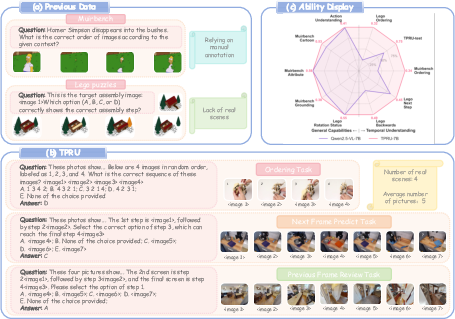
Figure 1: The TPRU dataset is constructed from real-world temporal sequences and specifically engineered for procedural understanding, with demonstrable performance gains in the TPRU-7B model.
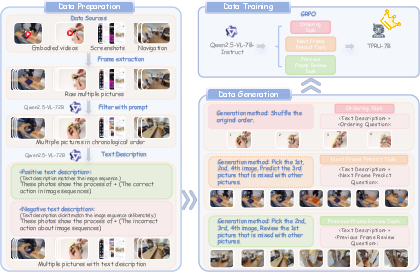
Figure 2: The dataset construction pipeline curates temporal sequences, annotates both positive and negative descriptions, and decomposes tasks for targeted model fine-tuning.
Training Methodologies and Experimental Protocol
MLLMs based on Qwen2.5-VL (3B, 7B, and 32B) are fine-tuned using RL, specifically Group-wise Preference Optimization (GRPO), with the objective of directly optimizing for procedural reasoning tasks. The reinforcement learning setup is superior to SFT (supervised fine-tuning) in instilling advanced multi-modal causal logic, as ablation studies demonstrate clear, consistent improvements under the GRPO paradigm.
Empirical Evaluation
Extensive experiments validate the efficacy of TPRU in both in-domain and general benchmarks:
This generalizes: TPRU-7B delivers a quadrupling of ordering accuracy on LEGO-Puzzles, underscoring strong transfer to real procedural skills, not just in-domain overfitting.
Ablations further support the necessity of each dataset and training component:
- Removal of negative samples reduces robustness to procedural inconsistencies.
- Combining all three reasoning tasks in training yields a clear synergistic gain.
- Scaling training data size yields diminishing returns past TPRU-25k, indicating sufficient coverage for robust generalization.
- Fine-tuning via RL (GRPO) outperforms SFT consistently, confirming the need for reward-driven policy updates.
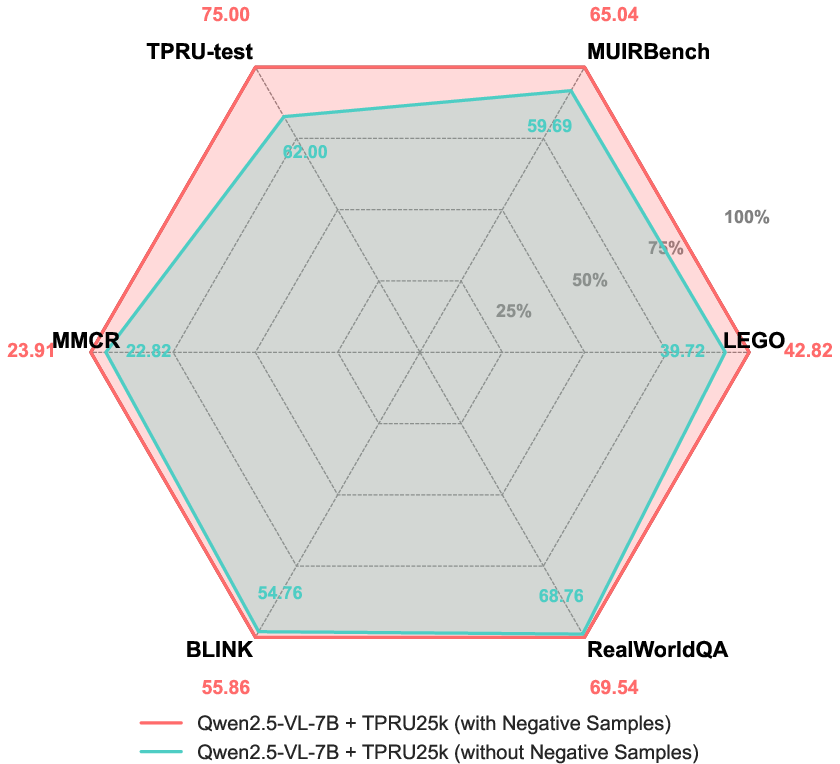
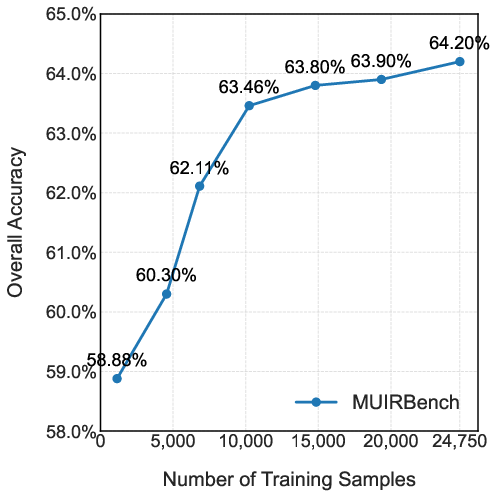
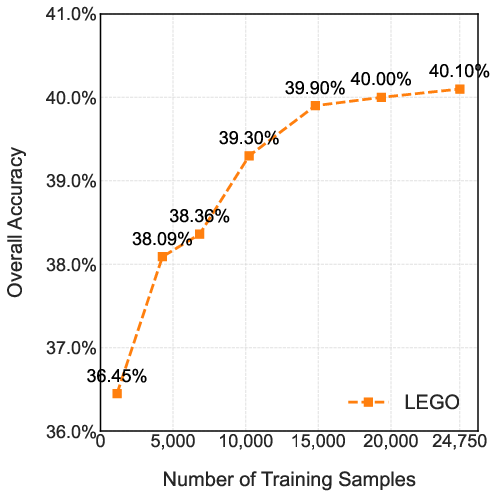
Figure 4: Ablations reveal the critical roles of negative sampling and multi-task training—the removal of either component degrades model performance.
Video Model Comparison
Although general video LLMs are sometimes expected to excel on temporal tasks, they fail on fine-grained procedural ordering. The best open-source video LLM (Qwen2.5-Omni-7B) substantially underperforms TPRU-7B on all key benchmarks, especially in temporal ordering, verifying that targeted, multi-image, real-world procedural data is necessary for genuine cross-modal temporal competence.
Practical and Theoretical Implications
TPRU’s results contradict the heuristic that small models are inherently incapable of sophisticated temporal reasoning. Instead, the limiting factor is the lack of procedurally coherent, negative-sample-enriched data and the inadequacy of traditional SFT. By bridging the train-test gap with large-scale, structured, diversified sequential supervision and RL fine-tuning, TPRU demonstrates that operational MLLMs can acquire skills previously associated only with very large, proprietary models.
Practically, the TPRU approach paves the way for efficient, deployable MLLMs suitable for edge devices in real-world, embodied settings (robotics, AR, HCI). Theoretically, it re-frames the narrative around model scale, curriculum design, and data diversity in multimodal representation learning, and motivates re-examination of benchmark and dataset design for future temporal reasoning research.
Future Directions
Several new research avenues are suggested. First, expanding TPRU to more domains and annotating longer, more challenging procedural chains could further improve generalization and model planning horizon. Second, integrating TPRU-style supervision with audio, instruction-following, and interactive feedback would move toward broader embodied AI competence. Finally, exploring algorithmic innovations (such as hierarchical reinforcement learning or explicit causal structure modeling) atop TPRU provides an avenue for making multi-modal, resource-efficient agents genuinely capable of real-world temporal and causal inference.
Conclusion
TPRU provides an actionable solution for advancing fine-grained temporal and procedural reasoning in MLLMs. By coupling authentic, large-scale datasets with reinforcement-based fine-tuning regimes, it closes much of the competence gap between large and small-scale models and establishes a clear empirical recipe for equipping multimodal agents with actionable temporal and causal intelligence suitable for real-world applications.