Graph Colouring: A Visual Tour
Abstract: Graph colouring is a combinatorial optimisation problem with applications in several important domains, including sports scheduling, cartography, street map navigation, and timetabling. It is also of significant theoretical interest and a standard subject in university-level courses on graph theory, algorithms, and combinatorics. In this paper, we consider the topics of node, edge, and face colouring along with their associated algorithms. Theoretical results are reviewed and brought to life through a collection of detailed, visually engaging figures designed to enhance understanding and appeal.
Paper Prompts
Sign up for free to create and run prompts on this paper using GPT-5.
Top Community Prompts
Explain it Like I'm 14
Overview of the Paper
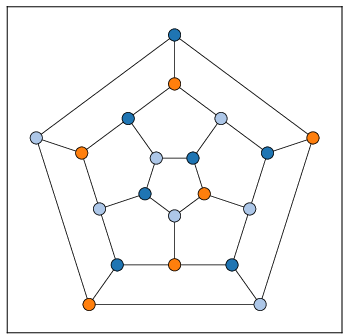
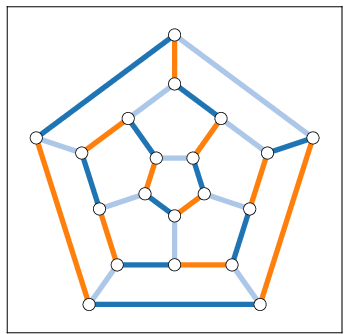
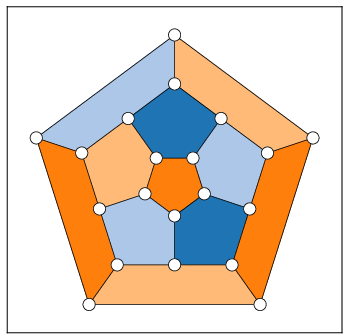
This paper is a friendly, picture‑rich tour of “graph colouring,” a classic math and computer science problem. A graph is a bunch of dots (called nodes) connected by lines (called edges). Graph colouring means giving colours to parts of a graph so that things that touch don’t share the same colour. The paper shows three kinds of colouring:
- Node colouring: colour the dots.
- Edge colouring: colour the lines.
- Face colouring: colour the regions in a drawing of the graph (only for drawings with no crossing edges, called planar graphs).
The paper explains important ideas, shows algorithms that try to colour graphs well, and uses many visuals to make the concepts easy to understand.
Key Questions the Paper Explores
- How can we colour a graph’s nodes, edges, or faces so that touching parts have different colours?
- What is the smallest number of colours we need in each case?
- Which algorithms work well in practice, and how can we make the results easy to see and understand?
How the Researchers Approach the Problem
What is a Graph?
Think of a graph like a social network:
- Nodes (dots) are people.
- Edges (lines) show who is friends with whom. Two nodes are “adjacent” if a line connects them (they are friends). A node’s “degree” is how many friends it has.
Three Types of Colouring
- Node colouring: colour each person so no two friends share a colour. The smallest number of colours that works is the chromatic number, written as χ(G).
- Edge colouring: colour each friendship line so no two lines touching the same person share a colour. The smallest number here is the chromatic index, written as χ′(G).
- Face colouring: if the graph is drawn with no crossing lines (planar), you can colour the regions (faces) so neighbouring regions are different. The smallest number is the face chromatic number, χ_f(G).
A famous result called the Four Colour Theorem says any planar map’s faces can be coloured with at most four colours.
Helpful conversions:
- Edge colouring can be turned into node colouring by making a new graph where each old edge becomes a new node (this is called the line graph).
- Face colouring can be turned into node colouring by using the dual graph, where faces become nodes.
Algorithms in Everyday Terms
- Greedy colouring: go through nodes one by one; for each node, give it the smallest colour number that doesn’t clash with its neighbours. It’s fast, but your order matters—bad order can use more colours than necessary.
- Backtracking: like trying outfits and undoing bad choices. The algorithm tries colours, and if it gets stuck, it backs up and tries a different choice. This can find the best possible answer but can take a long time on tough graphs.
- DSatur (smart ordering): always colour the “most troublesome” node next—the one whose neighbours already show the most different colours. This smart ordering helps greedy and backtracking work better and is perfect (exact) for some graph shapes (like trees and cycles).
- HEA with tabu search (a metaheuristic): start with a fixed number of colours, let temporary clashes happen, and then repeatedly “repair” them by changing colours. It mixes and improves solutions over time, aiming to reach zero clashes and then reduce the number of colours. It doesn’t guarantee perfect results but often finds very good ones quickly.
Visualising Graphs
How you draw a graph changes how easy it is to understand:
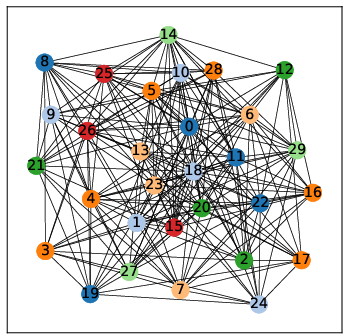
- Spring/force layouts: imagine nodes pushing apart like magnets, and edges are springs pulling connected nodes together. The drawing stabilises into a tidy shape.
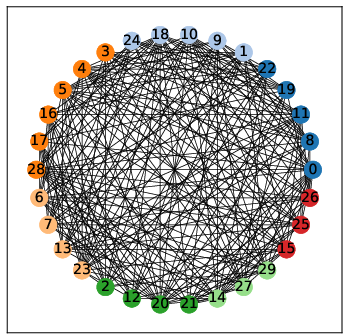
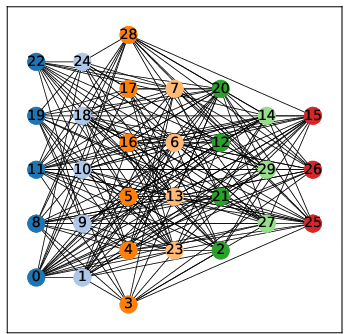
- Circular or column layouts: placing nodes in circles or columns grouped by colour can make clashing/non‑clashing patterns easier to see.
Main Findings and Why They Matter
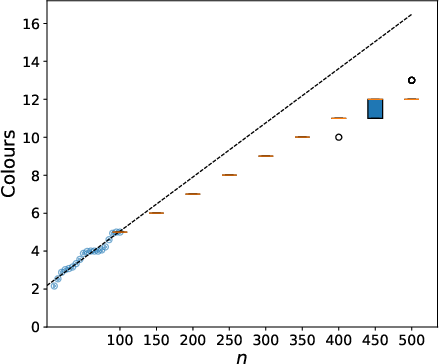
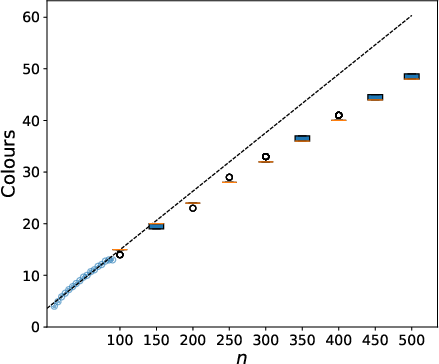
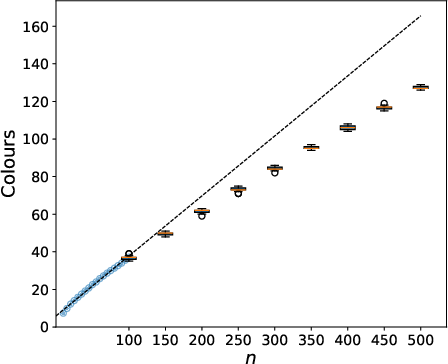
- Node colouring gets harder as graphs have more nodes or more edges (more “friends”). The paper’s tests on random graphs show the needed colours tend to grow with size and density.
- Some graph families are easy:
- Bipartite graphs (no odd cycles) need only two node colours: χ(G) = 2.
- Trees, cycles, and some special graphs are handled exactly by DSatur.
- Edge colouring:
- If the largest number of edges touching any node is Δ (the maximum degree), then the chromatic index χ′(G) is either Δ or Δ+1 (Vizing’s theorem).
- For bipartite graphs, Δ colours always suffice (König’s theorem).
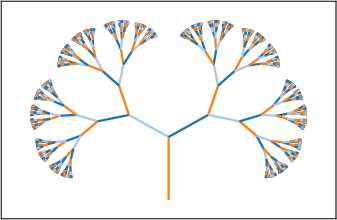
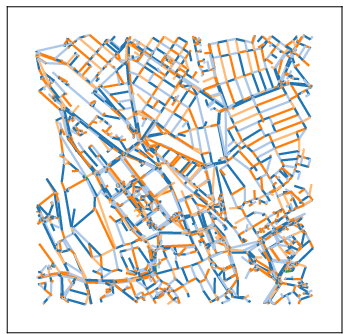
- Applications: scheduling sports leagues (each colour is a round), and describing routes in a street map using colour sequences on edges. For example, a city map with Δ = 6 can encode any path with just 3 bits per edge (because 6 colours fit in 3 bits).
- Face colouring:
- Any planar map needs at most four colours (Four Colour Theorem).
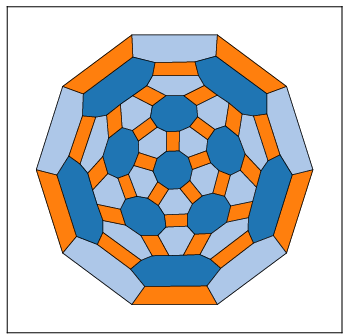
- If every node in a planar graph has an even degree (Eulerian), then its dual graph is bipartite, so the faces need only two colours. This explains checkerboards and many tiling patterns.
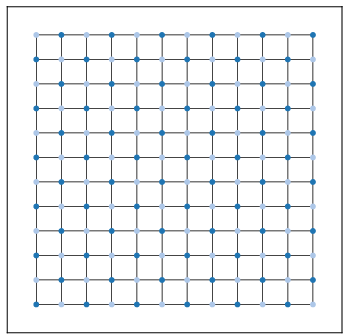
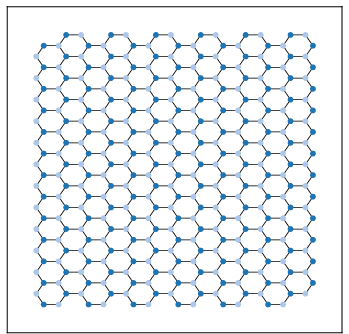
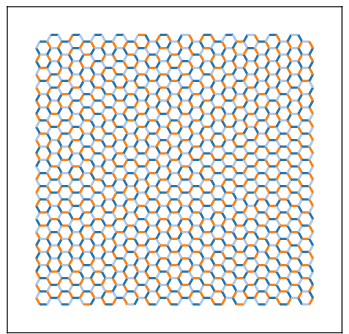
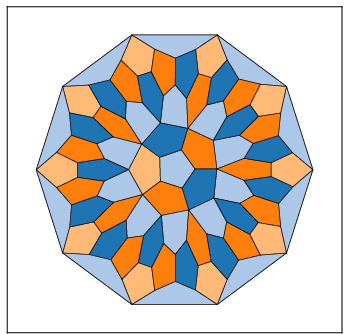
- The paper shows examples with square, triangular, and hexagonal tilings, plus an aperiodic “hat” tiling that needs four colours.
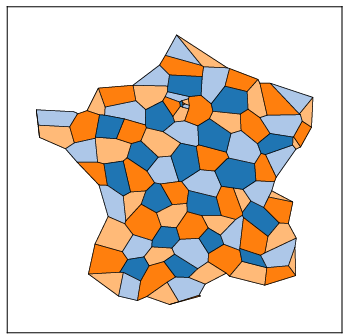
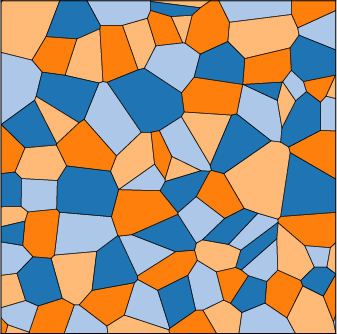
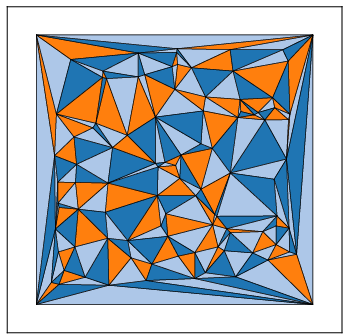
- Voronoi diagrams (cells closest to each seed point) and their duals (Delaunay triangulations) give real‑world geometric graphs. Often, the triangulation’s faces need only three colours.
- Art and puzzles:
- The paper turns portraits into triangulations and face colourings (like the Abraham Lincoln example).
- It references a famous April Fool’s claim of a map needing five colours—but shows a valid four‑colouring, matching the theorem.
Throughout, the author uses an open‑source Python library called GCol to run algorithms and create the pictures.
Implications and Potential Impact
- Scheduling and planning: Graph colouring models timetables (classes sharing teachers/rooms shouldn’t clash), sports schedules (teams shouldn’t play twice in a round), seating charts (avoid placing incompatible people together), and radio frequency assignments (nearby stations shouldn’t share interference‑prone frequencies).
- Mapping and navigation: Face colouring explains why maps need at most four colours; edge colouring can compress route descriptions (each step is just a colour).
- Graphics and design: Tiling patterns, artworks, and image triangulations can be analysed and styled using colouring rules.
- Education: Clear visualisations and accessible algorithms help students learn core ideas in math and computer science—graphs, optimisation, and algorithm design.
- Research tools: Libraries like GCol make it easier to try different algorithms, compare results, and build new applications.
In short, graph colouring connects neat maths ideas with practical problems and visual creativity. This paper makes those links easy to see by combining explanations, algorithms, and eye‑catching figures.
Knowledge Gaps
Below is a focused list of concrete knowledge gaps, limitations, and open questions left unresolved by the paper. These can help guide follow-on research and experimentation.
- Benchmark scope and scalability
- No large-scale benchmarking across standard graph-coloring benchmarks (e.g., DIMACS/ COLOR, register-allocation graphs, real timetabling instances); results are primarily small, synthetic G(n,p) graphs and a few curated examples.
- No scalability study to thousands/millions of nodes/edges; missing memory/time profiles and failure modes for DSatur, backtracking, HEA, and line/dual graph conversions.
- Lack of comparison against state-of-the-art exact (ILP/CP/SAT) and heuristic/metaheuristic solvers beyond HEA and DSatur; no baselines such as Tabucol variants, HEAD/HGA family, column-generation ILPs, SAT-based colorers.
- Experimental design and reproducibility
- HEA configuration (population size, tabu tenure, recombination strategy, stopping criteria) and sensitivity analyses are not reported; no ablations to assess which components drive performance.
- Stochastic variability is only shown via box plots on small random graph sets; no statistical significance testing, confidence intervals, or per-instance performance profiles.
- Random seeds, parameter files, and exact versions for reproducibility are not specified (despite a code/data link), limiting exact replication and fair comparison.
- Theory–experiment alignment for random graphs
- Empirical trends on G(n,p) are not compared to known asymptotic predictions for χ(G) (e.g., results of Bollobás and successors); no assessment of deviations or finite-size effects.
- No exploration of other random graph models (e.g., power-law, geometric, stochastic block models) to test algorithm behavior under different structural regimes.
- Line-graph approach for edge coloring
- Reliance on L(G) + node coloring is unexamined in terms of complexity blow-up: for dense graphs, |V(L(G))|=m and |E(L(G))| can be Θ(n·m), making DSatur/HEA potentially impractical.
- No comparison with specialized edge-coloring algorithms (e.g., Misra–Gries for Δ+1) or class-membership tests; no evaluation on Class 2 graphs or snarks (e.g., Petersen, Flower snarks).
- Class 2 edge-coloring coverage
- All edge-color examples are Class 1; no visualizations or algorithmic discussion for Class 2 graphs where χ′(G)=Δ+1, nor empirical detection of class membership (NP-complete in general).
- No study of real network datasets to assess how often urban street graphs, transportation networks, or infrastructure graphs are Class 1 vs Class 2 in practice.
- Face coloring: embedding dependence and computation
- The definition of face chromatic number χ_f(G) does not clarify dependence on planar embedding; it is unclear whether χ_f(G) is taken over a specific embedding or minimized across all embeddings. Consequences for algorithms and equivalence classes of embeddings are not discussed.
- No planarity-testing and embedding-selection details (algorithm choice, complexity, robustness) when constructing duals G* for face coloring at scale.
- Although a quadratic-time 4-coloring algorithm for planar graphs is cited, there is no implementation or empirical comparison against the DSatur-on-dual approach (both in runtime and success rate).
- No algorithmic treatment of deciding χ_f(G)=3 (known NP-complete); no heuristics, certificates, or structural conditions to speed detection in practical instances.
- Conditions for χ_f(G)=3 in triangulations and Voronoi/Delaunay graphs
- The paper observes that Delaunay triangulations “often” have χ_f(G)=3 but offers no characterization of when this holds; structural conditions (e.g., degree/boundary constraints) and fast tests remain unexplored.
- No linkage to classical equivalences (e.g., Tait colorings, 3-edge-colorability relations in certain planar classes) to explain or predict 3-colorable faces in these families.
- Eulerian planar graphs and boundaries
- Results and visuals focus on connected Eulerian planar graphs; disconnected cases and boundary effects (finite patches with odd-degree boundary nodes) are not analyzed formally.
- No general bounds or exact formulas for the minimum number of colors needed for finite tiling patches with boundaries, nor strategies to enforce χ_f(G)=2 with boundary modifications.
- Practical cartography constraints beyond four colors
- Although precoloring and list coloring are mentioned, there is no modeling, algorithmic framework, or empirical evaluation for map-specific constraints (e.g., unified country color across disjoint regions, fixed palette assignments like “water=blue”), nor quantification of the color blow-up these induce.
- No treatment of multigraphs or “touching-at-a-point” adjacency rules often used in cartography and their algorithmic implications.
- Route encoding via edge color sequences
- The proposed route encoding (start node + sequence of edge colors) is not evaluated for real-world constraints: one-way streets, dynamic changes, multigraphs, turn restrictions, and need for stable colorings under updates (dynamic edge coloring).
- No analysis of encoding length vs. Δ(G) distribution in road networks, or of recoloring costs to maintain short encodings as networks evolve.
- Visualization methodology and human factors
- Node/edge layout strategies are not quantitatively evaluated for readability, edge-crossing minimization, or interpretability; no user studies or objective layout metrics.
- Color-palette choices are not validated for diverse color-vision deficiencies, grayscale/print contexts, or accessibility standards; no algorithmic palette optimization given k and background.
- Algorithmic engineering details in GCol
- Missing low-level implementation details (e.g., bitset/bitboard representations, conflict detection data structures, incremental updates) that often dominate performance on large instances.
- No exploration of parallelization/GPU acceleration, scalability on multi-core systems, or distributed runs of stochastic methods (e.g., independent multi-starts, algorithm portfolios).
- Clique-based lower bounds in backtracking
- The algorithm assumes “a large clique C” but provides no method or study of heuristic clique-finding trade-offs; the impact of clique quality on pruning/backtracking time is not quantified.
- Solution-space structure and counting
- No investigation of the number of distinct optimal colorings, solution degeneracy, or transitions between colorings (e.g., via Kempe chains), which could inform diversification in metaheuristics and educational visualizations.
- Extensions and variants not explored
- No coverage or visual treatment of important variants: equitable, acyclic, star, harmonious, defective, total, list, circular, fractional, b-coloring, and their algorithmic/visual challenges.
- Higher-genus surfaces are only mentioned in passing (Heawood bound); no algorithms, constructions, or visualizations for χ_f on tori or higher-genus embeddings.
- Data quality and bibliographic issues
- Several references appear malformed or inconsistent (years, authors, formatting), which may hinder reproducibility and literature tracing; a curated, machine-readable bibliography would aid future work.
Practical Applications
Immediate Applications
Below are actionable, near-term uses that can be deployed today using the paper’s algorithms (DSatur, backtracking, HEA), transformations (line and dual graphs), and visualization practices, with GCol as a ready tool.
- University and school timetabling (Education; Software)
- Use node colouring to assign timeslots to exams/lectures so no student/room conflict occurs; DSatur provides fast high-quality solutions on many instances; HEA finds near-optimal schedules for larger/dense cases; precolouring/list-colouring (supported in GCol ≥2.2) handles fixed rooms, instructor availability, or mandated slots.
- Assumptions/dependencies: Conflicts must be correctly captured in the graph; real timetables often include soft constraints (spread, fairness) that extend beyond pure colouring and may require hybrid optimisation; exact optimality is NP-hard, so heuristics are used at scale.
- Round-robin league scheduling (Sports industry)
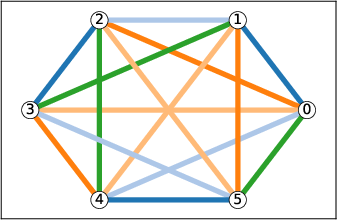
- Apply edge colouring to complete graphs to partition matches into rounds (“one-factorisations”); Class-1 result for even teams ensures optimal round counts; workflows translate directly to match calendars.
- Assumptions/dependencies: Additional constraints (venue availability, TV slots, derby separation) require extensions beyond pure edge colouring; odd team counts require byes or transformations.
- Seating plan generation for events (Events/Hospitality)
- Model guest incompatibilities as a conflict graph and use node colouring to place guests at tables or time slots; quickly produces arrangements that avoid clashes; GCol can be wrapped into a simple planner.
- Assumptions/dependencies: Real preferences are nuanced (soft/weighted conflicts, group affinities); outputs may need post-adjustment for social/practical factors.
- Spectrum/frequency assignment (Telecommunications)
- Build an interference graph and colour nodes to assign channels (e.g., Wi‑Fi or small cells) with minimal co-channel interference; DSatur is effective on many practical topologies; HEA scales when networks densify.
- Assumptions/dependencies: Interference models must be accurate; dynamic traffic and power control introduce multi-objective trade-offs; regulatory channel availability constrains feasible palettes.
- Map colouring for cartography and GIS (Public sector, GIS/Design)
- Use face colouring (via dual graphs) to assign visually distinct, colour-blind-friendly palettes to administrative regions; precolouring/list colouring enforces rules (e.g., all water blue, disjoint territories share a colour).
- Assumptions/dependencies: Requires planar embeddings or planarization; real-world datasets may include enclaves/exclaves and require consistent symbology policies; beyond-four colours may be desirable for aesthetics.
- Route encoding and transmission minimisation (Navigation/GIS)
- Edge-colour street graphs so routes can be encoded as “start node + colour sequence,” reducing per-edge instruction bits to ⌈log2(Δ)⌉ (e.g., 3 bits when Δ=6 as shown for central Cardiff); useful for bandwidth-constrained telemetry or logging.
- Assumptions/dependencies: Works on undirected or bidirectional graphs; directed networks need arc-colouring or paired encodings; network updates may invalidate colour assignments and require recolouring; uniqueness relies on edge colours being distinct at each node.
- Manufacturing and maintenance outage scheduling (Industry, Municipal policy)
- Model jobs or assets that cannot run/close concurrently as a conflict graph and colour nodes to define non-overlapping time phases (e.g., roadworks, utility outages); straightforward workflow with GCol.
- Assumptions/dependencies: Task durations and precedence constraints may require additional scheduling layers (e.g., RCPSP); rolling updates need incremental recolouring.
- Educational visualisation and pedagogy (Academia)
- Use the paper’s layouts, fractals, and tilings to teach graph theory, planarity, duality, and colouring; students can reproduce experiments with the provided code and GCol to explore algorithm behaviour.
- Assumptions/dependencies: Requires basic Python setup; large dense graphs may look cluttered—adopt the paper’s layout guidance (force-directed, circular, multipartite) to enhance interpretability.
- Creative design and puzzle generation (Creative industries; Daily life)
- Generate aperiodic tilings (“hat” tile), Voronoi/Delaunay art, and triangulated portraits; create “guess-the-identity” puzzles; exploit Eulerian planar graphs for two-colour face patterns in textiles/graphics.
- Assumptions/dependencies: Artistic goals may override strict optimality; colour palettes and pattern density must consider accessibility (colour-blind-safe palettes as used in the paper).
- Sudoku and logic puzzle solving (Consumer apps; Education)
- Cast Sudoku constraints as a graph colouring instance to build solvers or teaching aids; GCol provides out-of-the-box algorithms and visualisation hooks.
- Assumptions/dependencies: Efficient modelling and constraint propagation improve performance beyond naive encodings; puzzle-specific heuristics can augment general-purpose colouring.
Long-Term Applications
These opportunities require additional research, scaling, or integration beyond current proofs-of-concept, but are guided by the paper’s methods (DSatur selection, backtracking exactness for small cases, HEA metaheuristics, line/dual graph reductions, and visualisation practices).
- Bandwidth-efficient V2X/IoT navigation and telemetry (Automotive, IoT)
- Generalise edge-colour route encoding to constrained devices and vehicle-to-everything communications; couple with incremental recolouring and compact start-node addressing to reduce message size.
- Assumptions/dependencies: Directed, time-dependent, and multilayer road networks need arc colouring and dynamic update strategies; guarantees on decoding under topology changes must be formalised.
- Dynamic spectrum management in dense 5G/6G (Telecom; Policy)
- Deploy HEA-style metaheuristics for real-time channel assignment on rapidly varying interference graphs (small cells, private 5G); integrate list/precolouring for licensed/shared bands and priority traffic.
- Assumptions/dependencies: Requires fast, robust convergence under stochastic loads; regulatory frameworks and coexistence with incumbents constrain feasible solutions; multi-criterion optimisation (throughput, fairness, power) must be addressed.
- City-scale maintenance and event coordination platforms (Smart cities; Public policy)
- Build municipal tools that continuously recolour conflict graphs for road closures, utility works, and events to minimise simultaneous disruptions; publish open-data schedules derived from colouring outputs.
- Assumptions/dependencies: Accurate, timely asset and permit data; integration with traffic models and equity policies; support for hard/soft constraints and stakeholder overrides.
- Energy demand shaping and EV charging orchestration (Energy/Utilities)
- Model transformers/feeders and household EVs as conflict graphs to assign charging slots (colours) that avoid overloads while respecting user preferences (list colouring); apply HEA for large service areas.
- Assumptions/dependencies: Requires reliable load forecasts and flexibility signals; fairness and pricing add objectives; communication delays and failures need robust fallback policies.
- Multi-robot task and corridor deconfliction (Robotics; Logistics)
- Use node/edge colouring on conflict graphs for time-slotting shared corridors or tasks among robots/drones; line-graph transformations help schedule edge (path-segment) conflicts.
- Assumptions/dependencies: Continuous-time kinematics, safety buffers, and uncertainty complicate discrete colouring; coupling with trajectory planners is necessary.
- Automated cartography with rule-driven styling (GIS tooling; Standards)
- Embed list/precolouring in GIS to enforce style guides (e.g., water blue, protected areas specific palettes) while minimising adjacent conflicts; provide accessible, colour-blind-friendly defaults.
- Assumptions/dependencies: Real maps are nonplanar due to overlaps/bridges; labelling and generalisation introduce competing constraints; human-in-the-loop design remains essential.
- Large-scale, explainable visual analytics dashboards (Enterprise analytics; Academia)
- Combine force-directed/circular/multipartite layouts with colouring to reveal clusters, constraints, and conflicts in enterprise networks (projects, dependencies, org charts); add provenance via DSatur-style selection rationales for interpretability.
- Assumptions/dependencies: Scalability to millions of nodes requires graph sampling or partitioning; interaction design and caching strategies are needed for responsiveness.
- Standardised colour encodings for route and process logs (Software/Standards)
- Define compact, portable “colour-sequence” schemas for path logs in process mining, logistics, and network operations where incident edges are distinctly coloured; improve compressibility and privacy.
- Assumptions/dependencies: Requires stable node identifiers and immutable edge-colour assignments over log windows; directed/multigraphs need extended schemas.
- Curriculum-integrated research and benchmarking (Academia)
- Use the published code/data to build reproducible labs that benchmark heuristics (DSatur vs HEA) across random and real graphs (e.g., House of Graphs); foster student-led extensions (e.g., new tie-break rules, hybrid layouts).
- Assumptions/dependencies: Compute budgets for larger benchmarks; standardised datasets and metrics; continuous integration for didactic repositories.
- Design automation for tiling and pattern manufacturing (A/E/C; Materials)
- Automate colour assignment for large architectural tilings or printed patterns using Eulerian/planar face-colouring pipelines; enforce manufacturing constraints via list colouring.
- Assumptions/dependencies: Real floorplans contain holes and nonplanar features; material batch constraints and cost models add objectives; aesthetics may override minimal colour counts.
Glossary
- Aperiodic tiling: A tiling that does not repeat periodically; no translational symmetry occurs across the plane. "the aperiodic tiling pattern formed by the “hat” tile"
- Backtracking algorithm: An exponential-time depth-first search technique that systematically explores and backtracks over choices to guarantee optimality. "The greedy colouring algorithm can also be extended to form an exponential-time recursive backtracking algorithm that guarantees an optimal solution."
- Bipartite graph: A graph whose vertices can be partitioned into two sets with no edges within the same set. "including bipartite graphs, trees, cycles, and wheel graphs"
- Chromatic index: The minimum number of colours needed to colour a graph’s edges so that adjacent edges differ. "known as its chromatic index, denoted by ."
- Chromatic number: The minimum number of colours needed to colour a graph’s vertices so that adjacent vertices differ. "known as its chromatic number, denoted by ."
- Circumcircle: A circle passing through all three vertices of a triangle. "such that the circumcircle of every triangle contains no other points of in its interior."
- Class 1/Class 2 (edge colouring classes): The Vizing classification where graphs satisfy (Class 1) or (Class 2). "This means that all graphs can be classified into two classes: Class~1, in which ; and Class 2, where ."
- Clique: A set of pairwise adjacent vertices (each vertex connected to every other). "a clique is a subset of nodes such that, for all , ."
- Convex hull: The smallest convex set containing a given set of points. "These are a triangulation of the convex hull of "
- Delaunay triangulation: A triangulation of points where no point lies inside the circumcircle of any triangle; dual to the Voronoi diagram. "A set of seed points can also be used to generate a Delaunay triangulation."
- Dual graph: For a planar embedding, the graph whose vertices correspond to faces and whose edges join faces sharing a boundary. "A face colouring of a planar graph can be found by colouring the nodes of its dual graph ."
- DSatur algorithm: A vertex-colouring heuristic that selects the next vertex by maximum saturation degree (and breaks ties by degree). "The DSatur algorithm and its backtracking extension are both included in the GCol library."
- Edge colouring: Assigning colours to edges so that adjacent edges differ, minimizing the number of colours. "An edge colouring of is an assignment of colours to edges so that all pairs of adjacent edges have different colours."
- Erdős–Rényi graph: A random graph model where each possible edge appears independently with probability . "Erd\H{o}s-Renyi graphs, denoted by ."
- Euler's formula: For a planar embedding, the relation among vertices, edges, and faces: . "Euler's formula also tells us that the number of faces in a planar embedding is strictly related to the number of nodes and edges . Specifically, ."
- Eulerian graph: A connected graph in which every vertex has even degree. "a graph is called Eulerian if and only if it is connected and the degrees of all its nodes are even."
- Face chromatic number: The minimum number of colours needed to colour the faces of a planar embedding so that adjacent faces differ. "known as its face chromatic number, denoted by ."
- Face colouring: Assigning colours to the faces of a planar embedding so that faces sharing a boundary differ. "A face colouring of a graph is an assignment of colours to the faces of one of its planar embeddings (if such an embedding exists) so that faces with common boundaries have different colours."
- Force-directed method: A layout algorithm that models vertices as repelling and edges as springs to minimize an energy function. "One option in this regard is to use force-directed methods, such as the spring layout"
- Four colour theorem: Every planar graph’s faces can be coloured with at most four colours. "Due to the famous four colour theorem, it is known that never exceeds four"
- Greedy colouring algorithm: A constructive heuristic that colours vertices in sequence with the lowest-index feasible colour. "Perhaps the most basic approach is the well-known greedy colouring algorithm."
- House of Graphs: An online database of interesting and curated graphs. "the House of Graphs database \cite{Brinkmann2013}"
- Hybrid evolutionary algorithm (HEA): A metaheuristic combining evolutionary operators with local search (e.g., tabu search). "a stochastic hybrid evolutionary algorithm (HEA) that was originally proposed by Galinier and Hao"
- Independent set: A set of vertices with no edges between any pair; in colouring, colour classes are independent sets. "the task of partitioning a graph's nodes into a minimum number of independent sets."
- Induced subgraph: The subgraph formed by a subset of vertices and all edges between them present in the original graph. "the subgraph induced by the uncoloured nodes."
- König's theorem: In bipartite graphs, the edge chromatic number equals the maximum degree. "For bipartite graphs, K\"onig's theorem tells us that is always sufficient."
- Line graph: A graph where vertices represent edges of the original graph, adjacent when the original edges share an endpoint. "its line graph , where each node of corresponds to an edge of "
- List colouring: A colouring variant where each vertex (or face) has a list of permitted colours. "the precolouring and list colouring problems"
- Matching: A set of edges without shared endpoints. "The set of edges assigned to a particular colour corresponds to a matching;"
- Maximum degree Δ(G): The largest degree of any vertex in a graph. " denotes the maximum degree in ."
- Metaheuristic-based algorithm: A high-level heuristic framework (e.g., tabu search, evolutionary search) for hard optimization. "several metaheuristic-based algorithms are also included in the library."
- NP-complete: A class of decision problems as hard as any in NP; believed intractable in general. "the problem of determining if is -complete in general"
- NP-hard: Problems at least as hard as the hardest problems in NP; no known polynomial-time algorithms. "optimal node and edge colourings ... are known to be -hard"
- Planar embedding: A drawing of a graph in the plane with no edge crossings. "The smallest number of colours needed to colour the faces of a planar embedding of "
- Planar graph: A graph that admits a planar embedding (can be drawn without edge crossings). "Consequently, they are only possible for planar graphs."
- Precolouring: A colouring variant where some elements are assigned fixed colours in advance. "the precolouring and list colouring problems"
- Recombination operator: An evolutionary operator that combines two parent solutions to produce an offspring. "a specialised recombination operator"
- Saturation degree: In DSatur, the number of distinct colours used by a vertex’s coloured neighbours. "the saturation degree of an uncoloured node is defined as the number of different colours being used by the neighbours of ."
- Tabu search: A local search method that uses memory to avoid cycling and escape local minima. "The main element of this algorithm is a tabu search process"
- Unbounded face: The outer, infinite face surrounding a planar embedding. "the unbounded face"
- Vizing's theorem: Every graph has edge chromatic number either Δ(G) or Δ(G)+1. "Vizing's theorem generalises this result, stating that, for any graph , the chromatic index is either or ."
- Voronoi diagram: A partition of the plane into regions closest to given seed points. "a Voronoi diagram is a partition of the plane into “cells” so that each cell contains exactly one member "
Collections
Sign up for free to add this paper to one or more collections.

