- The paper demonstrates that network topology alone can induce persistent perceptual biases in group estimations using a message-passing model.
- Extensive simulations and empirical survey data validate that connectivity heterogeneity, group-size imbalance, and inter-community mixing drive these biases.
- The findings suggest that strategic interventions in network structure can mitigate skewed perceptions, informing policy, polling, and AI system designs.
Network-Topology-Induced Perceptual Biases: Undermining the Wisdom of the Crowd
Introduction
This study provides an analytical and empirical treatment of how the topology of social networks—independent of cognitive heuristics—systematically distorts collective perception. Grounded in a message-passing model for agents with binary attributes, the analysis formalizes and quantifies biases in collective estimation (mean perception μ) relative to the true attribute prevalence (m), isolating structural origins that persist even after aggregation. The results hold across structurally distinct models, validated through both simulation and survey data, and challenge classical assumptions underpinning crowd wisdom, with robust implications for both theory and policy.
Message-Passing Model and Network Construction
The study employs a stochastic block model (SBM) to encode a social network with two communities (e.g., smokers/non-smokers, political camps), allowing control over intra-community degree, inter-community mixing probability p, and community size imbalance. Each node i carries a binary attribute si∈{+1,−1}; the population mean m=N−1∑isi quantifies group prevalence. Individual perception μi(d) is iteratively updated via neighbor averaging (DeGroot dynamics):
μi(d)=ki1j∈Ni∑μj(d−1)
where ki is node i's degree and Ni its neighbors. At d=0, μi(0)=si; as d→∞, the process converges to a fixed point representing each node's stationary perception.
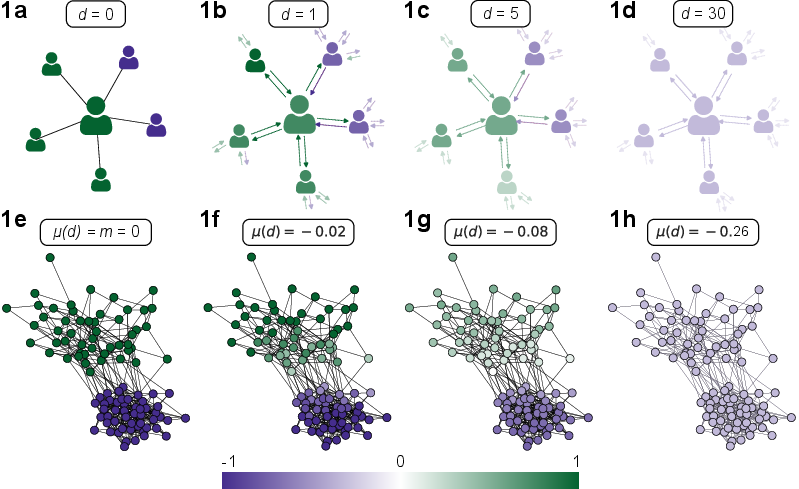
Figure 1: Schematic of message-passing updates illustrating the diffusion of attribute information and formation of distorted perceptions at both local and network level across propagation distances.
The analysis leverages community-level mean-field approximations to derive closed-form expressions for the stationary collective perception, μ∞, in terms of network parameters.
Analytical Characterization of Network-Induced Bias
The core analytical finding is that network topology parameters—community degree heterogeneity (k+=k−), group size imbalance (N+=N−), and inter-community mixing p—intrinsically induce a fixed, predictable bias in the mean perception, such that μ∞=m. The main expression is
μ∞=k+N++k−N−+4N+N−pk+N+−k−N−
A series of controlled scenarios elucidates the following mechanisms:
- Connectivity Heterogeneity: For equal-size communities (N+=N−), μ∞ is shifted towards the community with greater internal connectivity. This is a direct generalization of the friendship paradox, now at the group level.
- Community-Size Imbalance: For different-sized communities (but matched internal degree), the majority (minority) is systematically underestimated (overestimated) in perception.
- Polarization (Mixing): Increasing inter-group mixing p dampens all forms of bias, whereas strong community structure (low p) amplifies it and delays convergence to the stationary state.
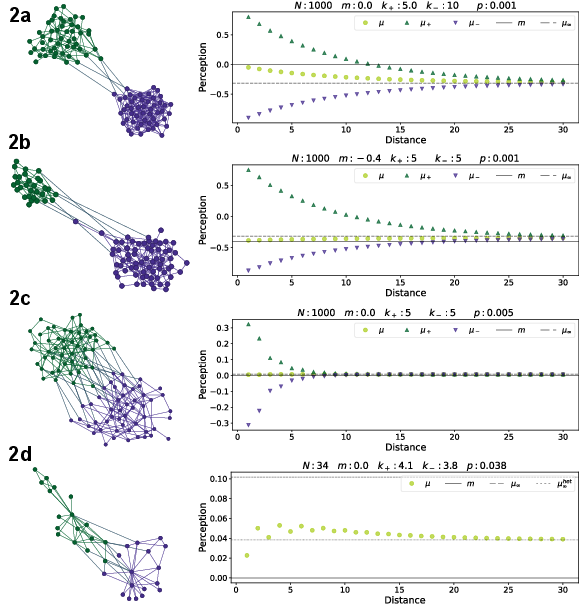
Figure 2: Empirical demonstration of the divergence between true mean m and realized stationary perception μ∞ across connectivity heterogeneity, group-size imbalance, and polarization regimes.
When benchmarked on real-world topologies (Karate Club network), extensions using a heterogeneous mean-field approximation maintain predictive validity, provided degree-attribute correlation is accounted for.
Theoretical and Simulation Concordance
Extensive simulations confirm the analytical results across the parameter space. The theoretical expression for μ∞ matches simulated stationary values for variations in m, degree parameters, and mixing probability p, validating the mean-field approach.
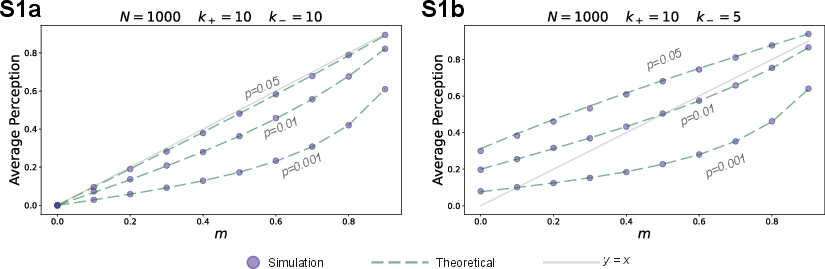
Figure 3: Alignment of simulated stationary perceptions with the closed-form theoretical solution as a function of m and p, in both degree-homogeneous and degree-heterogeneous settings.
Algorithmic Robustness and Label Propagation
The findings demonstrate algorithmic invariance: substituting the DeGroot update with Label Propagation produces identical stationary biases, differing only in convergence speed. The effect persists on complex networks such as the Karate Club graph and SBM with various community structures.
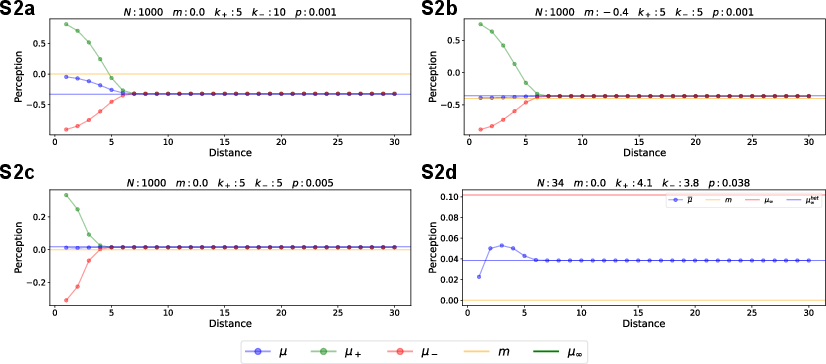
Figure 4: Comparative dynamics of Label Propagation and DeGroot on SBMs and empirical networks, showing faster evolution for Label Propagation but equivalent fixed points for average perception.
Additional simulations on homophilic Barabási–Albert (HBA) models preserve the bias effects, confirming that results are not SBM artifacts.
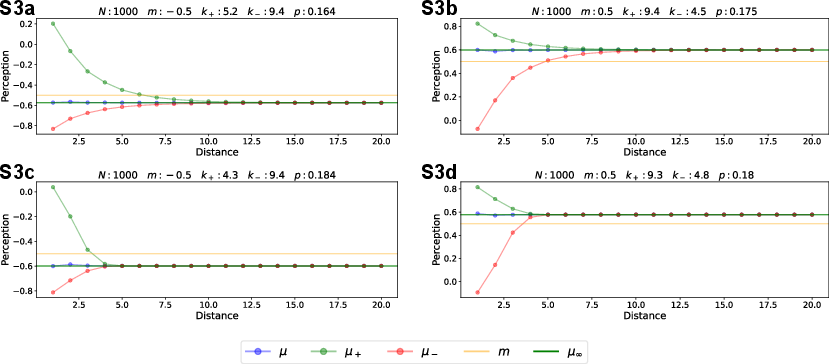
Figure 5: Stationary mean attribute perception on HBA networks corroborates theoretical predictions and replicates SBM findings, indicating model independence.
Empirical Validation with Survey Data
The analytical estimator for stationary bias, re-expressed in terms of accessible survey quantities (social circle estimates), outperforms the classical social-circle estimator in predicting respondents’ country-level group size perceptions. Empirical assessment over multiple countries and issues (Germany, USA, Korea) confirms systematically lower prediction error and lower reduced χ2 for the message-passing estimator compared to social-circle baselines.
Implications and Future Directions
The findings decisively show that network topology is an irreducible and quantifiable source of perceptual bias, independent of cognitive mechanisms. This bias violates the foundational assumption of unbiasedness critical to “wisdom of the crowd” phenomena: the aggregate estimate from peer-informed nodes is not an unbiased estimator of the global state except under restrictive symmetry conditions.
This challenges the reliability of network-aggregated polling methods and has direct consequences for public information campaigns, perception surveys, and AI systems relying on social data. In polarized or structurally imbalanced networks, intervention on the topology (e.g., increasing inter-group links or balancing degree distributions) can reduce specific systemic misperceptions, with immediate applicability to policy targeting segregation, misinformation, or prejudice.
Future research directions include extension to multi-state/continuous attributes, control for confounding cognitive and exogenous effects, and scalability to temporal, adaptive, and higher-order networks. There is also theoretical scope for establishing more general impossibility theorems for unbiased perception under local aggregation in arbitrary topologies.
Conclusion
The analysis demonstrates that the “wisdom of the crowd” can be systematically invalidated by purely structural features of the underlying social network, irrespective of agent-level rationality or information. Network topology alone is sufficient to induce robust, predictable, and persistent perceptual biases, making it a first-order factor for modeling, diagnosis, and intervention in collective cognition and judgment (2602.17146).

