- The paper introduces an affordance-based framework that enables partial world modeling with LLMs for efficient multi-task planning.
- It provides theoretical guarantees that task-agnostic and task-specific intents reduce search branching by focusing on actionable state-action pairs.
- Empirical results in tabletop robotics validate that the partial model outperforms full models in planning efficiency and cumulative rewards.
Affordance-Aware Partial World Modeling with LLMs
Overview of Contributions
The paper "Affordances Enable Partial World Modeling with LLMs" (2602.10390) introduces a novel framework for leveraging LLMs as partial world models in multi-task reinforcement learning. The central argument is that full world models, as directly instantiated by LLMs, are inefficient for planning due to inherent computational complexity and prediction inaccuracies (notably, hallucinations). In contrast, partial world models—guided by affordance-aware filtering—make high-quality predictions restricted to actionable subsets of the state-action space, significantly improving search efficiency and accuracy.
The authors establish a generalized affordance formalism, distinguishing between task-agnostic (agent-embodied) and task-specific (environment-driven) intents. They provide rigorous theoretical results—proving that agents attaining language-conditioned, task-agnostic intents must encode predictive partial world models robust across task distributions. Empirical results using tabletop robotics tasks substantiate that affordance-aware partial models (induced via LLMs) markedly reduce search branching factor and outperform full world models across metrics of reward and planning efficiency.
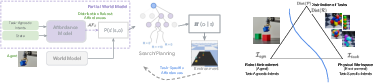
Figure 1: Multi-task affordance formalism categorizes agent intents as task-agnostic or task-specific, facilitating generalization across tasks and efficient partial world modeling.
The affordance-centric methodology is anchored in the formalization of intents: temporally extended, language-conditioned specifications over trajectories, denoted PI(τ∣s,o). Task-agnostic intents are grounded in the agent's embodiment (e.g., robot gripper skills), remain invariant across tasks, and define distribution-robust affordances. Task-specific intents reflect complex objectives, shaped by environmental context and high-level reward specifications.
The multi-task extension introduces distribution-robust agent affordances—state-option pairs that satisfy intents with bounded probability across task distributions. This framework induces partial world models with state-action coverage sculpted by affordances at the agent-environment boundary, effectively reducing the planning branch factor and facilitating transfer across related tasks.
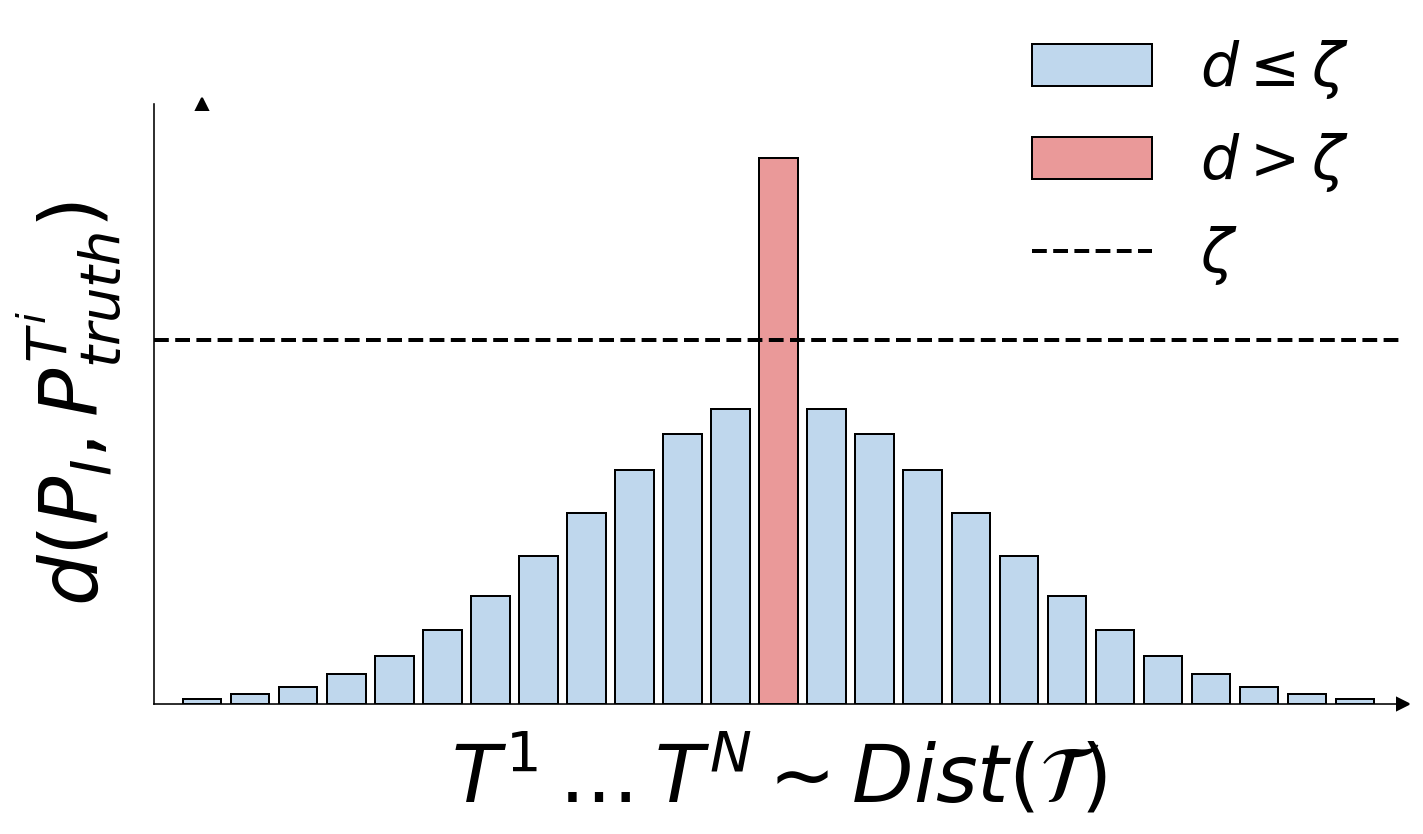
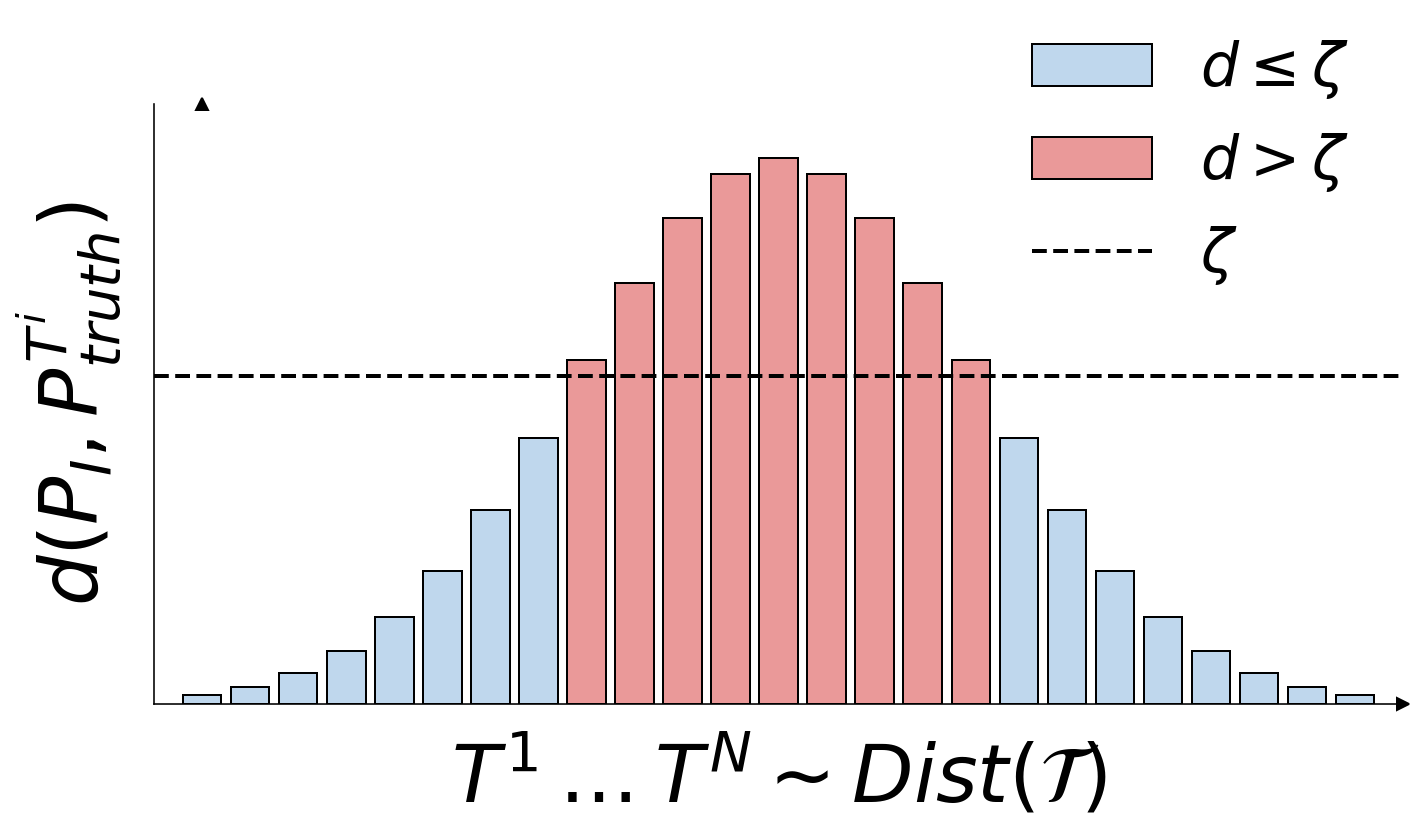
Figure 2: Task-agnostic intents represent invariant agent capabilities grounded in embodiment, supporting affordance generalization.
Theoretical Foundations
Partial World Models from Distribution-Robust Affordances
The authors prove that achieving a suite of language-conditioned, distribution-robust agent intents implies the existence of an underlying partial world model (Theorem 1). The agent's policy encodes a model P^par(s′∣o,s) whose error against the true dynamics is bounded with high probability, scaling as O(n−1/2) for task depth n and decaying exponentially in the intent-satisfiability regret bound. This result is crucial: performing well over a distribution of multi-step tasks ensures that the policy is implicitly supported by accurate predictions on afforded state-option pairs.
Planning Efficiency: Partial vs Full Models
Theoretical analysis quantifies an exponential improvement in search efficiency when planning uses the partial model induced by affordances (Theorem 2). Given k affordable intents versus n possible actions, the planning complexity reduction from nL to kL (for trajectory length L) can render previously intractable tasks feasible. The authors introduce a corrective partial model: by adaptively assigning small probability mass to missing intents, provable robustness to incomplete affordance sets is achieved, at only O(L) multiplicative overhead compared to the optimal corrected model.
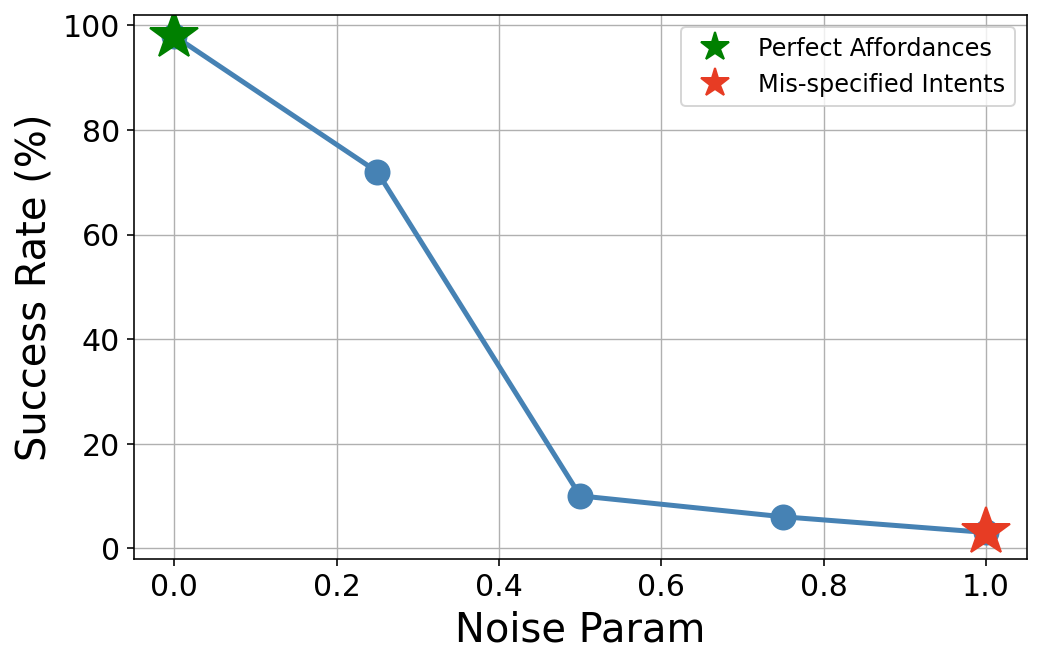
Figure 3: Improved affordance model accuracy translates directly to superior search policy performance under fixed search budgets.
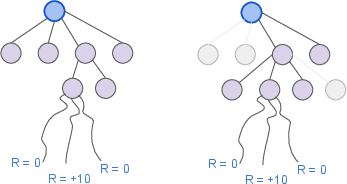
Figure 4: Partial models restrict MCTS expansion to afforded actions, whereas full models expand all state-action pairs, increasing branching factor.
Empirical Validation: Tabletop Robotics Planning
Experiments in simulated tabletop block rearrangement showcase the practical impact of affordance-driven partial modeling. Three configurations are assessed: full world model (LLM only), partial model (LLM affordances + LLM world model), and oracle partial model (programmatically specified affordances).
Key results:
- The partial model achieves higher rewards and completes tasks with fewer simulations and steps compared to the full world model.
- Improved search efficiency is directly correlated with the accuracy of affordance prediction; mis-specified affordances lead to catastrophic planning failures, even with a perfect world model.
Scaling to more complex (5–7 block) tasks, distribution-robust agent affordances facilitate effective generalization, preserving sample efficiency and outperforming full models in accumulated rewards and planning outcomes.
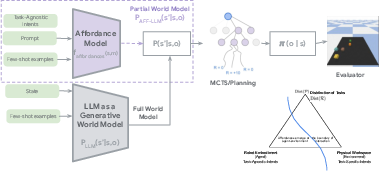
Figure 5: The proposed approach leverages LLMs for affordance-induced partial world modeling; affordance-informed partial models guide MCTS for efficient planning in tabletop robotics.
Practical and Theoretical Implications
From a practical standpoint, this affordance-aware methodology enables RL agents to efficiently utilize pre-trained LLMs for planning tasks with expansive action spaces, avoiding the pitfalls of hallucination and excessive computation inherent to naive full world model usage. Distribution-robust affordances induced by LLMs act as actionable priors, focusing planning resources and improving both sample efficiency and policy quality.
Theoretically, the delineation between task-agnostic and task-specific intents generalizes prior single-task affordance frameworks, providing rigorous guarantees for planning competence and model accuracy under multi-task RL with rich agent-environment interactions. The corrective adaptive partial model presents a principled mechanism for addressing incompleteness in affordance sets.
Future Directions
Major open challenges include automated synthesis of task-agnostic intents and affordance extraction from trajectories (e.g., via program synthesis), adaptation to dynamic agent morphologies, and integration of online experiential data to refine latent representations and affordances. Extending affordance-aware models to visual-language domains and continual learning scenarios represents promising future work.
Conclusion
By integrating affordance-based partial world modeling with LLMs, this work rigorously demonstrates that planning efficiency and reward acquisition in multi-task RL can be substantially enhanced. Task-agnostic, distribution-robust affordances constrain planning to actionable subsets of the state-action space, enabling scalable deployment of LLMs as world models for complex robotic and decision-making tasks. The theoretical analysis and empirical validation robustly support the claim that agents endowed with affordance-informed partial models possess provably efficient and generalizable planning capabilities.