- The paper identifies a universal relaxation ratio (c_relax) that quantifies the suppression of dissipation across holographic interfaces.
- It employs numerical analysis of quasinormal modes in a supersymmetric Janus model coupled to a BTZ black hole to probe dynamical behavior.
- The results demonstrate that c_relax is independent of local coupling details, correlating closely with effective central charge and energy transmission.
Universality of Dissipation at Holographic Interfaces: An Expert Analysis
Introduction and Motivation
The study of conformal interfaces in 2D CFTs, particularly through the lens of holography, provides a powerful probe of universal phenomena at strong coupling. While significant progress has been made in characterizing equilibrium properties via quantities such as the effective central charge ceff and energy transmission coefficient cLR, the dynamical/dissipative sector has remained less understood. This work addresses this gap by analyzing dissipation and relaxation in an interface CFT where only one side is coupled to an external thermal bath. In the holographic dual, this corresponds to gluing a supersymmetric Janus geometry to a BTZ black hole with double-trace deformations. A principal contribution is the identification and numerical extraction of a universal ratio, crelax, quantifying suppression of relaxation across the interface. The numerical results reveal an independence of crelax from both microscopic bath coupling and local details, establishing it as a robust, universal dynamical observable.
Framework: Holographic Duals of Interface CFTs
The model under study consists of a two-dimensional supersymmetric ICFT constructed using a top-down BPS-Janus solution in type IIB supergravity, exhibiting an interface across which coupling constants jump. The interface separates two asymptotic AdS3 regions. The bulk geometry is realized as a fibration over a striplike Riemann surface, with a parameter κ encoding the strength of the interface deformation. Scalar field fluctuations encode the relaxation channels, with their mode spectrum determined by solving the Klein–Gordon equation in this background.
To study dissipation, the authors introduce a double-trace deformation coupling one side of the interface to a BTZ bath. In the bulk, this requires matching transparent boundary conditions for the scalar field across the respective AdS3 and BTZ regions, thus affecting the spectrum of quasinormal modes (QNMs). The imaginary parts of the lowest QNMs set the Liouvillian gap, governing the late-time exponential decay of perturbations (relaxation).
Quantitative Results: Liouvillian Gap and Universality
The central dynamical question is how the interface affects the late-time dissipative relaxation rate. The QNMs are computed numerically for both Janus–BTZ and pure AdS3–BTZ setups, focusing on the modes with the smallest Imω. The relaxation suppression is compactly captured by the ratio
crelax=ΓAdS3ΓJanus
where Γ=−min(Imω) is the Liouvillian gap.
A robust numerical analysis confirms that crelax demonstrates the following universal features:
- It is independent of the position where the dissipation is coupled on the boundary (Figure 1).
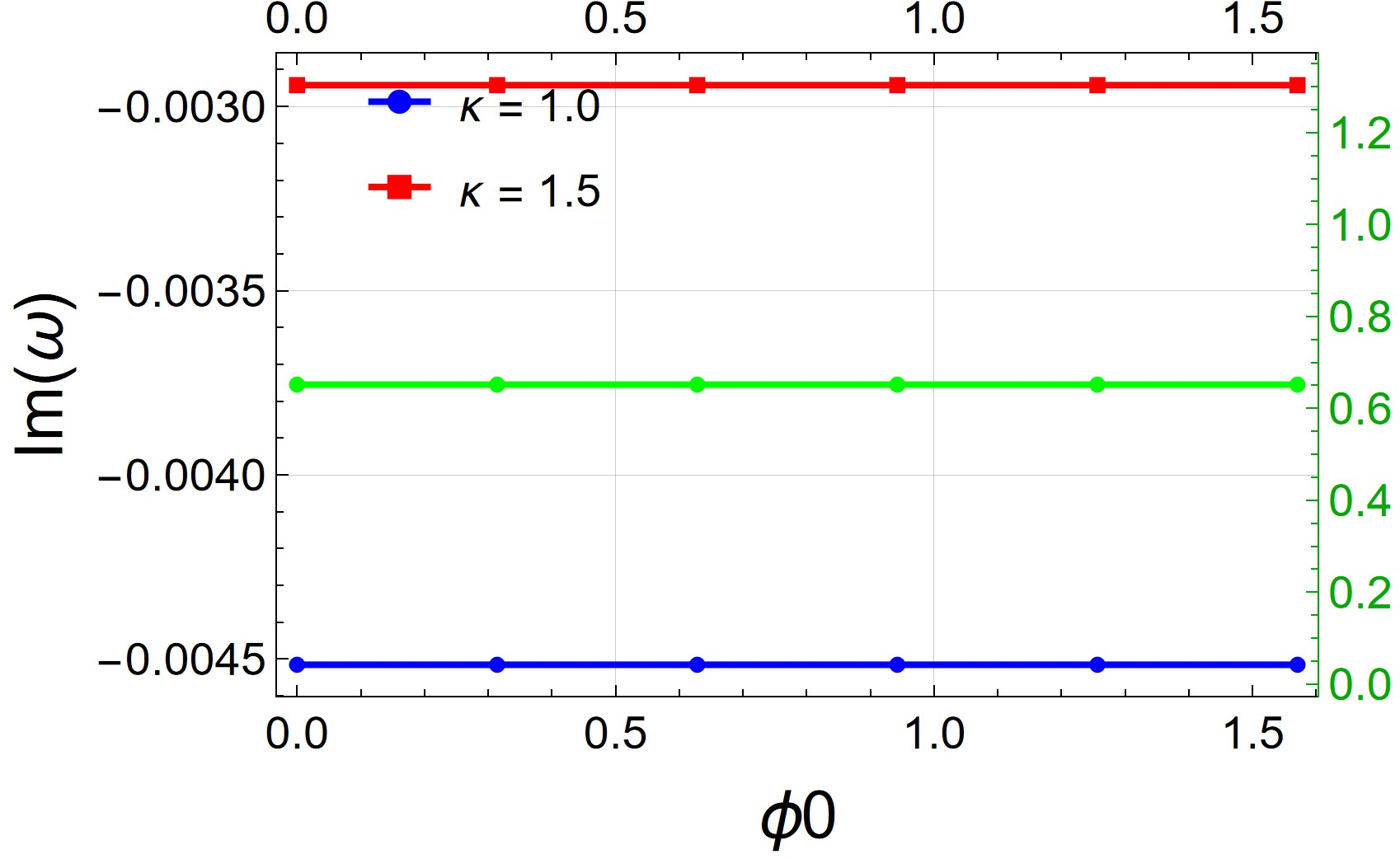
Figure 1: The quasinormal modes of BPS-Janus for Δ=1.3, κ=1 (blue) and κ=1.5 (red), at fixed coupling g≡∣(2Δ−2)∣h=0.1; the green line is their ratio crelax.
- It is independent of the double-trace coupling strength h (and equivalently g) in a wide parameter regime.
- It is independent of the conformal dimension Δ of the interface field in the physically allowed domain.
- It is independent of the microscopic details of the coupling, including whether the bath coupling is localized (delta-function) or extended over a half-space (subject to numerical stability).
These claims are substantiated by direct computation and are demonstrated numerically at high precision in Figure 2.
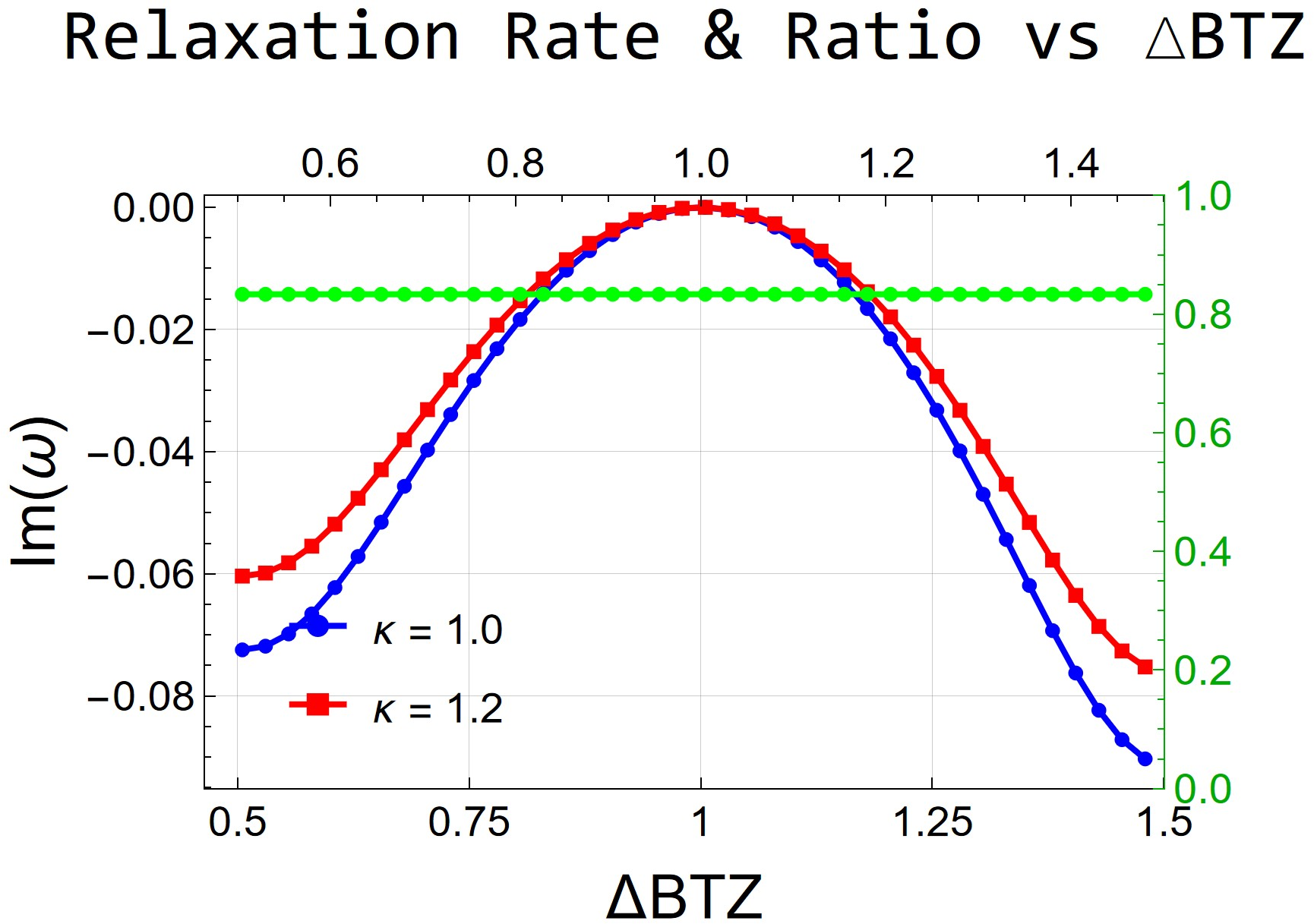
Figure 2: Quasinormal modes and their ratio crelax as a function of double-trace coupling g (top) and conformal dimension Δ (bottom); universality is observed across both variables.
Furthermore, the results show that for the supersymmetric BPS-Janus case, crelax tracks almost identically the effective central charge ceff=1/κ, and is consistently larger than the energy transmission coefficient cLR=1/κ2.
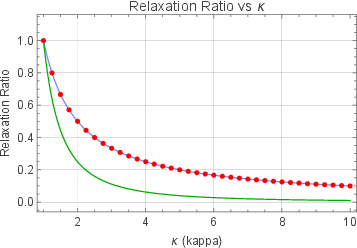
Figure 3: crelax (red dots) as a function of Janus parameter κ, compared to cLR (green) and ceff (blue); crelax nearly coincides with ceff for all κ.
Theoretical Significance and Implications
The emergence of crelax as a universal quantity is significant for several reasons:
- It extends the catalog of universal interface data from static quantities (central charges, energy transmission) to dynamical, nonequilibrium observables.
- The explicit independence from coupling details demonstrates that crelax is controlled solely by global geometric data (interface deformation κ) rather than local bath properties.
- The numerical finding crelax≈ceff—contrasting with certain spin-chain models where crelax<cLR,ceff [barad2025dissipationmeetsconformalinterface]—raises intriguing questions about the role of supersymmetry and holographic saturation of relaxation bounds in higher-dimensional and integrable systems.
Practical and Theoretical Implications
- Open Quantum Systems: Holographic models provide a physically transparent realization of dissipation in open quantum systems; crelax becomes a key figure of merit in characterizing memory-loss or decoherence times across defects.
- Holographic RG and Double-Trace Flows: The independence from deformation strength/position attests to strong universality properties of RG interfaces generated by double-trace flows, consistent with expectations from field-theoretic studies [giombi2025rginterfacesdoubletracedeformations].
- Entanglement and Transport: The close tracking of crelax and ceff suggests a tantalizing link between dissipative dynamics and entanglement measures at interfaces. This could lead to a deeper understanding of information and energy transport in strongly coupled systems.
Future Directions
There are several promising avenues to extend these results:
- Generalization to Non-supersymmetric Interfaces: The analysis of bottom-up Janus interfaces, including more general forms of double-trace couplings and systems without integrability or SUSY protection.
- Multiple Defects and Higher Dimensions: Exploration of relaxation suppression and universality for higher-dimensional defects and interfaces, as well as for domain wall structures in diverse holographic setups.
- Exact Analytical Formulas: An explicit analytic derivation of crelax for a broader class of holographic geometries, and its potential saturation of theoretical lower or upper bounds, as for effective central charge [PhysRevLett.133.091604].
- Connection to Quantum Chaos: Investigation of whether crelax encodes information-theoretic chaos bounds, or relates to Lyapunov exponents in the context of operator spreading across interfaces.
Conclusion
This work presents compelling evidence that dynamical suppression of relaxation at holographic interfaces is characterized by a robust, universal observable crelax in supersymmetric Janus geometries. The numerical analysis demonstrates insensitivity to details of the bath coupling, confirming that crelax is determined solely by interface geometry and matches the effective central charge ceff within numerical accuracy. This establishes crelax as a new, central member of the universal data governing interface CFTs, extending the paradigm of universality well beyond equilibrium to dissipative and nonequilibrium regimes. The findings offer new tools and guideposts for both theoretical characterization and practical exploitation of interface phenomena in strongly coupled quantum systems.
References
- "Universality of Dissipation across Holographic Interfaces" (2601.16888)
- [barad2025dissipationmeetsconformalinterface], [giombi2025rginterfacesdoubletracedeformations], [PhysRevLett.133.091604]

