- The paper demonstrates the creation of transient gas-phase gratings that achieve near-unity diffraction efficiency for high-power laser beams across UV, visible, and IR spectra.
- It details a photochemical mechanism leveraging DUV-induced ozone dissociation and CO₂ doping to optimize refractive index modulation and energy transfer.
- Experimental validation using time-resolved probes and hydrodynamic simulations confirms stability, minimal wavefront distortion, and scalable performance.
Near-Unity-Efficiency Gas Gratings for Ultraviolet, Visible, and Infrared High-Power Lasers
Introduction and Motivation
This work addresses a critical barrier in high-power laser systems: the susceptibility of traditional solid-state optics to optical damage, especially at high fluence, and their vulnerability to debris and cumulative surface degradation. The demand for handling beams with fluences far surpassing the endurance limits of conventional optics is particularly acute in inertial confinement fusion (ICF), laser-driven particle acceleration, and laboratory astrophysics. The study presents comprehensive experimental characterization and theoretical validation of transient, photochemically-induced gas-phase gratings capable of diffracting high-power laser probes across ultraviolet (UV), visible, and infrared (IR) regimes with near-unity efficiency. These gas gratings possess damage thresholds several orders of magnitude greater than solid alternatives, promising compact, refreshable, debris-immune optics for next-generation laser platforms.
Gas-phase transient gratings are established by interfering coherent deep-UV (DUV) laser pulses within an ozone-rich gas flow, typically with additional gases such as CO₂ to enhance performance. The DUV photons dissociate ozone molecules within the Hartley band, initiating rapid exothermic photochemistry that creates localized temperature and subsequent density modulations aligned with the interference fringes. The resultant periodic refractive index modulation produces a volume phase grating, capable of diffracting probe pulses via the Bragg mechanism.
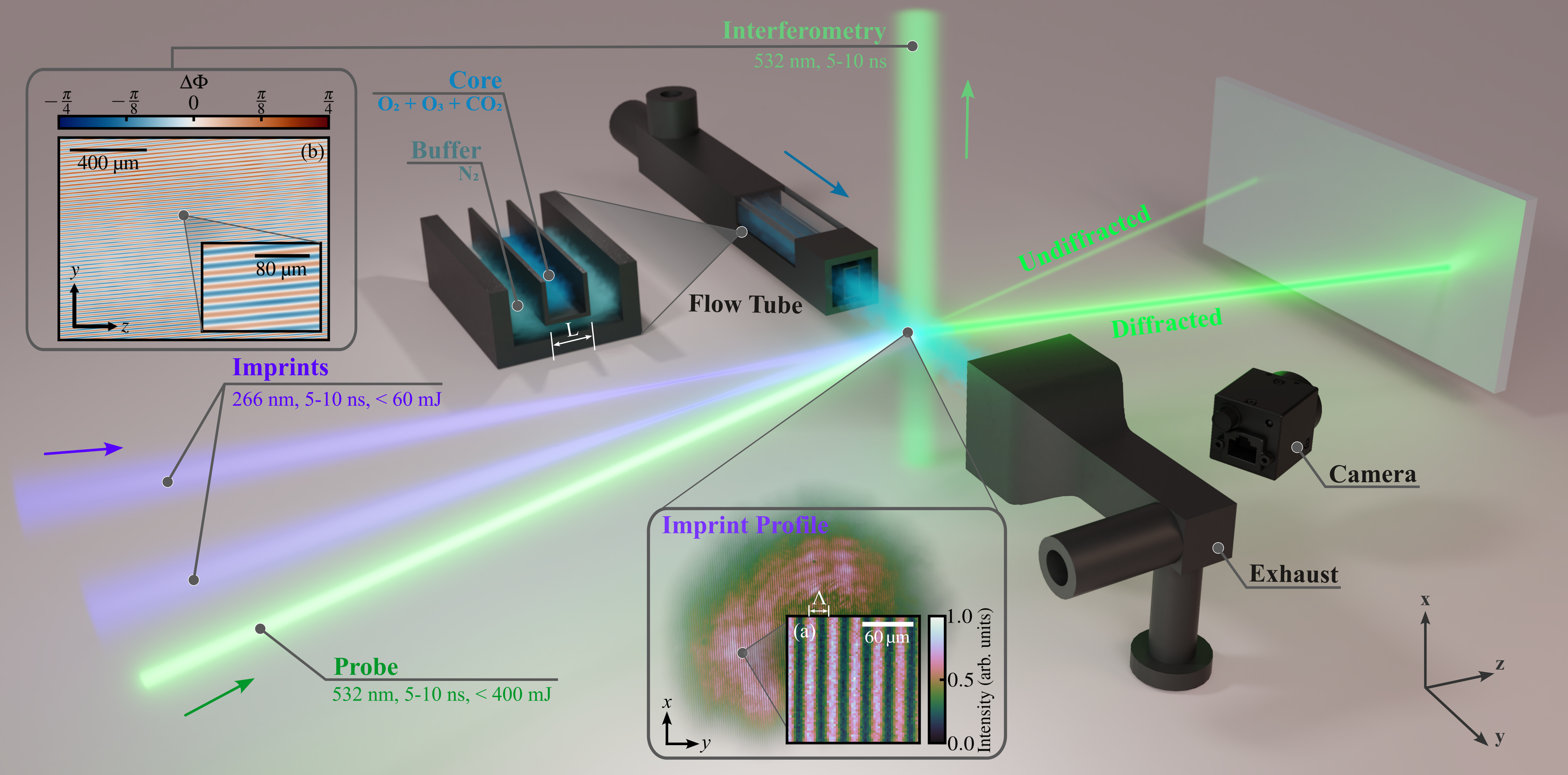
Figure 1: Experimental schematic of gas grating generation via interfering 266nm UV lasers and subsequent diffraction of a probe beam, with insets showing the interference pattern and resulting phase shifts from index modulation.
Coupled-wave theory predicts that optimal diffraction efficiency is achieved when the grating thickness, index modulation amplitude, probe wavelength, and incidence angle are arranged so that the coupling parameter κD approaches π/2. The theoretical maximum first-order diffraction efficiency approaches unity, subject to the incident probe matching the Bragg angle within the angular bandwidth dictated by the grating geometry and temporal evolution.
Experimental Validation Across Regimes
The authors demonstrate robust grating performance for pulsed probes ranging from deep-UV (266nm) to near-IR (1064nm), with pulse durations spanning nanoseconds to femtoseconds. The highest reported full-beam energy diffraction efficiency is 99% for a 532nm nanosecond probe after spatial filtering. Efficiencies for other wavelengths and pulses, including 800nm, exceed 80%; performance limits are set chiefly by probe beam quality and angular bandwidth overlap, not fundamental grating constraints.
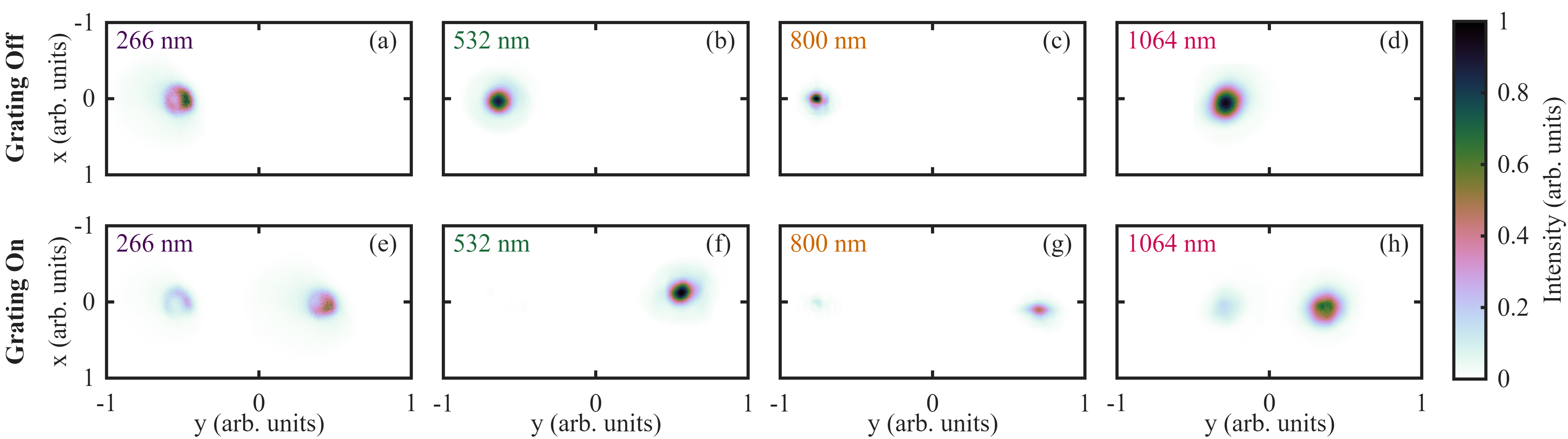
Figure 2: Probe beam transmission images for UV, visible, and IR pulses, showing first-order diffraction with efficiencies approaching 99% for spatially filtered beams.
Efficient diffraction is retained even for UV probes, despite significant ozone absorption, by probing above the saturation fluence for photodissociation. Notably, femtosecond pulse diffraction (800nm) is validated, and no evidence of dynamic grating distortion on such timescales is observed.
Grating Dynamics and Energy Deposition
The transient grating forms rapidly as the deposited energy is almost instantaneously converted into thermal modulation, launching counterpropagating acoustic and entropy waves. Measurements using time-resolved probes and CW diagnostics reveal oscillatory Bragg diffraction, with the period dictated by the grating spacing and sound speed. Persistent density modulations arise from differential damping of acoustic and entropy modes, corroborated by hydrodynamic simulations.
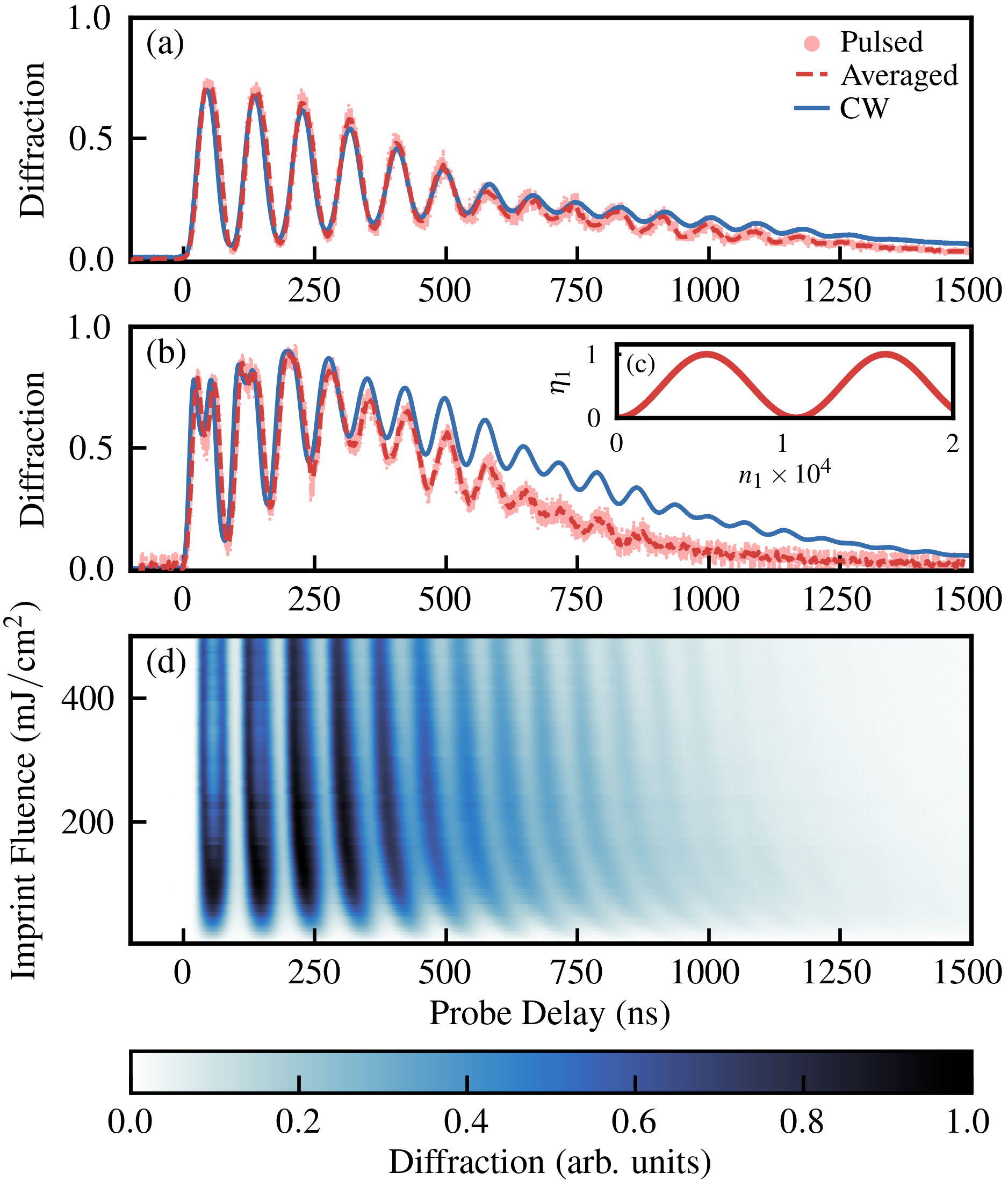
Figure 3: Temporal evolution of diffracted probe intensity, displaying acoustic oscillations and persistent background due to entropy wave retention.
The experimental data rigorously maps diffraction efficiency as a function of imprint fluence, gas composition, and grating geometry. The optimized regime, where the index modulation matches Bragg efficiency, is identified to be robust to fluctuations in system parameters.
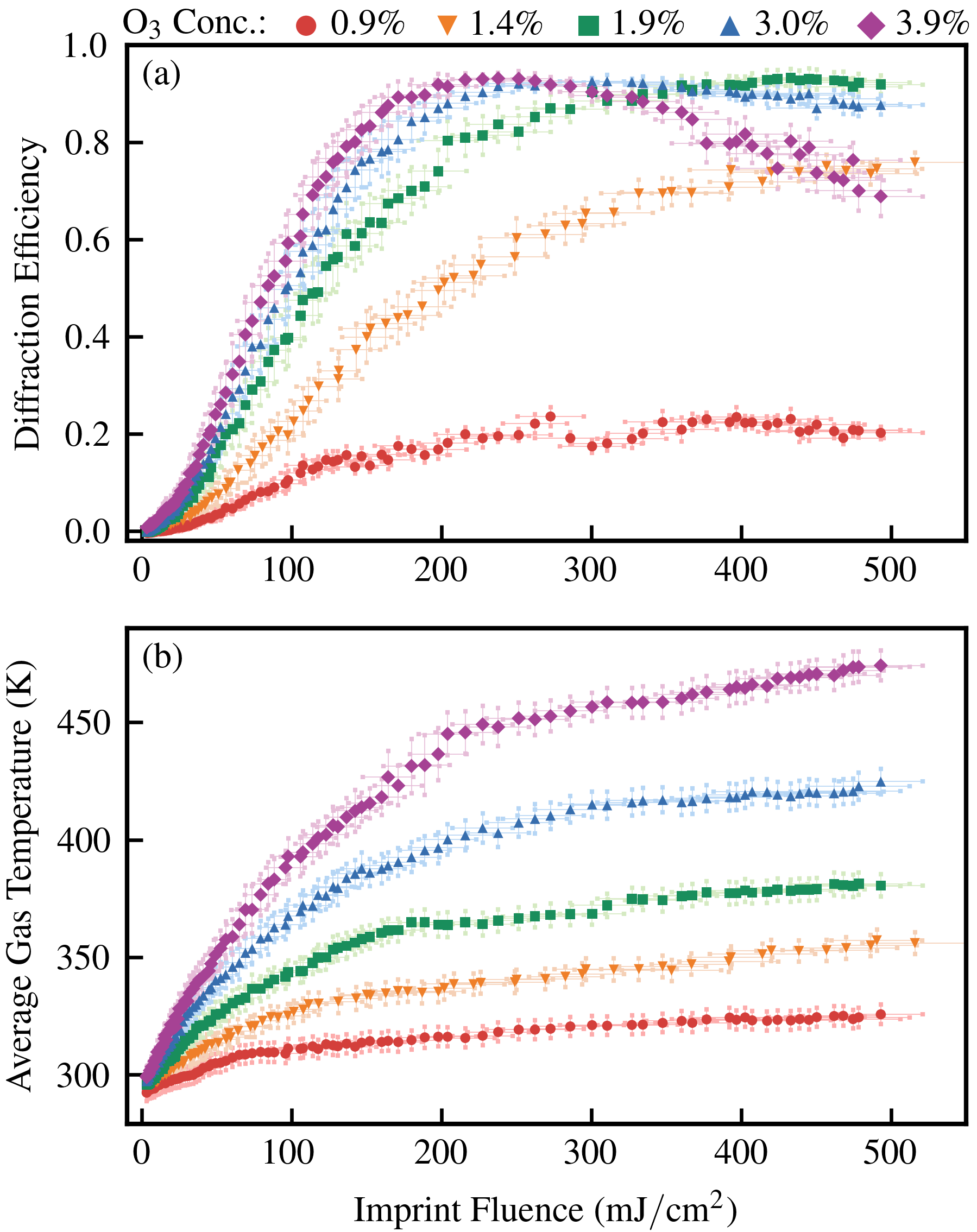
Figure 4: Diffraction efficiency versus imprint fluence and ozone concentration, showing the alignment with theoretical optimum and deleterious effects of overdriving the grating.
A significant enhancement of the index modulation and diffraction efficiency is achieved by doping the gas flow with CO₂, as predicted by the validated photochemical kinetics theory [michel2024photochemically]. CO₂ acts both as an efficient energy acceptor and exhibits higher refractive index per unit density than O₂, and provides rapid quenching for O(1D) radicals, funneling more energy into useful thermal modulation.
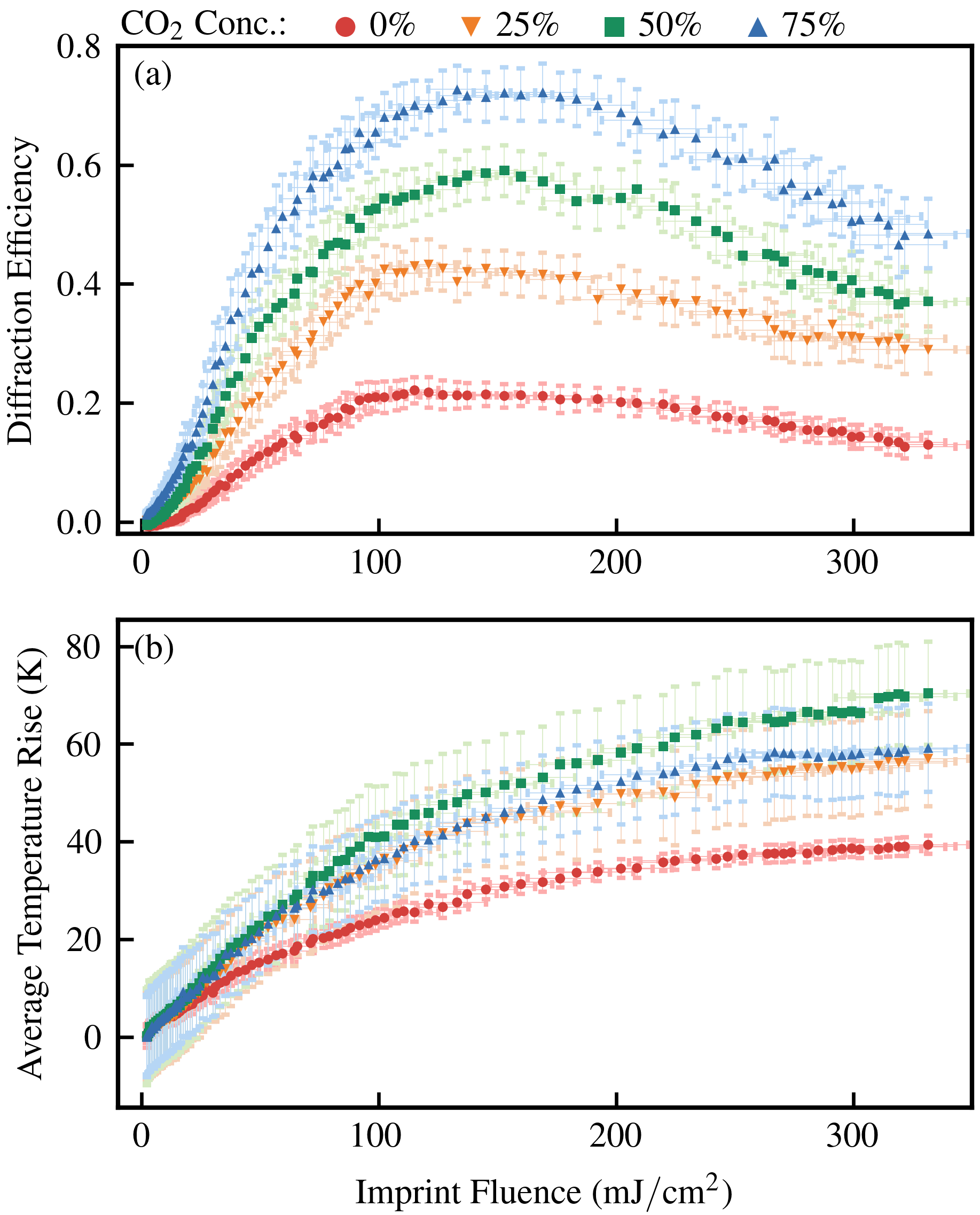
Figure 5: Diffraction efficiency and temperature rise as a function of CO₂ fraction, indicating more than a threefold improvement in grating performance at high CO₂ content.
This finding enables effective grating formation even in regimes where ozone concentration is low, which is advantageous for vacuum-applied or large-scale systems where ozone production is rate-limited.
Angular Bandwidth and Grating Geometry
The angular bandwidth of the Bragg diffraction process, essential for matching realistic beam divergences, is quantitatively characterized as a function of grating thickness and period. Thicker gratings and shorter periods reduce the acceptance bandwidth, dictating system design trade-offs between diffraction angle, efficiency, and spatial filtering properties.
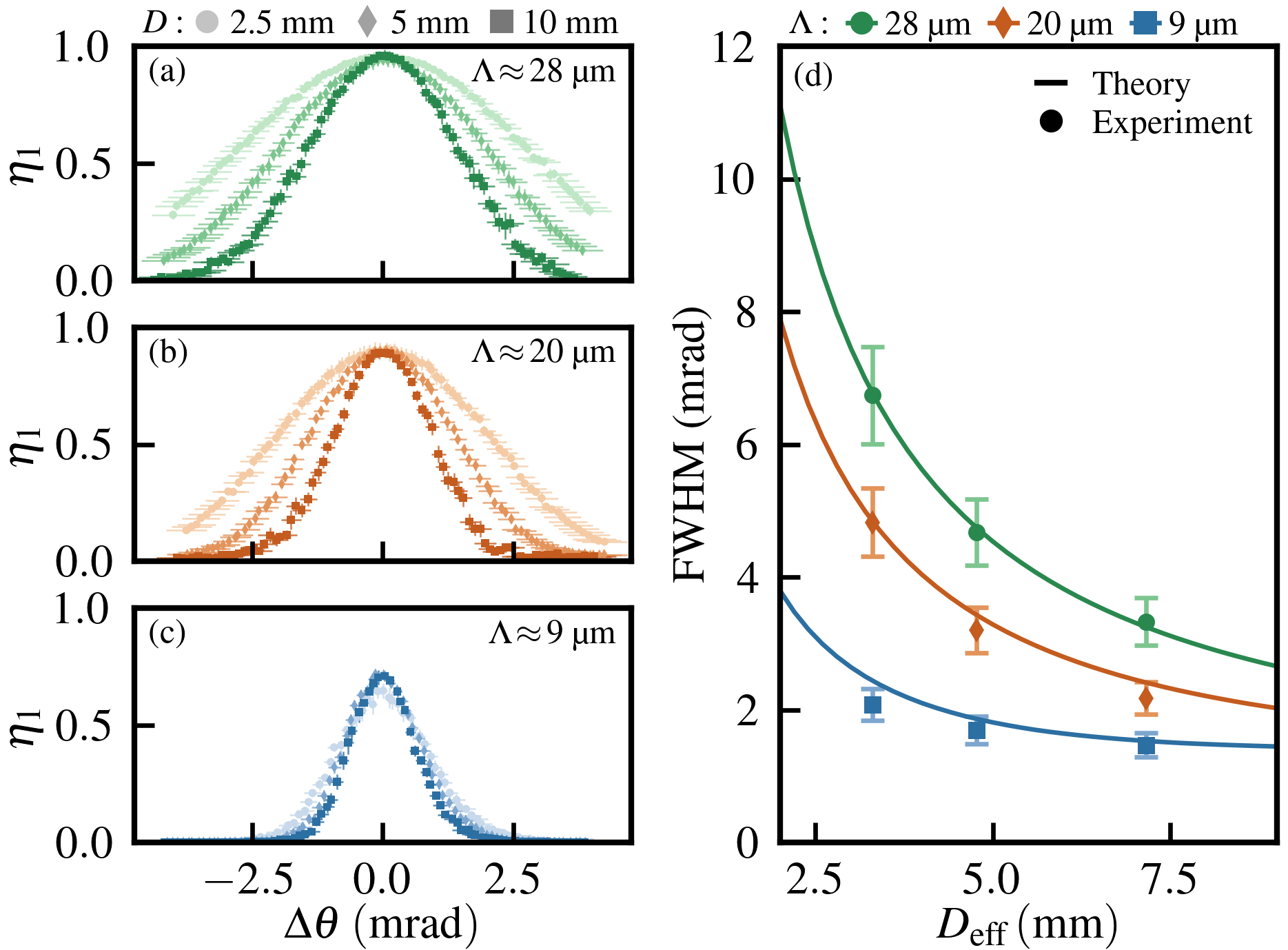
Figure 6: Diffraction efficiency as a function of angular deviation from Bragg angle for various grating periods and thicknesses, compared to theoretical predictions.
These measurements confirm that, with appropriate design, high-efficiency diffraction is achievable for beams with realistic divergence and spatial quality, and that the grating itself can serve as an effective spatial filter, improving the focusability of diffracted pulses.
Stability and Wavefront Quality
Operational stability is demonstrated at 10Hz repetition rates over thousands of shots, with mean single-shot efficiencies above 95% and minimal degradation. The statistical distribution of efficiency is sharply peaked, with 90% of pulses exceeding 90% efficiency.
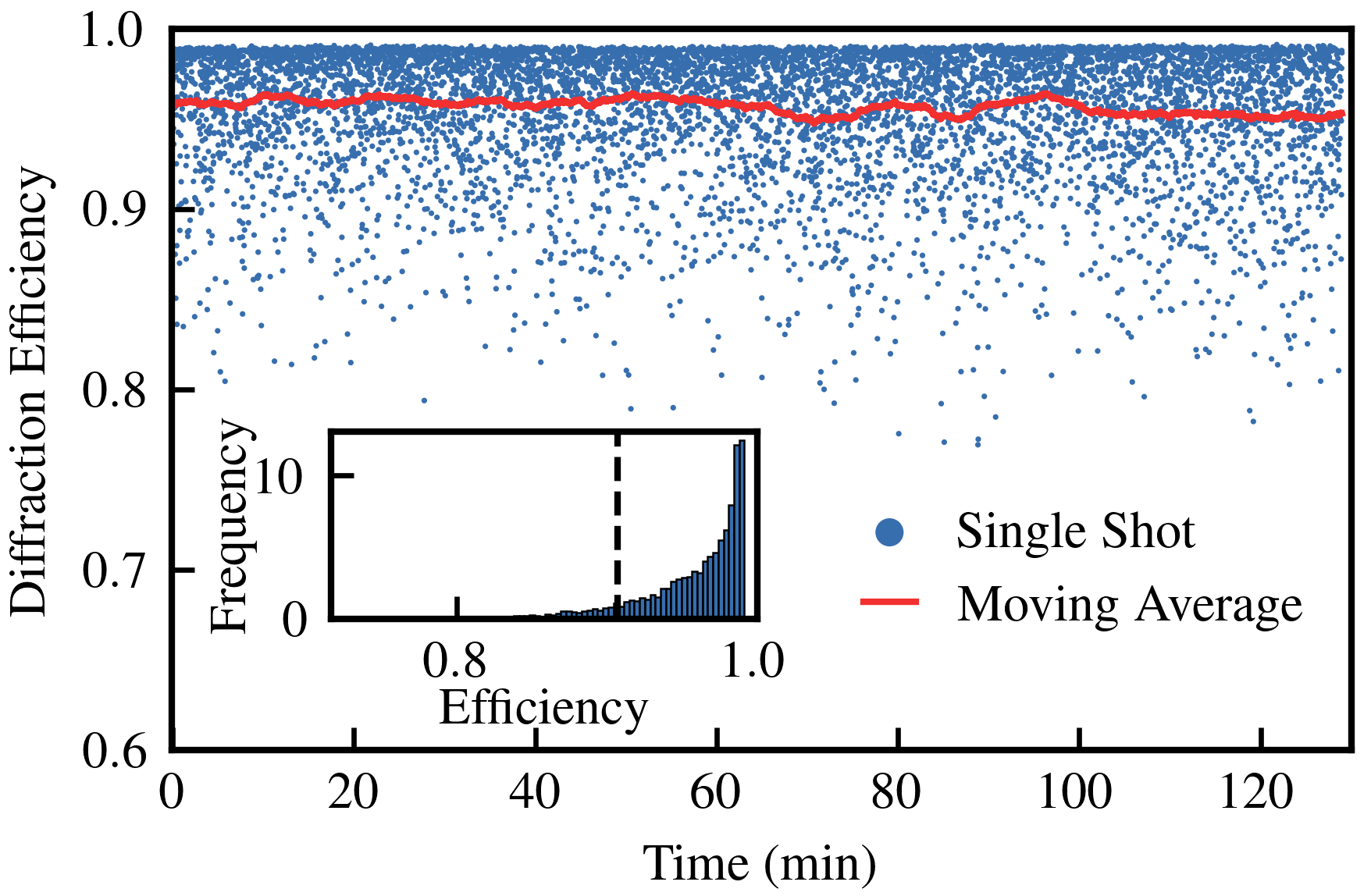
Figure 7: Long-term stability of diffraction efficiency measured over two hours of operation, showing minimal drift and high shot-to-shot consistency.
Wavefront measurements via Shack-Hartmann sensing reveal negligible aberration is imparted by the gas grating to the diffracted beam; in fact, the spatial filtering mechanism results in a modest improvement in peak-to-valley and RMS phase error in the first-order beam.
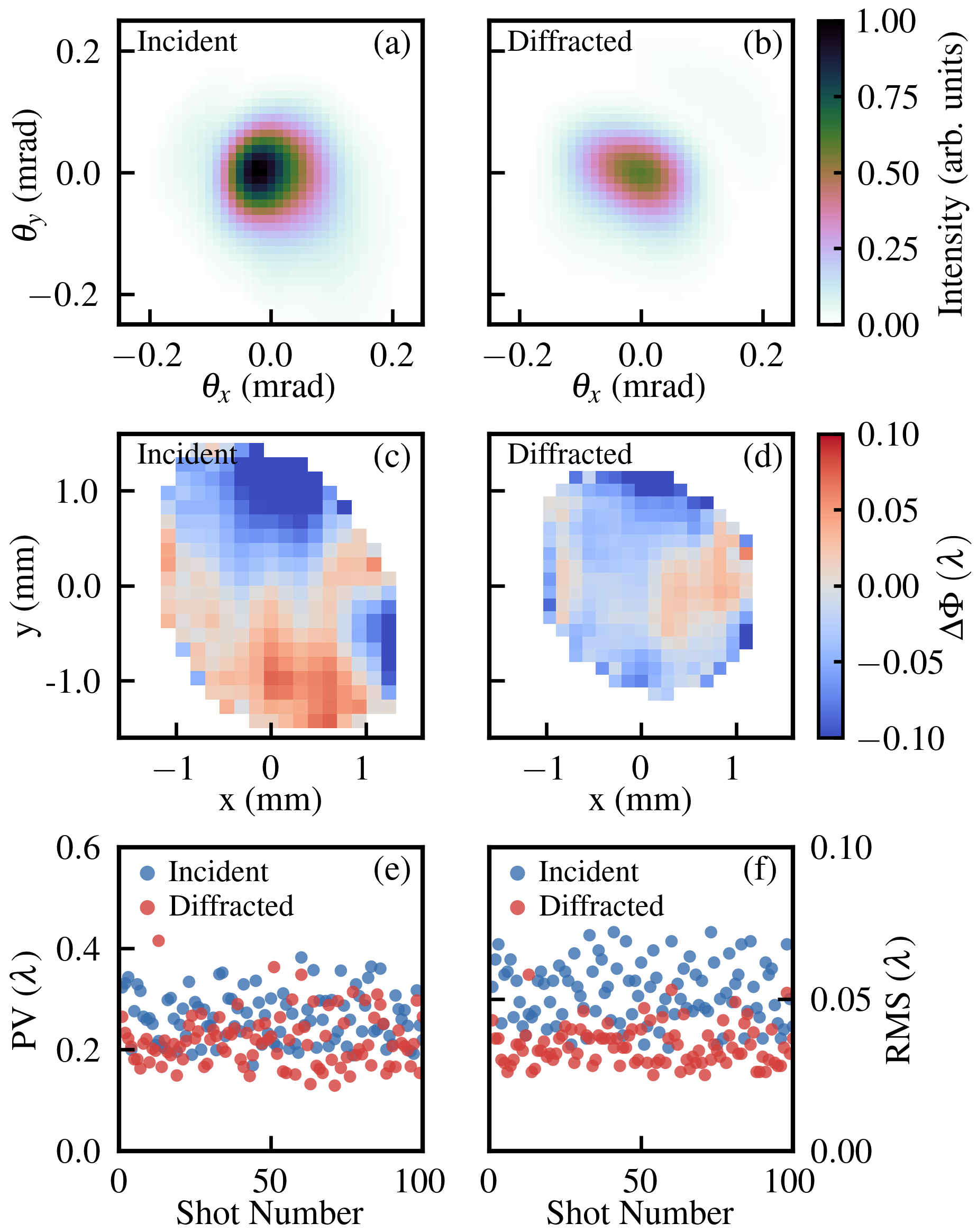
Figure 8: Comparison of focal spots and wavefronts between incident and diffracted probe beams, demonstrating preservation and slight improvement of spatial quality post-diffraction.
Theoretical and Practical Implications
This study confirms that transient, photochemically-induced gas-phase gratings can achieve operational metrics—diffraction efficiency, spatial fidelity, stability, and debris tolerance—that are commensurate with or surpass the requirements of next-generation high-fluence laser platforms. The results extend the utility of such gratings far beyond previous work, provide tight experimental validation of recent theoretical models [michel2024photochemically], and elucidate explicit parametric strategies for optimization. The scalable nature of gas-based optics, immunity to cumulative damage, and tunability for diverse wavelengths and pulse formats mark a path for their adoption as final optics in ICF and high-energy-density (HED) science.
In comparison to plasma gratings—limited by ultrafast hydrodynamics and shorter lifetimes—these gas-phase gratings operate on sub-microsecond timescales and are better suited for nanosecond and longer pulse durations, widely encountered in fusion-scale systems.
Realization of more elaborate gas-phase diffractive optics—including dynamic lenses and programmable components [singh2025holographic]—is now practical, with modeling and optimization guided by validated theory and hydrodynamic simulation codes [oudin2025piafs].
Conclusion
The authors present rigorous experimental and theoretical advances in the development of transient gas-phase diffraction gratings tailored for manipulation of UV, visible, and IR high-power lasers. Near-unity diffraction efficiency, robust spatial quality, and operational stability are demonstrated across critical wavelengths and pulse formats, with systematic characterization of the governing physics. The demonstrated performance and scalability position gas gratings as a leading candidate for high-damage-threshold, debris-resistant final optics in large-scale laser applications. Future directions include integrated gas-phase optical components, larger aperture systems, and programmable diffractive elements for adaptive beam control in extreme photonic environments.

