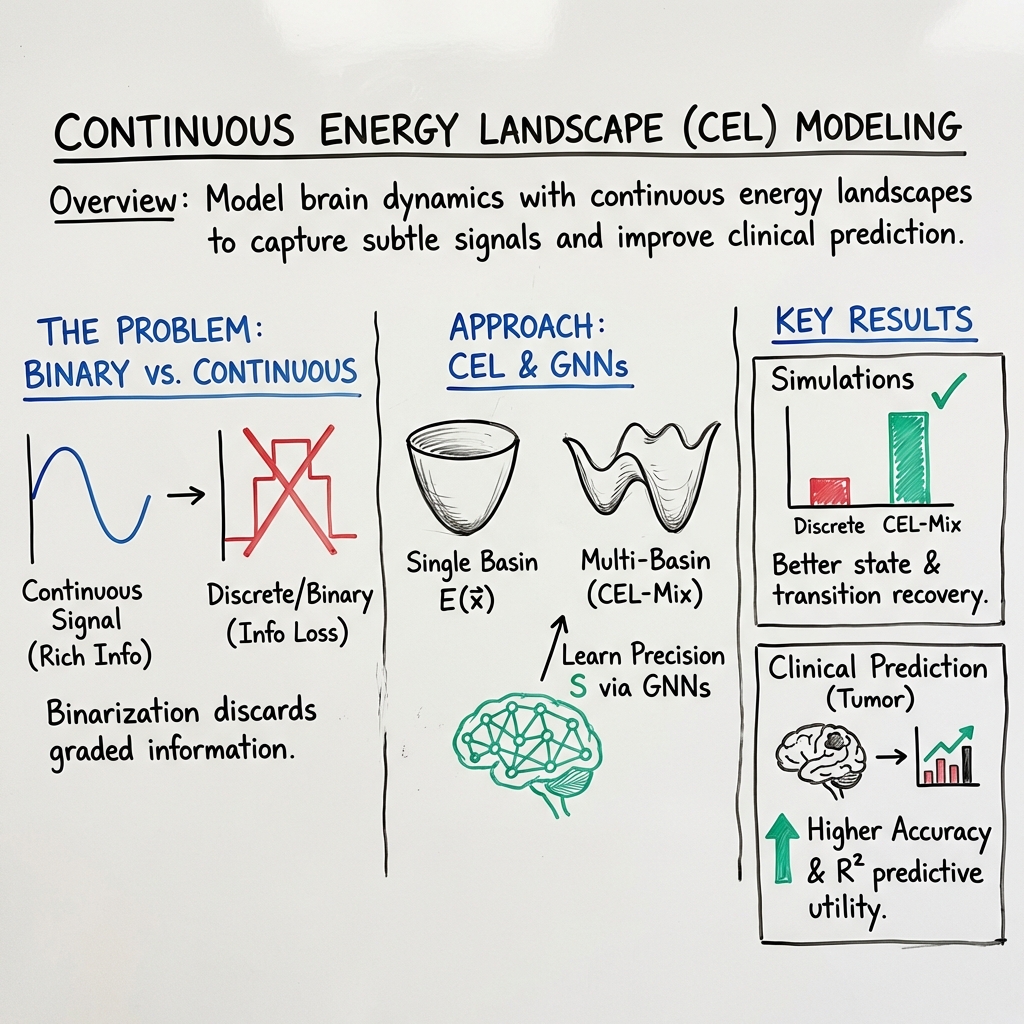
- The paper introduces a new model using GNNs to compute continuous energy landscapes from fMRI data, overcoming the limitations of discretized approaches.
- The model demonstrates superior performance on synthetic SLDS and real-world brain tumor datasets, showing improvements in AUC and explained variance.
- The approach enhances noise resilience and biological relevance, providing deeper insights into neural dynamics and aiding clinical diagnostics.
Continuous Energy Landscape Model for Analyzing Brain State Transitions
Introduction
The paper "Continuous Energy Landscape Model for Analyzing Brain State Transitions" (arXiv ID: (2601.06991)) introduces a novel framework to model neural dynamics using continuous energy landscape analysis. Traditional approaches often discretize brain signals, resulting in information loss and computational challenges given the exponential increase in possible brain states. To address these limitations, the proposed model leverages Graph Neural Networks (GNNs) to construct a continuous precision matrix from functional MRI (fMRI) data, preserving the complete range of neural signal variations.
Methodology
Graph Neural Networks and Energy Computation
The continuous energy landscape model employs GNNs to derive a precision matrix from fMRI signals without binarization. The continuous state vector, x, is centered around a baseline vector μ and adjusts for signal fluctuations y~. The model uses maximum entropy principles to generate a multivariate Gaussian distribution for brain states, capturing both mean activity and covariance between regions of interest. This enables the energy function E(x) to be expressed in terms of precision matrix S, allowing efficient learning and optimization of energy values.
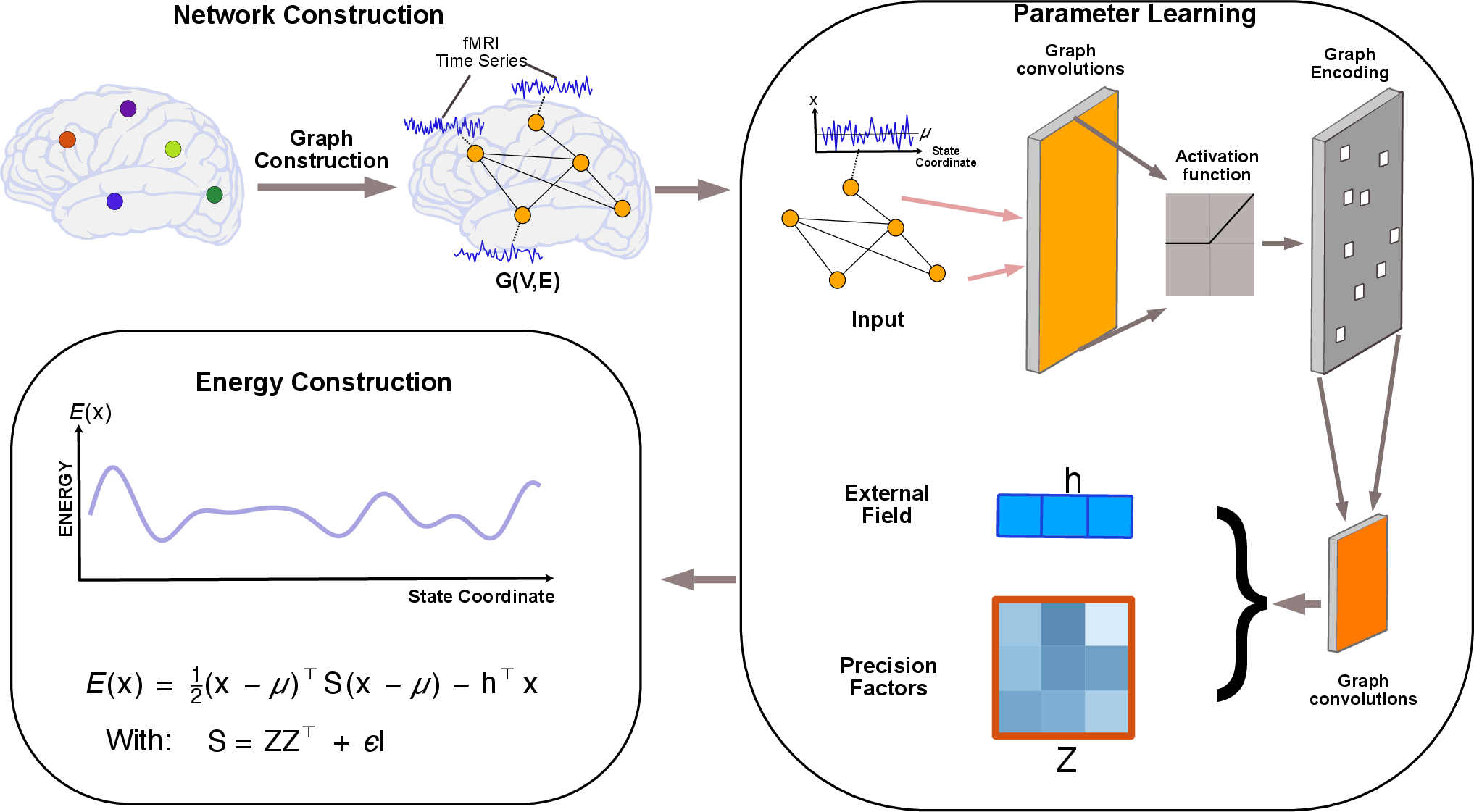
Figure 1: Continuous energy landscape modeling via graph neural networks. In Step one (Network Construction), we construct subject-specific functional networks G=(V,E) by thresholding Pearson correlations from standardized fMRI time series and form the normalized weight matrix B~.
Energy Landscape Analysis
Traditional maximum entropy models were limited by binary state discretization (±1), rendering them less efficient for high-dimensional brain networks and disregarding nuanced neural dynamics. The continuous model formulated here generalizes the binary representation by incorporating full signal values into the energy computation, offering improved noise resilience and biological relevance.
Experiments and Results
To validate the model, synthetic datasets simulated using Switching Linear Dynamical Systems (SLDS) and Kuramoto oscillators were employed. The continuous energy model demonstrated higher efficiency in capturing the basin geometry, state occupancy, and transition dynamics over conventional discrete models.
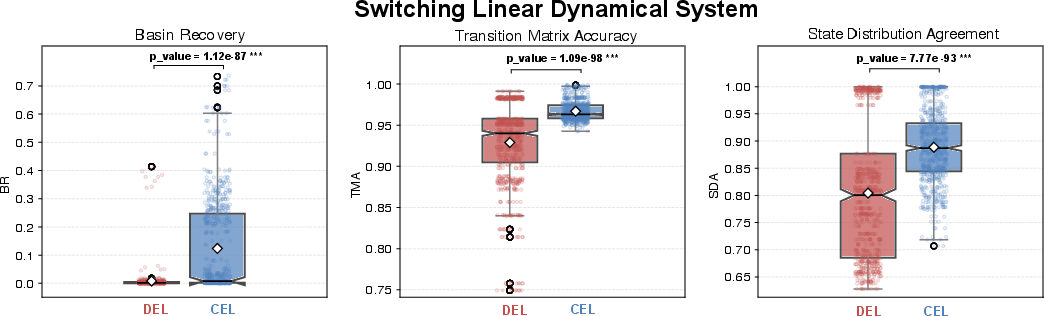
Figure 2: Switching Linear Dynamical System (SLDS): grouped performance on Basin Recovery (BR), Transition Matrix Accuracy (TMA), and State Distribution Agreement (SDA) for the discrete (DEL) and continuous (CEL) energy landscape models across the simulation grid.
Real-world fMRI Dataset Evaluation
Applying the continuous energy model to fMRI datasets from brain tumor patients, the model showed a significant increase in Area Under the Curve (AUC) by $0.27$ for the prediction of cognitive functions such as working memory and executive function. Additionally, explained variance (R2) improved by $0.35$ for predicting reaction time, underscoring the benefits of continuous energy landscapes in clinical settings.
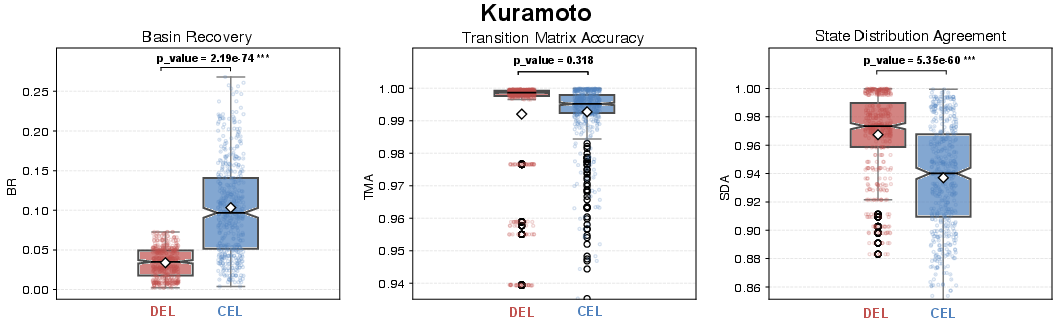
Figure 3: Kuramoto network with template locking: grouped performance on BR, TMA, and SDA for the discrete (DEL) and continuous (CEL) energy landscape models across the simulation grid. Bars summarize results across repeats; paired Wilcoxon signed-rank p-values are shown in-figure.
Implications and Future Work
Theoretical and Practical Impact
The continuous energy landscape approach provides a refined understanding of brain dynamics, highlighting potentials for improved diagnostic models for neurological disorders. Allowing for a complete continuum of signal values results in enhanced capturing of neural complexities, offering a richer substrate for theoretical explorations in cognitive resilience and control.
Future Directions
Further research may explore integrating both functional and structural connectivity measures to enrich model robustness. Extending beyond Gaussian assumptions and incorporating directional or higher-order interactions could deepen insights into true neural network configurations. Optimizations using direct integration of energy landscape principles within GNN frameworks may hold potential for future advancements.
Conclusion
The proposed continuous energy landscape model addresses crucial limitations of traditional discrete frameworks, presenting a methodologically sound and computationally feasible approach to brain state transition analysis. Demonstrating superior performance in both synthetic and real-world settings underscores its potential significance in advancing cognitive and clinical neuroscience.