- The paper introduces an edge-centric topological signal processing framework that leverages the Hodge Laplacian to capture neural dynamics.
- The methodology applies Hodge decomposition to separate gradient, curl, and harmonic components, thereby improving task decoding accuracy over node-based methods.
- Empirical results using human connectome data demonstrate that edge-level representations provide enhanced discriminability for cognitive state transitions.
Edge-Based Laplacians for Brain Signal Processing: A Topological Signal Processing Perspective
Motivation and Theoretical Framework
The paper "From Nodes to Edges: Edge-Based Laplacians for Brain Signal Processing" (2512.13420) presents a substantial shift from traditional node-centric graph signal processing (GSP) toward an explicit edge-based framework leveraging the Hodge Laplacian and associated tools from topological signal processing (TSP). Classical GSP methodologies focus predominantly on node signals within brain networks, typically extracting spectral and dynamic representations relative to the graph Laplacian. This convention, however, neglects the core fact that crucial neural dynamics and cognitive processes may be better characterized by the functional interplay, synchrony, and high-order interactions among network edges and higher-dimensional structures.
TSP generalizes GSP through the apparatus of simplicial complexes. Here, signals are assigned not only to nodes (0-simplices) but also to edges (1-simplices), triangles (2-simplices), and higher-order objects. The mathematical centerpiece is the combinatorial Hodge Laplacian, L1, which encodes relationships among edges, their incidence with nodes (L1↓), and, when the clique complex is constructed, triangles (L1↑). The associated spectral decomposition enables a topological Fourier transform (TFT) on edge signals. Critically, Hodge decomposition separates any edge-signal into gradient (exact), curl, and harmonic components, corresponding to purely local variations, higher-order circulations, and topologically non-trivial cycles, respectively.
An illustration of the Eigenmodes—both gradient and harmonic—of L1↓ on human connectome data is provided, explicitly showing the localization and sparsity properties which differentiate these components.
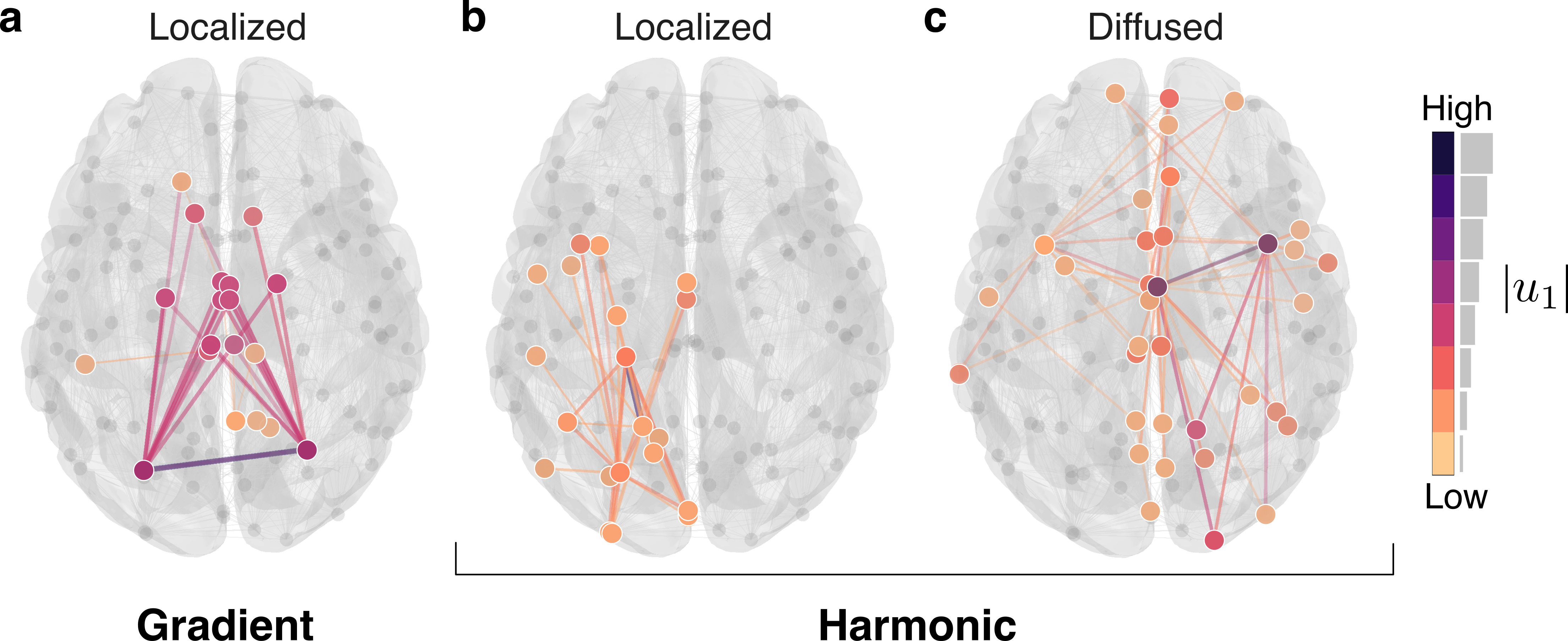
Figure 1: Visualization of gradient and harmonic eigenmodes of the edge-based Hodge Laplacian, highlighting their spatial localization and sparsity on the structural connectome.
Methodological Advances
The empirical validation centers on 100 subjects from the Human Connectome Project, utilizing both resting-state and task-based fMRI. Edge signals are derived from node-time series through amplitude-based co-fluctuation products and phase-based (via Hilbert transform) trigonometric mappings. For TSP analysis, the connectome is thresholded to retain the upper 20% of structurally weighted edges, and the clique complex up to order 2 captures the network’s full higher-order structure.
Two decomposition strategies are implemented: one using L1↓ (node-edge), and one using the full L1 (including edge-triangle relations) for complete Hodge decomposition. GSP/TSP outputs are compared on both dynamic (recurrence analysis, time–time correlation matrices, ECS partition similarity) and static (SVM-based task classification) axes.
A side-by-side comparison of dynamic decoding via GSP node-based, GSP edge-decoupled, and TSP harmonic signals illustrates clear advantages for the TSP-based, edge-centric representations.
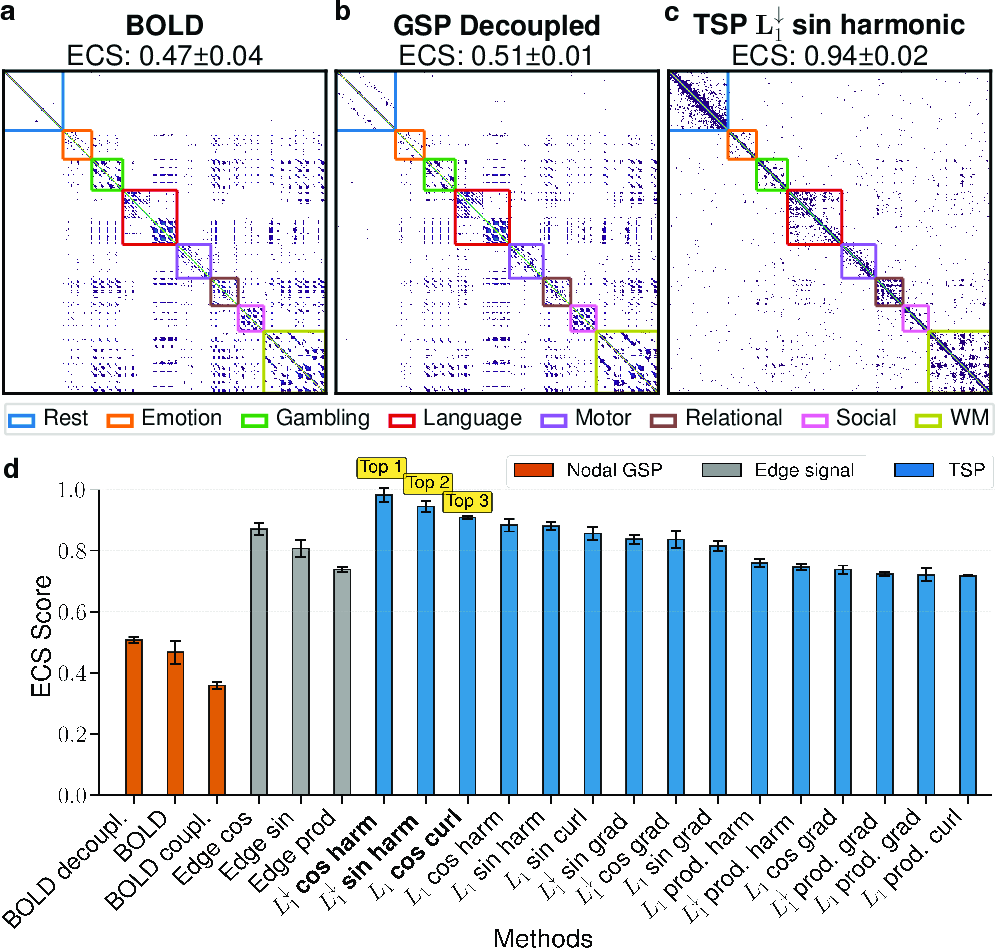
Figure 2: Representative recurrence matrices showing superior alignment of TSP-based harmonic edge signals with true task/rest segmentation (as measured by ECS).
Empirical Results
Quantitative evaluation establishes the empirical advantage of edge-based TSP measures in both dynamic and static cognitive state decoding. The ECS analysis, which quantifies correspondence between community partitions and ground-truth task segmentation, yields higher scores for TSP harmonic/curl components than for any node-based GSP measure. Static task decoding, assessed via node-projected features and a 100-fold cross-validated multiclass SVM, indicates consistent task classification accuracy improvements when employing edge-based (especially harmonic and curl) TSP representations compared to all GSP baselines.
The task decoding accuracy across GSP and TSP methods, illustrated succinctly, confirms the performance gain delivered by edge-level and higher-order projections.
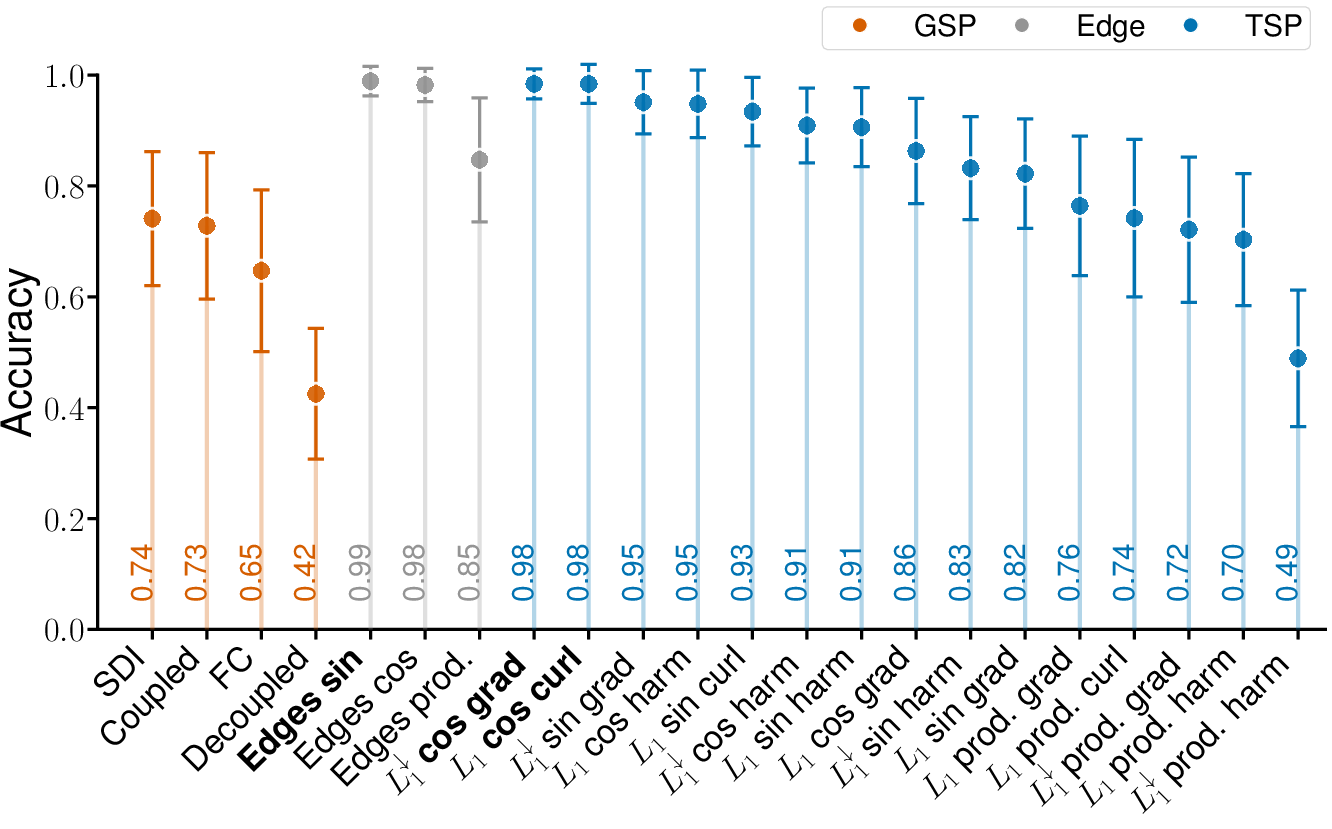
Figure 3: Task decoding accuracies demonstrate that TSP-based methods (especially those utilizing L1 harmonic/curl signals) surpass node-centric GSP approaches on fMRI data.
Implications and Future Directions
This study formalizes the application of edge-based TSP for neural data through both theoretical development and empirical validation. It provides direct evidence that activity and co-fluctuations on connections, particularly as disentangled via the Hodge decomposition, encode functionally discriminative information not available at the node level. The harmonic and curl subspaces, in particular, capture recurrent or cyclic organizational motifs that are implicated in the dynamics of cognitive state transitions and potentially in the emergence of topological signatures of disease or plasticity.
The practical implications are clear: fine-grained, edge-based TSP can deliver increased discriminability for cognitive and clinical neuroimaging studies, enabling both improved decoding and potentially richer biomarkers of network pathology. Theoretically, the work embeds classical GSP within a broader framework appropriate for analyzing data on arbitrary cell complexes, supporting the transfer of advanced spectral-topological methods into multiscale brain network science.
Future developments should pursue several extensions:
- Application of TSP frameworks to multimodal or even time-resolved (time-varying simplicial complex) neuroimaging data.
- Deeper exploration of the interpretability and dynamical meaning of curl and harmonic components in real cognitive transitions.
- Investigation of disease effects and inter-individual variability within the edge-centric, topological signal strata.
- Expansion of task decoding pipelines to harness deep learning architectures leveraging the edge-level spectral signatures, potentially advancing connectome-based predictive modeling.
Conclusion
The paper provides a robust theoretical and empirical argument for the inclusion of edge-based (and, by extension, higher-order) signal representations in neural data analysis. By leveraging the Hodge Laplacian, topological decomposition, and TSP tools, the authors demonstrate that critical aspects of brain function and cognitive state decoding are more richly encoded at the edge and higher-simplex level than at traditional nodes. This methodological transition is poised to inform both future AI approaches to neural data and fundamental neuroscience research.