An Algebraic Representation Theorem for Linear GENEOs in Geometric Machine Learning
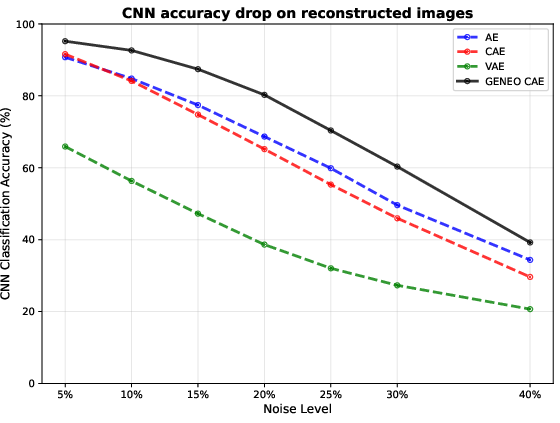
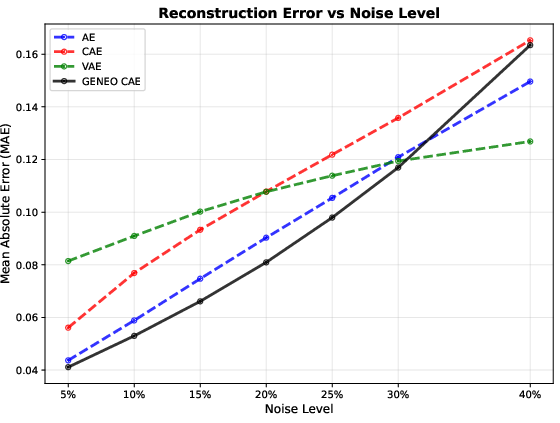
Abstract: Geometric and Topological Deep Learning are rapidly growing research areas that enhance machine learning through the use of geometric and topological structures. Within this framework, Group Equivariant Non-Expansive Operators (GENEOs) have emerged as a powerful class of operators for encoding symmetries and designing efficient, interpretable neural architectures. Originally introduced in Topological Data Analysis, GENEOs have since found applications in Deep Learning as tools for constructing equivariant models with reduced parameter complexity. GENEOs provide a unifying framework bridging Geometric and Topological Deep Learning and include the operator computing persistence diagrams as a special case. Their theoretical foundations rely on group actions, equivariance, and compactness properties of operator spaces, grounding them in algebra and geometry while enabling both mathematical rigor and practical relevance. While a previous representation theorem characterized linear GENEOs acting on data of the same type, many real-world applications require operators between heterogeneous data spaces. In this work, we address this limitation by introducing a new representation theorem for linear GENEOs acting between different perception pairs, based on generalized T-permutant measures. Under mild assumptions on the data domains and group actions, our result provides a complete characterization of such operators. We also prove the compactness and convexity of the space of linear GENEOs. We further demonstrate the practical impact of this theory by applying the proposed framework to improve the performance of autoencoders, highlighting the relevance of GENEOs in modern machine learning applications.
Paper Prompts
Sign up for free to create and run prompts on this paper using GPT-5.
Top Community Prompts
Explain it Like I'm 14
Overview
This paper is about a special kind of “smart” math tool used in machine learning called a GENEO. Think of a GENEO as a rule that turns one set of numbers into another, but in a careful way that respects symmetry (like shuffles or rotations) and doesn’t amplify noise. The authors prove a big result: they show exactly how every linear GENEO that maps one kind of data to a different kind of data can be built from simple, understandable pieces. They also show that the whole collection of these tools has nice mathematical properties, and they demonstrate how this helps improve autoencoders (a type of neural network).
Key Questions
- How can we describe all linear GENEOs that go from one data space to a different data space, while respecting symmetries?
- Can we write any such GENEO as a simple combination of small, easy-to-understand operations?
- What conditions make such operators stable (non-expansive), and what does that mean in practice?
- What does the space of all these operators look like (is it compact? convex?) and how can this help in machine learning?
Methods and Main Ideas
What is a GENEO?
- A GENEO (Group Equivariant Non-Expansive Operator) is a function F that maps input data to output data and satisfies two key properties: 1) Equivariant: If you apply a symmetry to the input (like permuting entries), the output changes in the corresponding symmetric way. In short: “symmetry in, symmetry out.” 2) Non-expansive: It does not stretch differences; it keeps changes from getting bigger (like a volume knob that never goes above 1).
- Linear GENEOs are the ones where F is linear (like a matrix multiplying a vector).
Perception pairs and symmetries
- A “perception pair” is:
- a space of data (think: all functions from a finite set X to real numbers, which is like vectors with one entry per point in X),
- plus a group of symmetries for that space (like all ways to permute positions in X).
- The paper studies GENEOs that go from one perception pair (RX with group G) to another (RY with group K), connected by a homomorphism T that says how input symmetries should translate to output symmetries.
- A mild but important condition: the action of T(G) on Y is “transitive,” meaning the symmetries can move any output position to any other. This keeps the output space nicely uniform.
Building blocks: “picking” functions and permutation matrices
- The authors use a very simple building block: a “picking rule” h that, for each output position y in Y, picks exactly one input position x in X. You can think of h as a recipe that says, “to fill this output slot, read from that input slot.”
- Each h corresponds to a rectangular permutation matrix (a matrix with exactly one 1 per row and zeros elsewhere). These are like clean “copy/select” operations.
- A key linear algebra fact: any matrix with nonnegative rows that each sum to the same number can be written as a weighted sum (convex combination) of these rectangular permutation matrices. This means complicated operations can be built from simple pick-and-copy pieces.
From operators to symmetry-aware “measures”
- The main step is to show that any linear equivariant operator F can be expressed as:
- F(φ) = sum over h of μ(h) * (φ∘h), where φ∘h means “apply h to pick which inputs feed each output,” and μ(h) are weights (possibly positive or negative).
- Because F must respect symmetry, the weights μ(h) must be symmetry-invariant. The paper packages these weights into what it calls a generalized T-permutant measure. “Measure” here just means a consistent way to assign weights to the picking rules h, and “generalized T-permutant” means the weights are constant along symmetry orbits (so they respect the group action).
- Non-expansivity (the “doesn’t amplify noise” property) turns into a simple condition on the weights: the sum of the absolute values of the weights must be at most 1:
- sum_h |μ(h)| ≤ 1.
Main Results
- Representation Theorem (core result): If the output symmetries act transitively on Y, then every linear equivariant map F between the two data spaces has a representation
- F(φ) = ∑_h μ(h) * (φ∘h),
- where μ is a generalized T-permutant measure. Conversely, every such μ gives a linear equivariant F.
- GENEO condition: F is non-expansive (so it’s a GENEO) exactly when the total absolute weight is ≤ 1:
- sum_h |μ(h)| ≤ 1.
- Norm equality: The “size” (operator norm) of F matches the total absolute weight:
- max_{φ≠0} ||F(φ)||∞ / ||φ||∞ = ∑_h |μ(h)|.
- Non-uniqueness: The same F can sometimes be written with different μ’s (there isn’t always a single unique choice of weights).
- Compactness and convexity of the space of linear GENEOs:
- Convexity: If you mix two GENEOs (take a weighted average of their μ’s), you get another GENEO.
- Compactness: The space is closed and bounded in the right sense, which is good for optimization and guarantees the existence of best solutions in learning tasks.
- Connection to Topological Data Analysis: Computing persistence diagrams is an example of a GENEO, so this theory links geometric and topological deep learning in a unified framework.
Why This Is Important
- Practical design of equivariant layers: The theorem gives a recipe for building every linear equivariant-and-stable layer between two different data types using simple pick-and-copy rules and symmetry-aware weights. This helps engineers design layers that are both efficient and interpretable.
- Fewer parameters, more structure: Equivariant operators naturally share parameters across symmetric parts of the data, reducing complexity without losing performance.
- Stability you can trust: The non-expansive condition ensures these layers won’t blow up small input errors—important for robustness.
Implications and Applications
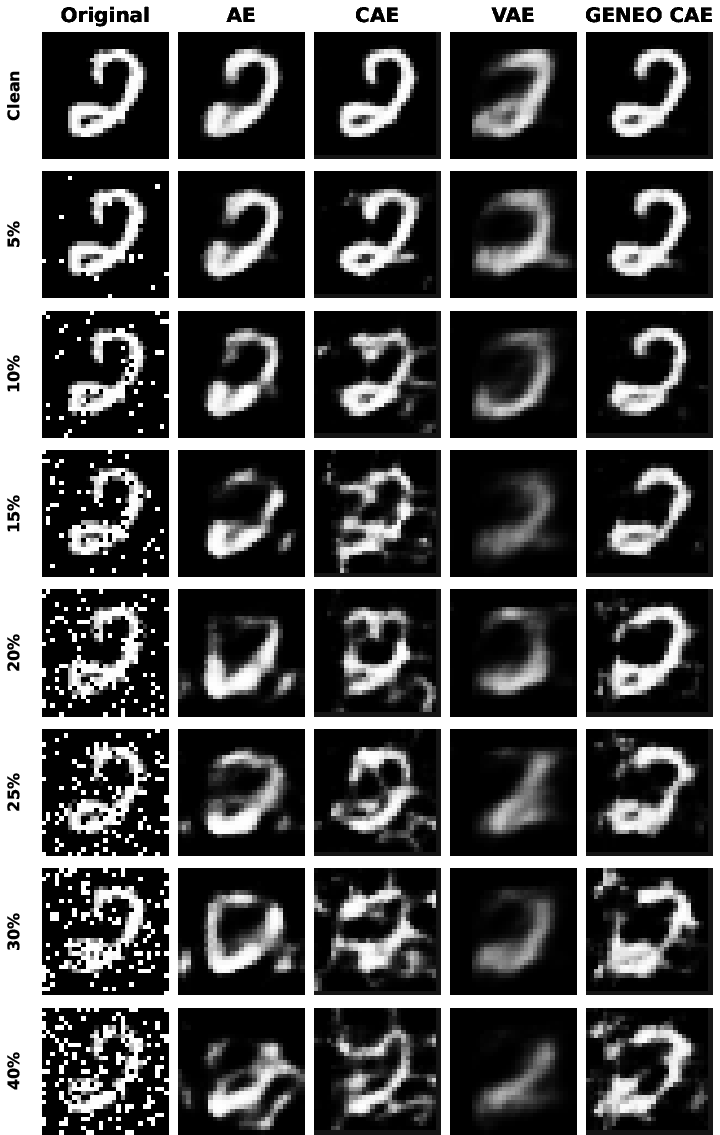
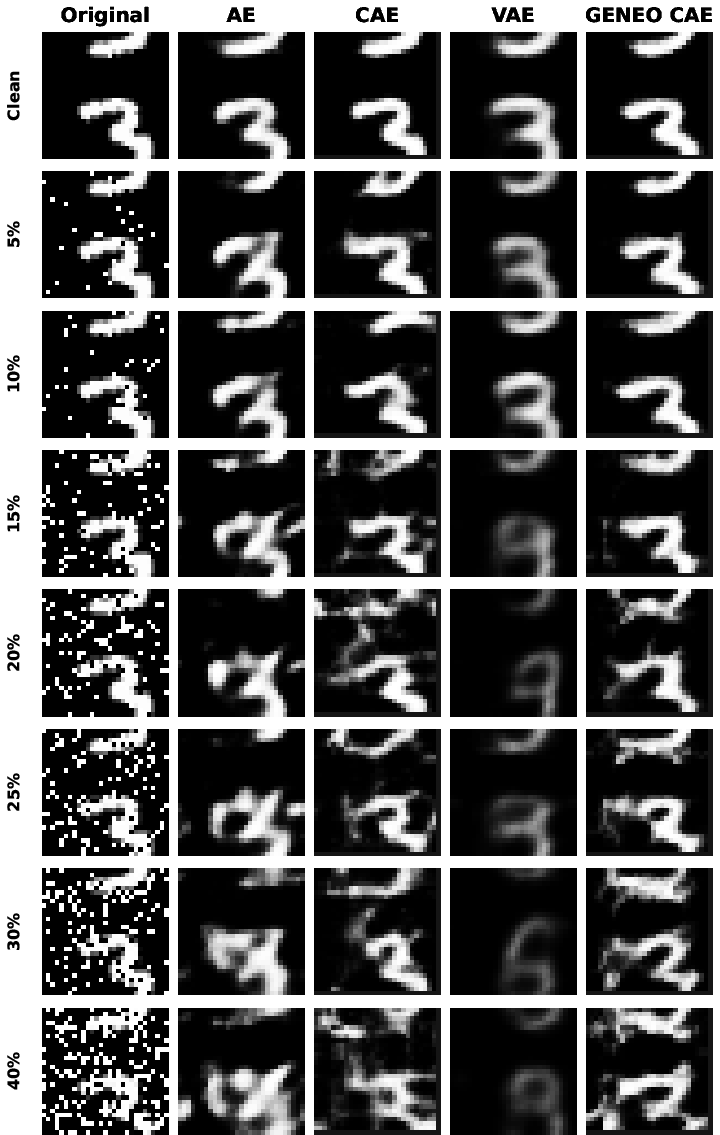
- Better autoencoders: The authors show how their framework helps improve autoencoders by adding structure that respects the data’s symmetries. This can lead to better reconstructions and fewer parameters.
- Unifying viewpoint: The same machinery covers geometric ideas (like respecting rotations, permutations) and topological ideas (like persistence diagrams), giving a common language across different deep learning subfields.
- Easier construction and theory: Because every operator can be broken down into simple picking rules with symmetry-aware weights, it’s easier to design, analyze, and optimize these models. The convexity and compactness results further support stable training and existence of optimal solutions.
In short, the paper gives a clear, flexible blueprint for building and understanding symmetry-respecting, stable linear layers in machine learning, even when inputs and outputs are different kinds of data. This helps make models both simpler and more reliable, with promising benefits for real-world applications.
Knowledge Gaps
Knowledge Gaps, Limitations, and Open Questions
Below is a single, focused list of concrete gaps and open questions that remain unresolved by the paper and could guide future research.
- Extension beyond finite domains: The representation and compactness results rely on finite sets X and Y. How can the framework be extended to infinite (e.g., countable or uncountable) domains, continuous manifolds, or measurable spaces while preserving equivariance and non-expansivity?
- Relaxing transitivity: The main theorems assume T(G) acts transitively on Y. What is the full characterization of linear GEOs/GENEOs when this action is non-transitive, beyond the suggested orbit-wise restriction? How do interactions between disjoint orbits affect representation and non-expansivity?
- Nonlinear operators: The representation theorem covers linear GENEOs only. Can analogous results be developed for nonlinear GENEOs (e.g., Lipschitz, monotone, or structured nonlinear maps), including those that arise in Topological Deep Learning (such as persistence-related operators)?
- Alternative norms: Non-expansivity is treated under the sup norm. How do the results change for other norms (e.g., ℓ₂, ℓ₁, weighted sup norms), and can corresponding characterizations of the operator norm via generalized T-permutant measures be derived?
- Approximate equivariance: Real-world models often satisfy equivariance only approximately. Can a robust “ε-GENEO” theory quantify and represent operators that are approximately T-equivariant, and how does this impact the measure-based representation and non-expansivity bounds?
- Uniqueness and canonical representations: The measure representation is generally non-unique. Are there canonical choices (e.g., minimal support, sparsity, entropy-regularized, or symmetry-respecting measures) that select a unique representative? What are conditions guaranteeing uniqueness?
- Computational algorithms: The construction of μ from F hinges on decomposing matrices into convex combinations of rectangular permutation matrices, which is non-unique. What are efficient, scalable algorithms (with complexity and stability guarantees) to compute μ for large X, Y, and groups G, K?
- Scalability and parameterization: The measure lives over XY, whose size grows exponentially with |X| and |Y|. What practical parameterizations (e.g., low-rank, orbit-based, learned templates, sparse supports) can make the representation usable in large-scale ML applications?
- Learning procedures: The paper demonstrates an application to autoencoders but does not specify a training procedure. How can μ be learned end-to-end (e.g., via differentiable surrogates, regularizers enforcing Σ|μ(h)| ≤ 1 and T-invariance), and how does training stability relate to non-expansivity?
- Empirical validation: Beyond the reported autoencoder example, broader empirical studies are needed to assess performance across tasks, datasets, and architectures. What benchmarks and evaluation protocols best demonstrate the benefits of GENEOs constructed via T-permutant measures?
- Sensitivity to group specification: The framework assumes known groups G, K and homomorphism T. In practice, groups may be unknown or partially known. Can T and the actions be learned or inferred from data, and how does misspecification impact the representation and performance?
- Handling non-transitive K-actions: When K is larger than T(G) or the action on Y is non-transitive, can one characterize the entire space of intertwiners (F satisfying Fρ_X(g)=ρ_Y(T(g))F) without orbit restriction, possibly via representation theory of finite groups?
- Relation to intertwiner spaces: The characterization via μ is operational but does not analyze the dimension and structure of the space of intertwiners between representations induced by G and T(G). Can these dimensions be computed explicitly, and can μ be related to a basis of intertwiners?
- Structure and rank constraints: What constraints on rank, sparsity, and spectral properties of F arise from its measure representation (e.g., via supports over rectangular permutations)? Can these structural properties be exploited for compression or interpretability?
- Robustness to noise: How sensitive is μ to perturbations of F (e.g., numerical errors or training noise)? Are there stability bounds linking perturbations in F to changes in μ, and do these impact practical deployments?
- Beyond convexity/compactness in finite dimensions: The paper claims convexity and compactness of the space of linear GENEOs under finite-domain assumptions. Do these properties hold (or how must they be modified) in infinite-dimensional settings (e.g., function spaces), and under which topologies?
- Generalized measures on infinite XY: The paper uses finite signed measures over the power set of XY. For infinite XY, what σ-algebras, measurability conditions, and integrability constraints are required to define generalized T-permutant measures and ensure well-posedness?
- Compatibility with continuous geometric structures: GENEOs are motivated by geometric/topological deep learning on manifolds (e.g., Laplacian operators). Can the measure-based representation be adapted to smooth or Riemannian settings, and does it connect to integral kernels or reproducing kernel Hilbert spaces?
- Connections to Birkhoff–von Neumann-type decompositions: The stochastic-matrix decomposition used here generalizes the Birkhoff–von Neumann theorem. Can stronger uniqueness, extremal structure, or polyhedral characterizations be established for rectangular cases under equivariance constraints?
- Design patterns for architectures: The paper suggests improved autoencoders but lacks systematic design guidelines. Which architectural motifs (encoders/decoders, skip-connections, normalization layers) pair best with GENEO layers constructed via μ, and how should hyperparameters be tuned?
Practical Applications
Overview
This paper proves a constructive, algebraic representation theorem for linear Group Equivariant Non-Expansive Operators (GENEOs) acting between heterogeneous data spaces (distinct “perception pairs”). It shows that every linear GENEO can be written as a signed generalized T-permutant measure over maps between finite domains, and that the space of such operators is convex and compact. Practically, this yields a way to systematically design, parameterize, optimize, and certify symmetry-preserving, 1-Lipschitz linear operators across different data types. The authors also demonstrate performance gains in autoencoders as an application.
Below are actionable applications grouped by time horizon. Each item indicates relevant sectors and notes dependencies/assumptions affecting feasibility.
Immediate Applications
- Symmetry-preserving linear layers for autoencoders
- Sectors: software/ML infrastructure; computer vision; healthcare (medical imaging); industrial inspection.
- What: Use the measure-based parameterization (generalized T-permutant measures) to build encoder/decoder layers that are both equivariant to specified group actions and non-expansive (L∞-Lipschitz ≤ 1), as demonstrated in the paper for improved autoencoder performance.
- Tools/products/workflows: A “GENEO layer” where weights are learned as (signed) mixtures of rectangular permutation operators with sum of absolute weights ≤ 1; training with projected or constrained optimization to enforce the L1 bound on the measure; unit tests for equivariance.
- Assumptions/dependencies: Finite input/output domains; known group actions with a homomorphism T and (ideally) transitive action on output indices; linearity of the layer; compute/parameterize only a tractable subset of h ∈ XY (sparsity).
- Low-parameter, interpretable equivariant modules
- Sectors: software, embedded ML, edge devices.
- What: Replace dense linear maps with convex combinations of structured permutation-like operators to reduce parameters and improve interpretability (each operator reflects a specific index mapping consistent with symmetry).
- Tools/products/workflows: Library that exposes a small, symmetry-aligned operator basis; compression by pruning measure support; explainability via active maps h and their orbits.
- Assumptions/dependencies: Quality of chosen group/model symmetries; non-uniqueness of measures implies the need for tie-breaking regularizers for interpretability.
- Certified Lipschitz and equivariant layers for robustness
- Sectors: safety-critical ML (healthcare, autonomous systems); finance (risk control); cyber-security.
- What: Use the equality “operator L∞-Lipschitz constant = L1 norm of the measure” to certify 1-Lipschitz layers and bound perturbation amplification while ensuring equivariance (predictable behavior under known transformations).
- Tools/products/workflows: Training with L1 constraints on the measure; post-training projection onto the GENEO set (feasible via convexity); robustness certification reports.
- Assumptions/dependencies: Proper estimation/enforcement of the L1 bound; linearity (compose with nonlinearities carefully to preserve global Lipschitz bounds).
- Equivariant pooling/unpooling and down/up-sampling
- Sectors: computer vision; audio/signal processing.
- What: Design pooling/unpooling operators as GENEOs that respect translations/rotations (via T mapping input to output actions) and are non-expansive, yielding stable multiscale representations.
- Tools/products/workflows: Drop-in linear GENEO pooling layers implemented as constrained mixtures of rectangular permutation matrices; training alongside standard CNN blocks.
- Assumptions/dependencies: Discrete grids and finite index sets; correct group action modeling (e.g., discrete rotations/reflections).
- Permutation-equivariant sensor fusion and ordering-invariant preprocessing
- Sectors: IoT, manufacturing, energy monitoring.
- What: Map multichannel sensor arrays to summaries while preserving invariance/equivariance to sensor re-ordering or array symmetries; ensure stability through non-expansivity.
- Tools/products/workflows: Preprocessing blocks implemented as GENEOs with G the sensor re-labeling group and T mapping to output indexing; certified invariance tests.
- Assumptions/dependencies: Accurate modeling of sensor symmetries; finite, manageable sets of indices; possibly orbit-wise decomposition if action on outputs is not transitive.
- Graph and set learning with symmetry-constrained linear maps
- Sectors: recommender systems; molecular modeling; logistics.
- What: Use GENEOs to construct permutation-equivariant linear operators between node- or set-indexed feature spaces (e.g., graph coarsening/refinement maps) with stability guarantees.
- Tools/products/workflows: Orbit-wise application of the theorem when actions are not fully transitive; constrained optimization over convex GENEO sets.
- Assumptions/dependencies: Known automorphism/permutation groups; heterogeneous node sets handled via the T mapping; finite domains.
- TDA features as first-class GENEOs in pipelines
- Sectors: healthcare (biomarkers), materials science, geoscience.
- What: Leverage the fact that computing persistence diagrams (and related distance transforms) fits in the GENEO framework to integrate topological summaries into models with explicit stability/equivariance guarantees.
- Tools/products/workflows: Modular pipelines where topological layers and linear GENEO layers are composed; joint training with robustness constraints.
- Assumptions/dependencies: For persistence diagrams, usual TDA assumptions (no multiplicities or handled appropriately); finite/discretized domains for linear layers in the same pipeline.
- Practical convex optimization over GENEOs
- Sectors: ML optimization platforms.
- What: Exploit convexity/compactness to perform projected gradient descent or proximal updates within the GENEO set; sample extreme points (rectangular permutations) for sparse designs.
- Tools/products/workflows: Projections via reweighting measures; proximal operators that shrink L1 norm of the measure while preserving equivariance.
- Assumptions/dependencies: Efficient orbit computation; scalable sparse parameterizations.
Long-Term Applications
- Scalable libraries/toolchains for heterogeneous equivariant layers
- Sectors: software/ML infrastructure; MLOps.
- What: End-to-end toolchain that takes a user-specified group action on inputs and outputs (via T) and emits optimized, certifiable GENEO layers (including auto-tuned sparse supports and orbit handling).
- Tools/products/workflows: Compiler-like tool that constructs bases, computes orbits, and exports efficient kernels (mixtures of permutations); integrated constraint handling in major DL frameworks.
- Assumptions/dependencies: Efficient algorithms for large groups; automated discovery/validation of real-world symmetries; ergonomic APIs.
- Nonlinear and continuous-domain generalizations
- Sectors: broad ML, scientific computing, robotics.
- What: Extend representation results beyond linear maps and finite domains to richer function spaces (e.g., manifolds, continuous groups) to cover more tasks (pose-aware perception, dynamics modeling).
- Tools/products/workflows: Kernelized or operator-valued measure frameworks; discretization schemes with convergence guarantees.
- Assumptions/dependencies: New theory for nonlinear GENEOs and continuous actions; numerical stability.
- Robust, symmetry-certified perception in robotics and autonomous systems
- Sectors: robotics, automotive, drones.
- What: Symmetry-constrained encoders/decoders (e.g., frame or calibration changes) with Lipschitz control for safer perception and control loops; predictable behavior under reparameterizations.
- Tools/products/workflows: GENEO-based perception stacks feeding controllers; certification artifacts for safety audits.
- Assumptions/dependencies: Accurate symmetry models between sensors/actuators; integration with nonlinear control layers.
- Domain-specific architectures in healthcare and scientific imaging
- Sectors: healthcare, microscopy, remote sensing.
- What: Specialized GENEO layers capturing modality-specific symmetries (e.g., rotations, reflections, slice permutations) to improve reconstruction, anomaly detection, and compression with guarantees.
- Tools/products/workflows: Regulatory-friendly packaging with testable Lipschitz/equivariance constraints; hybrid topological-geometric feature stacks.
- Assumptions/dependencies: Clinical validation; robust estimation of domain symmetries; handling partial/transitivity violations by orbit decomposition.
- Equivariant attention and matching as mixtures of permutations with guarantees
- Sectors: vision-LLMs; tracking; operations research.
- What: Develop attention/matching blocks constrained as GENEOs (mixtures of permutations) to enforce symmetry and stability in assignment-like subproblems.
- Tools/products/workflows: Differentiable, symmetry-aware assignment layers with L1-controlled measures; certified stability bounds.
- Assumptions/dependencies: Extending to large-scale problems with structured sparsity; compatibility with soft attention mechanisms.
- Policy and compliance: auditable symmetry and stability constraints
- Sectors: regulated AI (healthcare, finance, public sector).
- What: Use explicit GENEO parameterizations to document, test, and certify symmetry properties (fairness under relabeling/transformations) and Lipschitz bounds; integrate into model documentation and audits.
- Tools/products/workflows: Compliance reports derived from measures and group specs; continuous monitoring of equivariance during model updates.
- Assumptions/dependencies: Agreement on relevant symmetries; standardized testing protocols; extensions beyond linear components.
- Energy and infrastructure monitoring with symmetry-aware fusion
- Sectors: energy grids, smart cities.
- What: Large-scale sensor fusion respecting network symmetries (e.g., substation permutations, repeating topologies) to produce stable, interpretable indicators.
- Tools/products/workflows: Hierarchical GENEO blocks combining orbits across network partitions; anomaly scoring layers with Lipschitz guarantees.
- Assumptions/dependencies: Scalable orbit computation; partial/approximate symmetries; integration with temporal models.
- Automated discovery of symmetries and T mappings
- Sectors: general ML, scientific discovery.
- What: Learn or verify candidate group actions and T mappings from data, then instantiate GENEO layers accordingly to improve generalization and robustness.
- Tools/products/workflows: Meta-learning routines that infer symmetries, followed by constrained re-training using the theorem’s parameterization.
- Assumptions/dependencies: Reliable symmetry identification; theory for learning T and groups; robustness to model misspecification.
Notes on global dependencies and limits:
- Finite-domain and linear-operator assumptions underlie the current theorem; practical systems can compose these with nonlinearities, but end-to-end guarantees require care.
- The action of T(G) on the output must be transitive or handled orbit-wise (as noted in the paper).
- The measure is generally non-unique; identifiability and interpretability may need regularization or canonicalization.
- Enumerating XY is intractable for large domains; practical implementations must exploit sparsity, symmetry classes, and efficient orbit computations.
Glossary
- Aut(Z): The automorphism group of Z; all bijections from Z to itself under composition. "Moreover, Aut(Z) denotes the group of bijection from Z to itself with respect to the usual composition operation."
- Autoencoders: Neural networks that learn compressed representations by reconstructing inputs. "to improve the performance of autoencoders"
- canonical basis: The standard basis of a function space consisting of indicator functions of points. "RZ has the canonical basis \mathcal{B}{Z}=\left( \mathds{1}{z_1}, \dots, \mathds{1}{z\ell} \right)"
- circulant matrix: A matrix whose rows are cyclic shifts of a base vector, denoted circ(c0,…,cn−1). "the multiplication by each circulant matrix \mathrm{circ}(c_0,\ldots,c_{n-1})"
- compactness: A topological property where every open cover has a finite subcover; here, of operator spaces. "We also prove the compactness and convexity of the space of linear GENEOs."
- convex combination: A linear combination with nonnegative coefficients summing to one. "Every stochastic matrix can be expressed as a convex combination of rectangular permutation matrices."
- convexity: The property of a set containing all convex combinations of its points. "compactness and convexity of the space of linear GENEOs"
- equivariance: The property that an operator commutes with a group action via a homomorphism. "their theoretical foundations rely on group actions, equivariance, and compactness properties of operator spaces"
- extended half-plane: An augmented half-plane used to represent supports of persistence diagrams. "the extended half-plane "
- GEO (Group Equivariant Operator): A pair (F,T) with T a homomorphism and F T‑equivariant between perception pairs. "is said to be a Group Equivariant Operator (GEO)"
- GENEO (Group Equivariant Non-Expansive Operator): A GEO whose map F is non-expansive. "is called a Group Equivariant Non-Expansive Operator (GENEO)."
- generalized T-permutant measure: A finite signed measure on XY invariant under the action α_T of G. "is called a (generalized) -permutant measure"
- group action: A way a group acts on a set consistent with the group structure. "rely on group actions, equivariance, and compactness properties of operator spaces"
- Hahn–Jordan decomposition: Decomposition of a signed measure into mutually singular positive and negative parts. "Proposition~\ref{prop:singular} ensures that and are the Hahn-Jordan decomposition of ."
- Hausdorff distance: A metric measuring the distance between compact subsets. "Equipping it with the Hausdorff distance "
- homeomorphism: A continuous bijection with continuous inverse between topological spaces. "the group of all homeomorphisms of "
- homomorphism: A structure-preserving map between groups. "We fix a group homomorphism "
- Laplacian: A (discrete or continuous) operator capturing second-order variation, used on graphs/manifolds. "even the computation of the Laplacian"
- orbit: The set obtained by acting on an element with all group elements. "we are interested in the orbits of under the action "
- perception pair: A function space RZ together with a subgroup G of Aut(Z) describing observer actions. "we say that the couple is a perception pair."
- permutant measures: Measures characterizing certain linear GENEOs via permutations. "measures, known as permutant measures"
- persistence diagram: A multiset of birth–death pairs summarizing persistent homology features. "computing persistence diagrams in Topological Data Analysis can be viewed as a special case of a GENEO"
- persistent homology: Homology computed across scales to quantify the lifespan of topological features. "to handle invariance of persistent homology groups"
- rectangular permutation matrix: A {0,1}-matrix with exactly one 1 in each row, associated to functions Y→X. "rectangular (row) permutation matrices"
- Riemannian structure: A smooth geometric structure giving each tangent space an inner product on a manifold. "Riemannian structures on manifolds"
- stabilizer subgroup: The subgroup of elements that fix a given element under a group action. "be the stabilizer subgroup of with respect to "
- stochastic matrix: A nonnegative matrix whose rows each sum to one. "A matrix is (right) stochastic"
- Topological Data Analysis: A field applying algebraic topology to data to extract shape-based features. "Originally introduced about ten years ago in Topological Data Analysis"
- transitive action: A group action with a single orbit; any point can be moved to any other. " transitively acts on the finite set "
- uniform norm: The supremum norm on function spaces, denoted ||·||∞. "equipped with the usual uniform norm "
Collections
Sign up for free to add this paper to one or more collections.

