Mathematical Foundations of Geometric Deep Learning
Abstract: We review the key mathematical concepts necessary for studying Geometric Deep Learning.
Summary
- The paper presents a unified framework for geometric deep learning by rigorously integrating algebraic, topological, and spectral methods.
- It formalizes key concepts such as invariance, equivariance, and symmetry to enhance neural architectures on graphs and manifolds.
- The study bridges theory and practice, offering actionable insights to improve deep learning models in fields like computer vision and computational biology.
Mathematical Foundations of Geometric Deep Learning: An Expert Synthesis
Overview and Scope
"Mathematical Foundations of Geometric Deep Learning" provides a rigorous, comprehensive exposition of the algebraic, geometric, topological, and analytical structures underpinning Geometric Deep Learning (GDL). The text systematically develops the mathematical prerequisites for understanding neural architectures operating on non-Euclidean domains, such as graphs and manifolds, and elucidates the role of symmetry, invariance, and equivariance in model design. The treatise is notable for its breadth, covering set theory, group theory, vector spaces, normed and metric spaces, topology, differential geometry, functional analysis, spectral theory, and graph theory, with explicit connections to deep learning practice.
Algebraic Structures: Sets, Groups, and Symmetries
The paper begins with foundational set theory, emphasizing the abstraction of sets, maps, and functions, and their role in constructing higher-order mathematical objects. The treatment of groups is central, with explicit discussion of group actions, homomorphisms, and the formalization of symmetry. The text highlights the criticality of group-theoretic priors in GDL, such as translation invariance in CNNs and permutation invariance in GNNs, and details how group actions induce invariance and equivariance in neural operators.
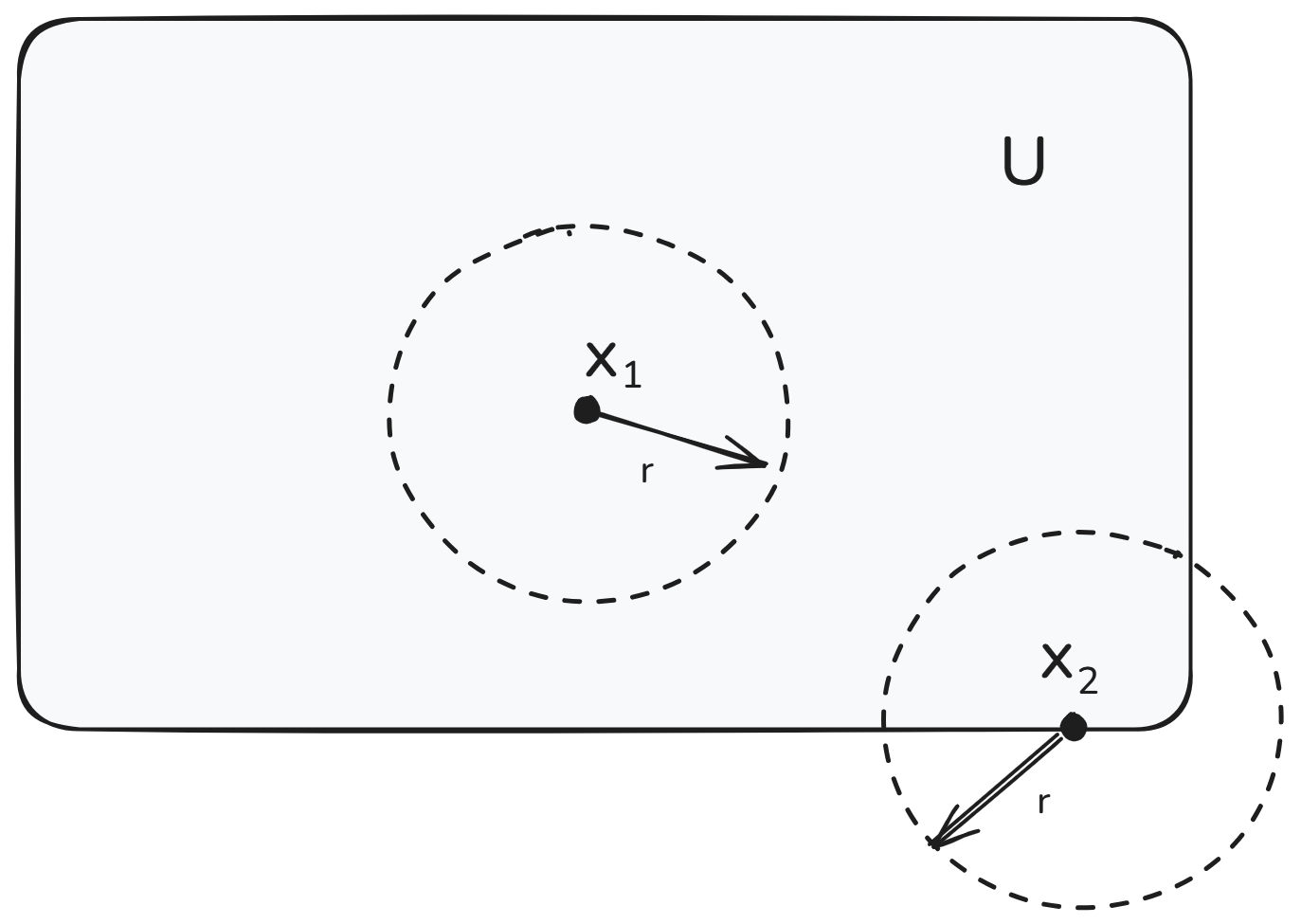
Figure 1: Illustration of open neighborhoods in a topological space, distinguishing interior and boundary points.
Vector Spaces, Norms, Metrics, and Inner Products
The exposition of vector spaces is rigorous, eschewing naive geometric or array-based definitions in favor of abstract algebraic properties. The hierarchy from normed spaces to metric spaces to inner product spaces is developed, with explicit axiomatic definitions and examples. The text clarifies the distinction between norms and metrics, and the conditions under which a norm is induced by an inner product (parallelogram law). The role of inner products in encoding similarity and enabling orthogonality is emphasized, with direct relevance to attention mechanisms and latent space geometry in deep learning.
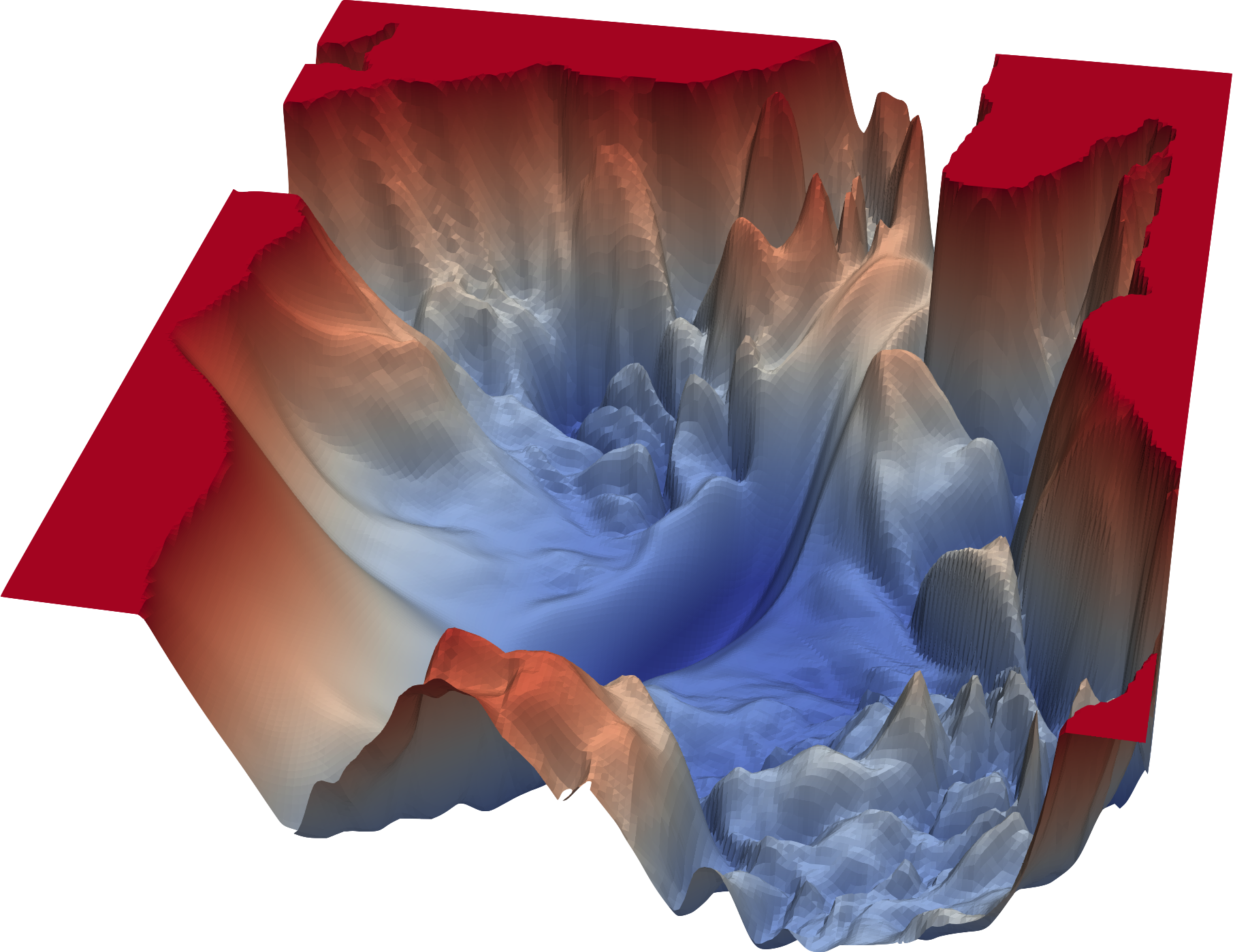
Figure 2: Example loss landscape visualization for a neural network.
Topology and Differential Geometry: Manifolds and Riemannian Structure
The treatise provides a formal introduction to topology, open sets, and topological spaces, followed by a detailed account of manifolds, charts, atlases, and transition maps. The distinction between topological, smooth, and Riemannian manifolds is made explicit, with careful attention to the requirements for differentiability and metric structure. The text discusses tangent spaces, bundles, and the exponential/logarithmic maps, which are essential for defining local linearizations and geodesic flows on manifolds.
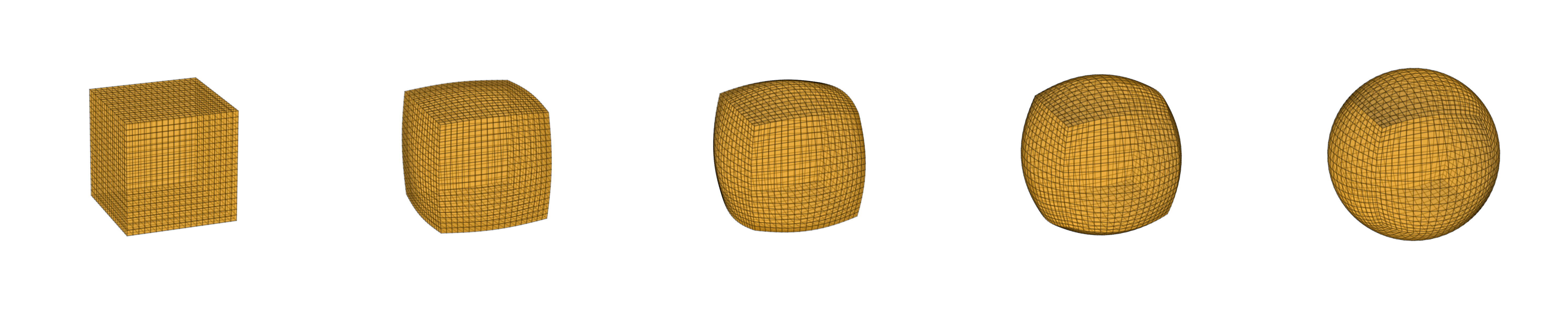
Figure 3: The cube and the sphere are homeomorphic, illustrating topological equivalence via continuous deformation.
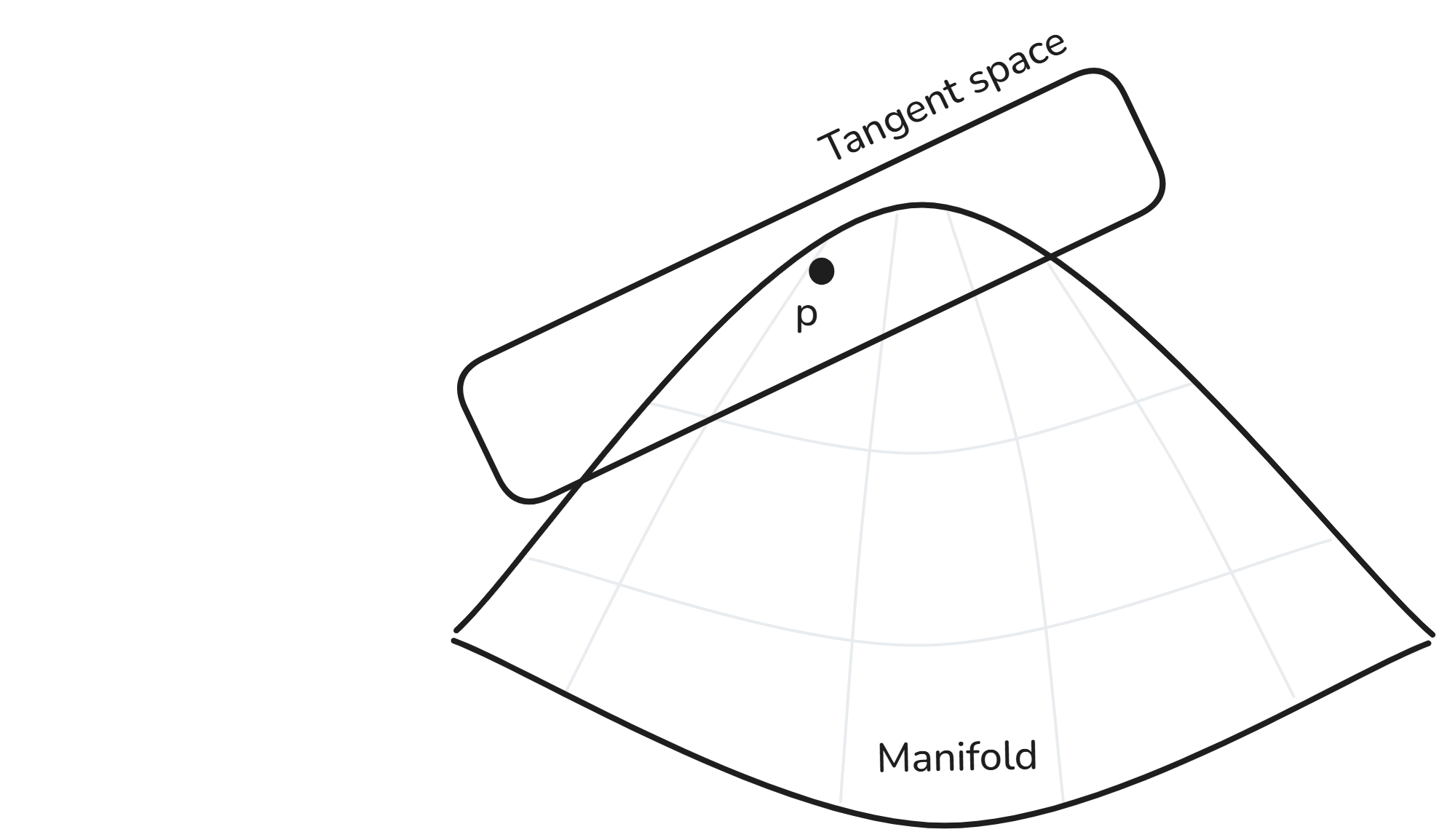
Figure 4: Illustration of the tangent space TpM at a point p on a manifold.
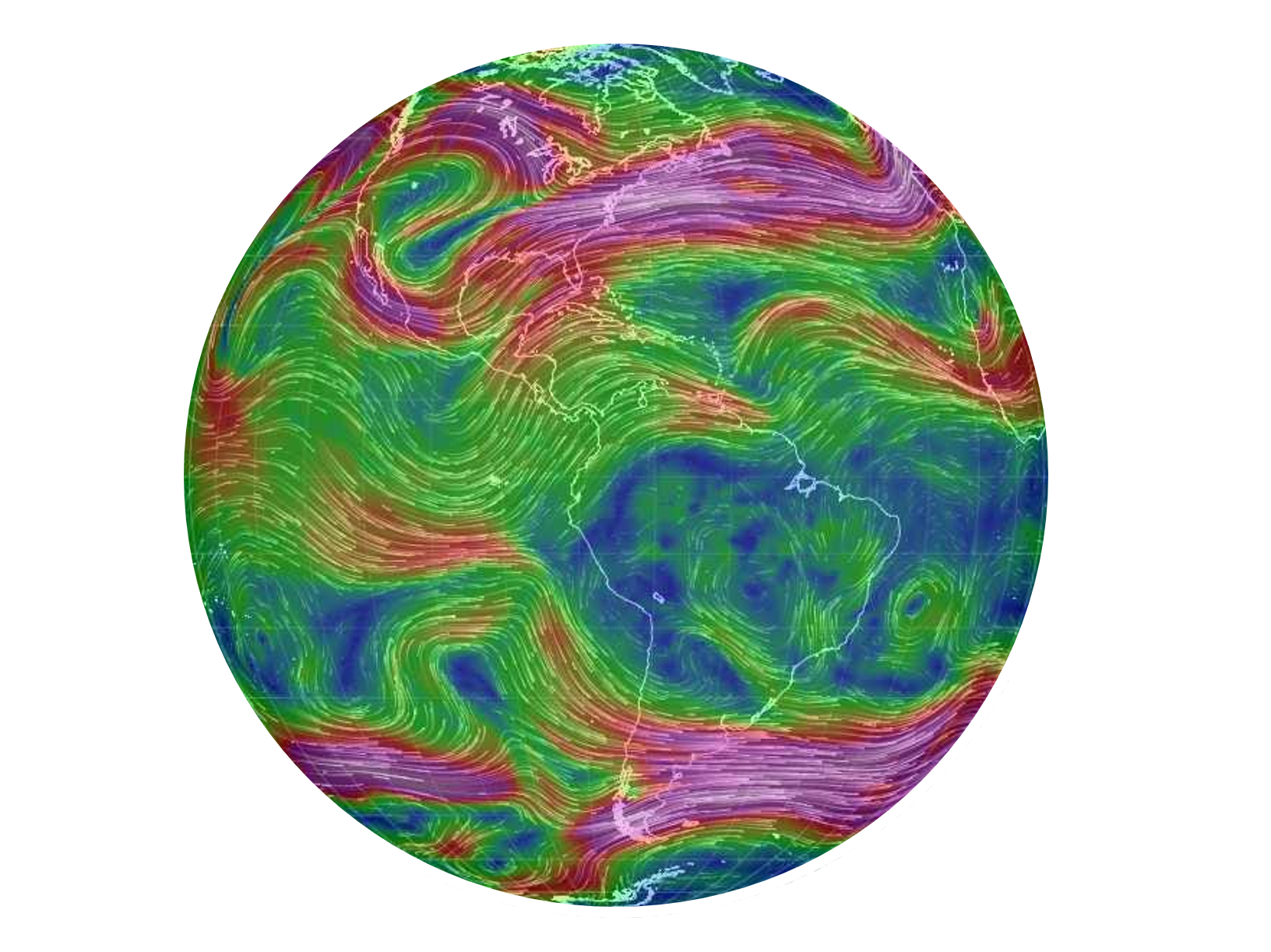
Figure 5: The sphere as a Riemannian manifold, locally Euclidean, supporting functions such as atmospheric pressure or wind velocity.
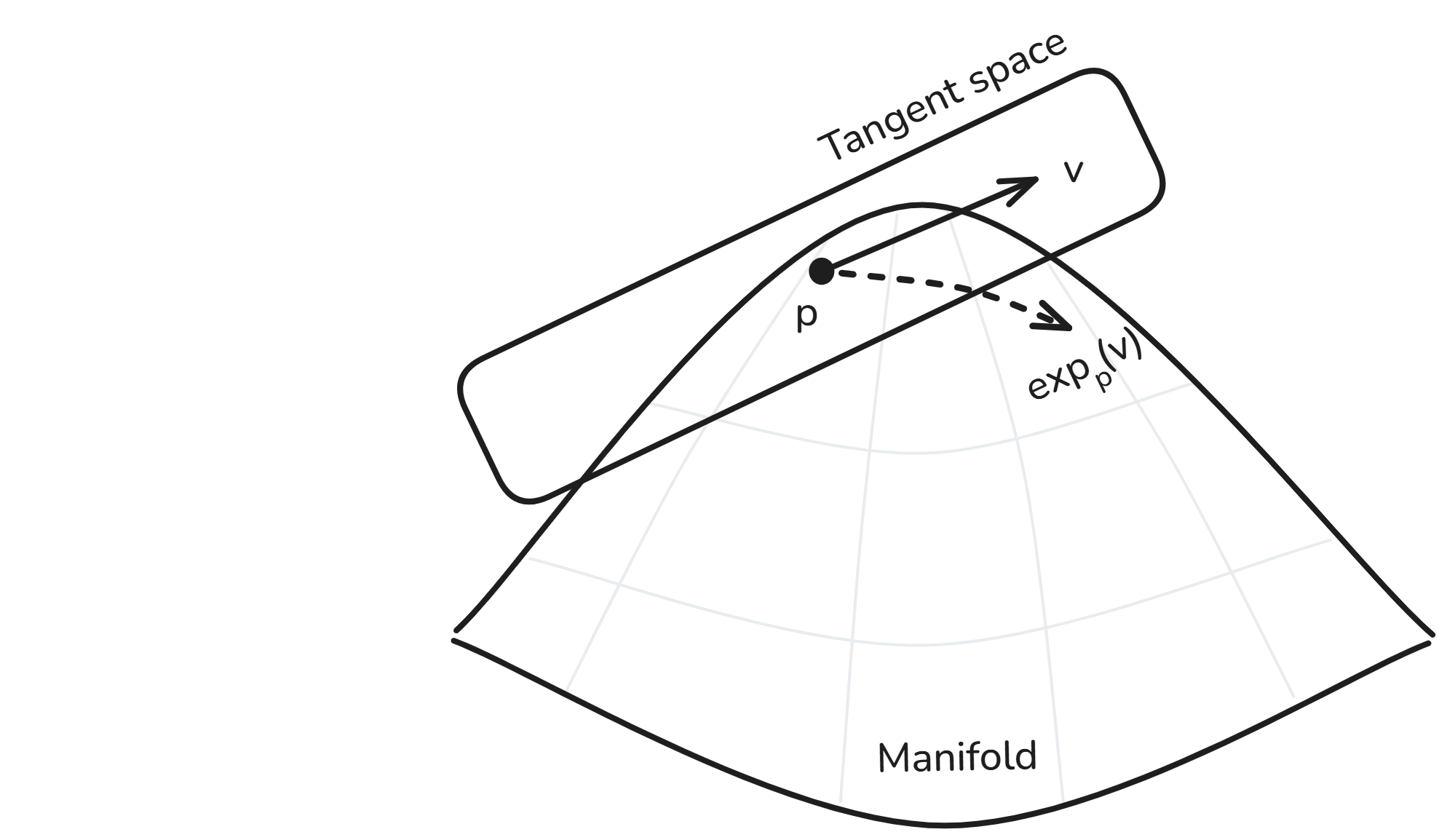
Figure 6: The exponential map expp mapping a tangent vector v at p to a point on the manifold via geodesic flow.
Functional Analysis and Spectral Theory
The text transitions to functional analysis, introducing Banach and Hilbert spaces, completeness, and orthonormal bases. The spectral theorem for compact self-adjoint operators is stated and proved, with emphasis on the orthogonality and real-valuedness of eigenfunctions. The connection to Fourier analysis is made explicit, with Parseval's identity and the decomposition of functions into orthonormal bases. The treatment of singular value decomposition generalizes spectral analysis to non-self-adjoint operators, with clear distinction between eigenvalues and singular values.
Graph Theory and Discrete Geometric Structures
The final sections provide a thorough account of graph theory, including definitions of graphs, adjacency matrices, connectivity, regularity, and geometric graphs. The text details the construction of the graph Laplacian, its spectral properties, and the interpretation of eigenvectors as graph Fourier bases. The message-passing framework for GNNs is formalized, with explicit update rules and the requirement for permutation-invariant aggregation. The role of group theory in graph isomorphism and the Weisfeiler-Lehman test is discussed.
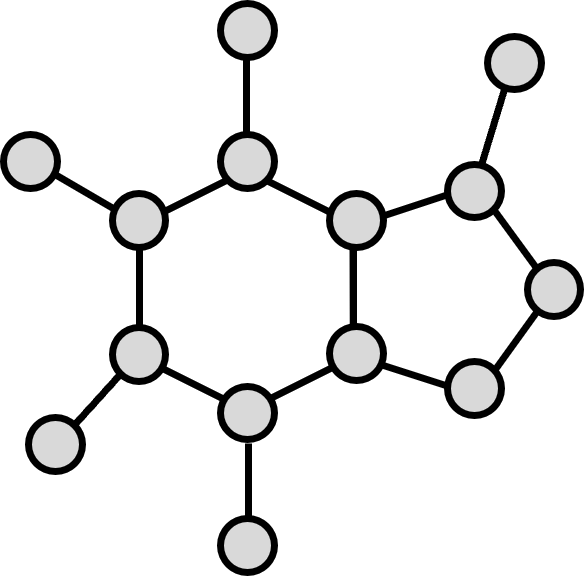
Figure 7: Diagram of a graph with nodes and edges, illustrating discrete connectivity.
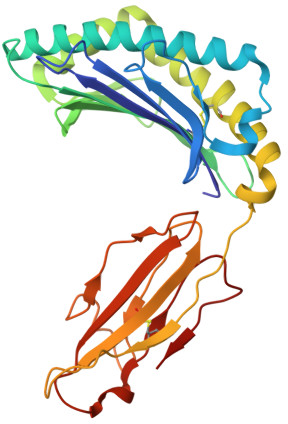
Figure 8: Geometric graphs as abstractions of biomolecules, with nodes representing atoms and edges proximity-based interactions.
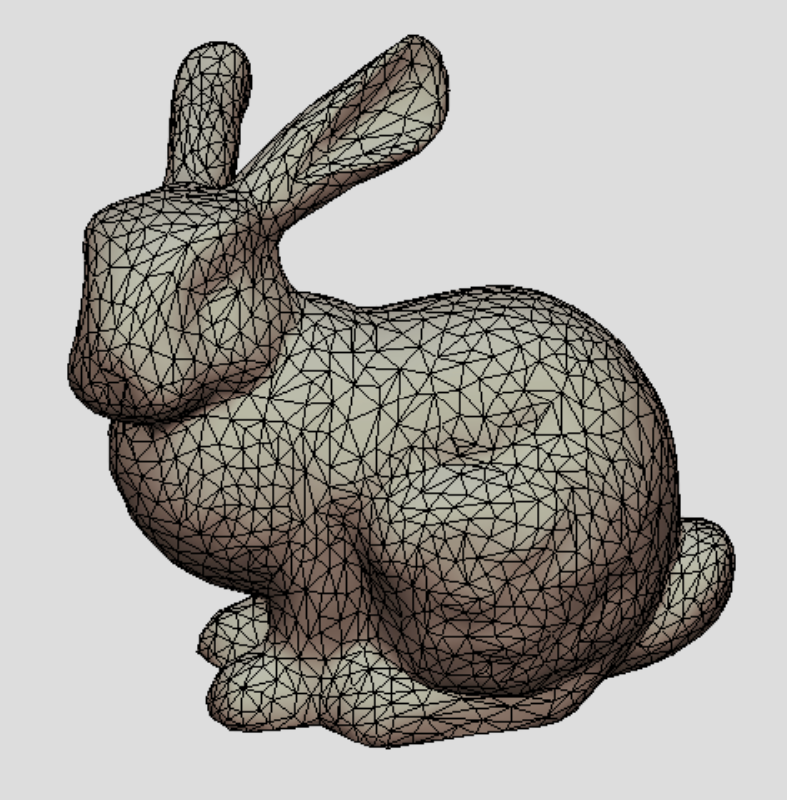
Figure 9: The Stanford Bunny mesh, a canonical 3D test model in computer graphics.

Figure 10: The Weisfeiler-Lehman test for graph isomorphism via iterative neighborhood aggregation.
Strong Claims and Numerical Results
The paper makes several strong claims:
- The spectral theorem for compact self-adjoint operators guarantees a countable, discrete spectrum with orthonormal eigenfunctions forming a basis of the Hilbert space.
- The Laplacian operator is rotation-invariant, as shown via the trace of the Hessian and orthogonal transformations.
- The manifold hypothesis is stated as an empirical observation, not a theorem, with the caveat that real-world data manifolds may lack smoothness or consistent local dimensionality.
- Permutation-invariant aggregation is necessary for graph-level pooling and isomorphism-invariant representations.
Numerical results are primarily illustrative, such as the loss landscape visualization and explicit calculations of graph diameters and shortest paths.
Practical and Theoretical Implications
Practically, the mathematical formalism enables the principled design of neural architectures that respect the intrinsic geometry and symmetry of data domains. The explicit construction of equivariant and invariant operators via group actions, the use of spectral methods for graph signal processing, and the embedding of latent representations into non-Euclidean manifolds (e.g., Poincaré ball) are directly applicable to state-of-the-art models in computer vision, computational biology, and generative modeling.
Theoretically, the synthesis of algebraic, geometric, and topological structures provides a unified framework for understanding the expressivity and limitations of deep learning models. The connection between functional analysis, spectral theory, and neural network optimization (e.g., loss landscapes, gradient descent) is made explicit, enabling rigorous analysis of convergence, generalization, and representation learning.
Future Directions
The text suggests several avenues for future research:
- Extension of GDL architectures to higher-order topological structures (e.g., simplicial complexes, sheaves).
- Development of gauge-equivariant operators for learning on manifolds with arbitrary local coordinate systems.
- Investigation of the manifold hypothesis in real-world datasets, including empirical validation of local Euclidean structure and dimensionality.
- Application of spectral methods to irregular domains, including non-homophilic graphs and non-smooth manifolds.
Conclusion
"Mathematical Foundations of Geometric Deep Learning" offers a rigorous, systematic account of the mathematical structures underlying GDL, bridging abstract theory and practical implementation. The text is essential reading for researchers seeking to design, analyze, and deploy neural architectures on complex geometric domains, and provides a solid foundation for future advances in AI, representation learning, and computational geometry.
Paper to Video (Beta)
No one has generated a video about this paper yet.
Whiteboard
No one has generated a whiteboard explanation for this paper yet.
Paper Prompts
Sign up for free to create and run prompts on this paper using GPT-5.
Top Community Prompts
Open Problems
We haven't generated a list of open problems mentioned in this paper yet.
Continue Learning
- How do algebraic structures contribute to the design of geometric deep learning architectures?
- What are the implications of differential geometry concepts on neural network performance in non-Euclidean spaces?
- In what ways does spectral theory inform the development of efficient graph neural networks?
- How can the manifold hypothesis be empirically validated for real-world datasets with irregular geometry?
- Find recent papers about invariant neural networks.
Related Papers
- Geometric Deep Learning: Grids, Groups, Graphs, Geodesics, and Gauges (2021)
- Geom-GCN: Geometric Graph Convolutional Networks (2020)
- Mathematical Introduction to Deep Learning: Methods, Implementations, and Theory (2023)
- Geometric deep learning: going beyond Euclidean data (2016)
- On the Expressive Power of Geometric Graph Neural Networks (2023)
- Hyperbolic Graph Neural Networks (2019)
- Beyond Euclid: An Illustrated Guide to Modern Machine Learning with Geometric, Topological, and Algebraic Structures (2024)
- Sheaf theory: from deep geometry to deep learning (2025)
- Riemannian Metric Learning: Closer to You than You Imagine (2025)
- Categorical and geometric methods in statistical, manifold, and machine learning (2025)
Authors (2)
Collections
Sign up for free to add this paper to one or more collections.
Tweets
Sign up for free to view the 10 tweets with 841 likes about this paper.
alphaXiv
- Mathematical Foundations of Geometric Deep Learning (37 likes, 0 questions)