- The paper reveals that systemic biases and cultural barriers, rather than a lack of talent, drive high attrition rates in astrophysics.
- It employs mixed methodologies, combining quantitative analysis and qualitative narratives to detail disparities in evaluations, resource allocation, and recognition.
- The study recommends actionable reforms in hiring, mentorship, and family-support policies to foster inclusion and improve retention.
Best Practices for Retaining Talent in Astrophysics: An Expert Essay on "Picture an Astronomer" (2512.24465)
Introduction and Rationale
"Picture an Astronomer: Best Practices for Retaining Talent in Astrophysics" (2512.24465) presents a multifaceted, rigorously referenced examination of attrition, retention, and inclusion within the discipline of astronomy. Primarily focused on the compounded impacts of gender, race, socioeconomic status, disability, and sexual orientation, the white paper synthesizes empirical research, community dialogue from the Picture an Astronomer symposium, and the lived experience of over 80 contributing astrophysicists. Through analysis of both large-scale quantitative studies and qualitative narratives, the work challenges prevailing "pipeline" paradigms and instead positions systemic barriers—cultural, structural, and practical—as key impediments to equity in astronomy.
Factors Underlying Talent Attrition
The paper identifies multiple, interacting axes of exclusion and attrition for historically marginalized groups, with a primary emphasis on women, people of color, disabled individuals, and LGBTQ+ astronomers. Attrition is not explained by a lack of interest or intrinsic ability; rather, data confirm that well-documented social and institutional mechanisms drive disproportionate loss at every career stage. Among the evidence:
- Stereotypes about the necessity of innate "brilliance" in physics and astronomy (see Leslie et al. 2015) dissuade high-achieving women and minorities from pursuing these fields, beginning in early childhood and accelerating through educational transitions.
- Persistent implicit and explicit biases pervade student evaluations, faculty hiring, grant review, professional recognition, and everyday academic interactions (see Moss-Racusin et al., 2012; Caplar et al., 2017; Madera et al., 2019).
- Women and underrepresented groups bear disproportionate burdens of administrative and service work—often undervalued and less visible for consideration in promotion and hiring (see Hanasono et al., 2019; OMeara et al., 2017).
- Parental and caregiving responsibilities, particularly related to family formation and the "motherhood penalty," directly reduce retention and productivity for women, with intensified impact for women of color (see Cech & Blair-Loy, 2019).
- Systemic inaccessibility and lack of accommodations create additional barriers for disabled astronomers, with dramatic decrease in participation at every academic transition (Figure 1).
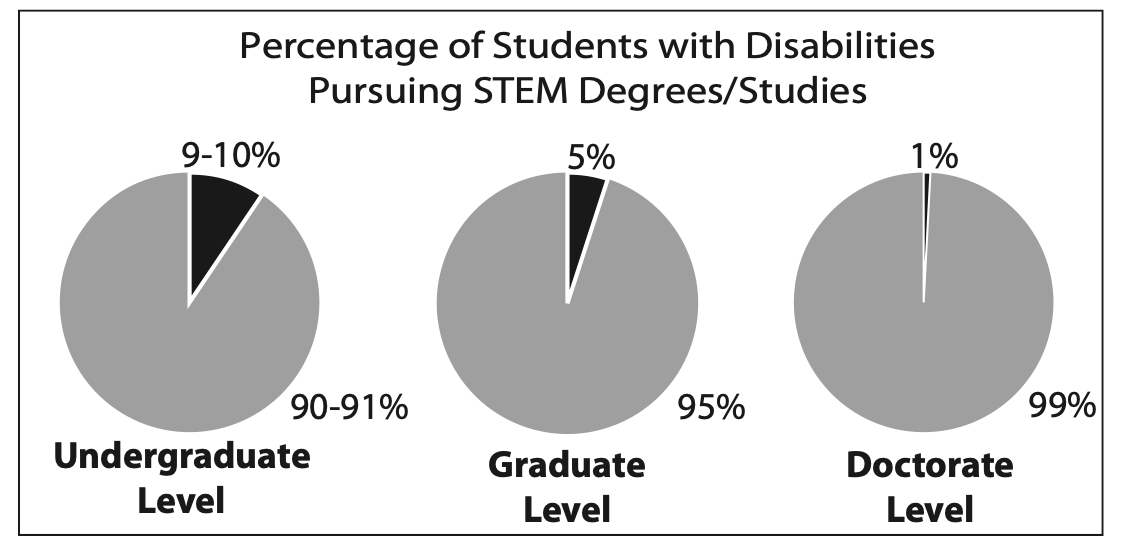
Figure 1: A pie chart showing the percentage of students with disabilities in STEM. At undergraduate level, the percentage varies from 9 to 10%, at graduate level it is 5%. Only 1% of STEM doctorate students are disabled, showing that the fraction systematically decreases.
Structural Bias and Perception in Academic Astronomy
The insidiousness of gender and intersectional bias is analyzed through statistical studies, experimental evidence, and first-person accounts. Significant findings include:
- Controlled audits of application reviews find that identical CVs and proposals are rated lower for perceived competence, hireability, and salary when a female name is used (Moss-Racusin et al., 2012; Eaton et al., 2020).
- Non-anonymized telescope proposal competitions systematically award less time and lower grades to women, independent of scientific quality; dual-anonymous review eliminates this disparity (Johnson & Kirk, 2020; Caplar et al., 2017).
- Women-led projects and diverse teams produce more novel and impactful science, yet receive less recognition and fewer citations (Yang et al., 2022; Yang et al., 2024; Hofstra et al., 2020).
- Letters of recommendation for women are persistently more likely to contain "grindstone" and doubt-raising descriptors rather than standout language, which negatively impacts placement (Dutt et al., 2016; Eberhardt et al., 2023).
- The impostor phenomenon is significantly higher for women and minority scientists, especially in fields perceived to require brilliance, contributing to lower persistence and satisfaction (Muradoglu et al., 2022).
The Role of Representation and Stereotype Threat
The authors demonstrate that visible representation of women and minorities is critical for retention, with the absence of identity-matched role models leading to decreased sense of belonging and academic self-concept. Stereotype threat and its psychological consequences—including performance decrements and disengagement—are evidenced not only in students but across faculty ranks.
- Effective counterspaces and mentoring programs foster increased belonging and buffer against stereotype threat.
- Growth mindset and mastery-based evaluation, as opposed to brilliance- or weed-out-framed assessment, are associated with improved outcomes for underrepresented groups.
- Intersectionality is emphasized, with data showing that individuals at the convergence of multiple marginalized identities are at highest risk for exclusion, harassment, and burnout (Clancy et al., 2017).
Resource Disparities, Workload Inequities, and Recognition
The analysis identifies persistent disparities in access to essential resources:
- Women in academia receive smaller grants, less space, and lower base and supplemental salaries even after controlling for rank and discipline (Kim et al., 2024).
- Service loads are heavier for women and especially for women of color, often comprising "invisible labor" necessary for departmental functions, but less valued in evaluations (Hanasono et al., 2019; Trejo, 2020).
- Self-promotion carries differential penalty for women and marginalized scientists, contributing to both lower objective visibility and subjective perceptions of competence (Peng et al., 2025; Exley & Kessler, 2022).
- Structural and behavioral barriers to negotiation (including social penalties for assertiveness) further entrench inequalities originating at hiring (Mazei et al., 2015; Bowles et al., 2007).
Parenthood, Family Expectations, and Retention
A substantial portion of the gender gap in astronomy is attributed to the "motherhood penalty" and the lack of institutional policies accommodating family formation:
- Parental responsibilities (especially for mothers) correspond to large productivity penalties, delayed career milestones, and disproportionately drive mid-career women out of academia (Cech & Blair-Loy, 2019; Morgan et al., 2021).
- Standard academic timelines and recurrent relocations pose particular disadvantages for parents, especially early-career astronomers who lack support networks.
- The existence of pro-family policies does not guarantee usage: social stigma and cultures of overwork deter parents, particularly mothers, from taking advantage of such accommodations.
Bullying, Harassment, and the Need for Community-Level Accountability
Incidents of bullying, harassment, and discrimination are shown to be prevalent, particularly for women, URM, LGBTQ+, and disabled astronomers. These behaviors are enabled by insufficient accountability structures and by power imbalances entrenched in hierarchical academic cultures.
- Codes of conduct, systematic onboarding, bystander training, robust and transparent reporting pathways, and resource sharing are highlighted as critical interventions.
- The paper advocates for disciplinary-level hotlines, clear guidelines for letter writers, and mechanisms to support individuals who are targets of harassment.
Disability, Accessibility, and Structural Exclusion
The review underscores the stark diminishment of disabled representation from undergraduate through faculty stages (see Figure 1 above), rooted in physical inaccessibility, poorly executed or absent accommodations, and stigmatization—especially for non-apparent disabilities. Best practices include universal design principles in pedagogy, transparent accommodation procedures, and explicit training for staff and faculty.
Recommendations: Interventions and Policy Changes
Recommendations are comprehensive and pragmatic, reflecting both structural and cultural imperatives:
- Hiring and Evaluation: Dual-anonymous review, standardized rubrics, delayed consideration of potentially biased components (e.g. letters), and periodic anti-bias training for all evaluators.
- Resource Allocation: Increased transparency in salary and resource offers, negotiation training, formal mentorship programs, and support for self-advocacy.
- Workload Equity: Departments must make advising, service, and teaching expectations explicit and monitor service loads to ensure parity and accountability.
- Family Support: Accessible flexible work arrangements, protected leave, prioritized on-campus childcare, and support for partner hiring.
- Inclusion and Accessibility: Prioritization of accessibility in all events and meetings, active support for disabled astronomers, and intersectional approaches to DEI.
- Culture and Climate: Distributed service and leadership, periodic assessment, and active bystander training. Senior leaders are charged with modeling and enforcing inclusion.
Implications and Theoretical Considerations
The persistent attrition and under-recognition of marginalized groups in astronomy are not explained by talent distribution, motivation, or performance. Rather, they are outcomes of cumulative, interacting biases and institutional inertia. The paper's synthesis implies that interventions focusing solely on "increasing the pipeline" or individual resilience will be insufficient. Instead, achieving equity—and retaining talent—demands discipline-wide accountability, transparent data, and policies that address structural as well as interpersonal dynamics.
The findings are highly relevant beyond astronomy, providing a replicable blueprint for other STEM disciplines grappling with similar disparities. Moreover, the documentation of measurable productivity and innovation advantages in gender-diverse, inclusive research teams (Yang et al., 2022; Hofstra et al., 2020) refutes productivity-based opposition to equity measures.
Future Directions
Ongoing research should focus on:
- Longitudinal tracking of the impact of anonymized review and hiring interventions.
- Experimentation with alternative evaluation metrics that de-emphasize output gaps known to reflect cumulative bias.
- Systematic collection and analysis of intersectional demographic data to monitor progress and identify remaining barriers.
- Development of discipline-wide structures for reporting, tracking, and intervening in cases of harassment and bullying.
The successful implementation of these recommendations will require collaboration across institutions, professional societies, and funding agencies. Lessons learned in astronomy may serve as valuable precedents for broader reform in academia and science.
Conclusion
"Picture an Astronomer" (2512.24465) provides a comprehensive, evidence-based roadmap for retaining diverse talent in astrophysics. The paper's rigorously documented analysis reveals the persistence of multiple forms of bias, exclusion, and undervaluation, but also the efficacy of actionable, tested reforms. Institutional leaders, departments, and individual astronomers are collectively accountable for building a culture in which all talented scientists can thrive, innovate, and contribute fully to the progress of astronomy. Structural change—not solely individual adaptation—is both necessary and achievable for the field to approach true meritocracy and scientific excellence.