- The paper introduces a novel hybrid qubit design that leverages semiconductor–superconductor interfaces to enable gate-tunable Josephson coupling and enhanced coherence.
- The paper employs advanced epitaxial growth and nanofabrication techniques to realize high-transparency devices with sub-kHz charge dispersion and robust parity lifetimes.
- The paper outlines pathways toward topologically protected qubits by utilizing engineered Andreev bound states and minimal Kitaev chains for fault-tolerant quantum computation.
Hybrid Qubits in Semiconductor–Superconductor Nanostructures: Architectures, Materials, and Topological Prospects
Introduction and Motivation
Hybrid semiconductor–superconductor qubits present a synthetic and tunable platform that integrates the advantageous properties of both spin qubits and superconducting circuits. This architecture exploits gate-tunable Josephson coupling, enabling voltage-driven control over the quantum degree of freedom and the engineering of novel superconducting devices with microscopic, mesoscopic, or even macroscopic ground states. The hybrid approach provides a complementary path to mitigate critical limitations in conventional qubit modalities—spin qubits suffer from slow long-range coupling and difficult readout, while superconducting qubits are restricted by charge noise and leakage to higher-energy states due to low anharmonicity.
The integration between the small-footprint, long-coherence-time properties of semiconductor-based quantum dots with superconducting coherence and circuit quantum electrodynamics (cQED) readout leads to new device modalities, including topologically protected states and Hamiltonian-protected qubits. The landscape of these hybrid qubits has rapidly expanded, based on advancements in nanofabrication, epitaxial interface engineering, and robust theoretical modeling of subgap states and their interactions with the electromagnetic environment.
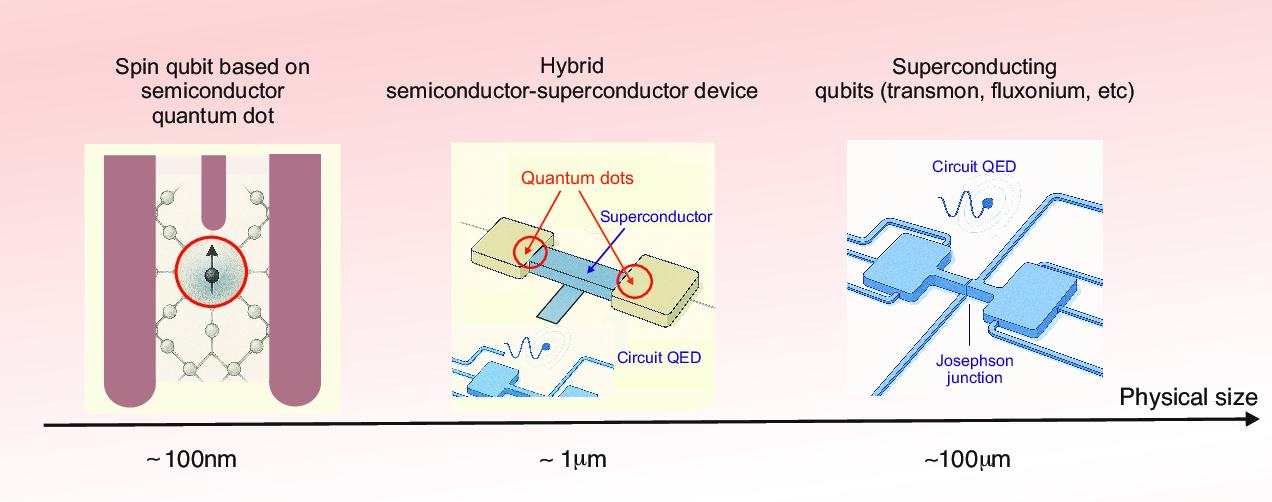
Figure 1: Schematics of solid-state qubit platforms. Red—spin qubits (semiconductor quantum dots); blue—superconducting qubits; middle—hybrid devices discussed herein, such as quantum dot arrays coupled to superconductors, achieving a trade-off between footprint and cQED compatibility.
Fundamentals of Superconducting Circuits and Subgap Nanostructures
Superconducting circuits (e.g., charge qubits, transmons, flux qubits, fluxoniums) are modeled by Josephson junction Hamiltonians parameterized by Josephson energy EJ and charging energy EC. The Cooper pair box and transmon qubits encode information in collective voltage or phase degrees of freedom, while the addition of flux quantization (through loops and large inductors) leads to flux and fluxonium qubits. A crucial ingredient is the coupling of these circuits to microwave resonators for cQED, enabling fast, dispersive readout and high-fidelity gate operations.
Phase-coherent transport through superconducting weak links results in the formation of subgap Andreev bound states (ABSs), Yu–Shiba–Rusinov states in the presence of strong Coulomb blockade or magnetism, and highly harmonic Josephson potentials. The spectral dispersion of ABSs plays a central role in advanced circuit designs and in the physics of protected qubits—enabling higher-order Josephson harmonics, cos(nϕ), which can be exploited for realizing π-periodic Josephson elements, or Hamiltonian protection against noise.
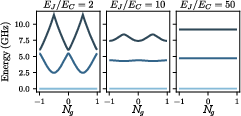
Figure 3: Energy-level splitting of the Cooper pair box versus offset charge, modulated by the ratio EJ/EC. At high EJ/EC, transition frequencies become charge-insensitive, suppressing charge noise sensitivity (transmon regime).
Materials Science of Hybrid Superconductor–Semiconductor Systems
The realization of high-coherence hybrid qubits rests on advancements in epitaxial growth of semiconductor quantum wells and nanowires with low-disorder, chemically abrupt superconductor–semiconductor interfaces. Molecular beam epitaxy (MBE) allows for precise engineering of InAs, InSb, or Ge quantum wells, coupled to superconductors such as Al, Sn, Pb, or NbTiN.
Interface transparency and the proximity-induced superconducting gap, as well as material parameters like spin–orbit coupling (SOC) strength and g-factor, are critical. For instance, maximizing the Zeeman energy at moderate magnetic fields—without suppressing superconductivity—requires engineering highly imbalanced g-factor heterostructures (e.g., InAs/Al). The development of ternary InAsSb alloys and platforms such as Ge/SiGe or InSbAs/Al, with atomically-flat interfaces, enables robustness against disorder, high critical fields, and strong gate-tunability.
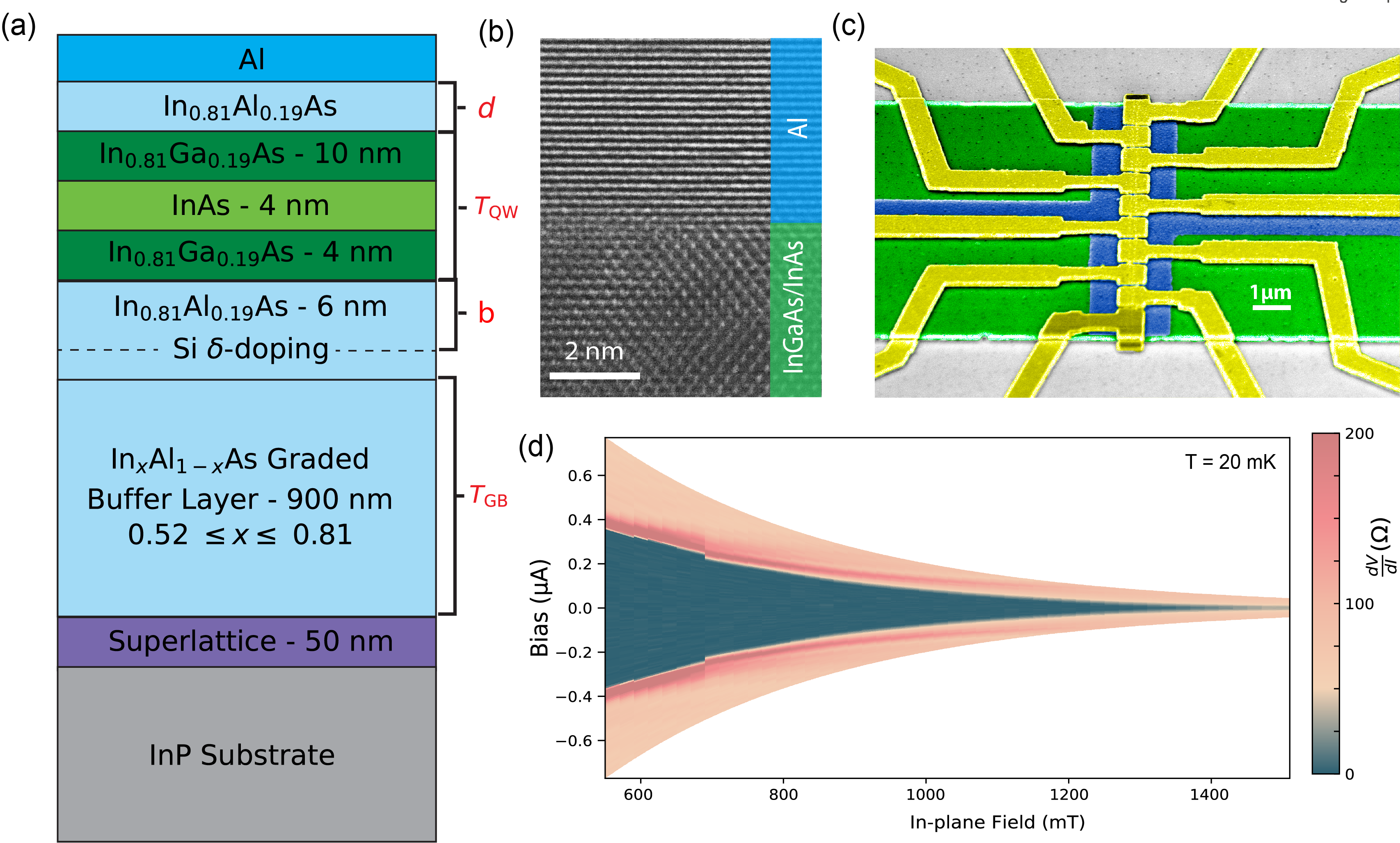
Figure 2: Atomically clean superconductor–semiconductor interface with InGaAs/InAs quantum well and epitaxial Al, leading to a hard induced gap and large in-plane critical fields.
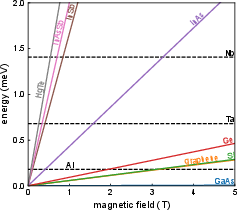
Figure 6: Zeeman energy for different semiconductors compared to the superconducting gap of contact metals, demonstrating selective materials design for large spin-splitting in the semiconductor at magnetic fields where superconductivity is preserved.
Subgap Bound States, Andreev Physics, and Measurement
Tunable Josephson coupling in hybrid nanostructures arises from coherent mixing of ABSs, routinely engineered and detected via tunneling spectroscopy and cQED microwave readout. The interplay between Coulomb repulsion (U), induced gap (Δ), and dot-lead coupling (Γ) defines quantum phase transitions between singlet and doublet ground states, with observable quantum criticality in the ABS spectrum. Spin–orbit coupling and noncollinear Zeeman fields induce spin splitting of the ABSs, enabling encoding and manipulation of spin qubits within subgap manifolds.
Modern experiments rely on both charge-sensing and fast microwave reflectometry for state readout. Highly coherent operation requires suppressing quasiparticle poisoning and charge noise, both of which scale favorably with interface cleanness and high transmission.
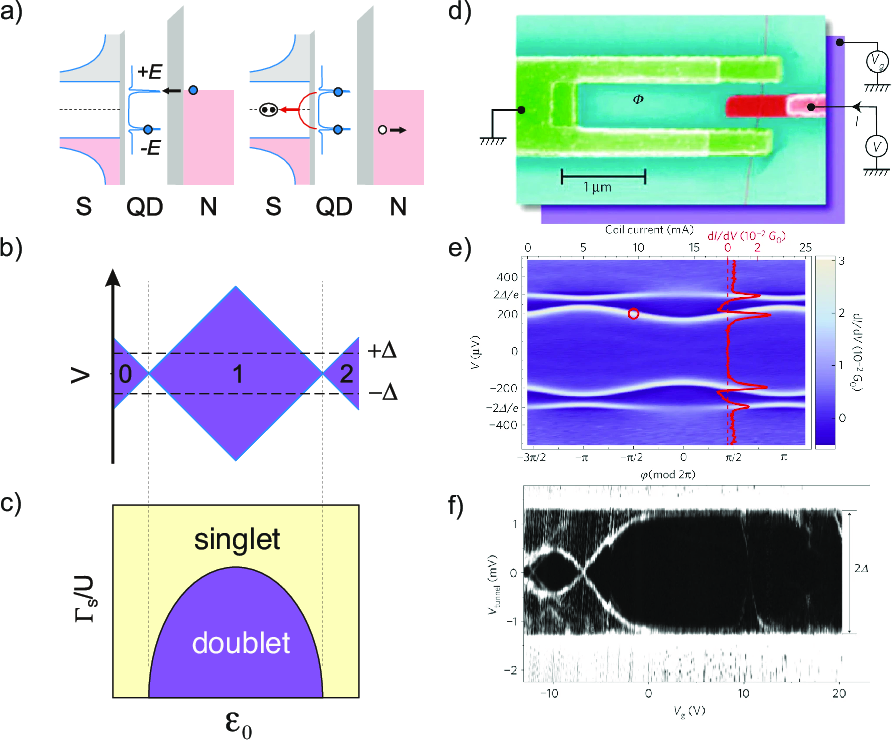
Figure 8: Spectroscopy of ABSs in a quantum dot–superconductor system, with phase and gate-tunable transitions between singlet and doublet ground states, and associated measurements of dI/dV.
Hybrid Qubit Architectures
Gate-tunable Qubits: Gatemons and Gatemoniums
By replacing conventional tunnel junctions with gate-tunable semiconductor–superconductor Josephson elements, one achieves gatemons and flux-gatemonium qubits, with frequencies tuned electrostatically rather than magnetically. Device modalities include nanowire-based junctions, 2D van der Waals structures, and planar quantum wells. In the high-transparency limit, hybrid junctions exhibit strongly reduced charge dispersion and lower anharmonicity, with observed charge dispersion below $1$ kHz and coherence times competitive with or exceeding conventional transmons, especially at high magnetic fields.
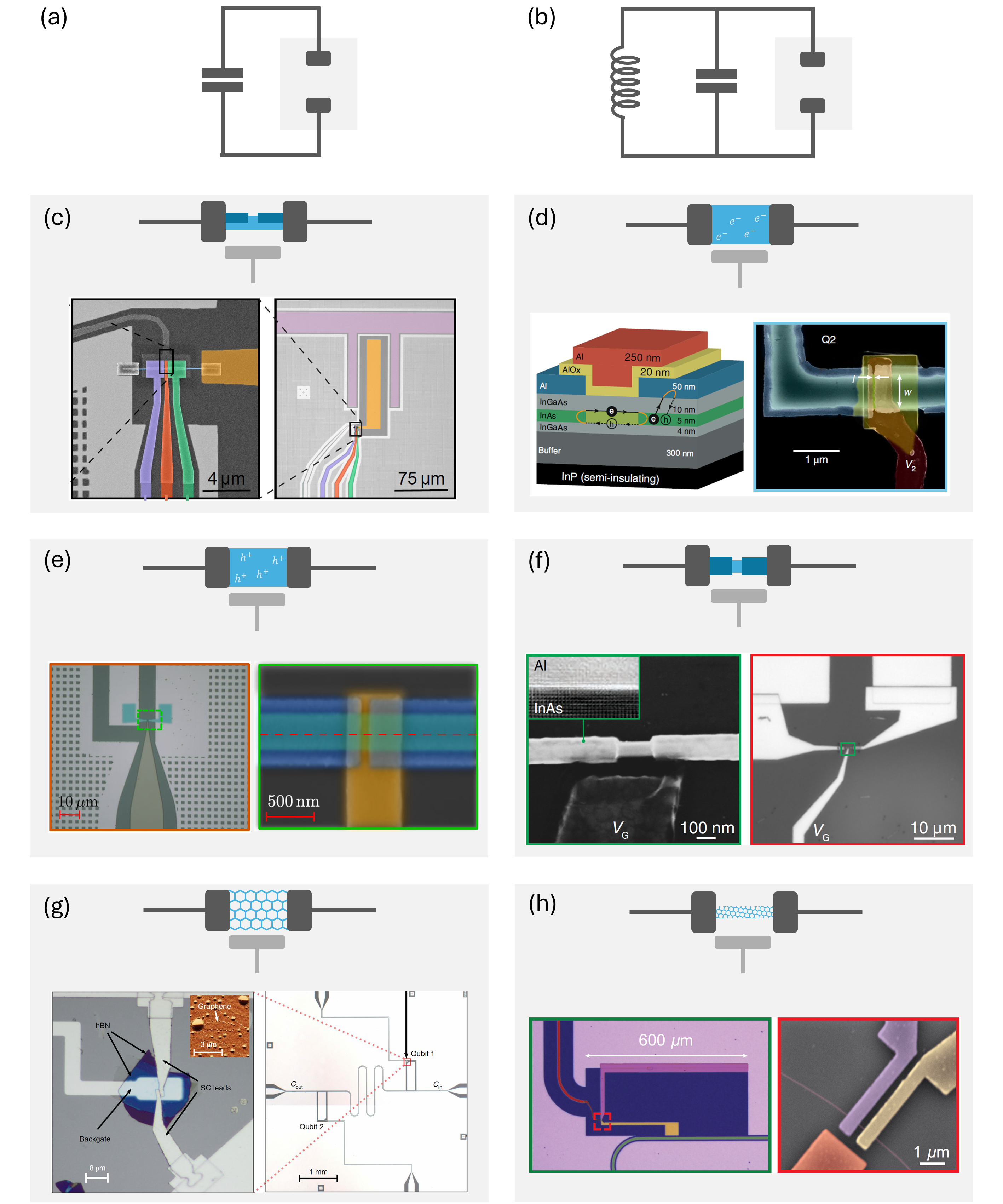
Figure 10: Circuit diagrams for gatemon and gate-tunable fluxonium, with a semiconducting Josephson weak link. Panels (c)-(h) show nanostructures used as weak links in literature.
Hamiltonian-Protected and Andreev Qubits
Architectures exploiting higher Josephson harmonics (e.g., cos(2φ)) are now realized in hybrid interferometers using high-transparency Josephson junctions frustrated at half-integer flux, or in modular arrays of such elements for passive error protection. Additionally, explicit encoding in localized Andreev bound states—Andreev level qubits (ALQs)—enables time-domain manipulation and coherent control at the level of single quantum states, validated by Rabi oscillation, Ramsey interference, and strong cQED coupling.
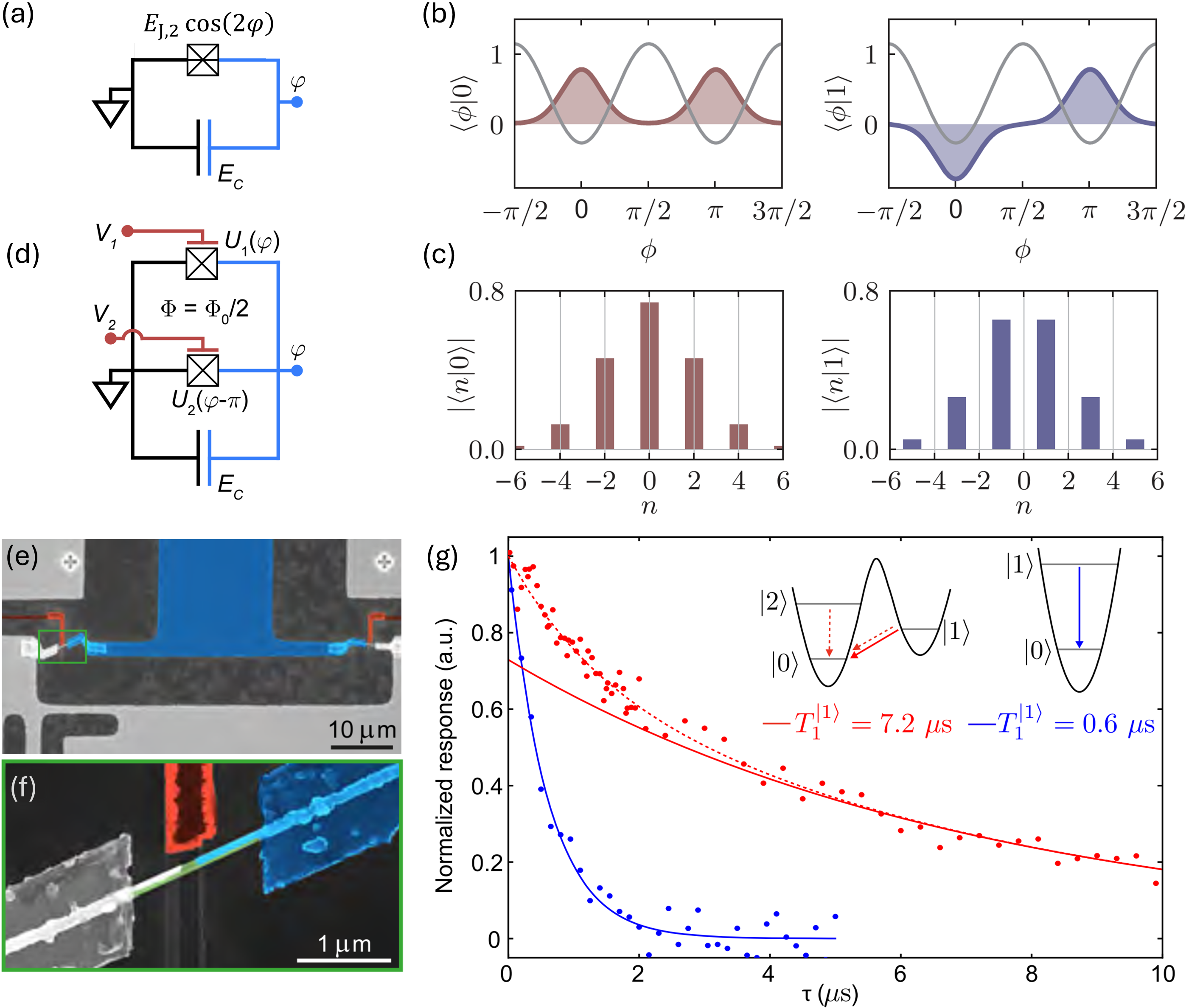
Figure 12: Schematic for a Hamiltonian-protected cos(2φ) qubit, with wavefunctions delocalized in charge and phase space.
Parity Qubits and Majorana-Based Protocols
With recent breakthroughs in engineering minimal arrays of coupled quantum dots (minimal Kitaev chains), hybrid devices now enable the realization and braiding of spatially separated Majorana zero modes (MZMs), nonlocal fermionic parity qubits, and the investigation of their topological protection, error rates, and exchange statistics. Single-shot parity readout protocols via quantum capacitance or interferometric measurements have demonstrated ms-scale parity lifetimes and high-fidelity state discrimination.
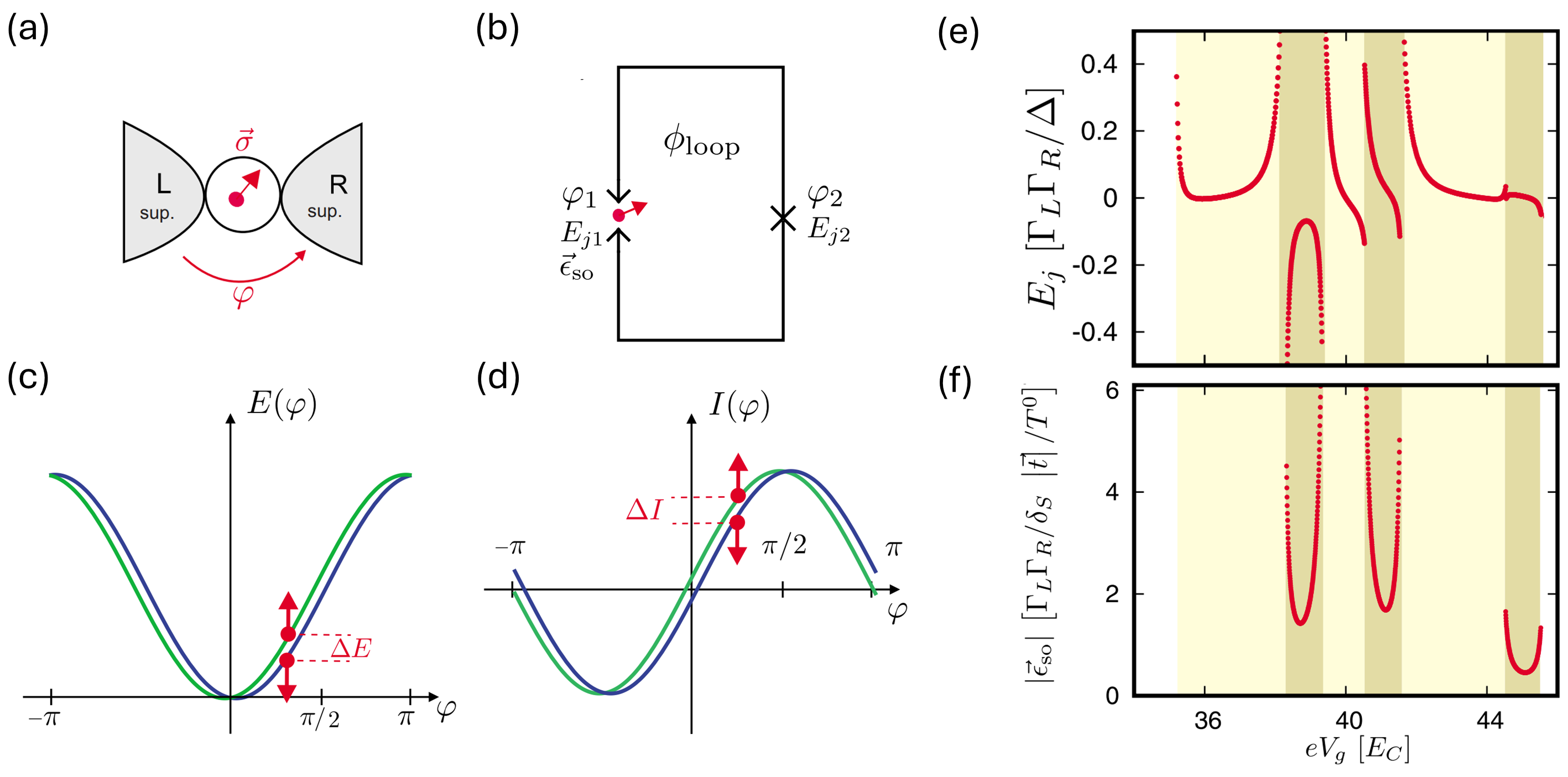
Figure 4: Model for an Andreev spin qubit based on a superconductor–quantum dot–superconductor junction, with explicit dependence of the ABS spectrum on superconducting phase and spin.
Topological quantum computing architectures are within reach with bottom-up scalable minimal Kitaev chains, gate-tunable networks of quantum dots, and multiterminal Josephson junctions exploiting high-spin–orbit-coupling materials. Majorana-based parity qubits leverage the nonlocality of the topological ground state for noise resilience, and recent experiments have demonstrated protected quantum information processing primitives (parity locking, fusion, and projective measurement), with control over system size, gap protection, and correlated error mechanisms.
Implications, Future Directions, and Open Problems
Numerical highlights and strong results:
- Single-channel ABSs with transmission T>0.9996 experimentally detected; charge dispersion suppressed below $1$ kHz; parity lifetimes >1 ms observed in minimal Kitaev chains.
- In-plane magnetic field resilience up to >1 T, with full electrostatic control of qubit frequencies and strong cQED readout.
- Parity-protected and Hamiltonian-protected qubits with order-of-magnitude improvements in T1 and T2 at topological/frustration points.
Contradictory/Nontrivial Claims:
- Strong interface transparency, while vital for a hard superconducting gap and robust proximity effect, also renormalizes material properties, presenting a fundamental trade-off between induced superconductivity and the preservation of large g-factors and strong spin–orbit coupling.
- The distinction between trivial ABSs, quasi-Majoranas, and true topological MZMs remains subtle; local measurements may not suffice, especially in the presence of disorder or soft-gap behavior.
Theoretical and Practical Implications:
- Hybrid platforms offer a testbed for studying non-Abelian exchange, topological error correction, and the interplay of strong interactions with subgap physics.
- The use of machine learning for high-dimensional tuning and the increasingly deterministic assembly of hybrid Kitaev chains suggest that robust, scalable, topologically protected quantum gates and error-corrected operations may soon be feasible.
- Hole-based hybrid systems (e.g., Ge/SiGe), with nuclear-spin-free isotopes and strong SOI, present a promising pathway to long-lived quantum memory, high-fidelity manipulation, and further integration with conventional CMOS manufacturing.
Conclusion
Semiconductor–superconductor hybrid qubits represent a versatile paradigm, uniting the advantages of superconducting, semiconducting, and topological matter. Gate-tunability, strong cQED coupling, and compatibility with topological superconductivity lay the groundwork for fault-tolerant, robust quantum information processing. While challenges remain in material optimization, device reproducibility, and unambiguous identification of topological protection, both experimental and theoretical advances are at a stage where parity-based quantum operations, non-Abelian statistics, and protected error correction can be accessed with near-term devices.
Ongoing developments in materials science, nanofabrication, and quantum measurement are anticipated to further stabilize these platforms, expand their scalability, and reveal new regimes of quantum many-body dynamics and computation. Hybrid quantum systems are thus poised to play a central role in the evolution of condensed matter quantum technologies.

