- The paper introduces a unified, modular, and fully-integrated toolkit that standardizes cross-modal physiological signal analysis in healthcare.
- The methodology employs a four-layered pipeline with YAML configuration to ensure reproducibility and rapid integration of diverse data types and models.
- Empirical evaluations across 13 datasets validate Tyee’s superior or comparable performance, offering scalable solutions for both clinical and research settings.
Introduction
The proliferation of physiological signal-based applications in intelligent healthcare has rendered data heterogeneity, rigid pipelines, and reproducibility deficits central obstacles impeding methodical progress in biomedical signal analysis. "Tyee: A Unified, Modular, and Fully-Integrated Configurable Toolkit for Intelligent Physiological Health Care" (2512.22601) constructs a comprehensive and highly modular platform specifically engineered to streamline cross-modal experimentation, encourage reproducibility, and facilitate scalable research spanning diverse physiological domains. The architecture integrates design principles prioritizing standardization, extensibility, modularity, and transparency, directly targeting the limitations observed in existing toolkits and enabling robust, state-of-the-art experimentation.
Architectural Design and Workflow Integration
The Tyee architecture is fundamentally modular, constructed as a four-layered pipeline that explicitly separates entity representation, task orchestration, training management, and configuration specification through declarative YAML files. This architecture ensures end-to-end configurability and maximal transparency of model development and experimental protocols.
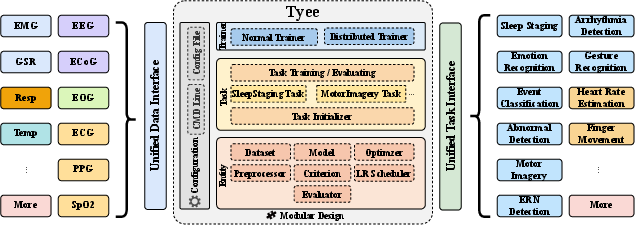
Figure 1: Architecture of the Tyee toolkit, showcasing modular components and end-to-end configurability over diverse physiological signals and healthcare applications.
Central to the system is the unified data interface layer, which supports seamless integration across more than 12 physiological signal types (EEG, ECG, EMG, EOG, PPG, etc.). This is realized via standardized parsers, a robust preprocessing engine supporting both online and offline transformations, and universal access interfaces for downstream tasks. The modular entity abstraction encapsulates datasets, modeling primitives (compatible with PyTorch), optimization pipelines, and metric computations, all accessible for substitution or extension through highly granular configuration. This is enforced at the configuration layer, where YAML-based task definitions fully specify experiment pipelines, ensuring reproducibility without requiring code-level adjustment.
Data Unification, Preprocessing, and Model Integration
Tyee's data ingestion subsystem unifies heterogeneous datasets via a rigorously defined protocol (read_record, online_transform, offline_transform, getitem). The objective is to isolate preprocessing idiosyncrasies in configuration, not code, thus expediting augmentation of new datasets and supporting precise control over signal-standardization and label normalization. The extensibility is operationalized both in built-in and user-defined transform classes, integrated through Python class registration and on-the-fly YAML configuration.
The platform supports both unimodal and multimodal signal analysis. Model integration is facilitated by PyTorch compatibility, and researchers can rapidly enumerate model architectures—ranging from convolutional, residual, to transformer-based deep models—through standard subclassing. Metric and loss tuning, optimizer specification, and distributed training are similarly abstracted into configuration primitives.
Evaluation Methodology and Empirical Results
Benchmarking is conducted over 13 public datasets, spanning 12 physiological signals and 11 distinct tasks. Datasets such as TUAB, MIT-BIH, BCIC-2A/4, PhysioP300, SleepEDFx, DEAP, and CinC2018 are included, demonstrating practicality for both unimodal and highly multimodal regimes. State-of-the-art models, including the recent EEGPT, are natively supported or ported, and baselines are rigorously reproduced for fair comparison.
A core finding is that Tyee matches or exceeds baseline toolkit performance in 12 out of 13 datasets, with uniform configuration-driven reproducibility and metric reporting. Specifically, it achieves marginal or pronounced improvements in challenging signal fusion tasks (SEED-V, SleepEDFx, DEAP), as well as robust generalization in single-modality settings like event detection, sleep staging, and gesture recognition.
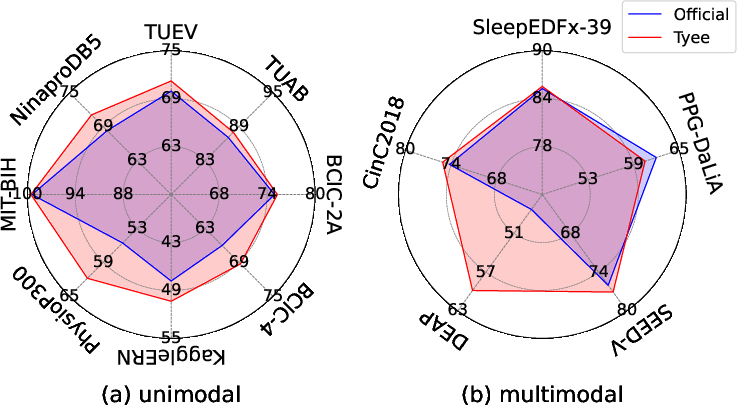
Figure 2: Comparative radar plots establish Tyee's parity or superiority to baseline toolkits across unimodal and multimodal tasks on 13 datasets.
Implications and Future Developments
The declarative configuration paradigm, modular abstractions, and explicit focus on reproducibility render Tyee uniquely positioned for large-scale methodological benchmarking and rapid prototyping in physiological signal processing. This architecture inherently lowers barriers to cross-comparative research and supports the clinical and computational requirements for scalable patient cohort analysis, robust model validation, and evidence-based workflow development.
Notable practical implications include: standardized model assessment pipelines for real-time patient monitoring; reproducible experimental documentation facilitating regulatory compliance; and the potential for rapid extension towards emerging modalities and multi-task deep learning frameworks. Theoretically, the system's modularity allows for quick adaptation to algorithmic advances (e.g., self-supervised or multi-view learning for biomedical data) and supports rigorous ablation or transfer learning studies, supporting generalizability research and fairness assessment in healthcare AI.
Future work will likely center on expanding Tyee with augmented reality/virtual reality interfaces for signal visualization, differential privacy mechanisms for compliance in sensitive medical environments, and deeper interoperability with emerging clinical informatics standards and ontologies.
Conclusion
Tyee advances the state of physiological signal analysis platforms by architecting a unified, configurable, and modular environment prioritizing reproducibility, data-unification, and integration extensibility, while empirically confirming parity or superiority to extant toolkits across a broad range of healthcare benchmarks. Its foundational toolkit design is well-suited to accelerate the theoretical and translational advancement of intelligent physiological health care solutions, facilitating both reproducible research and clinical pipeline development.