- The paper explores controlled AI agent use among developers and identifies motivations such as increased productivity and quality retention.
- It employs field observations and surveys to detail strategies like contextual prompting, version control, and expert oversight.
- Results indicate that while AI agents excel in automating routine tasks, they are unsuitable for complex design decisions.
AI Agent Use for Software Development in 2025
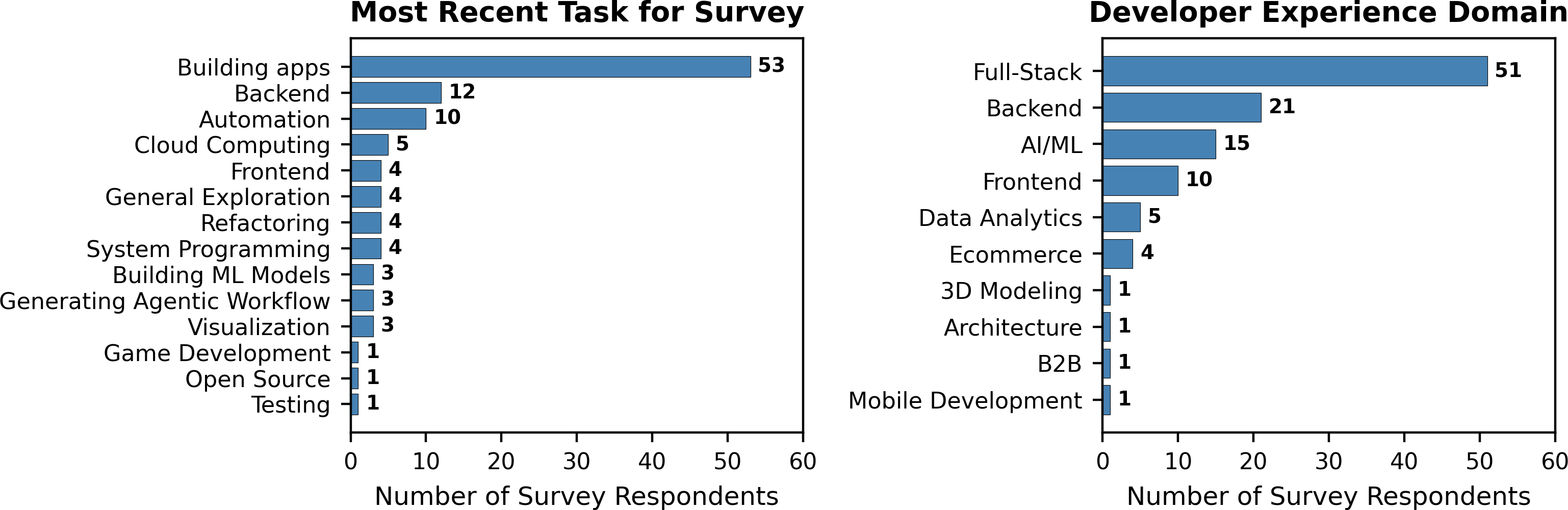
The paper "Professional Software Developers Don't Vibe, They Control: AI Agent Use for Coding in 2025" (2512.14012) seeks to investigate the roles AI agents play in professional software development, examining motivations, strategies, task suitability, and developer sentiments. It presents findings from field observations and surveys, highlighting experienced developers' controlled usage of AI agents for enhancing productivity while maintaining software quality.
Motivations for Using AI Agents
Experienced developers value AI agents for improving development speed but not at the expense of software quality. The study identifies personal productivity and the retention of software quality attributes as critical factors motivating the incorporation of AI agents in software processes. Developers appreciate agents' potential to simplify mundane tasks but remain cautious about delegating responsibilities that could impact software quality or design integrity.
Strategies for Agent Use
Developers employ strategies to oversee software design and implementation actively. Observations reveal that developers leverage agents for task execution while exercising control through meticulous review and verification of agent-generated code. Strategies include:
- Prompting Techniques: Developers use clear, context-rich prompts to guide agent actions effectively. Techniques such as step-by-step instructions, contextual file references, and proactive error handling are noted.
- Control Through Expertise: Developers rely on their software engineering expertise to validate and guide agent outputs, ensuring alignment with design principles and project requirements.
- Version Control: Use of version control systems helps manage multiple agents and maintain a coherent workflow.
Task Suitability of AI Agents
The study categorizes task suitability into three domains:
Developer Sentiments Toward AI Agents
Developers express a generally positive sentiment toward AI-assisted coding, citing enhanced productivity and enjoyment in the development process. The study notes that while confidence in agent utility is high, developers emphasize the necessity of human oversight to ensure quality output. The future of agentic coding is viewed optimistically, with expectations of broader adoption and integration in typical software development workflows.
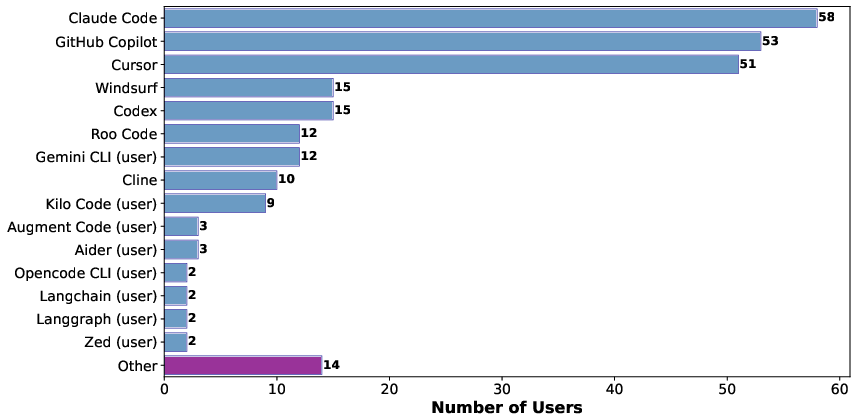
Figure 2: Use of agentic coding tools in the survey. Numbers sum up to more than 99 as one user may report more than one tool use.
Conclusion
The findings from the study illustrate that professional developers use AI agents not to replace traditional coding practices but to augment their productivity and capabilities under controlled conditions. The research underscores the importance of maintaining human expertise and decision-making, especially with complex and strategic software tasks. Future developments in AI interfaces and enhanced agent capabilities could further solidify the role of AI in software engineering.