- The paper presents a physicality oracle that verifies the Abelian Gauss law by comparing local chromoelectric flux between adjacent lattice sites.
- It introduces an efficient LSH mapping that reduces qubit requirements significantly compared to traditional Kogut–Susskind formulations.
- The work demonstrates a scalable quantum circuit design adaptable to multi-level qudit systems, advancing digital quantum simulations of QCD.
Physicality Oracle for SU(3) Loop-String-Hadron Dynamics in Digital Quantum Simulation
Introduction and Background
The efficient simulation of non-Abelian gauge theories such as SU(3) lattice gauge theory (LGT) is essential for probing quantum chromodynamics (QCD) beyond tractable analytic or perturbative regimes. Classical approaches, notably Monte Carlo methods, have shown limitations in scalability and real-time dynamics due to the sign problem and exponential resource requirements. Digital quantum simulation emerges as a natural platform to overcome these bottlenecks, necessitating rigorous mapping of gauge-invariant degrees of freedom onto qubit architectures.
The Loop-String-Hadron (LSH) formulation recasts the 1+1d SU(3) LGT into a basis where all SU(3) indices are contracted locally at lattice sites, inherently satisfying the non-Abelian Gauss laws. The principal residual constraint is the Abelian Gauss law, which ensures consistency of chromoelectric flux between adjacent sites. Accumulated quantum noise during time evolution may cause excursions into unphysical Hilbert space sectors—a problem the presented physicality oracle is designed to solve.
Within the LSH basis, the local Hilbert space per site is specified by five quantum numbers: two bosonic numbers (nP, nQ) representing distinct chromoelectric flux types, and three fermionic occupation numbers (ν1,ν0,ν1) denoting the presence of particular fermionic species and flux endpoints. Physical states require that flux generated at one site is absorbed or transmitted in a manner consistent with neighboring sites, enforced by the Abelian Gauss law:
P(1,r+1)=P(1,r),Q(1,r+1)=Q(1,r).
This transposes the problem of non-Abelian gauge invariance into local arithmetic constraints on site quantum numbers, amenable to efficient binary (or qudit) encoding.
Qubit Mapping Efficiency
A salient numerical result from this work is the substantial reduction in qubit requirements for state encoding using the LSH basis compared to naive IRREP-state mapping. For each lattice site, LSH requires $2N+3$ qubits (N per bosonic number, 1 per fermionic number), with N set by the desired cutoff Λ=2N for flux values. By contrast, the Kogut-Susskind formulation demands encoding both representation labels and intra-representation states for each link, scaling as $8N+5$ qubits per link, plus fermionic site qubits.
This linear-in-system-size scaling, with reduced qubit overhead, directly impacts the feasibility of simulating large systems on quantum hardware.
Quantum Circuit Design: The Physicality Oracle
The core contribution is a quantum circuit (oracle) that checks the Abelian Gauss law between neighboring sites:
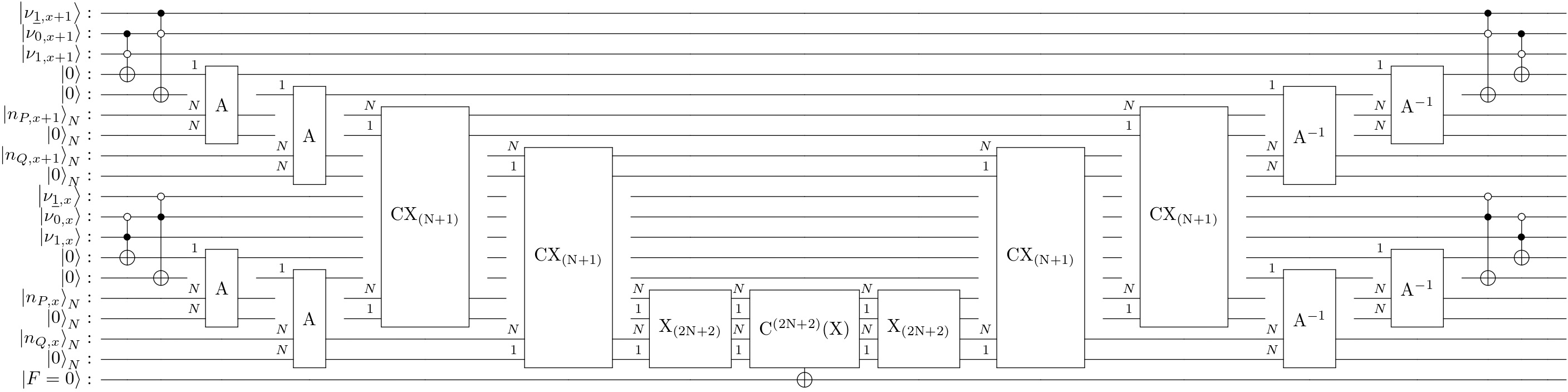
Figure 1: Computes the Abelian Gauss law and sets the flag qubit ∣F⟩ to indicate physicality; SU(3)-specific double flux computation and comparison layers are visible.
The circuit operates by:
- Computing outgoing (P(1,r), Q(1,r)) and incoming (P(1,r+1), Q(1,r+1)) flux for a pair of sites using quantum arithmetic subcircuits.
- Comparing these with CNOT-based comparators to verify equality.
- Setting a designated flag qubit conditioned on successful constraint satisfaction, enabling error detection or post-selection in simulation workflows.
- Uncomputing ancilla and intermediate qubits to preserve initial quantum states outside the flag outcome, ensuring oracle reversibility and minimal entanglement leakage.
Component count analysis yields the following resource summary:
| Resource |
Count |
| Site state qubits |
$2N+3$ |
| Ancilla per site |
$2N+2$ |
| Total qubits in oracle |
$8N+11$ |
| Adders per oracle |
$8$ |
| Multi-controlled-X |
$1$ |
| Two-qubit gate depth |
$30N-38$ |
Gate counts take advantage of Toffoli-congruent designs reducible to CNOTs for the majority of arithmetic steps, barring the multi-controlled-X requiring exact Toffoli implementations.
Prospects for Qudit Extension
The authors motivate transitioning to multi-level quantum hardware (qudits) to capitalize on direct base-d encoding for bosonic quantum numbers, further reducing physical component counts and gate overhead. The described oracle architecture and arithmetic subcircuits adapt straightforwardly to qudit logic, supporting scalable increases in field cutoffs Λ without corresponding binary encoding overhead. This opens attractive hardware-software co-design pathways for future QCD simulation platforms.
Practical and Theoretical Implications
Pragmatically, the presented physicality oracle facilitates error mitigation by identifying unphysical states induced by quantum noise—a critical requirement for reliable digital quantum simulation of lattice field theories. Its local structure and resource efficiency make the approach compatible with near-term quantum hardware, especially as multi-level qudit architectures mature. Theoretically, the LSH mapping continues to generalize to higher dimensions and may catalyze new algorithmic strategies for real-time non-Abelian gauge theory dynamics and quantum error correction modules specific to LGT.
Exploratory calculations of gate depth and resource requirements provide important bounds for hardware implementation, guiding the development of larger-scale QCD simulation pipelines as quantum devices advance.
Conclusion
This work presents a rigorous mapping of the SU(3) LGT in the LSH formulation onto an efficient qubit register, accompanied by a quantum circuit oracle for physicality verification. By reducing encoding overhead and localizing gauge constraint checks, the approach enhances the feasibility and fidelity of quantum simulations of gauge theories. The described methods are extensible to qudit hardware and higher-dimensional lattices, marking a significant advance in quantum algorithms for non-Abelian gauge dynamics.

