- The paper introduces the Scone framework, employing an understanding bridge strategy to effectively differentiate and synthesize target subjects.
- It leverages a Mixture-of-Transformer-Experts and a new SconeEval benchmark to validate superior composition and distinction performance.
- End-to-end backpropagation and guided semantic alignment enable robust multi-candidate subject generation even in noisy, complex contexts.
Scone: Unified Modeling for Composition and Distinction in Subject-Driven Image Generation
Introduction
The Scone framework addresses the persistent problem in advanced subject-driven image generation—specifically, the challenge of distinguishing and synthesizing the correct target subject from a set of multi-candidate inputs. Existing approaches, although increasingly able to compose multiple subjects, systematically fail to resolve issues of subject omission, misidentification, and interference, particularly in complex, unstructured visual contexts. Scone resolves this via a unified understanding-generation modeling paradigm, explicitly bridging composition and distinction through semantic alignment and end-to-end feedback mechanisms. The framework, built atop Mixture-of-Transformer-Experts architecture, introduces the novel understanding bridge strategy, reinforced by robust training and a new benchmark—SconeEval—for rigorous evaluation.
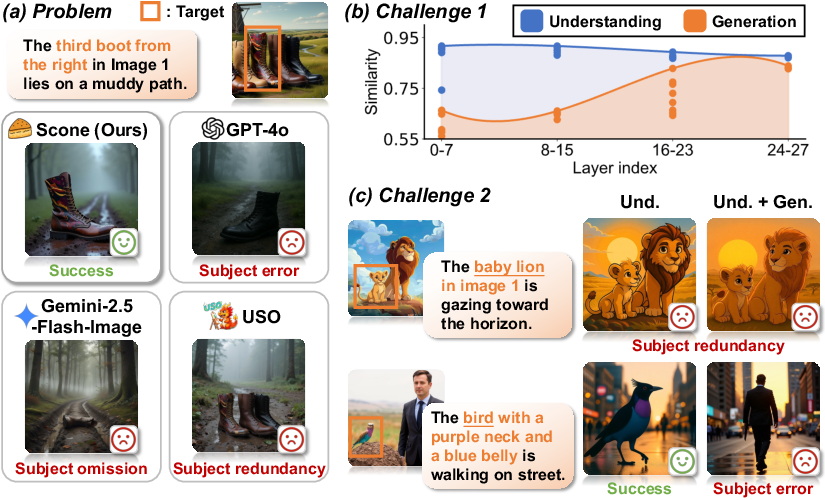
Figure 1: The distinction problem in legacy models, emphasizing semantic deficiency in generation and biased alignment; Scone's architecture remedies these issues by leveraging a unified understanding-generation model.
Motivation and Framework
Subject-driven image generation traditionally over-relies on either pure generation models or loosely coupled multimodal architectures. Scone leverages the empirical observation that the understanding expert within unified models offers superior semantic localization, attending sharply to instruction-relevant regions at earlier network stages, a property not shared by standard generation modules.
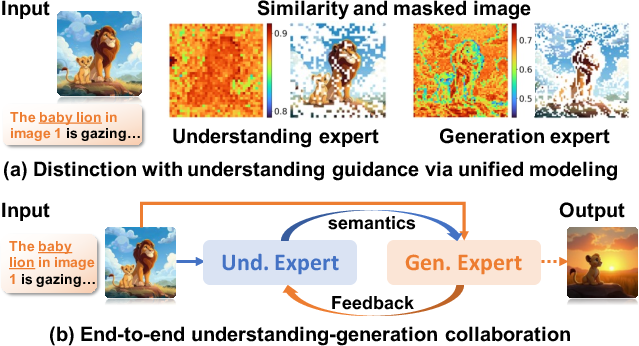
Figure 2: Similarity analysis of image and text token hidden states reveals that understanding experts attend to instruction-relevant semantic regions, while generation experts are less sensitive; this motivates guided end-to-end training.
Scone’s unified approach exploits the semantic early alignment capability of the understanding expert and rectifies its typical biases through reciprocal feedback with the generation expert. This is realized through end-to-end backpropagation, aligning fine-grained visual and textual cues and enabling contextually robust subject distinction, particularly as reference image complexity increases.
Understanding Bridge Strategy
Central to Scone is the understanding bridge strategy. This two-stage protocol comprises:
- Bridge Formation: Early-layer feature similarities between visual and textual tokens are computed and normalized. A threshold-based attention mask isolates instruction-irrelevant regions, with tokens below the cutoff rendered non-influential for subsequent attention computations. The mask is not applied as a hard discard but an attention-guidance, modulating logits to zero for suppressed tokens. Early layers (notably Layer 8) are shown empirically to carry maximal semantic separation.
- Bridge Guidance: With the semantic bridge established, both experts are further optimized to align generation with the filtered, instruction-guided semantic features, suppressing subject-misidentification and redundancy. The protocol enforces consistency and contextual fidelity in the resulting images across complex multi-candidate scenarios.
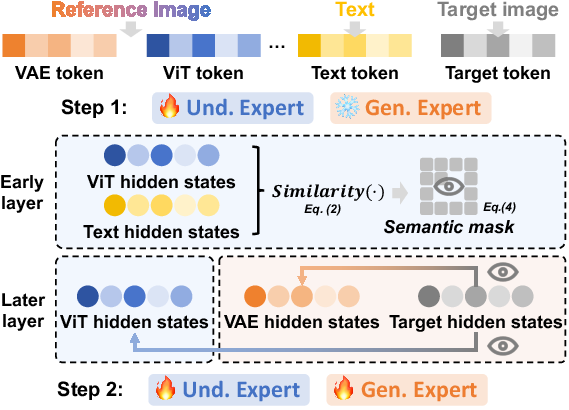
Figure 3: Stepwise formation and deployment of the understanding bridge, ensuring semantic isolation and cross-expert guidance during subject synthesis.
SconeEval Benchmark
To validate Scone’s efficacy, SconeEval is introduced—a benchmark explicitly measuring composition and distinction capability under increasingly complex scenarios. It comprises 409 test cases spanning 19 case types and 6 subtasks, methodically constructed via multi-candidate edits and two-step decoupled instruction generation, minimizing noise and cross-image confusion.
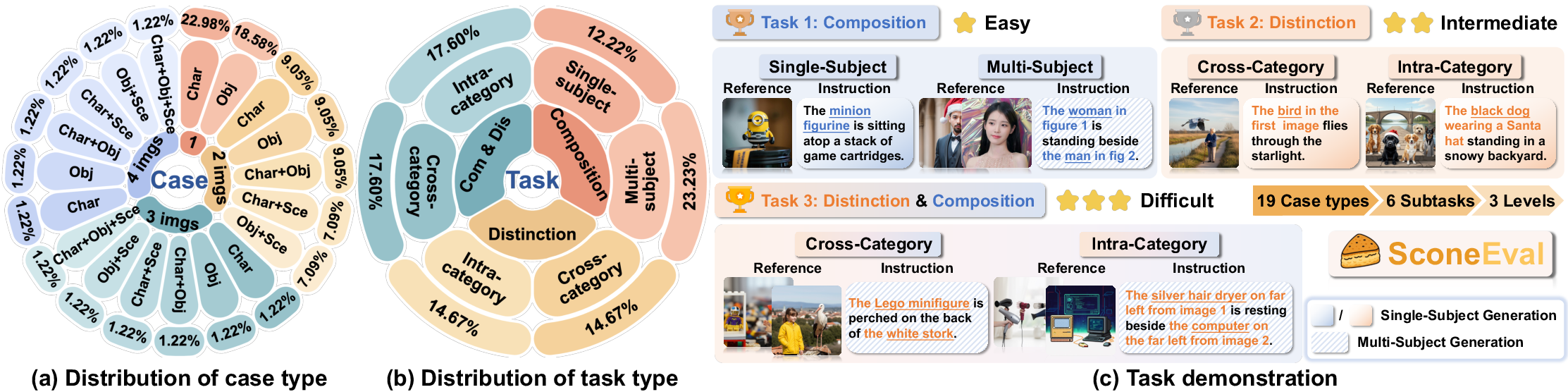
Figure 4: SconeEval's construction spans diverse categories (character, object, scene), systematically evaluating composition and distinction across complex multi-image scenarios.
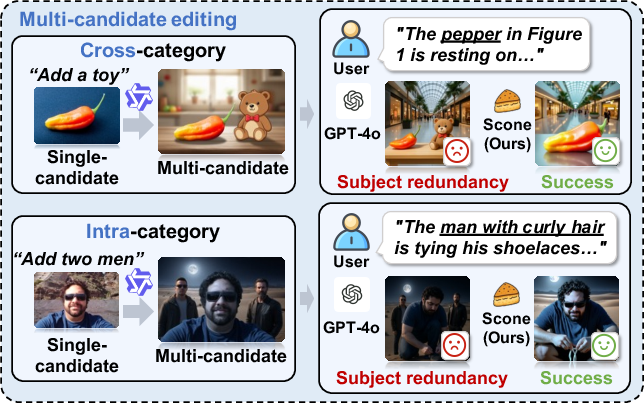
Figure 5: Multi-candidate editing pipeline, illustrating the progressive increase in task difficulty with reference image and instruction complexity.
SconeEval’s scoring protocol utilizes GPT-4.1 for both prompt-following/composition evaluation and explicit distinction accuracy, paired with precision, recall, and F1 computations for subject identification.
Quantitative and Qualitative Results
On OmniContext and SconeEval, Scone achieves the highest average scores among open-source models. Specifically, distinction F1 scores surge over 9.7, with composition scores nearly matching closed-source models Gemini-2.5-Flash-Image and GPT-4o.
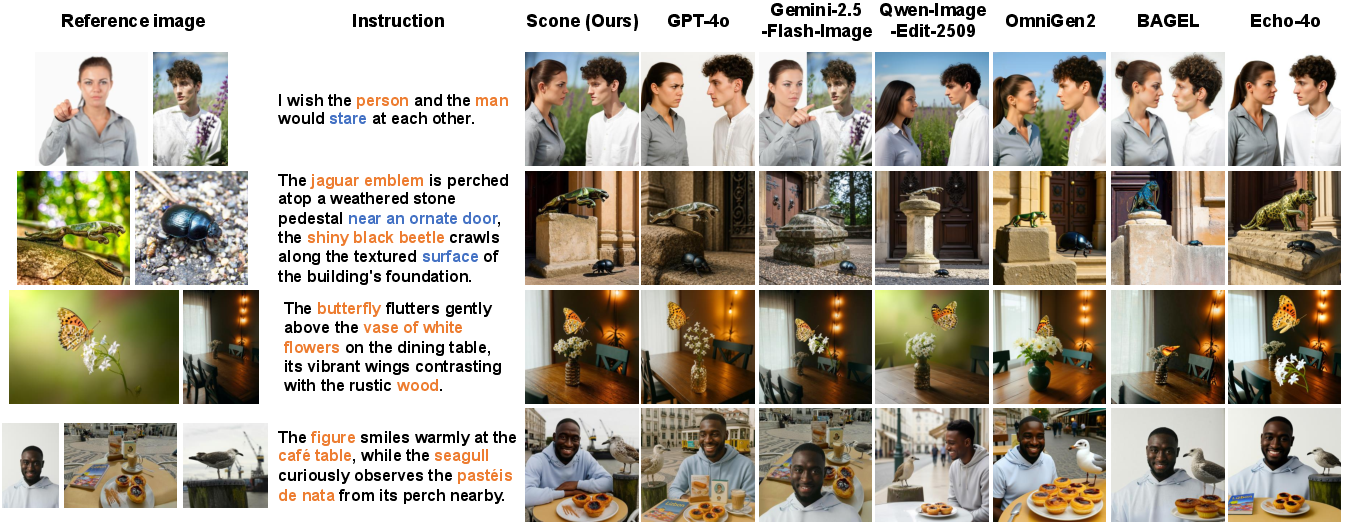
Figure 6: Qualitative comparison on OmniContext, demonstrating superior subject-preservation and harmonious composition by Scone in diverse settings.
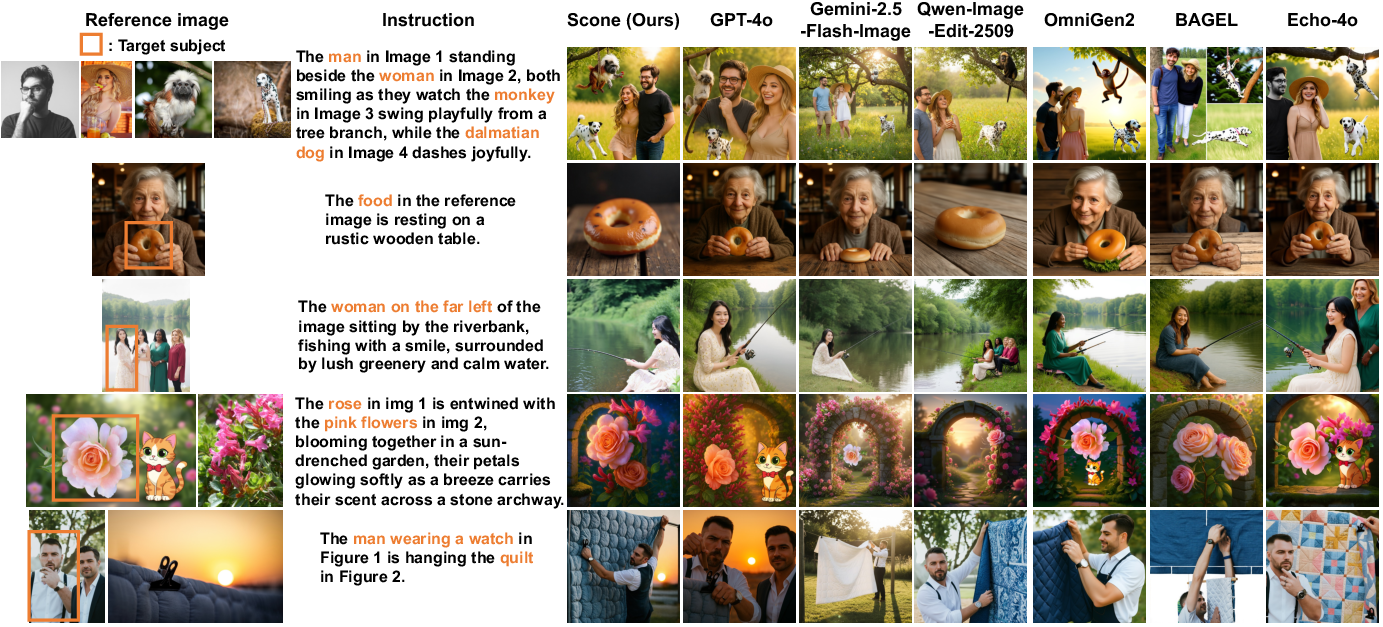
Figure 7: Qualitative output from SconeEval; Scone robustly composes multiple interacting subjects and consistently isolates the instruction-specified target across multi-candidate inputs.
Score stability, as measured by standard deviation, is lowest for Scone, underscoring its resistance to semantic interference and input noise.

Figure 8: Scone shows minimal score variance on SconeEval, indicating robust performance even as context complexity rises.
Data Pipeline, Training, and Ablations
Scone's superior performance is linked directly to high-quality, diverse training data and a rigorous pipeline integrating synthetic data, filtered open-source samples, and multi-step instruction construction. Ablation studies confirm the contribution of refined single-candidate data and validate the two-step bridge-guided fine-tuning protocol, with thresholds governing semantic mask application driving incremental gains in both composition and distinction metrics.
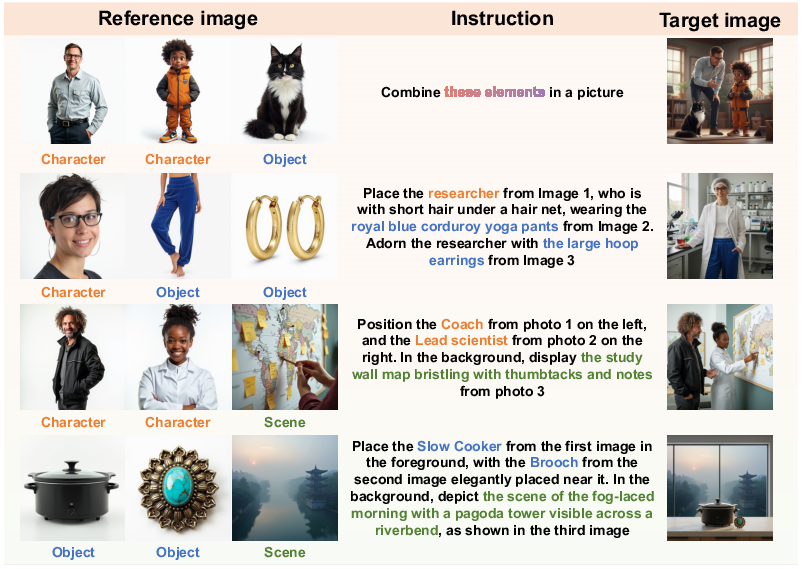
Figure 9: Synthesized data examples with 3 inputs, demonstrating character-object interactions and scene compositionality leveraged in Scone's training.
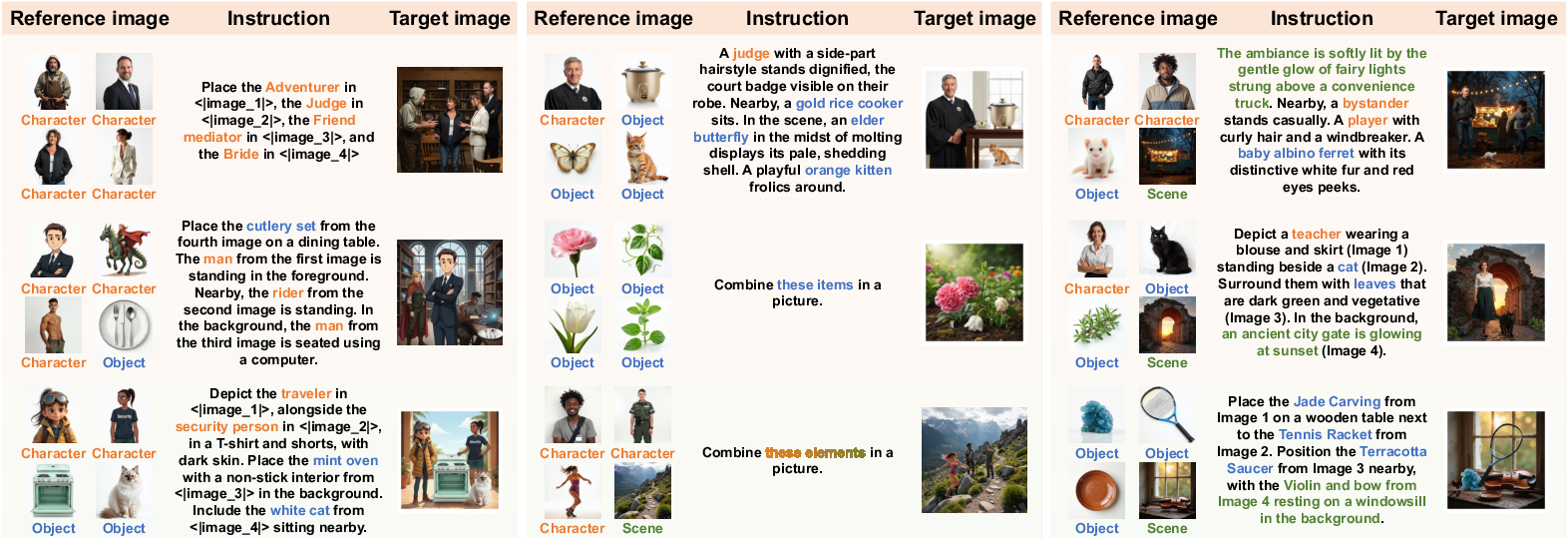
Figure 10: Synthesized data with 4 inputs, covering complex subject mixes including multi-character, multi-object, and hybrid scene compositions.
Instruction generation via two-step decoupling (image-to-text then text-to-text) is empirically shown to avoid ambiguity and eliminate cross-image reference confusion, outperforming direct heuristics.
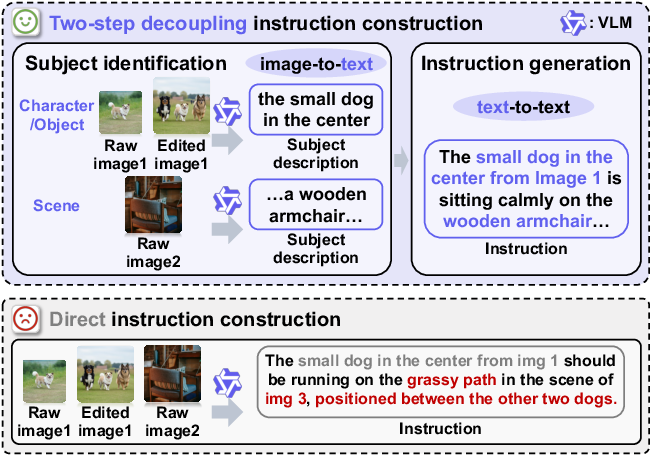
Figure 11: Direct vs. two-step decoupling for instructions; the proposed strategy dramatically reduces mistargeting and unseen subject errors.
Ablations quantifying bridge strategy and data filtering highlight the necessity of both components; omitting or simplifying these steps results in marked drops in subject-identification efficacy and overall output coherence.
Discussion and Limitations
Scone conclusively demonstrates that tight semantic integration, early alignment, and cross-expert feedback are essential for robust subject-driven generation in practical, noisy multi-candidate contexts. The model's architecture can process multi-image references efficiently—without external VLMs or staged inference—offering latency improvements and operational simplicity.
A known limitation is unrealistic subject-environment interaction (e.g., physically improbable placements), observed in some outputs. Continued research is needed to embed environmental and physical priors or train more sophisticated spatial reasoning components.
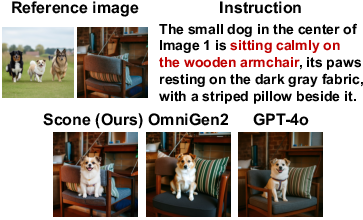
Figure 12: Limitation example—Scone fails to enforce physical plausibility, producing images with impossible object arrangements.
Conclusion
Scone establishes a new standard for unified multimodal image generation, bridging the gap between composition and semantic distinction via the understanding bridge strategy. The architecture and training protocol decisively resolve interference and misidentification observed in previous state-of-the-art systems. SconeEval provides an essential benchmarking tool for future model assessment. Prospective research will address scalable token filtering and more realistic subject-scene reasoning to further enhance subject-driven generation in high-complexity real-world environments.
(2512.12675)