- The paper demonstrates that Born-Infeld nonlinearity combined with GUP and exponential entropy corrections significantly alters black hole thermodynamics and observable signatures.
- The study uses 3D embedding diagrams and analytic lensing expansions to quantify the impact of charge, BI parameter, and cosmological constant on horizon structure and temperature.
- The paper finds that BI corrections are prominent only near the horizon, influencing heat engine efficiency and deflection angles in both vacuum and plasma environments.
Thermodynamics and Optical Signatures of Einstein-Born-Infeld-AdS Black Holes
Introduction
This study conducts a comprehensive analysis of the thermodynamic and optical properties of Einstein-Born-Infeld-Anti-de Sitter (EBI-AdS) black holes, focusing on how Born-Infeld (BI) nonlinear electrodynamics modifies classical black hole (BH) solutions and their observable signatures. The work systematically incorporates quantum corrections via the Generalized Uncertainty Principle (GUP) and exponential entropy modifications, and it rigorously analyzes gravitational redshift and lensing effects in both vacuum and plasma backgrounds. Throughout, the impact of the Born-Infeld parameter a, charge Q, and cosmological constant Λ is examined within the framework of extended black hole thermodynamics, including their role in black hole heat engines.
EBI-AdS Black Hole Geometry and Parameter Dependence
The EBI-AdS black hole arises from coupling Einstein gravity to nonlinear Born-Infeld electrodynamics and a (potentially nonzero) cosmological constant, yielding a charged generalization of the Reissner-Nordström-AdS (RN-AdS) solution. The BI parameter a regularizes the electromagnetic field at high strengths, introducing higher-order corrections in spacetime metrics that scale as a4/rn (n≥5), with corrections localized near the horizon. The horizon structure exhibits significant dependence on Q, a, and Λ, resulting in a variety of causal configurations: non-extremal, extremal, or naked singularities, established by root analysis of the lapse function.
Three-dimensional embedding diagrams concretely illustrate how horizon geometry and spatial curvature are deformed as BI and cosmological parameters are varied. For instance, increasing a or Q noticeably effects the size and position of event horizons, while the inclusion of nonzero Λ modifies asymptotic curvature.
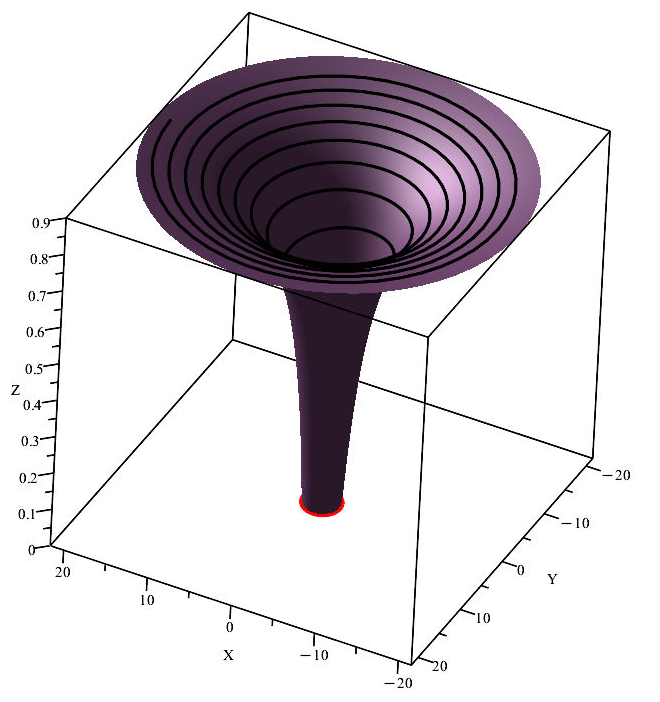
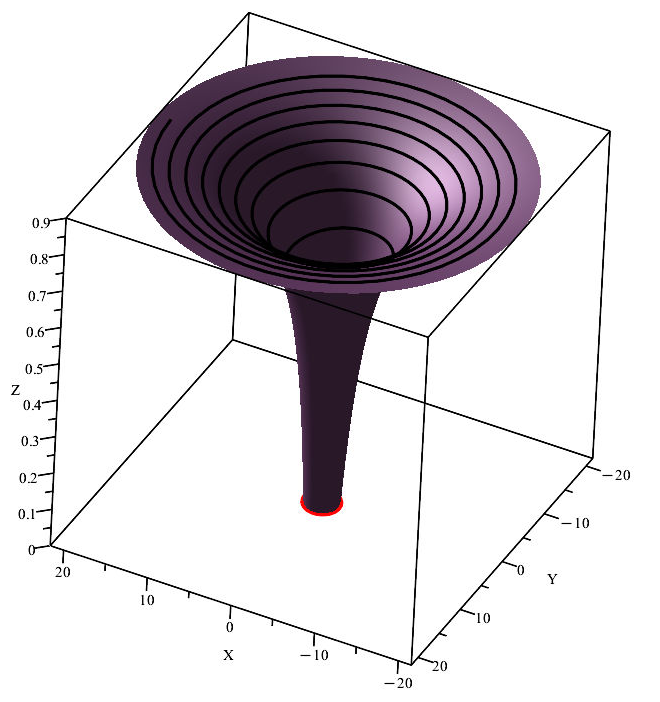
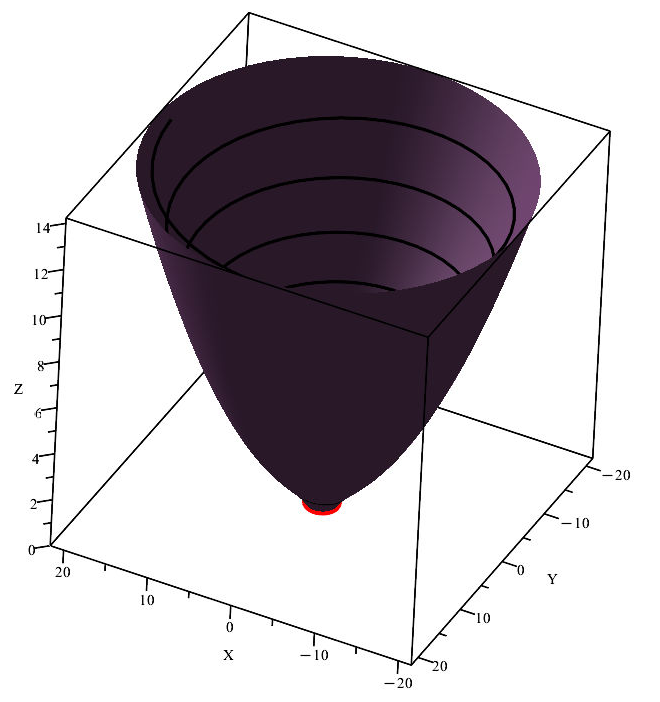
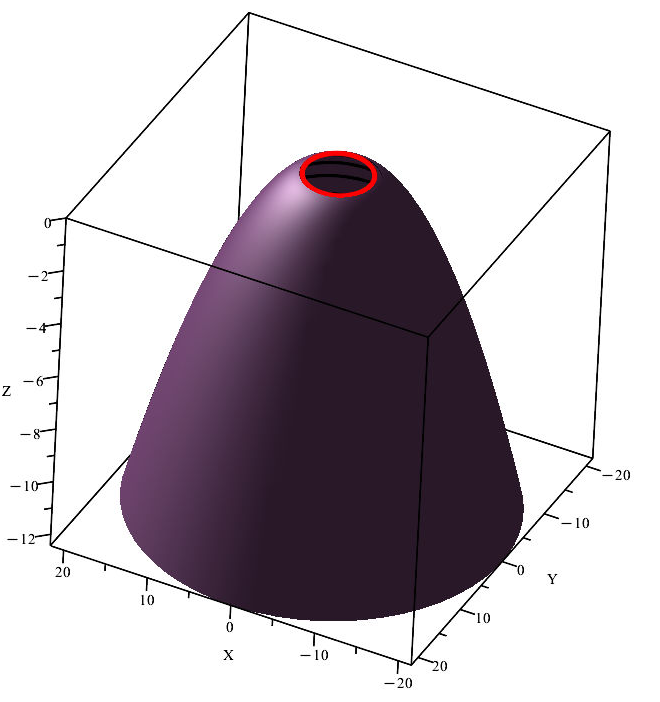
Figure 1: Three-dimensional diagrams display how increasing charge Q, Born-Infeld parameter a, and varying Λ distinctly deform the BH horizon geometry, notably in the near-horizon regime.
Black Hole Thermodynamics with GUP and Exponential Entropy Corrections
The thermodynamics of EBI-AdS black holes are profoundly influenced by both nonlinear electrodynamics and quantum corrections. The surface gravity approach yields the Hawking temperature, which incorporates contributions from Q and higher-order a corrections, manifesting strongly for rH≲1.5.
GUP corrections alter Hawking temperature as
TGUP≃TH(1+4rH2λ2−32rH4λ4)
where λ is the GUP parameter. These quantum gravity effects become significant for sub-Planckian horizon radii, leading to enhanced temperatures, possible remnant formation (when temperature ceases to increase as rH→lp), and modifications to BH evaporation dynamics. This interplay between GUP, BI, and AdS curvature is central to late-time BH evaporation, potentially relevant for primordial BH phenomenology.
Exponential entropy corrections, motivated by microcanonical ensemble approaches, augment the classical Bekenstein-Hawking area law:
SEC=S0+e−S0
with S0=πrH2. The inclusion of EC drastically modifies phase behavior and heat capacity near Planckian radii, offering new avenues for understanding microscopic BH structure and quantum gravity regularization mechanisms.
The polytropic structure of internal energy, Helmholtz and Gibbs free energies, and heat capacity exhibits nonmonotonic dependence on rH and a. Notably, heat capacity transitions between stability regimes, with sign changes indicating second-order phase transitions that are highly parameter-sensitive.
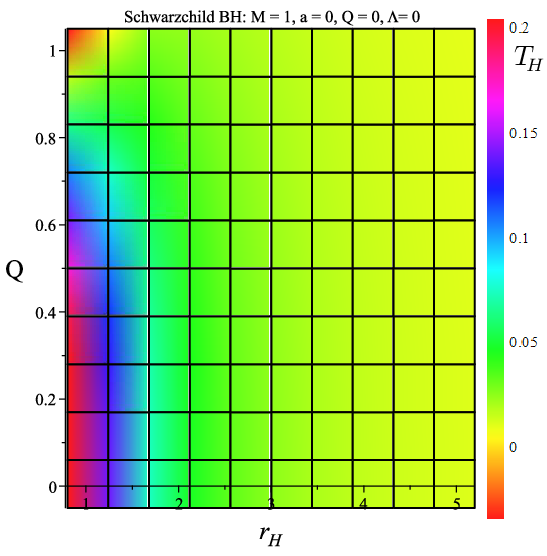
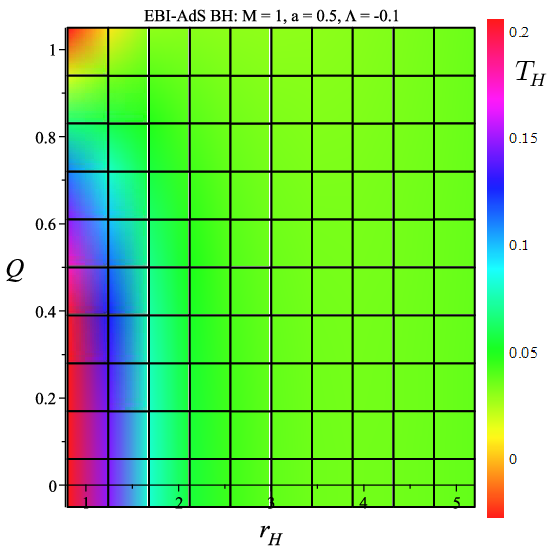
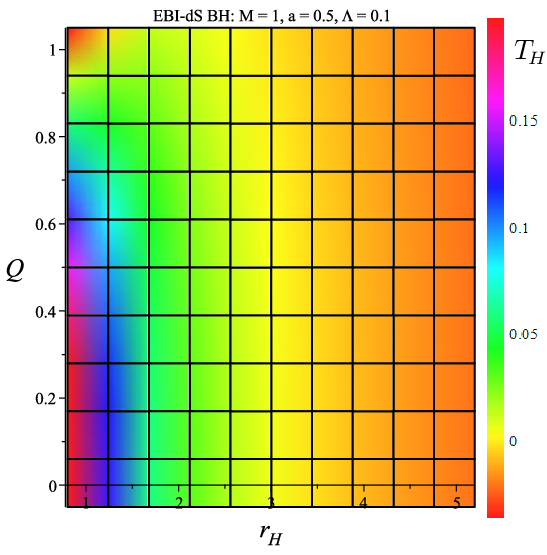
Figure 2: Hawking temperature as a function of horizon radius and charge illustrates how nonlinearities from a and background curvature Λ reshape the thermal landscape compared to the RN limit.
Gravitational Redshift and Its Decomposition
The gravitational redshift in EBI-AdS geometry admits a separation into mass (Schwarzschild), cosmological, charge, and BI components:
z∞=reM+6Λre2−2re2Q2+40re6Q2a4
The distinctive a4 dependence constrains BI contributions to the immediate near-horizon regime (re→rH), making their observational identification highly nontrivial except for extreme strong-field measurements.
(Figure 3)
Figure 3: Redshift dependence versus source radius reveals the rapid suppression of BI effects away from the horizon, with mass dominance at large re and charge/BI corrections relevant only at re≲2.
Gravitational Lensing: Vacuum and Plasma Environments
The Gauss-Bonnet theorem provides a geometric framework for calculating light deflection by these black holes. In vacuum, the deflection angle expansion in terms of impact parameter b reads:
Θ∼b4M−4b23πQ2+128b67πQ2a4+49b78MQ2a4+⋯
Again, BI corrections enter as high-order, rapidly-decaying terms, emphasizing their detectability only for photon trajectories grazing the event horizon.
(Figure 4)
Figure 4: BI corrections to the vacuum deflection angle, scaling as b−6 and b−7, are significant solely in the strong deflection regime.
In plasma backgrounds (characterized by δ=ωe2/ω∞2), lensing becomes frequency-dependent due to dispersive effects on the refractive index n(r). The expansion incorporates both BI and dispersive corrections, illustrating how plasma may enhance or mask nonlinear electromagnetic imprints in lensing observables. Higher-order mixed terms, such as those proportional to Q2a4δ, show that BI signals may be best sought in settings with dense plasma near charged compact objects.
(Figure 5)
Figure 5: Deflection angle as a function of b and plasma parameter δ demonstrates complex interplay between nonlinear electrodynamics and medium effects.
Black Hole Heat Engines in Extended Phase Space
EBI-AdS black holes, with AdS pressure identified as thermodynamic pressure, support heat engines operating in cycles in the P-V plane. The analysis of rectangular cycles indicates that work output and efficiency are sharply restricted by phase structure and parameter choices: maximal efficiency η∼0.21 is achieved at small volumes and pressures, corresponding to 30%-61% of the Carnot bound for typical cycles. Notably, explicit calculation confirms that BI corrections to efficiency are of order 10−12 for astrophysically meaningful parameters—consistent with prior findings for nonlinear electrodynamic AdS black holes. Only cycles with rH≲1.5 and large a show non-negligible BI-induced efficiency shifts.
Theoretical and Observational Implications
The systematic study illustrates that while BI electrodynamics provides an elegant nonlinear UV completion with well-defined thermodynamic and geometric consequences, its direct observational signatures are highly suppressed (except at Planckian scales). Quantum gravitational corrections—via GUP or exponential entropy—either reinforce the presence of terminal remnants or alter late-stage evaporation/thermal profiles, but always in extremely strong-field, small-scale, high-charge regimes.
These results reinforce the notion that current astrophysical observations are unlikely to distinguish BI from Maxwell corrections or detect quantum gravitational effects, except perhaps in primordial BH evaporation spectra or future high-precision tests near extremal compact objects. Nevertheless, the detailed parameter scaling, analytic decompositions, and comprehensive treatment of classical and quantum corrections in this work set a benchmark for future extensions, e.g., to rotating or higher-dimensional nonlinear electrodynamics BHs, alternative entropy functionals, or dark matter environments.
Conclusion
The paper delivers a rigorous, parameter-resolved analysis of Einstein-Born-Infeld-AdS black holes, establishing how the interplay between BI nonlinearity, quantum corrections, and AdS thermodynamics shapes black hole observables. Although the magnitude of BI signatures remains deeply subdominant for astrophysical black holes, especially in thermodynamic cycles and lensing, the explicit functional dependencies and highlighted parameter regimes will inform targeted searches and theoretical development for quantum-modified gravity and nonlinear field effects.

