New light mediators and the neutrino fog: Implications from XENONnT nuclear recoil data
Abstract: Current ton-scale, xenon-based dark matter (DM) direct detection experiments have now reached the sensitivity required to observe solar neutrinos, marking the onset of the so-called neutrino fog. In this work, we explore how this fog is modified when either neutrinos or DM interact with nuclei through a new scalar, vector, or axial-vector interaction, considering both heavy and light mediators. Using the latest nuclear-recoil data from XENONnT, which show indications of coherent elastic neutrino-nucleus scattering from $8$B solar neutrinos, we derive new strong bounds on light mediator couplings. We find that these limits are significantly more stringent when the mediator couples to DM, rather than when new physics affects only neutrino interactions. Building on these results, we recompute the expected neutrino fog and compare it with the corresponding constraints on spin-independent and spin-dependent DM-nucleon interactions. We show that the morphology of the neutrino fog can be markedly modified if either neutrinos or DM interact with nuclei through light mediators, even in light of these recent constraints.
Paper Prompts
Sign up for free to create and run prompts on this paper using GPT-5.
Top Community Prompts
Explain it Like I'm 14
What this paper is about
This paper looks at a big challenge in the hunt for dark matter: tiny signals from neutrinos (very light, almost invisible particles from the Sun and other places) can look a lot like the signals we expect from dark matter. As our detectors get better, they start to see these neutrino signals clearly, which makes it harder to tell if we’re seeing dark matter or just neutrinos. Scientists call this confusing region the “neutrino fog.”
The authors ask: if there are new kinds of particles that help neutrinos or dark matter interact with atomic nuclei (the centers of atoms), how would that change the neutrino fog and our ability to find dark matter? They use the newest data from the XENONnT experiment, which uses liquid xenon to “listen” for tiny bumps inside atoms, and has recently seen hints of solar neutrinos.
The main questions in simple terms
- Could new “messenger” particles (not in the Standard Model of physics) change how often neutrinos or dark matter bump into atomic nuclei?
- If so, would these changes make the neutrino fog thicker or thinner, and how would that affect our chances of finding dark matter?
- What limits can we set on these new messenger particles using the latest XENONnT data?
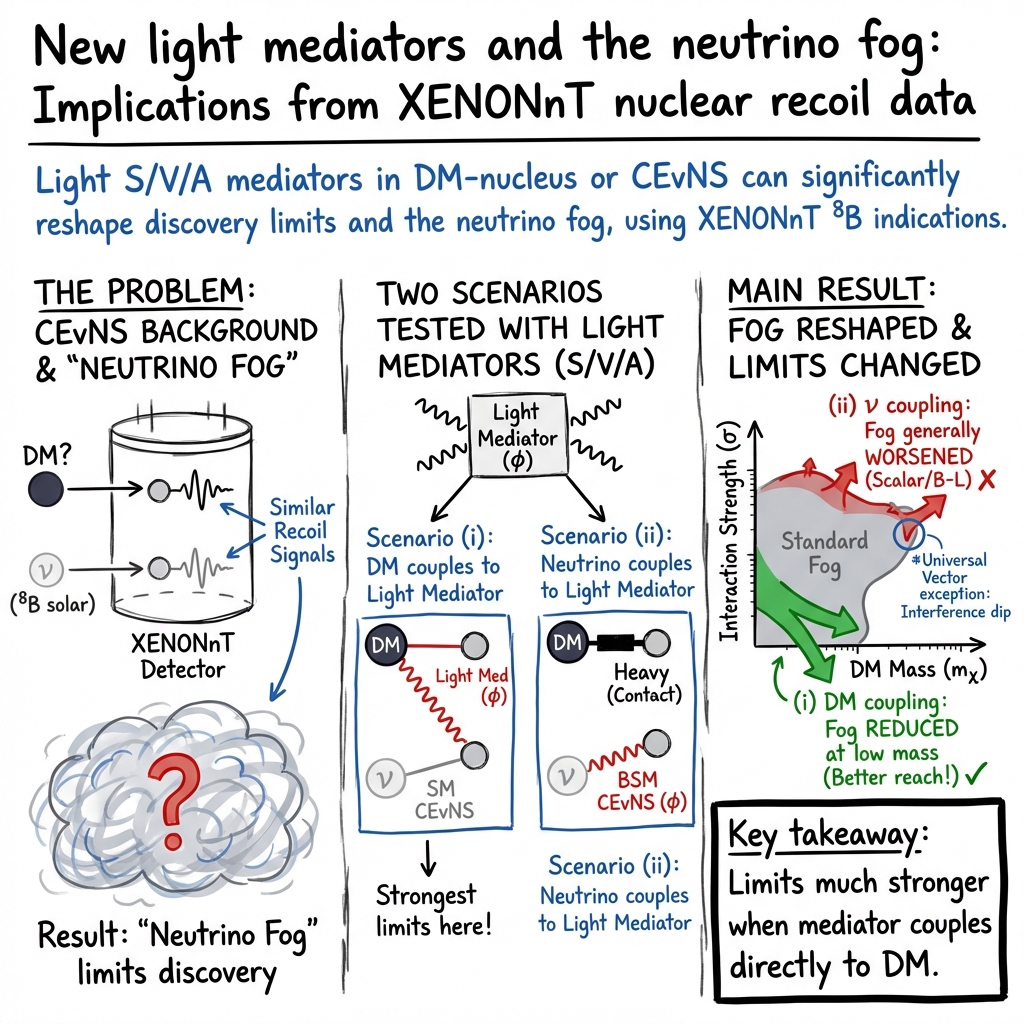
The paper studies two situations:
- Scenario (i): Neutrinos behave as expected, but dark matter talks to nuclei through a new light messenger (a scalar, vector, or axial-vector).
- Scenario (ii): Dark matter behaves as usually assumed, but neutrinos talk to nuclei through a new light messenger.
How they did it (with everyday analogies)
To understand the methods, imagine this:
- The detector is like a quiet room filled with a very clean gas. If something nudges the atoms inside, they give off tiny flashes of light and a trickle of electrons. The detector measures two signals (called S1 and S2) that tell you how big the nudge was.
- A “nudge” can come from dark matter passing through and tapping a nucleus, or from a neutrino doing the same. These taps are extremely gentle—more like a feather touch than a punch.
What are “light mediators”?
- Think of a mediator as a messenger that carries a force between two things (for example, between dark matter and a nucleus).
- A heavy messenger is like a very short-arm handshake: it only works at very close range and gives a steady, simple pattern of taps.
- A light messenger is like a long-arm reach: it changes how the tapping depends on the energy, often making low-energy taps more common. This can change the shape of what the detector records.
What the authors did:
- They calculated how many “taps” to expect from dark matter and from neutrinos, with and without these new light messengers.
- They matched those predictions to the real XENONnT data, which shows hints of neutrinos from the Sun’s boron-8 (B) reactions.
- They used statistics to judge which messenger strengths are allowed or ruled out by the data.
- They then recomputed the “neutrino fog”—a map showing how hard it is to discover dark matter at different masses and cross sections—when these new messengers are included.
A few helpful ideas:
- Spin-independent (SI) vs spin-dependent (SD): SI is like pushing on the whole nucleus at once; SD depends on how the nucleus’s internal spin is aligned. Xenon detectors are much more sensitive to SI because more isotopes respond strongly that way.
- “Discovery limit” or “neutrino fog”: Picture trying to spot a small flashlight (the dark matter signal) in a foggy night (the neutrino background). As detectors get bigger and run longer, you can usually see fainter lights. But if the fog gets too thick, making the light brighter or waiting longer doesn’t help much. The authors calculate how thick that fog is, and how it changes if new messengers exist.
What they found and why it matters
- XENONnT data shows signs consistent with neutrinos from the Sun gently bumping xenon nuclei—this is expected and is an important milestone.
- Using these data, the authors set strong limits on how strongly new light messenger particles could couple to matter.
- Key result: the limits are much tighter if the new light messenger couples to dark matter than if it only couples to neutrinos. In other words, XENONnT is especially good at ruling out new forces that would boost dark matter–nucleus interactions.
- The shape of the neutrino fog can change a lot if these light messengers exist. That means the boundary between “we could discover dark matter here” and “neutrinos make it too hard here” can shift—sometimes making discovery tougher, sometimes changing which dark matter masses are hardest to see.
- Even after applying the latest constraints from XENONnT, these light messengers can still noticeably reshape the fog, especially for SI interactions and for lighter mediator masses.
What this means going forward
- Direct detection experiments are entering the era where neutrinos are an unavoidable background. This is both a challenge (they hide dark matter signals) and an opportunity (we can study neutrinos in new ways).
- If new light messengers exist, we must take them into account when planning future dark matter searches. They can change how the neutrino fog looks and where experiments should focus their sensitivity.
- The new limits from XENONnT help narrow down which kinds of new physics are still possible, guiding both theory and experiment.
- Bottom line: we’re learning how to see better in the “neutrino fog.” That improves our chances of telling a true dark matter signal from the background, and it teaches us more about neutrinos and possible new forces in nature.
Knowledge Gaps
Knowledge gaps, limitations, and open questions
Based on the paper, the following items remain unresolved and point to concrete directions for future research:
- Cross-experiment synthesis: no joint likelihood combining XENONnT with PandaX-4T and LZ nuclear-recoil data (and their differing B normalizations/uncertainties), which is essential to reduce flux and detector systematics and sharpen mediator bounds and the neutrino fog.
- Treatment of the B flux uncertainty: the analysis adopts a 4% prior on the B flux in the XENONnT fit despite the experiment’s own ∼63% measurement uncertainty; a consistent treatment (e.g., using SNO/Borexino priors vs. XENONnT/PandaX-4T measurements, with scenario comparisons) and propagation to the fog is missing.
- Detector modeling systematics not propagated: uncertainties in charge/light yields at low recoil energy (e.g., Qy, Ly), g2, threshold and acceptance curves, and their model dependence (e.g., NEST variants) are not included in the limits or fog; quantify and marginalize these to assess robustness.
- Use of simplified S2-only binning with ad hoc correction factors ci: the forward model does not exploit the full 2D (S1, S2) response, pulse-shape, or position dependence; replace ci with a validated detector response model using calibration data and propagate its uncertainties.
- Fixed astrophysical assumptions: local DM density and SHM velocity parameters are held fixed; marginalize over ρχ, v0, vesc and consider non-Maxwellian halos to quantify their impact on mediator limits and the fog.
- Limited interaction hypotheses: isospin-violating couplings (fn/fp ≠ 1) and flavor-dependent neutrino couplings are not explored; scan generalized coupling spaces (g_u ≠ g_d, flavor-dependent gν) to expose degeneracies and xenon “blind spots.”
- Nuclear-physics uncertainties: no propagation of uncertainties in Helm parameters, neutron–proton form-factor differences, or spin structure functions (including two-body currents) for SD channels; quantify their effect on bounds and fog.
- Scalar mediator nucleon matrix elements: treatment neglects scalar gluon operator (heavy-quark loops) and uncertainties in fTq; include gluon contributions and updated lattice inputs to reassess scalar limits.
- Joint DM–neutrino mediator scenario omitted: the study separates “mediator couples to DM only” vs “mediator couples to neutrinos only”; analyze the realistic case where the same light mediator couples to both, including interference and correlations in a global fit.
- UV-complete model coverage: beyond U(1)B−L and a phenomenological “universal” vector, anomaly-free embeddings (with kinetic mixing and correlated quark/lepton couplings) are not systematically treated; derive bounds within concrete UV models to clarify interference patterns and external constraints.
- External constraints not integrated: collider, beam-dump, fixed-target, rare decays, stellar cooling, SN1987A, BBN, CMB, and ν–e scattering limits are acknowledged but not combined; perform a global fit to delineate truly viable parameter space.
- Very light mediator effects: potential in-medium/screening effects and mediator width/decay-channel dependencies at q ≲ keV are not considered; assess these for mX ≪ MeV and their impact on spectral shapes and limits.
- Future-neutrino backgrounds: while the code can include them “in principle,” a quantitative exploration of DSNB and atmospheric contributions (and their uncertainties) at exposures relevant to DARWIN/XLZD is not presented; extend fog projections to those regimes.
- Extended DM signal channels: sub-GeV DM enabled by light mediators via Migdal/bremsstrahlung and inelastic/bound-state processes are not considered; evaluate how these channels alter discovery limits and the fog.
- Time and direction observables: annual/diurnal modulation and directional information (and solar day–night effects for CEvNS) are not exploited; quantify their potential to mitigate the fog with light mediators.
- Statistical coverage: reliance on Asimov/profile-likelihood approximations without toy-MC validation in low-count, systematics-dominated regimes; test coverage and potential biases in discovery limits and n-index contours.
- Background systematics modeling: Gaussian, uncorrelated priors for AC, neutron, and ER backgrounds may be unrealistic; include correlations and non-Gaussian tails, and assess sensitivity to these choices.
- Mapping across mass regimes: the transition between light- and heavy-mediator limits (and mapping to standard SI/SD zero-momentum cross sections) is not systematically explored; provide continuous translations and clarify where contact-interaction assumptions fail.
- Multi-target complementarity: the study is xenon-only; quantify how combining xenon with argon/germanium/silicon (and different spin contents) can break mediator-type and DM–neutrino degeneracies and reshape the fog.
- Degeneracy analysis: no explicit quantification (e.g., Fisher/Bayesian) of degeneracies between mχ, gX, mX and neutrino-flux nuisances; identify “most confused” regions and which measurements break them.
- Isotopic composition effects: uncertainties in Xe-129/Xe-131 abundances and the potential of isotope enrichment/depletion to strengthen SD constraints are not assessed; evaluate their influence on mediator limits and fog.
- Reproducibility: details and code for the modified NeutrinoFog implementation and the XENONnT likelihood (with ci factors) are not provided; releasing these would enable independent validation and extension.
Practical Applications
Immediate Applications
The following items summarize practical uses that can be implemented now, drawing directly from the paper’s methods, constraints, and updated “neutrino fog” characterization.
- Sector: Academia—Dark Matter Experiments
- Description: Update discovery limits (“neutrino fog”) and search strategies for current xenon TPC experiments (XENONnT, LZ, PandaX‑4T) using the paper’s re-computed fog including B CEvNS indications and light-mediator effects.
- Tools/workflows: Integrate the modified NeutrinoFog code with light mediator modules and XENONnT-inferred B flux normalization and uncertainty; adopt the profile-likelihood, Asimov dataset approach for planning exposure and binning.
- Assumptions/dependencies: Standard Halo Model (local DM density, Maxwellian velocity, escape speed), detector response (S1/S2, charge yield Q_y), Helm form factors, nuclear spin structure functions, current B flux uncertainties dominate fog morphology.
- Sector: Academia—Particle Theory and Global Fits
- Description: Immediate narrowing of parameter space for light scalar/vector/axial mediators by incorporating the paper’s coupling–mass bounds; prioritize models where mediator couples to DM (tighter limits) versus neutrinos (looser limits).
- Tools/workflows: Recasting pipelines to translate bounds into nucleon‑level SI/SD cross sections; inclusion in global BSM scans alongside limits from COHERENT, CONUS+, Borexino, CHARM‑II, TEXONO, and ER datasets.
- Assumptions/dependencies: Flavor-universal light-quark couplings; gauge-consistency considerations (e.g., universal vector vs anomaly-free ); compatibility with other experiments’ constraints on electron couplings.
- Sector: Academia—Detector Operations
- Description: Optimize near-term run plans (exposure, S2 binning, thresholds) and background budgets using the paper’s binned Poisson-likelihood framework and updated CEvNS backgrounds (with systematic uncertainty treatment).
- Tools/workflows: S2-range binning [120–500 PE], detector efficiency maps, correction factors ci, and nuisance-parameter profiling for accidental coincidence, neutron, and ER backgrounds.
- Assumptions/dependencies: Stable and validated detector response models; accuracy of charge amplification gain (g2) and charge yield (Q_y) mapping from T_N to S2.
- Sector: Software/Data Science
- Description: Deploy “fog-aware” analysis templates for rare-event searches by adapting the paper’s statistical workflow (profile likelihood, nuisance-profiling) to other nuclear recoil or low-background analyses.
- Tools/workflows: Packaged likelihood modules with Gaussian priors for systematics; validation using Asimov datasets; modular rate calculators for light mediators.
- Assumptions/dependencies: Availability of high-quality background models and exposure estimates; acceptance that CEvNS acts as an irreducible background with non-negligible systematic errors.
- Sector: Policy/Research Coordination
- Description: Harmonize fog definitions and reporting across direct detection collaborations to standardize discovery claims and exclusions under light-mediator scenarios.
- Tools/workflows: Shared benchmarks for B flux uncertainty usage; cross-experiment adoption of the neutrino fog n-index reporting (e.g., n=2 contour as “floor-equivalent”).
- Assumptions/dependencies: Willingness to adopt common statistical standards and cross-calibrate neutrino flux inputs; timely data-sharing.
- Sector: Nuclear Safeguards and Applied Neutrino Detection
- Description: Use the new constraints on CEvNS modifications (light mediators) to rule out BSM interpretations of anomalous reactor or spallation CEvNS signatures in current and planned safeguards detectors.
- Tools/workflows: Recompute CEvNS rates in applied detectors with mediator terms; compare to operational baselines.
- Assumptions/dependencies: Relevance of the paper’s energy/momentum-transfer regime to reactor energies; mapping of nuclear form-factors and isotopic composition to applied detectors.
- Sector: Education and Outreach
- Description: Improve communications on “neutrino fog” (versus the older “neutrino floor”) using this concrete case where CEvNS is observed and limits evolve under light mediators; clarify implications for DM search difficulty.
- Tools/workflows: Visualizations of fog morphology changes; public-facing summaries explaining irreducible backgrounds and discovery limits.
- Assumptions/dependencies: Up-to-date outreach materials; collaboration approval for simplified interpretations.
Long-Term Applications
These applications require more research, scaling, new hardware, or multi-experiment integration before they can be fully realized.
- Sector: Academia—Next-Generation Detector Design
- Description: Engineer detectors with directional sensitivity, multiple target materials, or improved recoil discrimination to mitigate the neutrino fog and break degeneracies introduced by light mediators.
- Tools/products/workflows: Dual-target arrays (e.g., xenon+argon), low-threshold readout, direction-sensitive technologies, dedicated CEvNS veto or tagging schemes.
- Assumptions/dependencies: Technological feasibility of directional nuclear recoil detection; manageable costs and complexity; robust calibration strategies.
- Sector: Academia—Comprehensive CEvNS Neutrino Program
- Description: Use DM detectors as CEvNS observatories to precisely measure B and other fluxes, reducing systematic uncertainties that dominate the fog and enabling neutrino-sector BSM tests.
- Tools/workflows: Multi-exposure datasets across XENONnT/LZ/PandaX‑4T; joint likelihood fits combining reactor/spallation CEvNS (COHERENT, CONUS+) with solar flux measurements; targeted systematics campaigns.
- Assumptions/dependencies: Shared data access; sustained exposures; unified treatment of nuclear structure and form factors; consistent mediation models across energy regimes.
- Sector: Software—Integrated Global Analysis Platforms
- Description: Build a cross-experiment, fog-aware global fit framework for light mediators (S, V, A), combining nuclear and electron recoil datasets and accelerator constraints to coherently bound BSM parameter space.
- Tools/products/workflows: Open-source joint-likelihood toolchains supporting mediator-specific charge structures, interference (e.g., vs universal vector), and multi-target nuclear response.
- Assumptions/dependencies: Harmonized data formats; community consensus on priors and interference sign conventions; continued maintenance and validation.
- Sector: Policy—Strategic Investment and Coordination
- Description: Guide funding decisions toward reducing neutrino systematic uncertainties (dedicated solar neutrino measurements, improved CEvNS characterizations) and toward detector technologies that can escape the fog.
- Tools/workflows: Roadmaps quantifying returns from uncertainty reduction vs. detector scaling; fog-index-based KPIs for program assessment.
- Assumptions/dependencies: Acceptance of fog metrics in program evaluation; availability of complementary neutrino experiments; inter-lab collaboration.
- Sector: High-Energy Physics—BSM Search Synergy
- Description: Align direct detection searches for light mediators with accelerator and beam experiments (e.g., fixed-target searches for light vector bosons, gauge bosons), exploiting complementary sensitivity regions and interference patterns.
- Tools/workflows: Joint exclusion plots in ; coordinated scan strategies emphasizing destructive vs constructive interference regimes; theory task forces to ensure gauge-consistency.
- Assumptions/dependencies: Data interoperability; careful treatment of mediator couplings to electrons vs quarks vs neutrinos; consistent anomaly cancellation in model choices.
- Sector: Industry—Technology Spin-offs
- Description: Pursue long-term improvements in low-noise photodetection, cryogenic systems, and TPC engineering hinted by the precision demands of neutrino-fog-limited searches, with transfer to medical imaging and radiation monitoring.
- Tools/products/workflows: Next-gen photosensors, low-background materials, enhanced charge amplification designs.
- Assumptions/dependencies: Translational R&D pathways; verification that improvements beneficial to LXe TPCs also benefit applied systems.
- Sector: Cross-Domain Data Science
- Description: Adapt fog-aware rare-event statistical strategies (profile likelihoods with nuisance profiling and Asimov testing) to other domains (e.g., gravitational-wave detection, high-energy astrophysics, and, cautiously, cybersecurity/fraud analytics).
- Tools/workflows: Generalized libraries for discovery-limit computations under irreducible backgrounds and dominant systematics.
- Assumptions/dependencies: Domain-specific background modeling; ensuring that physics-driven assumptions (e.g., Poisson statistics, exposure scaling) translate meaningfully to non-physics contexts.
In implementing these applications, it is critical to acknowledge and, where possible, reduce dependencies that limit feasibility: astrophysical assumptions (Standard Halo Model), detector-specific response functions, nuclear structure uncertainties, the interference properties of vector mediators (universal vs ), and cross-experiment consistency in statistical treatments and data-sharing.
Glossary
- Accidental coincidences (AC): Random overlaps of uncorrelated signals that mimic true events in the detector. "Additional background contributions are included with their respective uncertainties: 4.8% for accidental coincidences (AC), 50% for neutron-induced background, and 100% for the subleading electron-recoil (ER) background."
- Asimov dataset: A representative dataset equal to expected values used to estimate median discovery significance without statistical fluctuations. "For the evaluation of , we employ the Asimov dataset approximation"
- Axial-vector interaction: A spin-dependent interaction mediated by an axial-vector current between particles and nuclei. "new scalar, vector or axial-vector interaction"
- B−L (U(1)_{B−L}): A gauge symmetry for baryon-minus-lepton number that can introduce a new vector mediator coupling to neutrinos and quarks. "we also consider a extension of the SM"
- Charge yield function: The function relating nuclear recoil energy to the number of ionization electrons produced (used to map recoil energy to the S2 signal). "and the charge yield function, taken from~Ref.~\cite{XENON:2024kbh}."
- Coherent elastic neutrino–nucleus scattering (CE): A neutral-current process where a neutrino scatters off an entire nucleus, producing a low-energy nuclear recoil. "coherent elastic neutrinoânucleus scattering from B solar neutrinos"
- Diffuse supernova neutrino background (DSNB): The isotropic, relic flux of neutrinos from all past core-collapse supernovae. "and the diffuse supernova neutrino background (DSNB)"
- Discovery limit: The minimal dark-matter–nucleon cross section that can be statistically distinguished from neutrino backgrounds for a given exposure. "The sensitivity frontier of DM direct detection experiments is characterized by the discovery limit"
- Dual-phase liquid xenon time projection chamber (TPC LXe): A detector technology using liquid/gas xenon to measure both scintillation (S1) and ionization (S2) signals with a TPC geometry. "two-phase liquid xenon time projection (TPC LXe) chambers"
- Effective Lagrangian: A low-energy interaction description encapsulating mediator couplings to fields without specifying a full ultraviolet-complete theory. "We consider the following effective Lagrangian"
- Fermi constant: The coupling constant governing the strength of weak interactions in the Standard Model. "where is the Fermi constant"
- Galactic escape velocity: The maximum speed of gravitationally bound halo particles, used as a cutoff in the dark-matter velocity distribution. "the cutoff at the Galactic escape velocity ."
- Galilean transformation: The classical velocity-frame transformation used to obtain the lab-frame dark-matter velocity distribution from the halo frame. "is obtained via the Galilean transformation "
- Helm parametrization: A commonly used model for nuclear form factors that accounts for finite nuclear size effects. "the Helm parametrization"
- Isoscalar and isovector couplings: Axial coupling combinations to proton and neutron spins defined as symmetric (isoscalar) and antisymmetric (isovector) parts. "For axial-vector interactions, the isoscalar and isovector couplings are defined as and "
- Light mediator: A new, low-mass particle that mediates interactions and introduces momentum-transfer dependence in cross sections. "considering both heavy and light mediators."
- Maxwellian velocity distribution: The assumed (SHM) velocity distribution of dark matter in the halo, modeled as a Maxwell–Boltzmann profile. "with a Maxwellian velocity distribution of root mean square (rms) dispersion ."
- Neutrino fog: The regime where uncertainties in neutrino backgrounds increasingly limit dark-matter discovery potential. "marking the onset of the so-called neutrino fog."
- Neutrino floor: A traditional benchmark curve indicating the Poisson-limited background subtraction boundary in discovery reach. "although following a neutrino-floor approach."
- Nuclear form factor: A function encoding finite nuclear size and structure effects in scattering, dependent on momentum transfer. "The nuclear form factor is taken to be identical for neutrons and protons"
- Nuclear recoil: The kinetic energy imparted to a nucleus in a scattering event, measured as the signal in direct detection. "leading to nuclear recoils that can mimic those of DM interactions."
- Nuclear spin structure functions: Functions describing the spin-dependent response of nuclei to axial interactions as a function of momentum transfer. "the nuclear spin structure functions ."
- Poisson-likelihood χ2: A binned statistical measure for count data based on Poisson statistics, used in spectral analyses. "based on the Poisson-likelihood function"
- Profile likelihood ratio test: A hypothesis test comparing signal-plus-background and background-only models while profiling nuisance parameters. "we employ a profile likelihood ratio test"
- Reduced mass: The effective two-body mass governing kinematics in scattering, defined by the masses of the interacting particles. "being the â reduced mass"
- Spherical Bessel function: A special function (here j₁) appearing in form-factor models of nuclear scattering. "where is the spherical Bessel function of order one"
- Spin-dependent (SD) interaction: A scattering process sensitive to the spin content of the target nucleus. "spin-independent (SI) or spin-dependent (SD) DMânucleon interactions"
- Spin-independent (SI) interaction: A scattering process largely insensitive to nuclear spin, typically coherently enhanced with target mass. "spin-independent (SI) or spin-dependent (SD) DMânucleon interactions"
- Standard Halo Model (SHM): The benchmark model assuming a smooth, isotropic, virialized dark-matter halo with Maxwellian velocities. "we adopt the Standard Halo Model (SHM)"
- Weak mixing angle: The electroweak parameter (sin²θ_W) setting the relative strengths of neutral and charged weak currents. "where ~\cite{ParticleDataGroup:2024cfk} is the weak mixing angle."
- Weakly interacting massive particles (WIMPs): Hypothetical dark-matter candidates with weak-scale interactions and masses in the GeV–TeV range. "weakly interacting massive particles (WIMPs)"
Collections
Sign up for free to add this paper to one or more collections.

