- The paper presents SPHEREx’s detailed mapping of 3I/ATLAS, highlighting a CO₂-dominated, water-poor coma through multi-wavelength IR spectroscopy.
- It employs high-cadence observations and robust photometry to measure volatile production rates and spatial coma structures with precision.
- Findings suggest that 3I has experienced significant thermal processing, indicating prior perihelion passages and advanced evolutionary states.
SPHEREx Pre-Perihelion Mapping of H2O, CO2, and CO in Interstellar Object 3I/ATLAS
Introduction and Motivation
The detection and detailed characterization of interstellar objects (ISOs) traversing the Solar System provide rare opportunities to probe the physicochemical conditions of extrasolar minor body populations. The third confirmed ISO, 3I/ATLAS (hereafter, 3I), was mapped by the SPHEREx satellite prior to perihelion in August 2025, utilizing its all-sky near-IR spectrophotometric survey mode. The work presents high-cadence, multi-wavelength mapping of water vapor, carbon dioxide, and carbon monoxide in 3I’s coma, delivering unprecedented insights into volatile abundance, grain properties, radial outflow, and evolutionary processing of material acquired from interstellar space.
Observational Campaign and Data Acquisition
SPHEREx conducted 160 targeted spectrophotometric exposures of 3I between 01–15 August 2025, augmenting the nominal sky survey with a customized sequence to increase the temporal and angular sampling of the rapidly-moving target. The spectral coverage extended from 0.7 to 5.0 μm with %%%%2%%%%, capturing diagnostic molecular and continuum features with sufficient S/N for robust decomposition. Ancillary datasets from ground-based facilities (SOLO lightcurves, IRTF/SpeX prism spectra) and concurrent JWST/NIRSpec IFU mapping were used for cross-comparison and calibration of fluxes and reflectance. The spatial scan and orbital geometry are illustrated in Fig. 1.
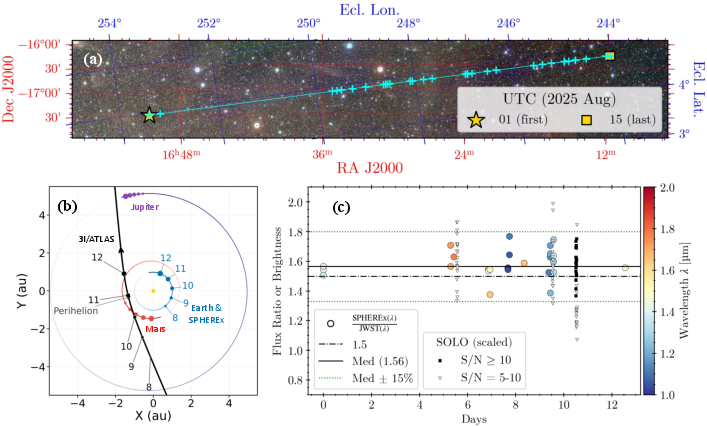
Figure 1: (a) SPHEREx color composite showing 3I trajectory in 1.185, 1.716, and 2.194 μm bands; (b) orbital motion of 3I projected on the ecliptic; (c) relative lightcurve derived from SPHEREx/JWST and SOLO data, showing less than 15% variability—indicative of a coma-dominated flux.
Data Reduction and Analytical Methodology
Aperture photometry (12″ radius, local annulus sky subtraction) and simulation-based contaminant correction were employed to mitigate stellar background confusion, leveraging the SPHEREx Sky Simulator. A contamination diagnostic factor was used to flag exposures with potential cross-contamination. Flux extraction in calibrated MJy/sr units allowed for simultaneous assessment of spatial extension and robust error propagation, incorporating instrument and environmental variance. Spectra were scaled to standard heliocentric and observer distances, and reflectance curves normalized to the solar spectrum—enabling direct compositional analysis.
Results: Temporal Behavior, Spectroscopy, Imaging
Lightcurve and Temporal Stability
Analysis of temporal brightness variations in the near-IR (1.0–1.8 μm) shows ≲15% variation over the 12-day baseline, with the continuum dominated by the coma rather than the unresolved nucleus. Independent visible imaging confirms this low-amplitude behavior is not masking a significant rotational lightcurve, consistent with a scenario where large, long-lived icy grains are the dominant scatterers.
Spectroscopic Signatures: H2O, CO2, and CO Gas
The composite SPHEREx spectrum resolves robust emission from H2O vapor at 2.7–2.8 μm, and CO2 at 4.25–4.27 μm (with a notable shoulder at 4.31 μm attributed to 13CO2), as well as tentative detection of CO near 4.7 μm. The spectral continuum reveals a strong water ice absorption in the 1.5–4.0 μm region, consistent with KBOs and dynamically evolved Oort cloud comets. SPHEREx’s large aperture yields systematically higher gas line fluxes than JWST NIRSpec (which has a much smaller FOV), underscoring the spatially extended nature of the gas-rich coma.
Gas Outflow and Radial Structure
The median-combined images demonstrate a highly extended CO2 (and to a lesser degree H2O) coma, with median radial profiles exceeding 1′ (>300,000 km projected; see Fig. 3). The CO2 brightness profile declines more steeply than the canonical 1/ρ law, approaching a 1/ρ1.5 slope. This indicates non-steady-state outflow—either acceleration due to gas loading or significant photolytic/charge exchange destruction of CO2 at large radii.
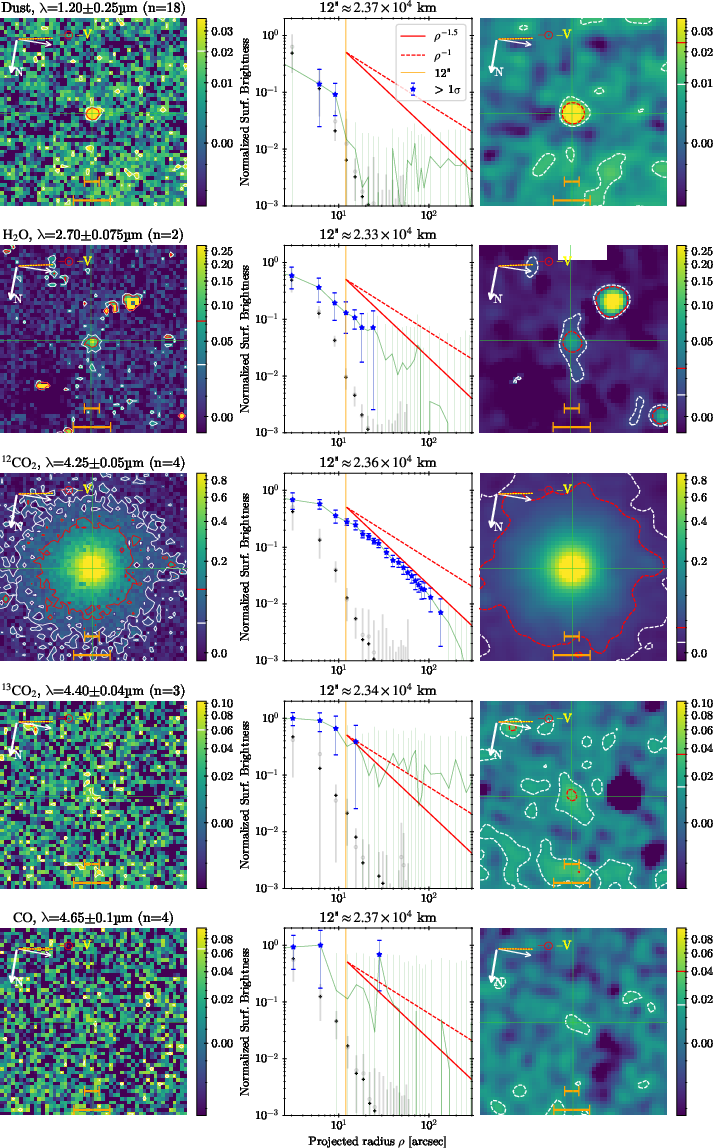
Figure 2: (Left) Median-stacked, simulation- and background-subtracted images (∼5′×5′), showing the spatial extent of 3I’s coma in different IR bands. (Middle) Radial profiles compared to those of field stars; 3I is clearly extended at CO2 and H2O emission wavelengths. (Right) Gaussian-smoothed visualizations demonstrate the asymmetric, sunward-leaning morphology.
Gas Production Rates
The line fluxes yield gas production rates: QH2O=3.2×1026 molecules/s, QCO2=1.6×1027 molecules/s, Q13CO2=1.3×1025 molecules/s, and QCO=1.0×1026 molecules/s, with CO2 dominating H2O by a factor of ∼5, and CO production extremely suppressed. The isotopologue ratio 13CO2/12CO2≈1/100 matches ISM expectations within errors.
Nucleus Characterization
The lack of resolved nuclear extension, plus HST upper limits, restrict the nucleus effective radius to <2.5 km for a low-albedo body, with the observed scattered light requiring a coma-to-nucleus brightness ratio of ∼100. No significant nucleus-induced lightcurve modulation is found.
Discussion: Evolutionary State and Context
The coma structure, volatile dominance, and compositional ratios unequivocally place 3I in a highly processed evolutionary state. The object is CO2 dominated, severely CO depleted, and physically analogous to short-period, hyperactive comet 103P/Hartley 2 (e.g., QCO2/QH2O≫1; see also A’Hearn et al. 2012 [2012ApJ...758...29A] and Lisse et al. 2009 [2009PASP..121..968L]). The absence of water outgassing at this heliocentric distance is interpreted as coma thermal regulation: the sublimation of CO2 from large icy grains cools the material and dynamically suppresses water vaporization until 3I drops inside the water ice line (∼2.5 au). This scenario mirrors the advanced thermochemical processing seen in inner solar system comets at the near-cessation of activity.
Other alternative hypotheses, such as primordial CO depletion or isotopic fractionation driven by GCR irradiation in the ISM, are not supported, given the normal strength of organics and expected isotopic ratios—both in 3I and comparably evolved native comets. The low CO content, extended CO2 coma, and minimal activity variability converge on a history of multiple periapse passages by the host star before ejection, likely from the inner system inside the natal star’s snow lines.
Implications for ISO Origins and Dynamical Ejection
The observed volatile inventory, grain properties, and activity patterns in 3I imply a high degree of thermal evolution prior to interstellar ejection. This sets it apart from both the primitive, volatile-rich 2I/Borisov and the devolatilized 1I/‘Oumuamua. The necessary ejection energy and semimajor axis evolution suggest interaction with a body at least as massive as Neptune (or a close stellar/brown dwarf binary). Thus, the galactic ISO population is shown to sample not only planetesimals directly ejected from young, dynamically excited disks, but also those subjected to sustained thermal and physical processing before dynamical release.
SPHEREx’s survey demonstrates the feasibility and diagnostic power of rapid, multi-wavelength, temporal monitoring of ISOs, resolving both gaseous and solid-state constituents across extended spatial scales.
Conclusion
The SPHEREx mission’s pre-perihelion mapping of 3I/ATLAS establishes a comprehensive volatile and structural inventory for the third detected ISO. 3I displays a CO2-dominated, water-poor coma with strong evidence for hyperactive activity driven by large icy grains and a small, inconspicuous nucleus. This object is highly processed, resembling solar system comets at the end of their lifetimes, and is distinct from 2I/Borisov and 1I/‘Oumuamua in activity profile and evolutionary history.
This study provides strong evidence that ISOs sampled by observational selection are often objects processed thermally inside the snow lines of their natal systems, and that ejection via Neptune-mass (or larger) perturbers is dynamically plausible. Future population studies utilizing all-sky IR surveys (SPHEREx, Roman, etc.) will further quantify the diversity and origins of the galactic ISO population, with implications for protoplanetary disk evolution, planetesimal dynamics, and the distribution of complex organics and volatiles in the Galaxy.
Key quantitative results:
- QCO2=1.6×1027 mol/s, QH2O=3.2×1026 mol/s, QCO=1.0×1026 mol/s
- Extended CO2 coma out to >3′ (>340,000 km)
- Nucleus effective radius <2.5 km, coma-dominated brightness
- Volatile ratios and coma structure matching hyperactive, thermally processed comets like 103P/Hartley 2
Implications:
ISOs frequently represent thermally and dynamically processed objects, not pristine planetesimals, and their properties inform the late-stage evolution and ejection mechanisms in exoplanetary systems.
References:
- "SPHEREx Pre-Perihelion Mapping of H2O, CO2, and CO in Interstellar Object 3I/ATLAS" (2512.07318)
- Relevant cross-comparisons: [2025ApJ...991L..43C], [2025RNAAS...9..242L], [2022PSJ.....3..247H], [2009PASP..121..968L], [2012ApJ...758...29A]