A three-dimensional model for the reversal in the local large-scale interstellar magnetic field
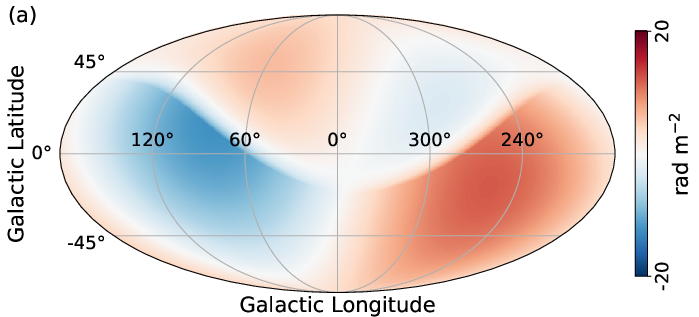
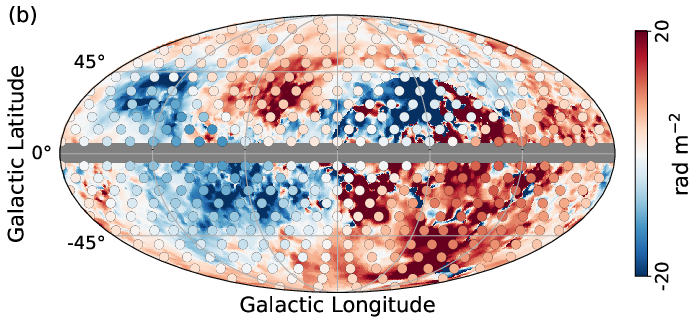
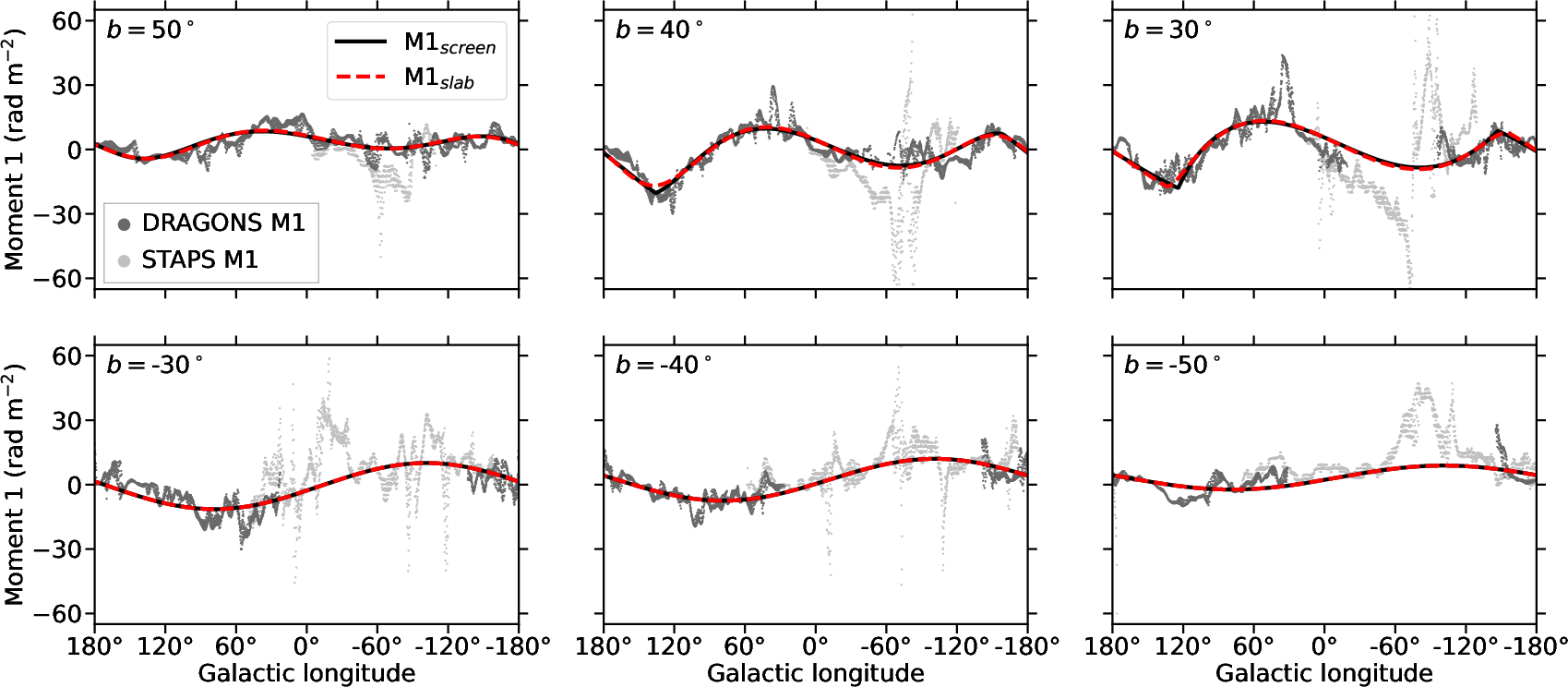
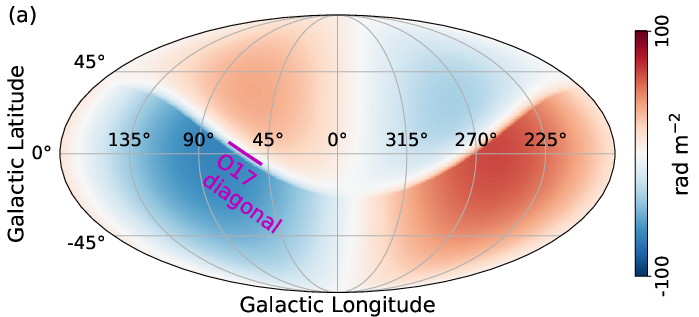
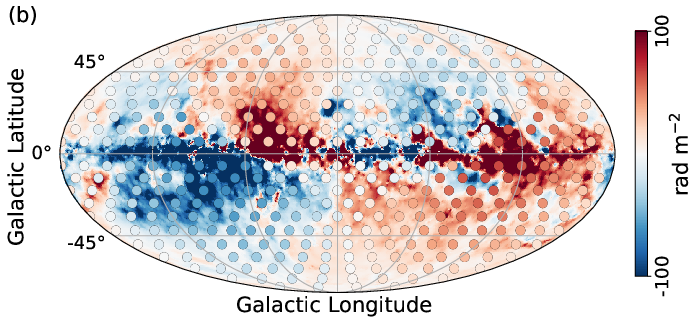
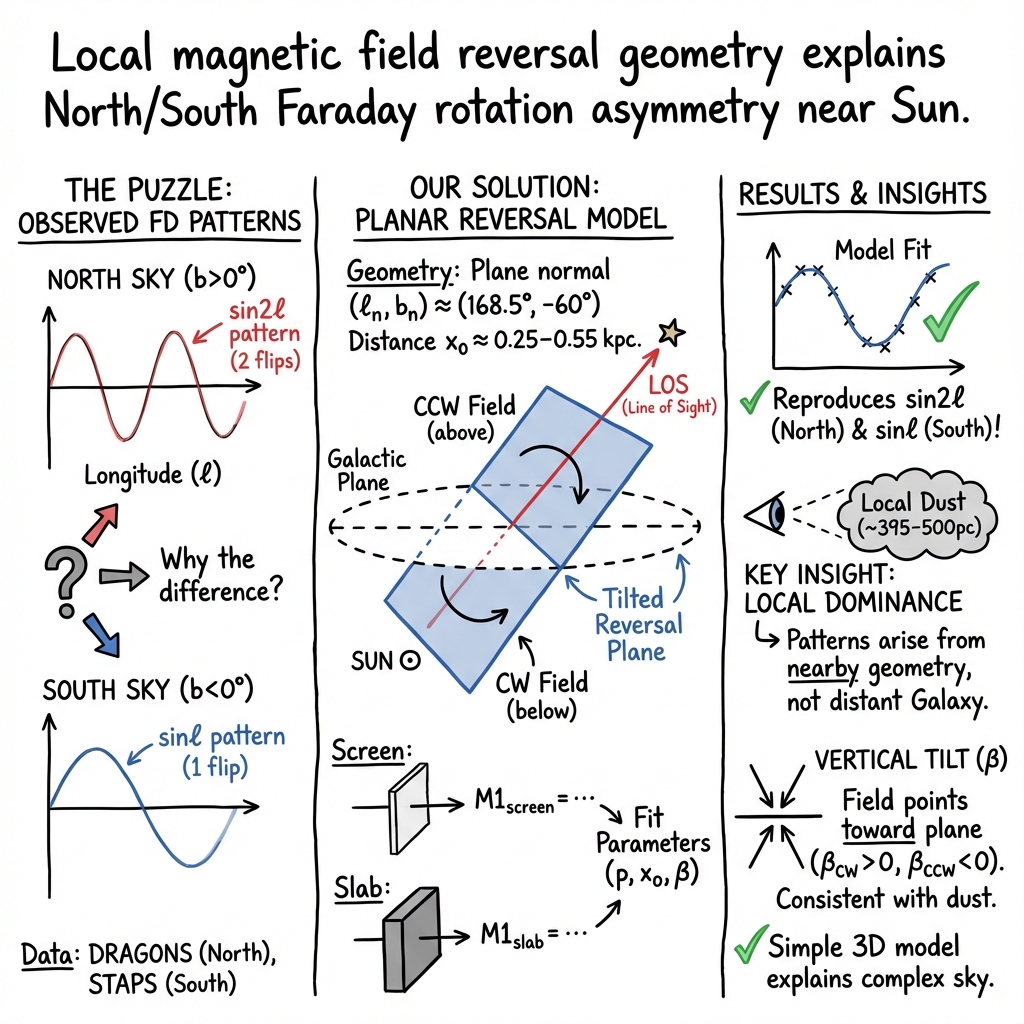
Abstract: We probe the three-dimensional geometry of the large-scale Galactic magnetic field within 1 kpc of the Sun using the Dominion Radio Astrophysical Observatory (DRAO) Global Magneto-Ionic Medium Survey (GMIMS) of the Northern Sky (DRAGONS). DRAGONS is a new full polarization survey of the Northern sky from 350 to 1030 MHz covering declinations -20° < < 90° and a component of GMIMS. The first moment of the Faraday depth spectra produced from DRAGONS above 500 MHz reveals large-angular-scale Faraday depth structures with signs that alternate only once in the Southern Galactic hemisphere and twice in the Northern hemisphere, patterns shared by other Faraday rotation datasets. DRAGONS is the first survey to achieve high Faraday depth resolution while maintaining sensitivity to broad Faraday depth structures, enabling the first use of Galactic longitude-Faraday depth plots. These plots reveal Faraday-complex structures across the sky, indicating a slab-like scenario in which emission and Faraday rotation are mixed. This complexity is overlaid on the same large-scale Faraday depth patterns that appear in the first moment map. We model these patterns as a magnetic reversal slicing through the disk on a diagonal and passing above the Sun in Galactic coordinates. We describe this reversal as a plane with a normal vector parallel to the line directed along (, b) = (168.5°, -60°) and estimate its distance to be between 0.25 and 0.55 kpc. Our results show that much of the observed Faraday sky may be dominated by the local magnetic field configuration.


Paper Prompts
Sign up for free to create and run prompts on this paper.
Top Community Prompts
Explain it Like I'm 14
Overview
This paper studies the magnetic field in our part of the Milky Way — the huge “invisible” field made by moving electric charges that threads through space. The authors use radio waves to make a 3D picture of this field within about 1,000 light-years of the Sun. Their main discovery is that the magnetic field flips direction (a “reversal”) nearby, and this flip can explain big, repeating patterns seen across the sky.
Objectives
The researchers set out to answer a few simple questions:
- Where, exactly, does the local magnetic field flip direction?
- What shape does that flipping region have in 3D space?
- Can this flip explain the large patterns seen in radio measurements across the sky, especially the different “one flip” pattern in the Southern sky and “two flips” pattern in the Northern sky?
Methods and Key Ideas (in everyday language)
To study the magnetic field, the team used polarized radio waves — radio light whose electric field wiggles in a preferred direction — from gas in the Milky Way. As these waves pass through a “fog” of free electrons and magnetic fields, their wiggle direction rotates. This effect is called “Faraday rotation.”
- Think of polarized light like an arrow pointing a certain way. As the arrow flies through an electrically charged, magnetized fog, it slowly turns. How much it turns tells you about the fog’s density and the magnetic field along the path.
Here’s what they did:
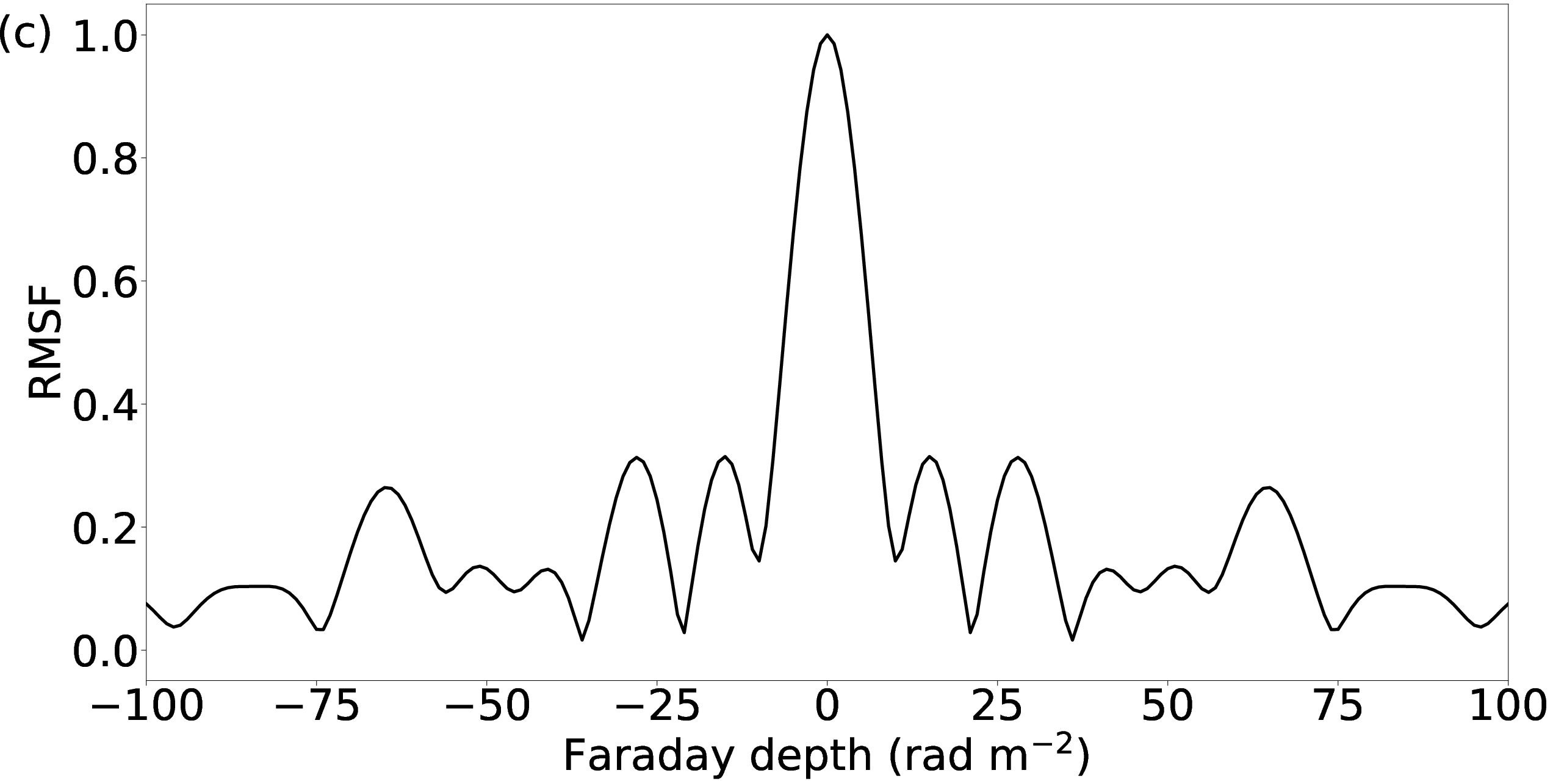
- They used a new radio survey called DRAGONS (observed in Canada) that covers 500–1030 MHz, plus a Southern-sky survey (STAPS) at higher frequencies. DRAGONS has excellent “Faraday depth” resolution, which means it can separate different layers of rotating signals along the line of sight.
- “Faraday depth” (FD) is a way of stacking all the rotations from different distances along your view, like layers in a cake. A “Faraday depth spectrum” shows how much polarized signal comes from each layer.
- If light is emitted and rotated in separate places (like a lamp behind a rotating glass), the signal is “Faraday-simple.” If emission and rotation are mixed together throughout the same material (like a glowing, rotating fog), it’s “Faraday-complex.” DRAGONS shows a lot of this mixed, slab-like behavior.
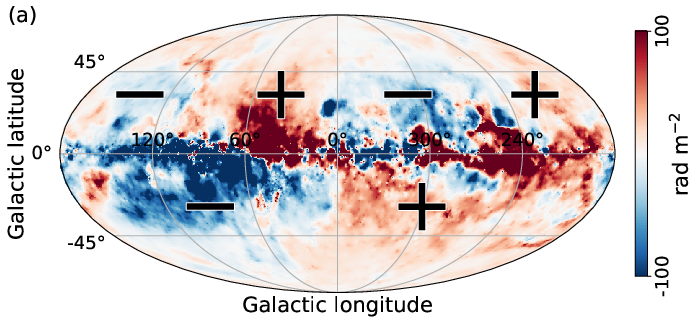
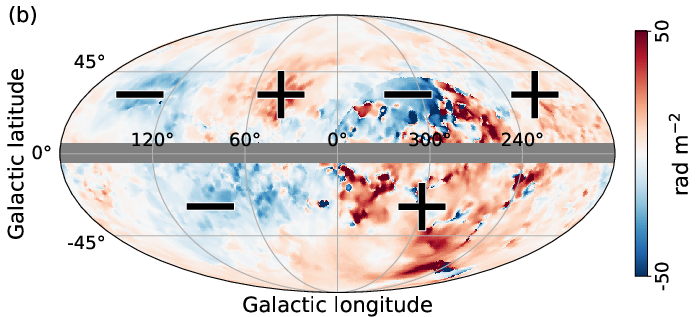
- To turn the 3D FD data into a simple sky map, they computed the “first moment” (called M1). This is a weighted average of the Faraday depths along each sightline, showing overall positive or negative rotation patterns.
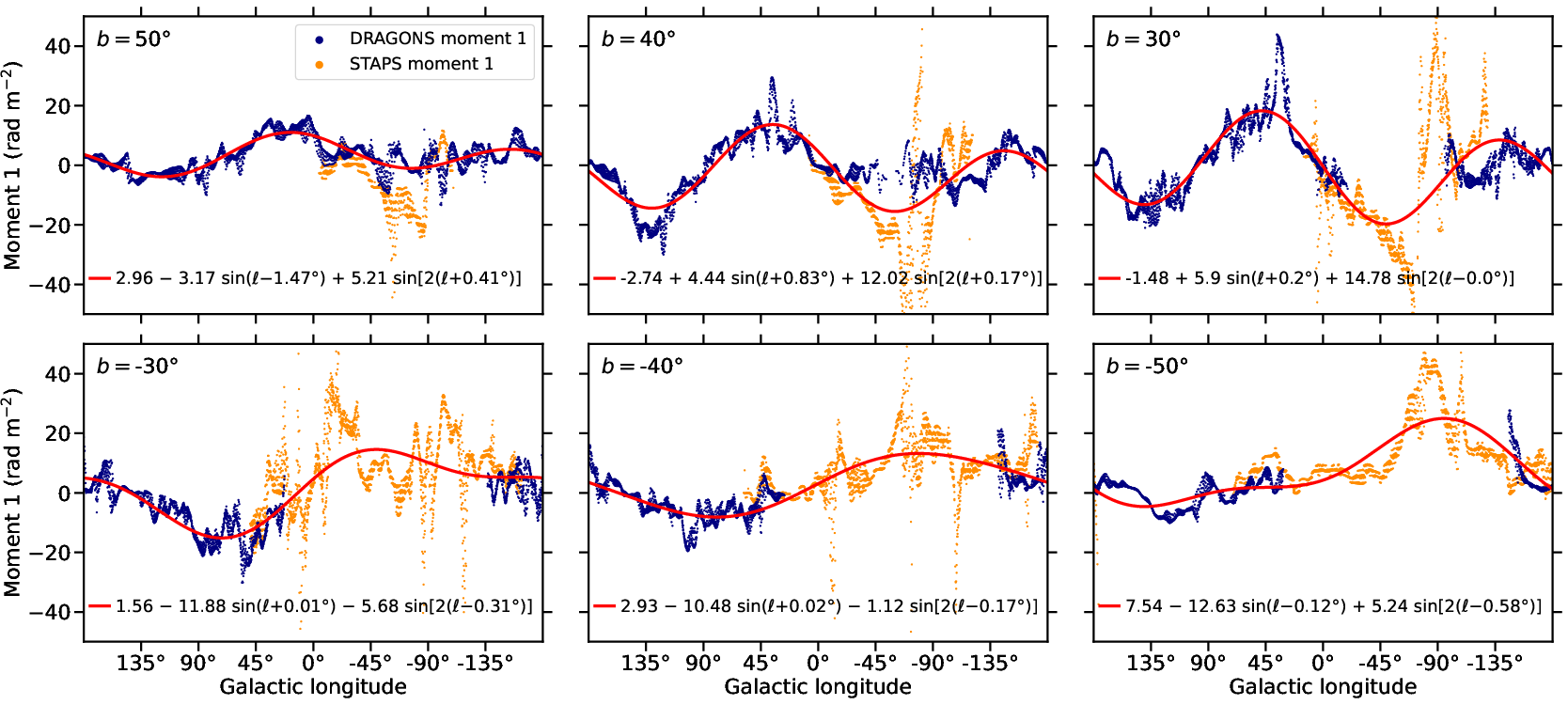
- They looked for smooth, wave-like changes with Galactic longitude (the way we label directions around the Milky Way): a “sin(ℓ)” shape in the South and “sin(2ℓ)” shape in the North, where ℓ is longitude. These patterns mean the line-of-sight magnetic field changes sign (toward us vs. away from us) in regular ways.
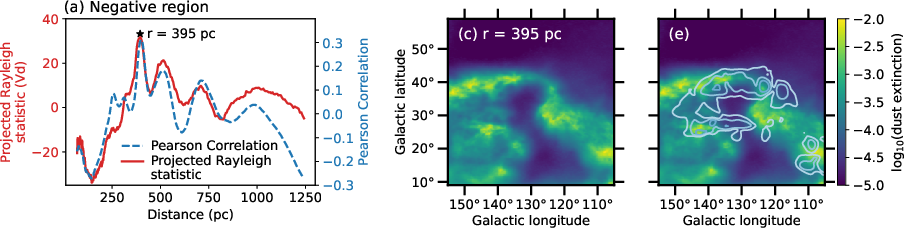
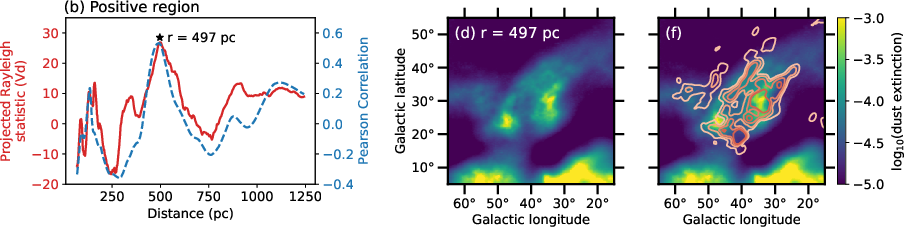
- To estimate distances, they compared DRAGONS features with a 3D dust map (made from starlight extinction and Gaia distances) using a statistical shape-comparison tool (AstroHOG). If the radio and dust structures have matching shapes at a particular distance, that’s a clue to how far the radio effect is.
Finally, they built a simple 3D model:
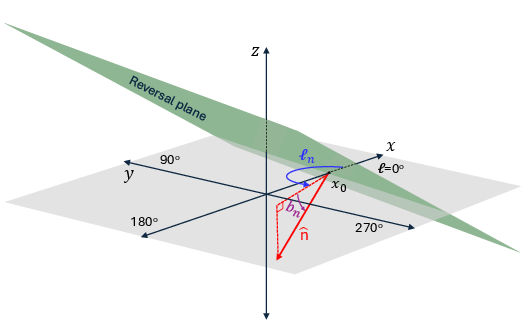
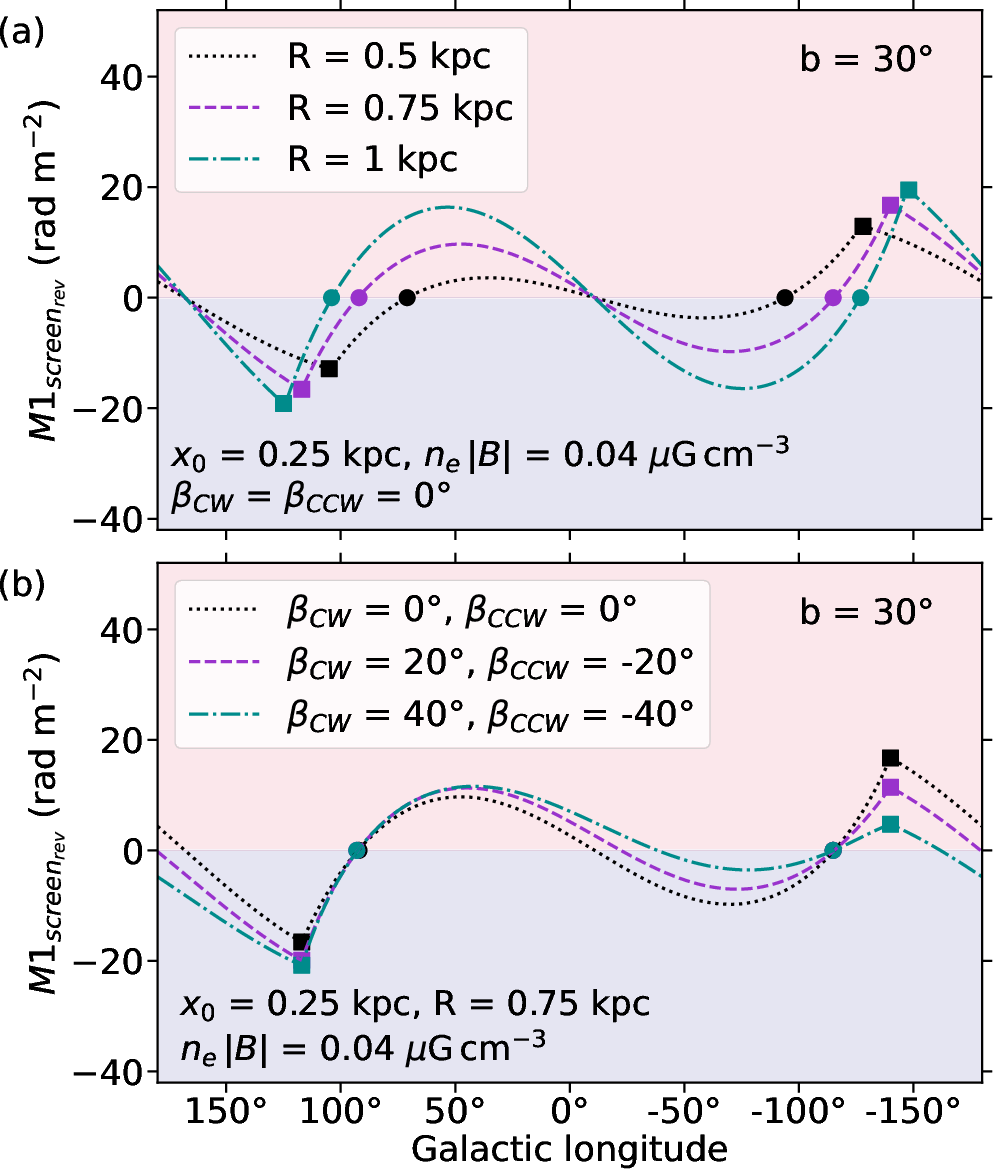
- They modeled the magnetic field reversal as a tilted plane slicing through local space. Below the plane (where the Sun sits), the large-scale field is clockwise (looking down from above the Galaxy). Above the plane, it’s counterclockwise.
- By adjusting the plane’s orientation and how far away it is, they matched the observed Northern and Southern patterns in the radio data.
Main Findings
Here are the main results the authors highlight:
- The sky shows two big, repeated patterns of Faraday rotation:
- In the Southern sky, the sign (positive vs. negative FD) switches only once around the full circle — like a “sin(ℓ)” wave.
- In the Northern sky, it switches twice — like a “sin(2ℓ)” wave.
- DRAGONS is the first survey to combine high resolution in Faraday depth with sensitivity to broad structures, making it possible to see complex, slab-like mixing of emission and rotation and to make longitude–FD plots across the sky.
- Two standout Northern regions (one strongly negative near ℓ ≈ 130°, b ≈ 35°; one strongly positive near ℓ ≈ 40°, b ≈ 30°) match nearby dust structures in the 3D dust map at about 395 pc and 497 pc (roughly 1,300–1,600 light-years). This shows that at least part of the Northern “sin(2ℓ)” pattern comes from the local disk of the Milky Way, not far away in the halo.
- A simple, tilted plane model for the magnetic field reversal reproduces the large patterns well:
- The plane’s normal (its perpendicular direction) points roughly toward Galactic coordinates (ℓ, b) ≈ (168.5°, −60°).
- The plane passes above the Sun, at a distance of about 0.25–0.55 kpc (≈ 800–1,800 light-years).
- Overall, much of what we see in the Faraday rotation sky is shaped by the local magnetic field configuration near the Sun.
Why This Matters
Magnetic fields affect how gas moves and cools, how stars form, and how high-energy particles (cosmic rays) travel. If a nearby field flip is shaping the radio sky, it means:
- Our local neighborhood’s magnetic geometry is a key part of what radio telescopes measure, even when they look across the Galaxy.
- Models of the Milky Way’s magnetic field need to include this tilted, nearby reversal to correctly interpret data.
- Better local 3D maps help astronomers correct for magnetic effects when studying distant galaxies and the early universe.
Takeaway
The team used polarized radio waves to build a 3D picture of the magnetic field near the Sun. They found that a tilted plane where the field flips direction — located hundreds to about a thousand-and-a-half light-years away — explains the big, wave-like patterns seen across the sky. This means the local magnetic field plays a major role in the Faraday rotation we observe, and understanding it helps us see the rest of the universe more clearly.
Knowledge Gaps
Below is a single, actionable list of knowledge gaps, limitations, and open questions that remain unresolved in the paper. Each item is intended to be concrete enough to guide future research.
- Geographic coverage and data completeness:
- Lack of DRAGONS coverage below δ = −20° necessitates reliance on STAPS, which has much poorer Faraday depth resolution (δφ ≈ 140 rad m⁻²) and a different polarization horizon, potentially biasing large-scale pattern fitting in the Southern sky.
- The Galactic plane (|b| < 5°) is masked because of instrumental leakage; the reversal’s geometry and continuity across the mid-plane remain untested.
- RFI removes 43% of DRAGONS channels, altering the RMSF and sensitivity in φ; the systematic impact of this incomplete λ² sampling on moment maps and reversal inference is not quantified.
- Methodological limits in using the first moment (M1):
- The analysis collapses Faraday-complex spectra into M1 maps, losing information about multi-component and Faraday-thick structures; the extent to which M1 faithfully traces LOS B-field sign in mixed emission/rotation (“slab-like”) regimes is not assessed.
- No sensitivity analysis comparing M1 to alternative summaries (e.g., peak φ, weighted centroid with different thresholds, kurtosis/skewness of spectra) to test robustness of large-scale sign patterns.
- RM-CLEAN thresholds are set via Rayleigh fits at |φ| > 750 rad m⁻²; the sensitivity of M1 and sinusoids to CLEAN threshold choices and residual sidelobes is not explored.
- Polarization horizon and depolarization:
- The DRAGONS polarization horizon is only qualitatively estimated (~500 pc and possibly closer); no quantitative, sky-dependent horizon determination (including beam and depth depolarization modeling) is provided.
- The differential polarization horizons of DRAGONS and STAPS are not explicitly modeled, yet both are jointly used in sinusoid fits, risking mixed-path integration artifacts.
- Beam depolarization at 2.45° resolution (and its latitude/longitude dependence) is not quantified; its impact on the visibility of the purported planar reversal is unknown.
- Electron density and emissivity assumptions:
- The FD modeling hinges on nₑ·B∥ along the LOS, but no explicit electron density model (e.g., YMW16/NE2001 or 3D warm ionized medium distributions) is incorporated; the extent to which spatial nₑ variations (and filling factor) drive the observed patterns versus magnetic geometry is left unresolved.
- Synchrotron emissivity (cosmic-ray electron distribution and spectral index) is not modeled, yet emission weighting affects M1 in Faraday-mixed media; future work needs explicit emissivity models to interpret M1 as a B-field tracer.
- Reversal geometry and parameter inference:
- The reversal is treated as an infinitesimally thin, infinite plane; the physical thickness/width, curvature (e.g., arm-following), and lateral continuity of the shear are not constrained.
- Uncertainties on the plane parameters (normal vector orientation, intercept distance) are not reported; no MCMC/Bayesian inference or uncertainty propagation is provided for the plane fit.
- Potential curvature of the reversal with Galactocentric azimuth (arm geometry) is acknowledged but not modeled; the validity range of the “local flat-plane approximation” is not quantified across the sky.
- Latitude-dependent vertical tilt (β) above and below the reversal is introduced conceptually but not empirically constrained; the vertical parity and scale height of the disk-field vs. local structures remain open.
- Sinusoid fitting and cross-dataset consistency:
- The fitted sinusoids (C₁ for sinℓ, C₂ for sin2ℓ) are influenced by higher STAPS magnitudes and uneven coverage; a joint fit that explicitly models each survey’s polarization horizon and noise characteristics is not performed.
- No formal assessment of goodness-of-fit (beyond visual inspection) to the sinusoids across all latitudes; the contribution of higher-order harmonics or latitude-dependent phase shifts is unexplored.
- The persistence of sinℓ/sin2ℓ patterns is argued qualitatively; quantitative cross-validation with independent RM catalogs (EG sources, pulsars) restricted to matched path lengths is limited.
- Distance assignments and dust correlations:
- Distances to the strongest Northern M1 features rely on morphological matching to a single dust map (Edenhofer 2024) using HOG; uncertainties in the preferred distances (395 pc and 497 pc) and sensitivity to kernel size, projection, and distance binning are not reported.
- The assumption that dust structures trace the same magneto-ionic features responsible for FD is not validated with independent gas-phase tracers (Hα EM, HI/CO kinematics) and 3D ionization modeling.
- Only two Northern features are distance-anchored; systematic mapping of the entire sin2ℓ pattern (and the Southern sinℓ pattern) to 3D dust/gas structures is missing.
- Physical origin and environment of the reversal:
- The dynamical mechanism producing a tilted, planar shear near the Sun is not identified; competing scenarios (spiral density wave, Parker instability, superbubble/Local Bubble shell interactions, arm–interarm shear) are not modeled or discriminated.
- The relationship between the observed reversal and known local structures (Local Bubble shell, NCPL cavity, HI bubbles) is qualitative; quantitative magneto-hydrodynamic modeling is required to test causal links.
- Ambiguity between local and halo contributions:
- Although evidence suggests parts of the sin2ℓ pattern are local (~250 pc above the mid-plane), the fractional contribution of halo vs. disk fields to the large-scale patterns remains undetermined.
- The proposed dominance of the “local magnetic field configuration” over the observed Faraday sky is not quantified (e.g., via path-integrated FD decompositions or component separation across latitudes/frequencies).
- Alternative explanations and falsifiability:
- Anisotropic turbulence, random field compressions, or field draping around local cavities could produce similar sign patterns; the paper does not present falsification tests to exclude these alternatives.
- Predictions of the plane model (e.g., a sky map of R_p, expected sign transitions vs. latitude/longitude, FD magnitude gradients) are not fully enumerated and tested against independent datasets.
- Frequency dependence and multi-band synthesis:
- The decision to exclude 350–500 MHz sacrifices FD resolution; the trade-off is asserted but not quantitatively evaluated. Multi-band RM synthesis combining DRAGONS, LBS, HBN, and STAPS to recover Faraday-thick structures is not attempted.
- Bandwidth depolarization across the wide DRAGONS band (500–1030 MHz) and its effect on FD spectra is not assessed; potential biases in feature widths and centroids remain.
- Calibration and systematics:
- Cross-calibration between DRAGONS and STAPS (absolute FD scale, leakage corrections, ionospheric RM removal, beam modeling) is not detailed; systematic offsets in magnitudes and signs may affect pattern interpretation.
- The impact of spatially varying noise and CLEAN cut-offs on M1 distributions (especially near survey boundaries and RFI gaps) is not characterized.
- Model-to-observation forward simulations:
- A full forward model (nₑ, B-field geometry including the plane, synchrotron emissivity, and Faraday synthesis to produce mock FD cubes/M1 maps) is not presented; without this, the explanatory power and uniqueness of the planar reversal interpretation cannot be rigorously tested.
- The width of Faraday-thick features relative to DRAGONS φ_max-scale (≈37 rad m⁻²) and their detectability is not explored via simulations, leaving open whether key structures are partially resolved or smeared.
- Scope and generalization:
- The model’s applicability beyond ~1 kpc is not evaluated; it is unknown whether the same geometry explains sinℓ/sin2ℓ patterns at higher latitudes and greater distances.
- The paper does not provide a roadmap for how future surveys (e.g., GMIMS LBS South, SKA pathfinders, LoTSS polarization, high-resolution single-dish mosaics) could decisively refine the plane parameters or test competing models.
Practical Applications
Overview
This paper introduces a three-dimensional, planar model of the local large-scale Galactic magnetic field reversal within ~1 kpc of the Sun, using the DRAGONS (GMIMS Northern low-band) full-polarization survey and complementary STAPS data. Key innovations include:
- High Faraday depth resolution while retaining sensitivity to broad Faraday depth structures, enabling longitude–Faraday depth plots and robust first-moment (M1) mapping.
- Empirical identification of large-scale Faraday patterns (Southern sin ℓ and Northern sin 2ℓ) across datasets with different polarization horizons.
- A geometrically constrained, three-dimensional “planar reversal” model that slices diagonally through the local disk, passing above the Sun; best-fit normal vector direction near (ℓ, b) ≈ (168.5°, −60°), with inferred distances ~0.25–0.55 kpc.
- A reproducible workflow to assign distances to Faraday structures via morphological matching (AstroHOG) against the Edenhofer et al. 3D dust map, confirming major Northern sin 2ℓ contributors at ~395 pc and ~497 pc (heights ≈250 pc).
Below are practical applications and pathways derived from these findings, grouped by deployment horizon.
Immediate Applications
These can be deployed now with current data, tools, and methods.
- Galactic RM correction layers for pulsar-, FRB-, and extragalactic-polarimetry pipelines
- Sector: astronomy (time-domain, radio), software
- Application: Integrate the local planar reversal geometry and M1-based sin ℓ/sin 2ℓ priors to improve RM corrections and distance-based RM partitioning in propagation models for pulsars and FRBs; reduce systematic biases in dispersion and RM analyses.
- Tools/workflows: Use the provided “Local_reversal” Python library, RM-Tools (CIRADA), and the longitude–FD plots; add a “local RM prior” module to data reduction pipelines.
- Assumptions/dependencies: DRAGONS polarization horizon (~few hundred pc); planar approximation valid within ~1 kpc; electron density models (e.g., NE2001/YMW16) used consistently with local RM priors.
- Foreground modeling for CMB/dust polarization and microwave surveys
- Sector: cosmology, software
- Application: Use the sin ℓ/sin 2ℓ large-scale Faraday structure and local reversal plane to refine polarized foreground models (synchrotron + rotation) for component separation and B-mode searches; improve cross-calibration with dust polarization.
- Tools/workflows: Inject M1 maps and planar-reversal geometry as spatial priors in parametric or Bayesian component-separation frameworks.
- Assumptions/dependencies: Mixed emission/rotation (“slab-like”) lines-of-sight; coupling to dust polarization varies with environment; requires coordination with 3D dust models.
- Targeted follow-up of high-|M1| regions (e.g., NCPL and nearby H I bubble)
- Sector: astronomy (ISM studies), observatories
- Application: Plan H I, Hα, radio-polarization, and Zeeman follow-ups to probe ionization and compression at the edges of cavities that dominate local Faraday rotation; validate field-direction continuity and slab-like mixing.
- Tools/workflows: Use DRAGONS/STAPS M1 cut-outs and AstroHOG-derived distances (≈395 pc and ≈497 pc) to design observing campaigns.
- Assumptions/dependencies: Morphological matching via AstroHOG is robust; local enhancements reflect ambient field direction rather than random small-scale distortions.
- Survey design and calibration guidance for wideband polarization instruments
- Sector: radio instrumentation, SKA/MeerKAT/LOFAR/ASKAP/CHIME operations
- Application: Apply DRAGONS trade-offs (high FD resolution with sensitivity to broad FD structures) to band selection, beam size, and RM-CLEAN thresholds; anticipate Faraday-complex “slab” LOS and depolarization horizons in survey planning.
- Tools/workflows: Adopt the Rayleigh-based RM-CLEAN cutoff determination; generate longitude–FD plots to identify complexity and optimize scan strategies.
- Assumptions/dependencies: RFI environment, frequency channelization, uniform calibration across bands; beam depolarization effects scale with resolution.
- Distance-tagging workflow for Faraday structures using 3D dust maps
- Sector: academia, software
- Application: Generalize the AstroHOG+Gaia-anchored 3D dust methodology to assign distances to Faraday rotation features in other surveys (LOFAR, MeerKAT, ASKAP), enabling true 3D tomographic catalogs of RM features.
- Tools/workflows: AstroHOG package; Edenhofer et al. dust map; gradient-based morphology statistics (projected Rayleigh statistic, Pearson correlation).
- Assumptions/dependencies: Good angular registration between datasets; dust–ionized-gas spatial layering may offset peaks; requires scale-appropriate smoothing.
- Rapid prototyping/updating of Galactic magnetic field (GMF) models
- Sector: academia (theory and simulations), software
- Application: Add a local planar-reversal component to GMF models (e.g., JF12-class), tuned to (ℓ, b) ≈ (168.5°, −60°) and distances 0.25–0.55 kpc; test odd-parity disk assumptions vs. local constraints.
- Tools/workflows: Fit Fourier terms per latitude (sin ℓ and sin 2ℓ), combine with RM catalogs (pulsars, EG sources) and M1 maps; validate via synthetic RM sky generation.
- Assumptions/dependencies: Planar segment approximates a locally curved reversal; pitch angle and vertical tilt (β) parameterization consistent across components.
- Training data for ML classifiers of Faraday-simple vs. Faraday-complex LOS
- Sector: software/ML for astronomy
- Application: Use DRAGONS FD cubes and longitude–FD plots as labeled examples of slab-like complexity; improve automated classification and cleaning in RM-synthesis pipelines.
- Tools/workflows: Generate curated datasets with FD spectra, RMSF characteristics, and depolarization diagnostics; benchmark models against known regions.
- Assumptions/dependencies: Stability of labels across frequency bands and resolutions; model generalization to other instruments.
- Advocacy for spectrum protection and wideband polarimetry
- Sector: policy/regulation for radio astronomy
- Application: Leverage demonstrated sensitivity to broad FD structures to argue for protecting low-frequency bands from RFI; support radio quiet zones and coordinated spectrum management for magnetism key-science.
- Tools/workflows: White papers incorporating DRAGONS/STAPS performance metrics and FD-max-scale requirements.
- Assumptions/dependencies: Regulatory processes; community engagement (SKA, IAU, ITU).
Long-Term Applications
These require further research, scaling, and/or new infrastructure.
- Full-sky, high-resolution 3D magneto-ionic atlas of the local ISM
- Sector: astronomy (Galactic structure), software/infrastructure
- Application: Combine DRAGONS-like FD cubes, high-band surveys, and 3D dust/gas maps to build a distance-resolved GMF atlas with embedded reversal surfaces; support ISM tomography and multi-phase modeling.
- Tools/workflows: Harmonize multi-band RM synthesis, 3D dust (Gaia-based), H I/CO/ionized tracers; probabilistic LOS deconvolution with distance priors.
- Assumptions/dependencies: Improved electron-density models; robust LOS disentanglement in Faraday-complex sightlines; data uniformity across hemispheres/bands.
- Cosmic-ray transport and anisotropy modeling constrained by local reversal geometry
- Sector: high-energy astrophysics, space environment
- Application: Integrate the planar reversal into diffusion and drift models to refine predictions of cosmic-ray arrival directions, local grammage, and gamma-ray/neutrino backgrounds.
- Tools/workflows: MHD+CR transport simulations tuned to local field orientation; validate against CR anisotropy and γ-ray maps.
- Assumptions/dependencies: Turbulence spectra and coherence scales in the local ISM; coupling to multi-phase gas; time stability of local field configuration.
- Polarized foreground leakage mitigation for 21-cm EoR and intensity mapping
- Sector: cosmology (low-frequency radio)
- Application: Use local FD priors and reversal geometry to better model and subtract polarized leakage into Stokes I; improve EoR/intracacy detection fidelity.
- Tools/workflows: Incorporate FD-aware priors into calibration and beam-modeling; cross-validate with LOFAR/SKA pathfinders.
- Assumptions/dependencies: Accurate beam polarization models; wideband, low-RFI data; scalable pipelines for full-sky correction.
- Refinement of GMF global models with curved, arm-following reversal surfaces
- Sector: theory/simulation, SKA-era surveys
- Application: Extend the local planar approximation to curved surfaces aligned with spiral arms; reconcile with odd/even parity disk field hypotheses and halo transitions.
- Tools/workflows: Joint fits to pulsar RMs, EG-source RMs, dust polarization, and synchrotron; Bayesian hierarchical modeling with spatially varying pitch angles and β.
- Assumptions/dependencies: Denser pulsar RM sampling (SKA), improved distance ladders, consistent cross-calibration of multi-tracer datasets.
- Time-domain RM tomography of the local ISM
- Sector: astronomy (monitoring), infrastructure
- Application: Monitor RM variations to separate static local reversal geometry from dynamic ionized structures (e.g., expanding shells, shocks); refine slab-like mixing models.
- Tools/workflows: Long-term multi-frequency polarization monitoring; RM time-series analyses with 3D contextual maps.
- Assumptions/dependencies: Sufficient cadence and sensitivity; disentangling ionospheric/solar contributions.
- Standardization and dissemination of FD-aware processing across facilities
- Sector: observatory operations, software
- Application: Codify best practices (Rayleigh-threshold RM-CLEAN, longitude–FD diagnostics, AstroHOG distance-tagging) into community pipelines for SKA/MeerKAT/ASKAP/LOFAR.
- Tools/workflows: Open-source modules, reproducible notebooks, validation suites; training and documentation.
- Assumptions/dependencies: Community adoption; interoperability across data formats and instrument idiosyncrasies.
Notes on Assumptions and Dependencies
- Planar reversal approximation: Valid primarily within ~1 kpc; true reversal likely curves along spiral structure; local plane parameters (normal near (ℓ, b) ≈ (168.5°, −60°), intercept 0.25–0.55 kpc) should be treated as local constraints.
- Polarization horizons and depolarization: DRAGONS is most sensitive to nearby (~few hundred pc) emission; beam and depth depolarization limit interpretability at larger distances.
- Faraday-complex “slab” LOS: Emission and rotation are mixed; first-moment (M1) maps provide robust large-scale patterns but do not uniquely resolve LOS layering.
- Electron density and magnetic-field parameterization: RM depends on both; improvements in 3D n_e models will tighten distance and field-geometry inferences.
- Morphology-based distance attribution: AstroHOG gradients and Pearson correlations rely on consistent angular registration and appropriate smoothing; dust–ionized gas offsets are expected and must be modeled.
- Cross-survey integration: STAPS has coarser FD resolution than DRAGONS; joint use requires careful treatment of frequency coverage, RMSF differences, and calibration.
Glossary
- AstroHOG: An astrophysics toolkit that implements Histogram of Oriented Gradients to quantify morphological agreement between images. "AstroHOG compares two images by computing the two-dimensional spatial gradient of each and performing a statistical analysis of the distribution of gradient angle differences across the images, quantifying their morphological agreement."
- Bayesian inference: A statistical framework using priors and likelihoods to infer parameters; used here to construct 3D dust and RM maps. "produced by applying Bayesian inference to the stellar extinction and Gaia distances of 54 million stars."
- beam depolarization: Reduction of observed polarization due to variations of polarization angle across the telescope beam. "there may be multiple black{FD}s or emitted polarization angles distributed across the telescope beam (beam depolarization)."
- CIRADA RM-Tools: A software package for Faraday synthesis and rotation measure analysis. "To apply Faraday synthesis to the DRAGONS data, we used the CIRADA RM-Tools package"
- CLEAN cut-off threshold: The stopping criterion in RM-CLEAN deconvolution, often set in terms of sigma. "the CLEAN cut-off threshold for each LOS in the DRAGONS maps set to "
- declination: A celestial coordinate measuring angular distance north or south of the celestial equator. "covering declinations "
- depth depolarization: Polarization loss caused by differential Faraday rotation along the line of sight. "experiences varying amounts of Faraday rotation along the path, causing different angles to emerge at the point of observation (depth depolarization)."
- DRAGONS: The DRAO GMIMS survey of the Northern Sky, a low-frequency, full-polarization mapping project. "We use the Dominion Radio Astrophysical Observatory (DRAO) GMIMS of the Northern Sky (DRAGONS) survey"
- DRAO-15: A 15-m offset paraboloid radio telescope at DRAO used for DRAGONS. "using the DRAO-15 telescope, an offset paraboloid with an effective diameter of 15 m."
- dust extinction: Attenuation of starlight due to interstellar dust; mapped in 3D to estimate distances to structures. "The result is a three-dimensional map of dust extinction"
- extragalactic (EG) sources: Radio sources outside the Milky Way used to probe Galactic Faraday rotation. "using the RMs of 55190 extragalactic (EG) sources, compiled from 41 catalogs"
- Faraday-complex: A line of sight where emission and rotation are mixed, yielding multiple Faraday depth components. "the LOS ISM is `Faraday complex' as there are multiple values along the path."
- Faraday depth (FD): The integral of electron density times the line-of-sight magnetic field, governing polarization angle rotation per unit wavelength squared. "is referred to either as a Faraday depth black{(FD)} or rotation measure (RM)."
- Faraday rotation: Rotation of the linear polarization angle as radio waves traverse magnetized plasma. "Much of our understanding of cosmic magnetism is based on observations of Faraday rotation, in which linearly polarized radiation undergoes a rotation of polarization angle"
- Faraday synthesis: A technique reconstructing FD spectra from broadband polarization data. "To apply Faraday synthesis to the DRAGONS data"
- Fourier sine series: A sum of sine terms used to fit longitudinal patterns in Faraday maps. "\citet{Dickey2022} fitted a Fourier sine series,"
- FWHM: Full width at half maximum; here, the resolution of the RMSF in FD space. "The DRAGONS RMSF has a black{FWHM} of = 14~"
- Gaia: ESA’s astrometric spacecraft providing parallaxes and distances for stars. "determined using the European Space Agency's Gaia satellite"
- Galactocentric azimuthal angle: The angular coordinate around the Galactic center used to locate positions in the disk. "We take the Galactocentric azimuthal angle, , to be "
- Galactocentric distance: Distance from the Galactic center, often denoted . "we use a Galactocentric distance of 8.15~kpc"
- Galactic coordinates: The longitude–latitude system centered on the Milky Way. "passing above the Sun in Galactic coordinates."
- Galactic longitude-Faraday depth plots: Visualizations mapping Faraday depth as a function of Galactic longitude. "enabling the first use of Galactic longitude-Faraday depth plots."
- Galactic mid-plane: The z=0 plane of the Milky Way’s disk. "heights of approximately 250~pc above the Galactic mid-plane"
- GMIMS: The Global Magneto-Ionic Medium Survey, a multi-band full-sky polarization project. "Global Magneto-Ionic Medium Survey (GMIMS) project"
- HEALPix: A sky map pixelization scheme with equal-area, iso-latitude pixels. "has in HEALPix format"
- Histogram of Oriented Gradients (HOG): An image descriptor comparing gradient orientations to assess morphology. "applied the Histogram of Oriented Gradients (HOG) method"
- kiloparsec (kpc): A distance unit equal to 1,000 parsecs (~3,262 light-years). "within 1~kpc of the Sun"
- line-of-sight (LOS): The direction from the source to the observer along which quantities are integrated. "the line-of-sight black{(LOS)} component of the field"
- Local Bubble: A cavity in the local interstellar medium surrounding the Sun. "the magnetic field in the shell of the Local Bubble alone to produce such sinusoidal patterns"
- magnetic reversal: A region where the large-scale magnetic field changes direction. "We model these patterns as a magnetic reversal slicing through the disk on a diagonal"
- Magneto-Ionic Medium: Ionized gas threaded by magnetic fields that alters radio polarization via Faraday rotation. "Global Magneto-Ionic Medium Survey (GMIMS)"
- microgauss (G): A unit of magnetic field strength commonly used in astrophysics. " (G)"
- moment 1 (M1): The intensity-weighted mean Faraday depth of a spectrum. "For each LOS, the first moment (M1) is calculated as,"
- Murriyang: The Parkes 64-m radio telescope in Australia. "observed with the Parkes Murriyang 64-m telescope"
- North Celestial Pole Loop (NCPL): A nearby dust and H I cavity contributing to local Faraday structures. "is the North Celestial Pole Loop (NCPL)"
- offset paraboloid: A reflector design with the feed offset from the axis to reduce blockage. "an offset paraboloid with an effective diameter of 15 m."
- parallax distances: Distances to stars determined from apparent positional shifts due to Earth’s orbit. "Extinction measurements towards stars with parallax distances"
- parsec (pc): An astronomical distance unit (~3.26 light-years). " (pc)"
- Pearson correlation coefficient: A statistic measuring linear correlation between two datasets or images. "We also show the Pearson correlation coefficient as a function of distance"
- pitch angle: The angle of a spiral field relative to circular motion around the Galactic center. "with a pitch angle of approximately 11.5"
- polarization horizon: The maximum distance from which polarized emission can be detected before depolarization dominates. "depolarization effects limit the distance probed to a finite polarization horizon"
- projected Rayleigh statistic: A measure quantifying the alignment of gradient directions between images. "the projected Rayleigh statistic for the gradient vector direction, "
- radio frequency interference (RFI): Contaminating radio signals from man-made sources that must be excised. "The dark gaps are due to channels omitted as a result of radio frequency interference."
- Rayleigh distribution: A probability distribution used here to model polarized intensity noise at high |FD|. "we fit a Rayleigh distribution to the polarized intensity for ~."
- RM-CLEAN: An algorithm to deconvolve RMSF sidelobes from FD spectra. "can be reduced using RM-CLEAN"
- rotation measure (RM): The slope of polarization angle versus for Faraday-simple sources. "is referred to either as a Faraday depth black{(FD)} or rotation measure (RM)."
- rotation measure spread function (RMSF): The instrument’s response function in FD space that blurs the true spectrum. "The DRAGONS rotation measure spread function."
- RMSF sidelobes: Secondary peaks of the RMSF that contaminate FD spectra. "produced `dirty' (contaminated by the RMSF sidelobes) black{FD} spectra"
- Sagittarius Arm: One of the Milky Way’s spiral arms used as a reference for field reversals. "between the Sun and the Sagittarius Arm"
- single-dish radio telescopes: Large standalone radio antennas used for total-power polarization surveys. "using large single-dish radio telescopes."
- slab-like: A mixed-emission and rotation scenario where polarized emission and Faraday rotation coexist along the path. "indicating a black{slab-like} scenario in which emission and Faraday rotation are mixed."
- Stokes parameters: The I, Q, U quantities describing total intensity and linear polarization. "Stokes , , and observations cover frequencies 350 MHz to 1030 MHz"
- synchrotron emission: Radio emission from relativistic electrons spiraling in magnetic fields. "diffuse Galactic synchrotron emission"
- wavelength squared (): The square of radio wavelength; Faraday rotation scales with . "The change in polarization angle, , depends on wavelength squared, (m)"