- The paper demonstrates that nearly identical, collimated (~10^55 erg) Galactic Center outbursts can jointly produce the nested Fermi and eROSITA bubbles.
- Analytical models and hydrodynamical simulations accurately reproduce observed bubble morphologies, Mach numbers, and shock features.
- The study attributes the pronounced east-west asymmetry in bubble structure to an eastward ambient density gradient rather than a horizontal wind.
Nested Fermi and eROSITA Bubbles: Evidence for Collimated Galactic Center Outbursts and Their Environmental Implications
Introduction and Motivation
This study addresses the observed phenomenon of two spatially nested, extensive bipolar bubbles emanating from the Galactic center of the Milky Way: the inner Fermi bubbles (FBs) and the larger eROSITA bubbles (RBs). Both structures have been identified as expanding, shock-bounded outflows with strong forward shocks, necessitating energetic injection events at the Galactic center. The existence of these nested features, their similar morphology, and their pronounced longitudinal asymmetry present stringent constraints for models of their origin and evolution.
Analytical and Numerical Modeling Framework
The authors construct a multi-stage, physically stratified model of bubble evolution in a planar, power-law circumgalactic medium (CGM), accounting for the gravitational potential of Galactic baryonic and dark matter components. Each outflow is modeled as a pair of collimated jets characterized by injection energy Ej, half-opening angle θj, velocity vj, and duration Δtj. Analytical solutions delineate three evolutionary regimes: an initial ballistic phase (head speed ∼vj, slow lateral expansion), a slowdown phase (power-law head deceleration), and eventual quasi-spherical expansion (approaching Sedov-Taylor scaling far from the disk). Key dimensionless parameters, notably ξ (controlling ballistic-to-slowdown transition), are derived and systematically explored.
Constraints are obtained by matching model predictions to broadband observational data, including projected X-ray and γ-ray morphologies, Mach numbers, and comparative energetics. A suite of two- and three-dimensional hydrodynamical simulations (using PLUTO) validate the analytic approach and probe parameter sensitivity.
Observational Constraints and Morphological Analysis
Strong Shock Identification and Morphology
Multiple distinct lines of evidence—spectral analysis of radio, X-ray, and γ-ray emission, polarization diagnostics, and temperature/density jumps—point to strong, M>4 forward shocks at the rims of both FBs and RBs. Contradictory claims in recent literature suggesting weak shocks (M<2) are quantitatively refuted by the combination of plasma diagnostics and model evolution.
Bubble Edge Deprojection and Parameter Estimation
Detailed projection analysis quantifies half-opening angles θj≈4∘, heights zFB∼10 kpc (FBs), and zRB∼30 kpc (RBs). The best-fit models necessitate similar outburst energies for both bubble generations: Ej∼1055 erg, accurate within a factor of $2$–$3$, thus demonstrating that both FBs and RBs can be explained by nearly identical episodic outbursts, separated by ∼10–$20$ Myr.
Asymmetry and Environmental Gradient
Whereas previous works invoked a horizontal, westward Galactic wind to account for the observed east-west elongation and asymmetry, the modeling presented here demonstrates this is dynamically implausible. Instead, the paper explicitly favors an eastward ambient density gradient as the origin of the asymmetry, supported by correlated enhancements in bubble brightness and shock strength observed in the eastward sectors.
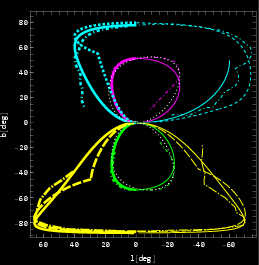
Figure 1: Projected edges of the FB and RB as traced by X-ray edge detectors, with overplotted analytic projections for both ballistic and slowdown models, highlighting the east-west asymmetry and model fit.
Hydrodynamical Simulation Results
Single-Bubble Evolution
Hydrodynamical simulations explore both ballistic (ξ≫1) and slowdown (ξ≪1) evolution scenarios for RBs. Ballistic solutions (satisfying FB constraints) require elevated jet velocity and produce strong shocks (MH∼12, interior T≳1 keV), over-bright in X-rays, while low-energy, high-velocity cases undergo significant deceleration and yield weaker, quasi-spherical shocks.
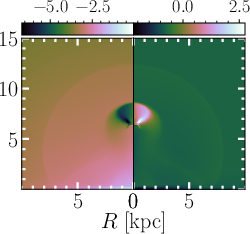
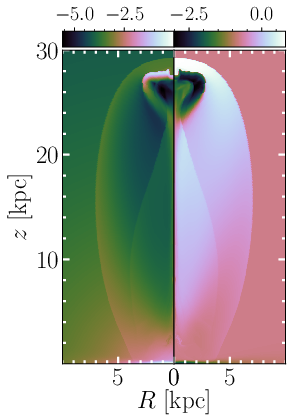
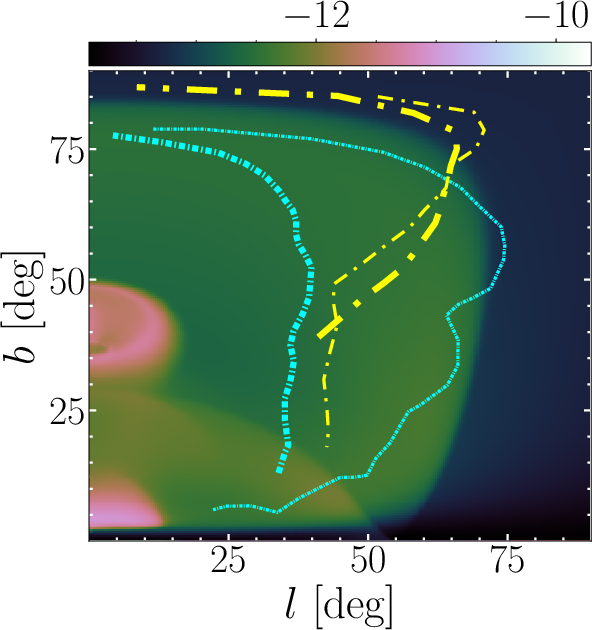
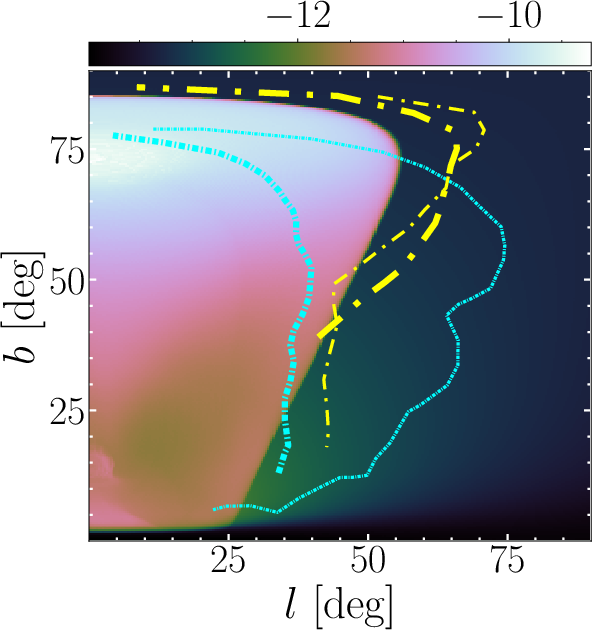
Figure 2: Comparison of RB-only simulations (B: ballistic, S: slowdown regimes); top: density and temperature structure; bottom: projected $2$--$10$ keV X-ray surface brightness, with observed edges overlaid.
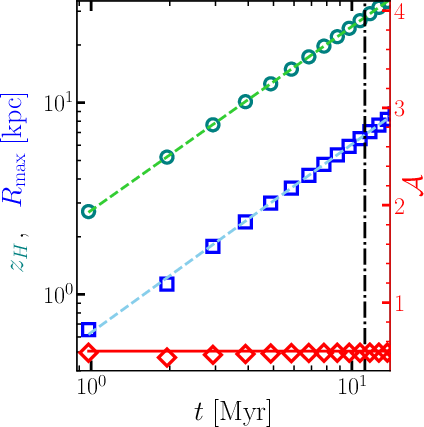
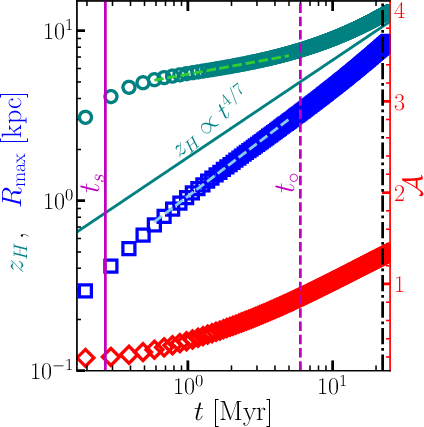
Figure 3: Evolution of simulated RBs—bubble head height, width, and aspect ratio—illustrating transition points between ballistic, slowdown, and quasi-spherical isotropic expansion phases.
Parameter Sensitivity and FB/RB Coupling
A systematic parameter sweep and convergence analysis shows the FB evolution is highly sensitive to the RB as a preconditioned medium: FBs propagating into RB-shocked, rarefied gas retain a ballistic character even for ξ≲1, as the critical mass to decelerate the FB head increases, thereby tightly constraining the available phase space.
Nested Bubble Modeling and Principal Results
Joint Outburst Scenario
The full numerical setup launches two identical (or near-identical) collimated jets from the GC separated by $7$–$20$ Myr, naturally yielding spatially nested RBs and FBs. Simulations recover observed X-ray and γ-ray morphologies, Mach number distributions, and aspect ratios. RB edges are best fit at the onset of slowdown (ξ∼1), while FBs remain ballistic. The matching of simulated and observed structures is robust for a range of Ej∈(1055,3×1055) erg, vj∼2000 km s−1, θj∼4∘.
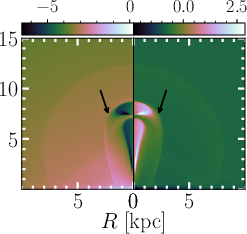
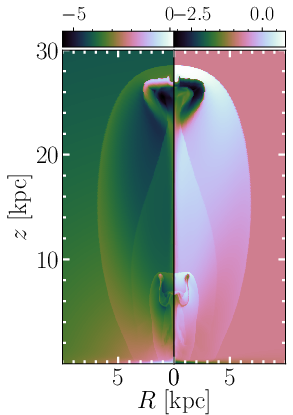
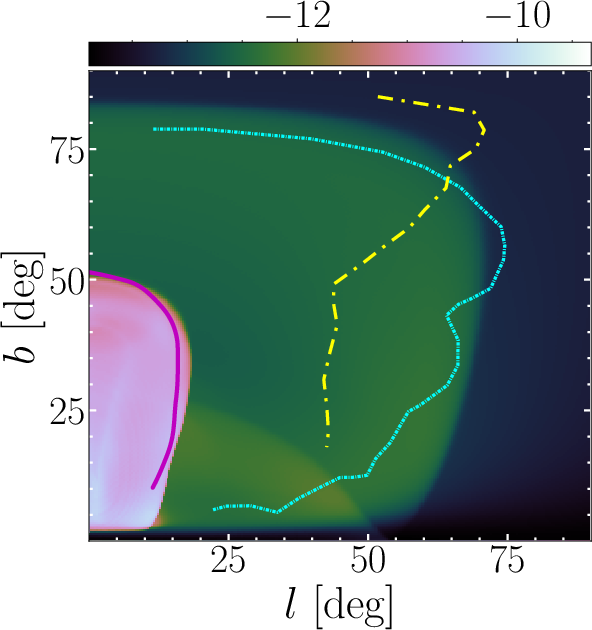
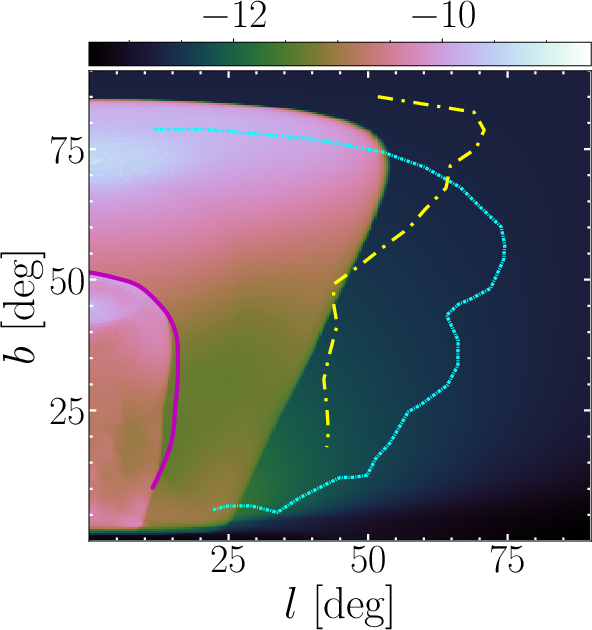
Figure 4: Simulated thermal and projected X-ray structure of nested RB and FB pairs resulting from temporally separated, identical collimated outbursts.
Environmental Gradient Effects
Further, the simulations confirm that introducing an east-west density gradient, rather than an external wind, reproduces the observed asymmetry; faster expansion in the west is a generic outcome of this configuration.
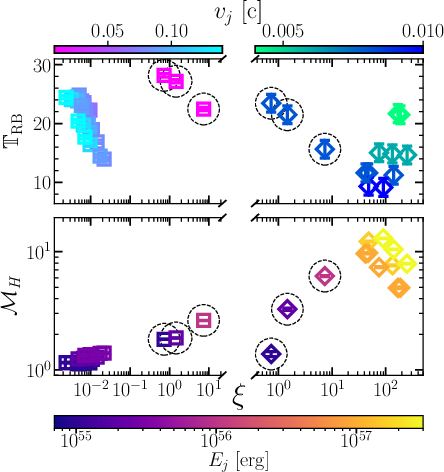
Figure 5: RB head age and Mach number as functions of critical transition parameter ξ for simulations spanning the relevant Ej, vj, and θj range, demonstrating model robustness and preferred evolutionary phases.
Implications, Contradictions, and Prospects
Energetic Universality and Physical Constraints
The finding that RBs and FBs are best reproduced by nearly identical, highly-collimated outburst events sets a stringent requirement on the central engine's energy injection mechanics and duty cycle. By constraining the kinetic energy, opening angle, and temporal separation, the model establishes that GC outflows responsible for both bubble pairs are consistent with AGN jet-driven or nuclear-starburst-driven scenarios, but place the latter under tension due to the energetics and observed collimation.
Contradiction of Wind-Dominated Models
The analysis explicitly disfavors models positing weak, wind-driven bubbles or large-scale horizontal wind interaction. The simulated and observed Mach numbers, degree of collimation, and east-west asymmetry are collectively explained via gradient-induced preferential expansion, rather than kinetic deflection.
Forecasts and Further Directions
The authors highlight the need for further study on the origin, persistence, and potential feedback effects of large-scale Galactic density gradients. There are implications for cosmic ray transport, multiphase CGM evolution, and the role of repeated outbursts in regulating Galactic baryon flows. The scenario provides a direct framework for interpreting analogous extra-galactic structures, offering a calibrated testbed for models of AGN feedback and episodic nuclear activity.
Conclusion
The analysis presented rigorously demonstrates that the nested Fermi and eROSITA bubbles are the product of two very similar, collimated, ∼1055 erg outbursts from the Galactic center, with a temporal separation of ∼10–$20$ Myr and half-opening angles ≈4∘, both expanding vertically at ∼2000 km s−1. The observed pronounced east-west asymmetry is quantitatively attributed to an eastward density gradient, not to a wind. The correspondence between analytic modeling, hydrodynamical simulations, and multiwavelength observations tightly constrains both the physical mechanisms at play and the permissible astrophysical scenarios for energetic Galactic center feedback and CGM structuring (2602.00226).

